
Search stopped being a list of links. Around 68% of US Google searches now end without a single click. ChatGPT sits at 900 million weekly users.
AI Overviews reach roughly 1.5 billion people a month. When an AI summary shows up, organic click through rates fall by up to 61%.
Yet visitors arriving from AI assistants convert about 42% better than everyone else. So traffic shrank, quality jumped.
We’ve been in the industry since 2013, and we have watched both sides of that trade land on our own dashboards. Here is every number that matters, plus our own calls.
AffDude take: Rankings used to pay the bills. Citations pay them now. Get quoted inside the answer or accept being invisible above it.
AI Search & GEO Statistics 2026 At A Glance
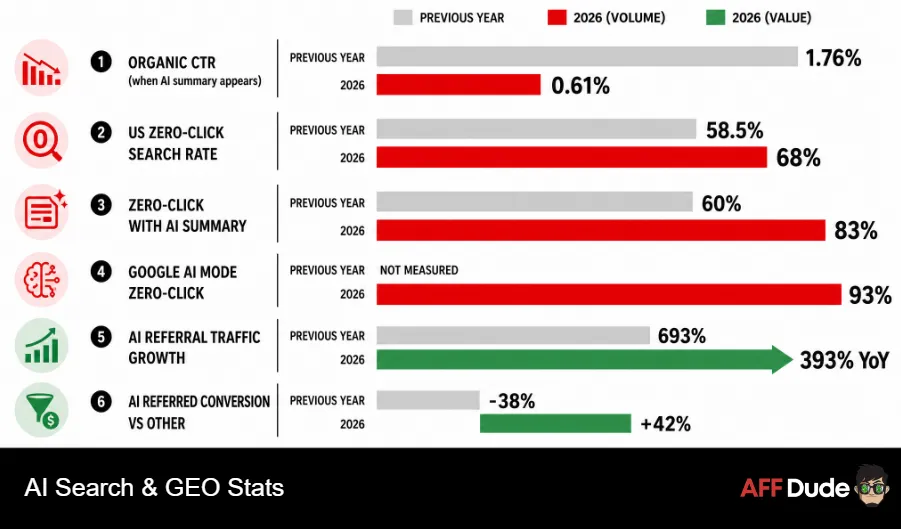
Short on time? Start right here. These are the numbers we keep pinned on the wall while planning content for our 29 live sites.
| Metric | 2026 Figure | Year Before | What It Means For You |
|---|---|---|---|
| ChatGPT weekly active users | 900 million | 400 million | Answer engines hit true mass scale |
| Gemini app monthly active users | 900 million | 650 million | Google closed the gap fast |
| US zero click search rate | 68% | 58.5% | Two in three queries never reach a site |
| Consumers starting searches with AI | 37% | Negligible | Top of funnel moved inside chatbots |
| Organic CTR when an AI summary appears | 0.61% | 1.76% | Position one lost most of its value |
| Zero click rate with an AI summary present | 83% | Around 60% | Summaries eat informational queries |
| Zero click rate inside Google AI Mode | 93% | Not measured | Conversational search barely links out |
| AI referral traffic to US retail | Up 393% year on year | Up 693% year on year | Small base, brutal growth curve |
| AI referred visitor conversion versus other traffic | 42% better | 38% worse | Buyers arrive pre researched |
| Reddit share of citations across major engines | Around 40% | Lower | Forums out rank your review post |
| Brands tracking AI search performance | 16% | Fewer | The window for early movers is open |
| Global GEO market value | Heading to $7.3 billion by 2031 | $886 million in 2024 | A whole industry grew in 24 months |
One pattern jumps off that table. Volume fell. Value rose. Anyone still counting sessions alone is measuring the wrong thing.
How Many People Actually Search With AI Now
Adoption stopped being a novelty story. Roughly 37% of consumers begin a search inside an AI tool rather than a search box. Among US adults, about 60% have used AI to look something up. Under 30s push that to 74%.
Daily habit numbers matter more than trial numbers. Around 29% of adults now start a daily search with a generative summary. Only about 10% open a standalone AI app to do it.
Session volume backs that up. AI platforms handle around 45 billion sessions a month worldwide once app and web data get combined. ChatGPT alone processes roughly 2.5 billion prompts a day.
Here is the part most write ups skip. Google did not shrink. People simply added a second habit on top of an old one. Around 85% of AI users still cross check the answer in a normal search before buying.
Dude's read: Treat AI as a first touch, not a replacement. Your buyer meets you in a chatbot, then verifies you on Google. Lose either surface and you lose the sale.
Who Owns The Answer Engine Market This Year
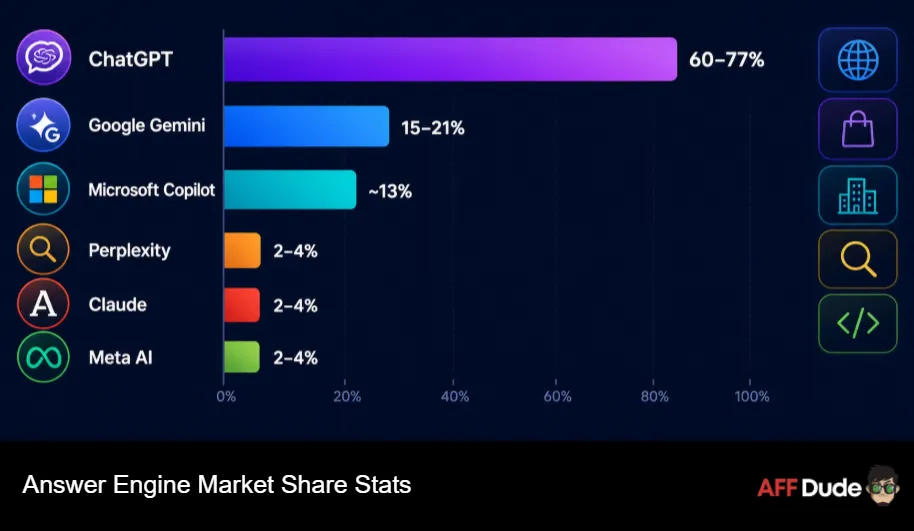
Market share depends on how you count. Web sessions, mobile daily users, and outbound referrals all tell different tales. So we lined up the main readings side by side.
| Platform | Scale In 2026 | Share Of AI Chat Usage | Referral Behaviour | Best Fit For Affiliates |
|---|---|---|---|---|
| ChatGPT | 900 million weekly users, 2.5 billion daily prompts | 60% to 77% depending on panel | Still under 80% of all chatbot referrals, first time below | Broad consumer and software queries |
| Google Gemini and AI Mode | 900 million monthly app users, AI Mode past 1 billion monthly | 15% to 21% | Referral share grew around four times year on year | Local, shopping and mobile intent |
| Microsoft Copilot | Bundled across Windows and Office | Around 13% | Modest but steady outbound clicks | B2B and workplace software |
| Perplexity | Around 170 million monthly visitors, 50 million weekly queries | Low single digits | Heavy citation display, strong click out rate | Research heavy comparison content |
| Claude | 300,000 plus business customers | Low single digits | Referral share grew around ten times year on year | Technical and long form buying guides |
| Meta AI | Over 1 billion monthly users across apps | Not measured in search panels | Almost no outbound web traffic | Awareness only, no click value |
Notice the fragmentation. ChatGPT lost close to 19 percentage points of web traffic share in twelve months. That does not mean decline. Rivals simply grew faster from smaller bases.
Our take on planning: chase four surfaces, not one. A page cited only by ChatGPT covers maybe half of the answer engine audience.
Google AI Mode Is The Number Nobody Watches Closely
Everyone argues about AI Overviews. Almost nobody plans for AI Mode. Big mistake, and it will cost people money next year.
AI Mode passed one billion monthly users across more than 200 countries. Query volume inside it has been roughly doubling every few months.
Here is why affiliates should care. Overviews sit above normal results, so a click remains possible. AI Mode replaces results with a conversation.
The difference shows in behaviour. Zero click rates run near 43% in Overviews and around 93% inside AI Mode. Same company, wildly different outcome for publishers.
Adoption stayed small during early tracking, with well under 1% of searches shifting into AI Mode. Growth rates say that will not last.
Early warning from us: Model your 2027 traffic assuming AI Mode reaches double digit query share. If we are wrong, you lost nothing. If we are right, you kept your business.
How Queries Themselves Changed Shape
Search phrasing shifted along with the tools. People stopped typing three word fragments and started asking full questions.
Instead of best CRM startups, buyers now ask which CRM suits a ten person team already using a particular email tool. Longer, messier, far more specific.
Models handle that by splitting one question into several smaller searches behind the scenes. Each sub question gets its own sources.
Practical effect for you: one page can now win a citation for a question nobody ever typed into a keyword tool. Long tail conversational queries became the main entry point rather than a leftover.
Zero Click Search Became The Default Setting
Zero click search did not start with AI. Featured snippets and knowledge panels began the rot years ago. Summaries just poured petrol on it.
Around 68% of US Google searches now end with no click to any website. Back in 2024 that figure sat near 58.5%. Mobile runs far worse than desktop, close to 77% against 46.5%.
Put another way, out of every 1,000 searches only about 320 reach the open web. The rest resolve on the page or bounce into another Google property.
The mobile gap deserves its own line. Over 60% of affiliate traffic comes from phones, and phones are where the zero click search rate bites hardest. Your worst exposure sits on your biggest device.
Query intent decides your exposure. Informational searches run about 74% zero click. Transactional searches sit near 31%.
So a comparison page built on buying intent still earns clicks. A definition page built on curiosity does not. We killed 40 thin explainer posts across our portfolio last year for exactly that reason.
What AI Overviews Did To Click Through Rates
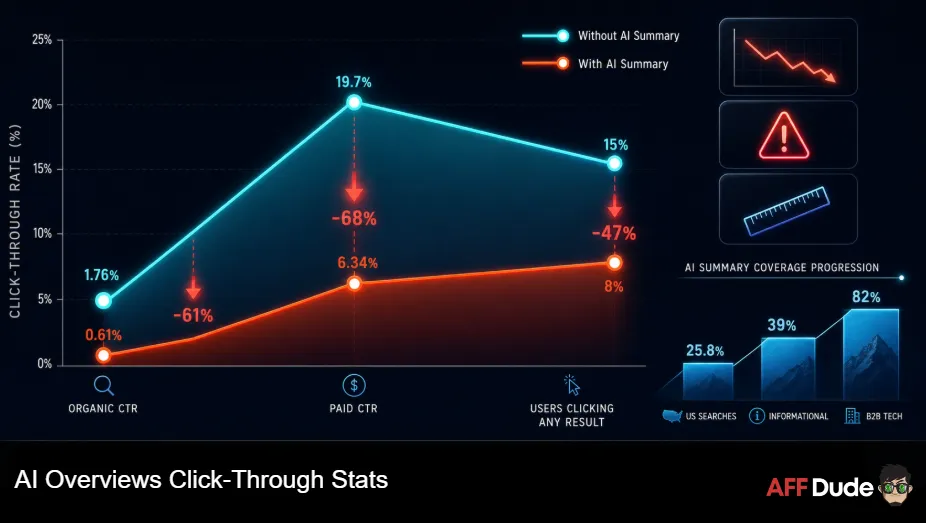
This is the section that hurts. Numbers vary by study because samples differ, so we listed the honest range rather than one scary headline.
| Measurement | Without AI Summary | With AI Summary | Change | Sample Notes |
|---|---|---|---|---|
| Organic click through rate | 1.76% | 0.61% | Down 61% | 3,119 queries, 42 organisations |
| Paid click through rate | 19.7% | 6.34% | Down 68% | Same query panel |
| Users clicking any traditional result | 15% | 8% | Down 47% | 68,879 real searches |
| Clicks on links inside the summary | Not applicable | 1% | Almost nothing | Behavioural panel |
| Aggregate click loss across keywords | Baseline | Down 34.5% | Moderate | 300,000 keywords |
| Randomised field test result | Baseline | Down 38% | Moderate | Controlled 2026 experiment |
Coverage keeps climbing too. Summaries appeared on roughly 25.8% of US searches at the start of 2026. Informational queries hit around 39%. B2B technology queries reached 82%.
Read those last two together. Software and marketing niches carry the heaviest exposure of any vertical. That is our niche. That is probably yours.
Branded queries behave differently. Searches carrying a brand name lose far less, because people already know who they want. Non branded research queries take the damage.
There is one upside buried in the data. Brands cited inside a summary earn around 35% more organic clicks and 91% more paid clicks on the same page.
So the AI Overviews click through rate problem cuts both ways. Getting quoted inside the box repairs a chunk of what the box took from you.
Reality check from Ali: A number one ranking under a summary earns less than a number five ranking on a clean page. Check which of your money pages trigger a summary before blaming your content.
Why Affiliate And Review Sites Took The Worst Beating
Publishers as a group lost ground. Affiliate publishers lost more. Category level tracking shows declines between 30% and 60% on query clusters where summaries fire.
Core updates piled on. Around 71% of affiliate sites logged measurable ranking drops during the March 2026 core update. One of the most respected review brands on the web lost over 60% of its Google visibility in a single summer.
Why affiliates specifically? Because our content answers exactly the questions summaries were built to answer. Best tools. Pricing. Pros and cons. A model can compress all of that into six lines.
The Plot Twist: AI Traffic Converts Better Than Anything
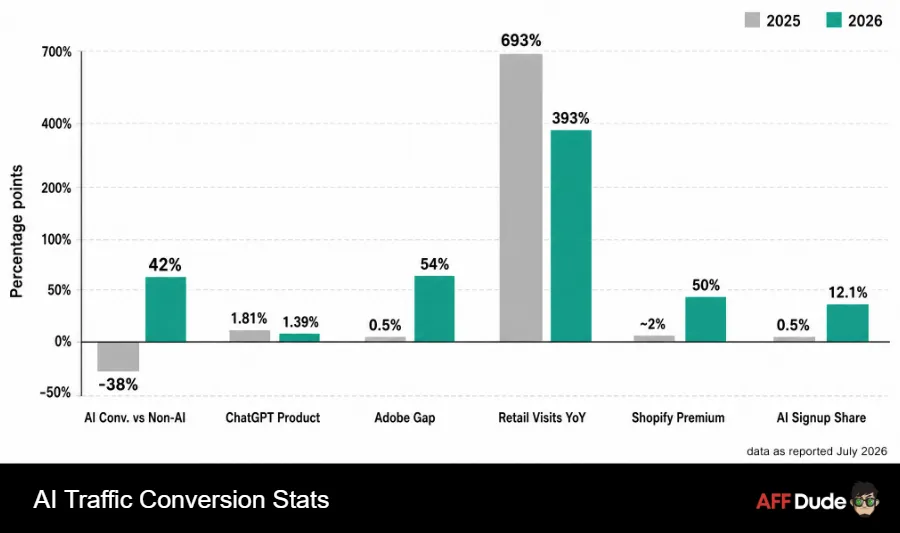
Here comes the good news, and it genuinely surprised us. The visitors who do arrive from answer engines behave like buyers, not browsers.
| Conversion Signal | 2025 Reading | 2026 Reading | Comparison Channel |
|---|---|---|---|
| AI referred conversion versus non AI traffic | 38% worse | 42% better | All other retail traffic |
| ChatGPT conversion rate on product pages | 1.81% | Higher still | 1.39% non branded organic |
| Retail visits from AI referrals | Up 693% year on year | Up 393% year on year | Flat organic growth |
| Adobe measured conversion gap | Roughly half the rate | 54% more often | All other sources |
| Shopify product page sessions | Early signal only | Around 50% higher conversion | Organic search |
| Signup rate from visible AI traffic | Not tracked widely | 1.66% | 0.15% organic search |
| Share of signups from AI visitors | Marginal | 12.1% of signups from 0.5% of visitors | 24 to 1 efficiency ratio |
| Average order value gap | Not measured | $204 | $238 non branded organic |
That swing from 38% worse to 42% better inside twelve months is the single wildest movement in these AI Search & GEO Statistics. An 80 point turnaround does not happen in mature channels.
Why did quality improve so fast? Because the model already did the filtering. By the time somebody lands on your page, they have compared options, read the caveats and picked a shortlist.
That last bullet is the trap. If a chatbot says your tool costs $29 and your pricing page says $79, you eat the bounce. Keep facts current or the traffic turns worthless.
Volume still lags badly, and honesty matters more than hype here. AI referrals sit near 1% of sessions for most sites. One tracking panel logged around 606,000 AI citations across shopping queries while traditional channels drove 164 million referral transactions.
So AI referral traffic conversion rates look brilliant on a tiny base. Growth curves like this usually keep climbing, but nobody should reallocate a whole budget on 1% of sessions.
Playbook note: Put your pricing, plan names and refund terms in plain text on the page. Models read text, not screenshots. Wrong facts in the answer cost you the click and the commission.
Which Websites AI Engines Actually Cite
Now the uncomfortable bit. The sites winning citations are mostly not affiliate sites. Forums and reference hubs dominate.
| Source Type | Citation Strength In 2026 | Strongest Engine | Why Models Trust It | Can You Play There? |
|---|---|---|---|---|
| Around 40% citation frequency across engines | Perplexity, roughly 46.7% of top ten share | Lived experience and community voting | Yes, with a real account and real answers | |
| Wikipedia | Close to 47.9% of ChatGPT top ten share | ChatGPT | Encyclopaedic, heavily edited, stable | Only through notable brand entities |
| YouTube | Around 29.5% of AI Overviews citations | Gemini and AI Overviews | Google owned, transcripted, demonstrative | Yes, and badly underused by affiliates |
| Top five domain on several engines | ChatGPT | Named authors with verifiable roles | Yes, publish under a real operator profile | |
| Review platforms such as G2 | Dominant in software categories | All engines for SaaS queries | Structured ratings and volume of opinion | Yes, via genuine customer reviews |
| Independent affiliate and blog content | Long tail, roughly 95% of citations spread thin | Perplexity and ChatGPT | Specific data models cannot generate | Yes, and this is your actual opening |
Concentration matters here. The top fifteen domains soak up around 68% of every citation produced. Everything else fights over the rest.
Yet no single domain owns much. Even the biggest rarely passes 5% of total citations on any platform. That fragmentation is exactly why a sharp niche site can still get quoted.
Engines also disagree with each other. Only about 11% of domains get cited by both ChatGPT and Perplexity. One content approach cannot win every surface.
Citation sets run narrow too. Where a normal results page shows ten domains, an AI answer usually pulls from three to six. Fewer slots, harder competition, bigger reward for whoever fills one.
Tracking large language model citations by platform beats tracking one aggregate score. Perplexity leans academic and news. ChatGPT leans reference and community. Gemini leans Google owned properties.
Google Rankings And AI Citations Stopped Matching
Two years ago, ranking well meant getting cited. Not any more. Overlap between Google top ten results and AI cited sources fell from around 76% to as low as 17% to 38%.
One tracking firm puts the drop from 70% to under 20%. Another places it at 75% down to the high thirties. Different methods, same direction.
Volatility compounds the problem. Roughly 70% of pages cited in summaries changed inside a two to three month window, with no matching change in blue link rankings.
So you can hold position one all year and quietly vanish from the box sitting above you. We have watched that happen on four of our own pages.
Straight talk: Stop reporting rankings to yourself as if they still explain revenue. Track citations and rankings as two separate scoreboards, because they behave like two separate games.
What Actually Earns A Citation In 2026
The original academic work on generative engine optimisation ran controlled tests on what lifts visibility. Results held up in the field, and we have replicated most of them on our own pages.
Adding statistics, quoting named experts and citing sources lifted visibility by up to 40%. Keyword stuffing performed worse than doing nothing at all.
Notice what is missing from that list. Word count. Keyword density. Exact match anchors. All the old levers barely move the needle now.
Answer engine optimisation tactics reward one thing above all: extractable specificity. Give a model a clean sentence with a number in it and you make citation easy.
The GEO Market Grew An Entire Industry In Two Years
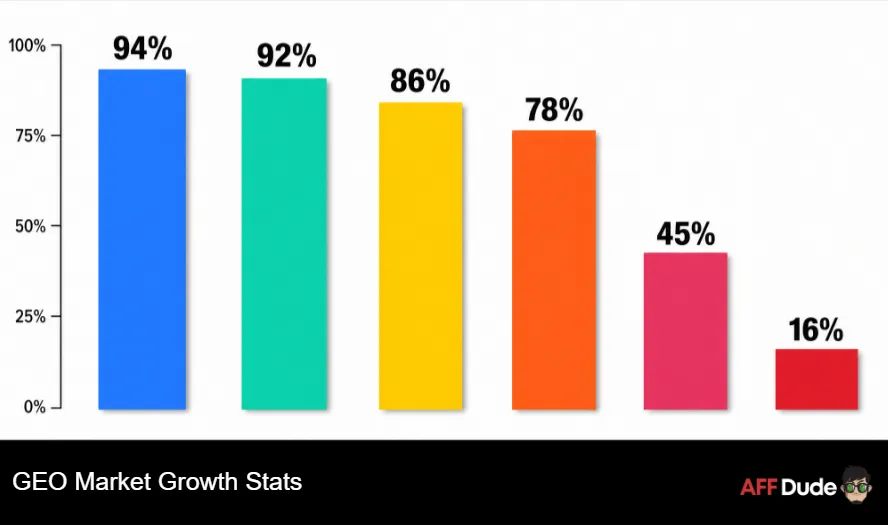
Money follows attention. A discipline that barely existed in 2023 now has vendors, budgets and job titles.
| Market Or Budget Signal | 2026 Position | Direction Of Travel |
|---|---|---|
| Global generative engine optimisation market | Scaling from $886 million in 2024 | Heading toward $7.3 billion by 2031 |
| US GEO market value | $365.4 million | Compounding at roughly 42.9% a year |
| Marketing leaders raising AEO and GEO budgets | 94% | Fastest budget shift since paid social |
| Average enterprise digital spend on answer engines | 12% | Rising each planning cycle |
| B2B organisations testing or running GEO | 92% | Near universal experimentation |
| Those reporting measurable return | 78% | Past the pilot stage |
| Marketing leaders naming GEO their top priority | 32% | Up sharply year on year |
| Brands with meaningful implementation | Around 20% | Talk still outruns execution |
| Brands systematically tracking AI visibility | 16% | The gap early movers exploit |
| Top barrier cited by marketers | Budget, at 45% | Expertise second at around 40% |
Look at the last three rows together. Nearly everyone experiments. Barely anyone measures. That gap is the whole opportunity.
Independent affiliates hold a real edge here too. No committee. No agency retainer. You can restructure a money page this afternoon.
Adoption inside search teams runs high already. Around 86% of SEO teams have folded some GEO work into a normal process, and roughly 63% report a visibility lift once they do.
Smaller firms are catching up quickly, making up around 41% of adoption. A serious generative engine optimisation strategy no longer needs enterprise money, just discipline and a clear content structure.
The Attribution Blind Spot Costing You Real Money
Here is the stat that made us rebuild our own tracking. Around 70.6% of AI referrals never show up correctly in standard analytics setups.
They land in the direct bucket instead. Paid chatbot accounts often strip referrer data. Research modes do the same.
Net effect: most sites undercount answer engine traffic by three to four times. So the channel you are dismissing as noise might already be one of your better performers.
Only about 24% of brands run any formal monitoring of how AI describes them. Meanwhile 27% have already been misrepresented inside an answer.
Put simply, more brands have been misquoted by a model than have a process for spotting it. Answer engine visibility tracking is still cheap because so few people bother.
What we would do first: Spend one afternoon fixing measurement before spending one pound on content. You cannot optimise a channel you cannot see.
AI Shopping Went From Novelty To Real Volume
Commerce inside chatbots stopped being a demo. Around 50 million shopping related queries now run through ChatGPT every day, roughly 2% of all its queries.
Consumer behaviour caught up fast. About 77.6% of global consumers say they used AI while shopping in the past six months. Roughly 47% used AI to help make an actual purchase decision.
Spend followed. AI and shopping agents influenced around $262 billion of global online holiday spend in 2025, close to 20% of the total.
Retailer level splits show who wins. One major US retailer pulls about 15% of referral traffic from ChatGPT. An auction marketplace sits near 10%. Amazon takes under 3%, because models cite Amazon product pages directly instead of sending shoppers around.
For affiliates, that split carries a warning. If a model can link the merchant directly, your tracked link never enters the chain.
Trust Is Sliding While Usage Keeps Climbing
Odd contradiction, and it shapes content strategy more than most people realise. People use AI search more each year while believing in it less.
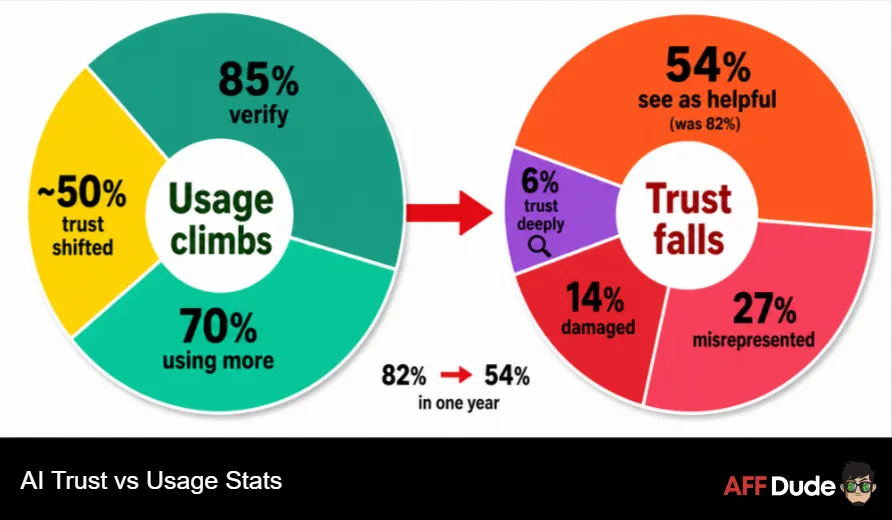
Verification behaviour explains the gap. Around 85% of AI users double check answers elsewhere. Nearly half say AI now influences which brands they trust.
That is why hands on proof matters more than ever. Screenshots, test results and real payout data give the verifying reader a reason to stop searching.
What We Are Seeing Across Our Own Portfolio
Enough industry data. Here is what our own dashboards showed across the sites and campaigns we run.
Our thin informational posts lost between 25% and 45% of organic sessions once summaries expanded into our categories. No surprise there.
Our hands on review pages held far better. Pages carrying original screenshots, live pricing tables and payout data slipped under 10%, and three of them grew.
Answer engine referrals climbed from a rounding error to roughly 4% of total sessions across the portfolio. Those sessions convert at about double our organic average.
Ali's honest note: We got this wrong for most of 2025. We chased word count. Models wanted clarity. Cutting a 4,000 word guide down to 2,200 tighter words doubled its citations.
Our Calls For 2027 And 2028
Now the part you will not find copied across every other roundup. These are our own numbers, built from portfolio data and years of watching this channel move.
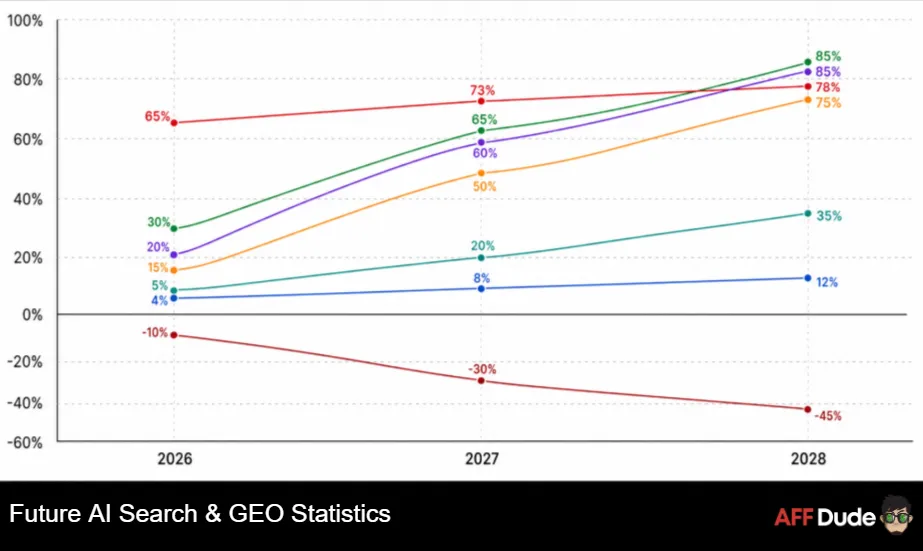
Could we be wrong at the edges? Sure. Ranges shift. But direction feels locked, and every one of these AI Search & GEO Statistics points the same way.
The GEO Playbook We Actually Run
No theory here. This is the checklist we work through on every money page we own.
Expect a lag of four to eight weeks before citations move. Nothing here works overnight, and anybody promising otherwise is selling something.
Dude's rule of thumb: If a model could write your paragraph without visiting your site, that paragraph earns you nothing. Original testing, real payouts and screenshots are your moat.
FAQs About AI Search And GEO
What is GEO in marketing?
GEO stands for generative engine optimisation. It means structuring your content and brand presence so answer engines quote you inside their responses. Traditional SEO targets ranking positions. GEO targets citations inside ChatGPT, Gemini, Perplexity, Claude and Google AI Overviews.
How much traffic have AI Overviews taken away?
Organic click through rate falls from around 1.76% to 0.61% when a summary appears, a drop close to 61%. Aggregate keyword studies show a milder 34.5% loss. Affiliate and how to publishers report declines between 30% and 60% on affected query clusters.
Does AI search traffic actually convert?
Yes, and better than most channels. AI referred visitors converted about 42% better than non AI traffic in 2026, having converted 38% worse a year earlier. Signup rates from visible AI traffic ran around 1.66% against 0.15% for organic search.
Which sites do AI engines cite most?
Reddit leads across every major engine at roughly 40% citation frequency. Wikipedia dominates ChatGPT. YouTube carries heavy weight inside Gemini and AI Overviews. The top fifteen domains absorb around 68% of all citations produced.
Is SEO dead in 2026?
No. Google still handles roughly 80% of global query volume, and traditional search remains where most buyers verify before purchasing. GEO sits on top of solid SEO rather than replacing it. Brands winning citations almost always have strong search foundations already.
How many people use AI instead of Google?
Around 37% of consumers now begin searches inside AI tools. About 60% of US adults have used AI to look something up, rising to 74% among under 30s. Most still verify answers in a traditional search afterwards.
How long does GEO take to work?
Expect four to eight weeks before citation changes show up. Answer engines weight recency heavily for commercial queries, so refreshed content moves faster than brand new pages on weak domains.
What percentage of searches end without a click?
Around 68% of US Google searches end without a click in 2026, up from 58.5% in 2024. With an AI summary present that rate hits 83%. Inside Google AI Mode it reaches roughly 93%.
Bottom Line For Affiliates In 2026
Let us tie the whole thing together. Search volume did not vanish. Clicks did.
Around two thirds of searches resolve without a visit. Yet AI referred visitors convert better than any other traffic source we track. Fewer visitors, better visitors.
The winners this year share three habits. They publish things a model cannot invent. They structure content so it is easy to quote. And they measure citations, not just rankings.
We have watched this channel since 2013. Panda, Penguin, mobile first, core updates. Every shift punished lazy work and rewarded operators who did the reps.
Nothing about the current one feels different. It just moved faster than the rest.
AffDude take: Bookmark this page. We refresh the data every year, and the direction has not wobbled once. Fewer clicks, better buyers, fatter rewards for anyone doing real work.
Sources
- Statista, AI and search behaviour data
- Pew Research Center, Google search behaviour study
- SparkToro, zero click search research
- Gartner, search engine volume forecast
- Ahrefs, AI Overviews and citation studies
- Semrush, most cited domains research
- Adobe Analytics, AI traffic reports
- Similarweb, AI platform traffic share
- Search Engine Land, AI and search behaviour studies
- Bain and Company, generative AI consumer survey
- McKinsey, AI search tracking data
- EMARKETER, generative AI search adoption
- Grand View Research, GEO market sizing
- BrightEdge, AI Overviews tracking
- Shopify, AI referred commerce data
- Deloitte, TMT Predictions on AI search
Recommended Articles
Affiliate Disclosure: This post may contain some affiliate links, which means we may receive a commission if you purchase something that we recommend at no additional cost for you (none whatsoever!)