Dropshipping Statistics 2026: Market Share and Profit Data
 20 min read
The global dropshipping market size hits 543.53 billion dollars in 2026, up from 445.5 billion last year. Roughly 23% of all online sales now get fulfilled by someone who never touched the product. About 7.7 million stores run this way.
Then you look at who actually makes money. Only 10% to 20% of new stores turn a profit in year one. Somewhere between 1% and 5% build anything that survives past the honeymoon. Around 90% get abandoned within months.
That gap is the whole story, dude. A 22% annual growth rate on one side, a dropshipping success rate that would scare off most sane people on the other.
So we pulled the real numbers. Dropshipping profit margins by store stage. Customer acquisition cost by niche. TikTok Shop GMV doubling to 112.2 billion. What Shopify dropshipping stores and AliExpress suppliers actually deliver versus what the ads promise. Shipping times, return rates, the money that quietly leaks out the back.
How Big Is the Global Dropshipping Market in 2026?
Big. Really big. The global dropshipping market size sits at 543.53 billion dollars in 2026. That is up from about 445.5 billion in 2025.
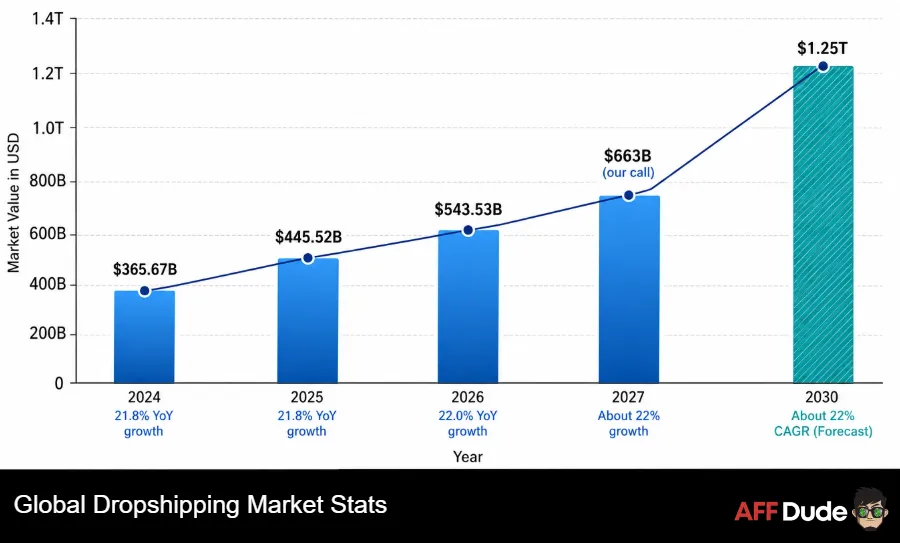
Growth runs near 22% a year. At that pace, the market crosses the one trillion dollar mark for the first time around 2030, landing near 1.25 trillion.
Dropshipping now makes up about 6.5% of the total ecommerce pie. Small slice by percentage. Massive by dollars.
| Year | Global Market Value | Year-on-Year Growth |
|---|---|---|
| 2024 | $365.67 billion | 21.8% |
| 2025 | $445.52 billion | 21.8% |
| 2026 | $543.53 billion | 22.0% |
| 2027 (our call) | $663 billion | About 22% |
| 2030 (forecast) | $1.25 trillion | About 22% CAGR |
AffDude read: we reckon the market clears 660 billion dollars in 2027 if social selling keeps its current heat. That is our own read, not a borrowed one.
Why the Market Size Numbers Never Agree
Here is something most stat posts hide from you. The market size figure changes wildly depending on who you ask.
Some firms say 343 billion. Others say 590 billion. Same year, same industry. What gives?
Simple. One camp counts platform revenue only. The other counts the full value of goods moved through dropshipping channels.
So do not sweat the exact billion. The direction is what matters, and every model points up.
Dropshipping's Share of Ecommerce Keeps Climbing
Roughly 27% of all ecommerce businesses now run dropshipping as their primary order fulfilment model. That is about 7.7 million stores worldwide.
And about 23% of all online sales get fulfilled this way. Nearly a quarter of everything bought online. Not a side hustle anymore.
A big chunk of that volume is not scrappy solo stores either. Established brands now use dropshipping to test products and cover long-tail stock without holding inventory.
Dropshipping vs Holding Inventory: The Profit Gap
Why do sellers pick this model over stocking a warehouse? Money and risk, mostly.
Stores that dropship tend to pull about 50% more profit than traditional inventory-based stores. No rent on stock. No dead product sitting on shelves.
Manufacturers feel it too. In one survey of 350 makers, net margins averaged 12.2% on dropshipped goods against 10.3% on direct online sales. That is an 18.33% profit boost for those who let retailers handle marketing and fulfilment.
The gain holds across categories. Electronics saw about a 20% lift. Fashion saw around 17%. The reason is simple. Partners offload the messy, costly parts to someone else.
Startup Costs: Why Everyone Gives It a Go
Here is the hook that pulls millions in. You can start a dropshipping store for pocket change.
Compared with traditional ecommerce, startup costs can run up to 80 times cheaper. No inventory to buy upfront. No storage bills. Just a store, a supplier, and ad budget.
That low barrier is a blessing and a curse. Cheap entry means fierce competition. Everyone piles into the same viral products.
So the door is wide open. Walking through it and staying in the room are two very different things. The numbers on that come next.
Dropshipping Profit Margins: The Real Numbers
Time for the number everyone lies about. Dropshipping profit margins look juicy on the surface and thin underneath.
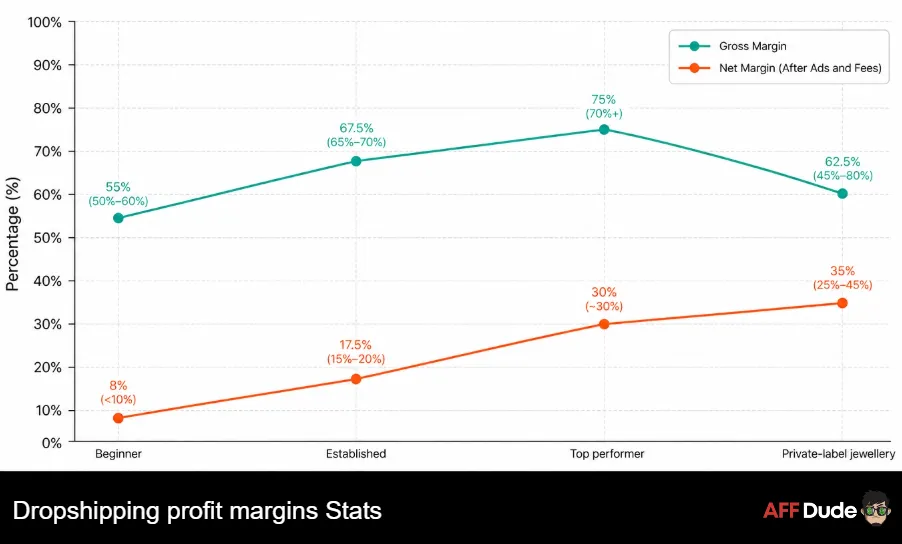
Gross margins average around 68% to 70%. Feels great. Then ads, fees, and returns take their cut.
The average net profit margin lands at 15% to 20% for experienced sellers. Top stores push near 30%. Beginners often sit below 10%.
| Store Stage | Gross Margin | Net Margin (After Ads and Fees) | What It Means |
|---|---|---|---|
| Beginner | 50% to 60% | Under 10% | Often break-even or worse |
| Established | 65% to 70% | 15% to 20% | Sustainable if scaled right |
| Top performer | 70%+ | Around 30% | Branded, high average order value |
| Private-label jewellery | 45% to 80% | 25% to 45% | Best margin profile going |
Real talk. A store doing 10,000 dollars in monthly sales keeps roughly 1,500 to 2,000 dollars in actual profit. Not the six-figure fantasy the gurus sell.
The Brutal Truth About Dropshipping Success Rates
Now the part that keeps it honest. The dropshipping success rate is low. Way lower than the ads on your feed suggest.
Ali blew up two campaigns before anything stuck. So we get it. Razor-thin margins are the main killer here.
Even stores pulling 1.2 million a year in revenue can struggle to break even once ads and product costs land. Revenue is vanity. Profit is the game.
What Dropshippers Actually Earn Each Month
Let us kill the income myth with data.
Most active dropshippers earn 1,000 to 5,000 dollars a month. Intermediate operators reach 5,000 to 10,000. Experienced sellers hit 10,000 to 50,000 and beyond.
But remember that 1.5% number. Very few stores ever touch 50,000 a month. The middle is where nearly everyone lives.
On Amazon, the picture looks brighter for those who last. A large share of active Amazon dropshippers stayed profitable through the year. Built-in buyer traffic helps a lot there.
Experience is the real multiplier. Sellers who fail once and try again see success rates climb. First-time small business owners sit near an 18% success rate, rising to 20% on the second attempt.
Dude's gut check: the earnings ladder is real, but so is the drop-off. We have watched more stores stall at 3,000 a month than break past it. Patience and product testing separate the two.
Conversion Rates and Cart Abandonment Reality
Traffic is only half the battle. Getting the sale is the harder half.
Standard ecommerce sites convert at 2% to 3%. Well-run dropshipping stores sit in the same band. TikTok Shop nudges higher at about 3.2%.
Then there is the leak most sellers ignore. Cart abandonment stays painfully high across ecommerce.
See the pattern? Shipping cost and speed decide more sales than your product page ever will. Fix that first.
The average order value also shapes your maths. Higher-priced carts absorb ad costs better. Cheap impulse buys need volume to work, and volume needs a sharp funnel.
Platform Wars: Shopify, Amazon and AliExpress in 2026
Where does all this selling happen? Three names carry most of it.
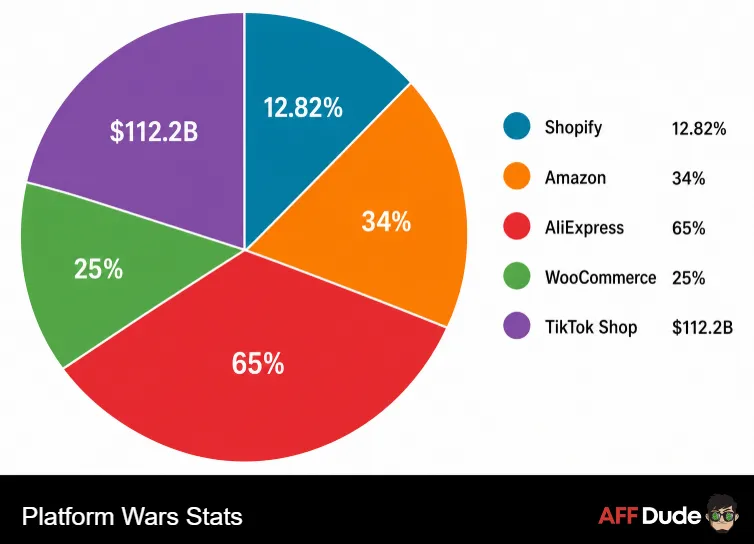
Shopify dropshipping stores jumped from 5.16% to 12.82% of all stores on the platform. That share more than doubled. Shopify stays the go-to store builder thanks to its app stack.
Amazon quietly runs on it too. About a third of all Amazon sales move without the seller holding stock.
For sourcing, AliExpress still rules. Around 65% of dropshippers use it as their main product sourcing platform.
| Platform | Role | Key 2026 Stat | Best For |
|---|---|---|---|
| Shopify | Store builder | 12.82% of stores dropship | Full-control branded stores |
| Amazon | Marketplace | About 34% of sales | Built-in buyer traffic |
| AliExpress | Sourcing | Used by about 65% | Low-cost product testing |
| WooCommerce | Store builder | About 25% of stores | WordPress-based stores |
| TikTok Shop | Social selling | $112.2B GMV in 2026 | Viral, impulse-buy products |
The top five players (Alibaba, Shopify, Amazon, Printful and Zendrop) hold only 13.9% of the market combined. This space is wildly fragmented. Room for the little guy still exists.
TikTok Shop Is the Rocket Nobody Can Ignore
If one channel defines 2026, it is this one. Social commerce dropshipping on TikTok Shop is going vertical.
TikTok Shop GMV roughly doubled from about 64.3 billion dollars in 2025 to a forecast 112.2 billion in 2026. No other social channel moves at that pace.
US shop counts exploded from 4,450 in mid-2023 to more than 475,000 by 2026. Read that again.
Our money's on this: we expect TikTok Shop GMV to push past 150 billion dollars in 2027. If your product looks good on camera, test it there first.
Traffic and Ad Channels: Where the Clicks Come From
Products do not sell themselves. Paid social drives most dropshipping revenue in 2026.
Meta ads still dominate. About 68% of stores pull most of their traffic from Facebook and Instagram. Roughly 72% of dropshippers run Meta ads at 2x to 4x return on ad spend.
TikTok ads are catching fast. Around 45% of sellers use them, often at 2.5x to 5x return.
| Channel | Share of Dropshippers Using It | Typical Return on Ad Spend | Best Fit |
|---|---|---|---|
| Facebook and Instagram ads | 72% | 2x to 4x | Broad targeting, all niches |
| TikTok ads | 45% | 2.5x to 5x | Visual, impulse products |
| Google and search ads | 34% | Varies by niche | High-intent buyers |
| Email and popups | 65% of top stores | Retention driver | Repeat purchases |
One quick edge worth knowing. Video ads pull up to 3x more clicks than plain images. And stores active on social earn about 32% more revenue than those that ghost it.
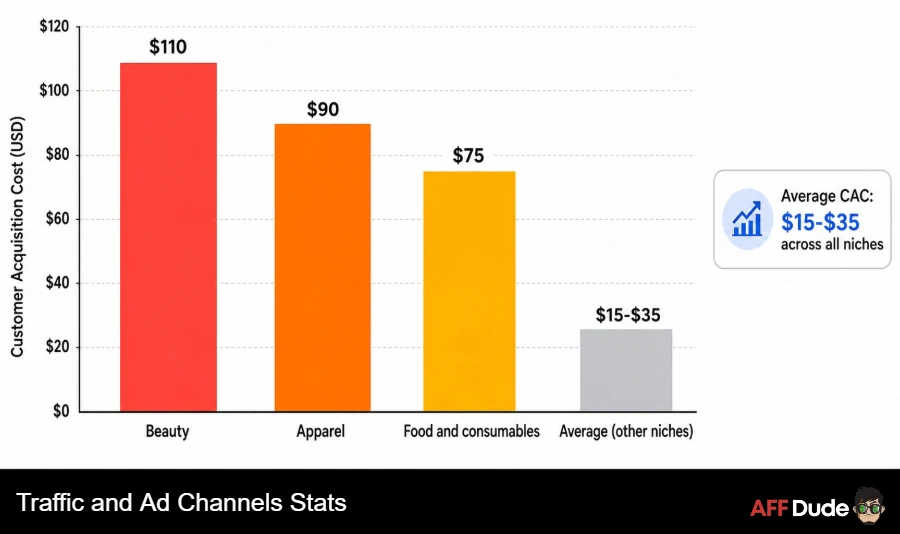
Your customer acquisition cost matters more than any vanity metric. Average CAC for dropshipping runs 15 to 35 dollars, but it climbs hard by niche.
Email and Retention: The Quiet Money Machine
Ads get the glory. Email pays the bills quietly in the background.
About 65% of top-performing stores run email popups. Spin-wheel and popup offers capture emails at 5% to 12% opt-in rates. Not flashy. Very profitable.
Why does it matter so much? Because your first sale barely breaks even after ad costs. The profit lives in the second, third, and fourth order.
Most beginners chase new clicks and ignore the list. That is money left on the table, dude.
Winning Dropshipping Niches by Category
Not all products pay the same. Fashion leads by sheer volume. Margin lovers look elsewhere.
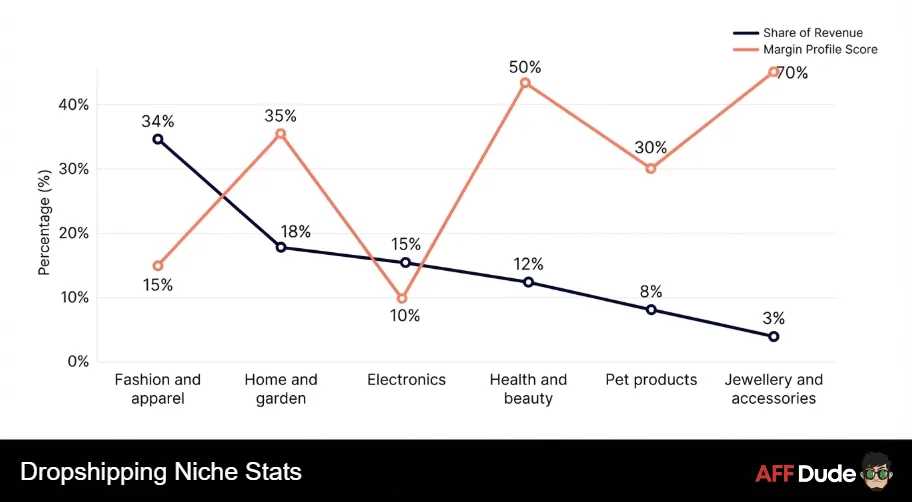
Fashion and apparel holds the largest category share at 34% to 37%. Electronics grabs about 30% of the North American market. But volume and margin rarely live in the same place.
| Niche | Share of Revenue | Margin Profile | Competition Level |
|---|---|---|---|
| Fashion and apparel | About 34% | Low to medium | Very high |
| Home and garden | About 18% | Medium to high | Medium |
| Electronics | About 15% | Low (warranty risk) | High |
| Health and beauty | About 12% | High | Medium (compliance) |
| Pet products | About 8% | Medium | Low, loyal buyers |
| Jewellery and accessories | Niche | Very high (45% to 80%) | Low if branded |
The median wholesale cost of a dropshipping product is 18 dollars in 2026. The sweet spot sits at 10 to 30 dollars. Cheap enough for an impulse buy. Fat enough to cover ad spend.
Real talk from the vault: generic electronics look tempting but bleed margin. Branded, lightweight products with a story win more often. That is the whole margin game.
High-Ticket Dropshipping: The Margin Escape Route
Tired of fighting for pennies on cheap gadgets? A growing crowd is moving upmarket.
High-ticket dropshipping stores sell products above 500 dollars. Fewer sales needed. Fatter margins on each one.
These stores are growing faster than low-ticket ones in 2026. The reason is basic maths. One 800 dollar sale beats forty 20 dollar sales for effort and ad spend.
The catch? Buyers scrutinise big purchases harder. Trust signals, reviews, and store polish matter far more when someone spends real money.
What we'd bet on: high-ticket keeps stealing share from the race-to-the-bottom crowd. Margin beats volume when ad costs keep rising.
Supplier Headaches and Shipping Time Reality
Here is where dreams meet logistics. Finding good suppliers is the number one gripe in the game.
About 84% of dropshippers say finding reliable suppliers is their biggest challenge. Shipping delays top the complaint list at 64%. Thin margins follow at 52%.
See the problem? Buyers want three-day delivery. Overseas suppliers ship in three weeks. That gap kills reviews and refunds pile up.
This is why fast dropshipping suppliers with local warehouses are winning share. US and EU sourcing options keep growing for exactly this reason.
Sourcing agents like CJdropshipping and Zendrop grew fast by fixing this pain. They offer warehousing, quality checks, and quicker delivery than raw AliExpress listings.
Our advice from years of testing? Order samples yourself before you sell a single unit. Photos lie. Delivery times lie. Your own hands do not.
Returns and Fraud: The Costs Nobody Advertises
The gurus never mention this bit. Returns and fraud quietly eat margin all year.
Ecommerce fraud losses were projected near 48 billion dollars for 2025. Chargebacks, fake orders, and payment scams hit dropshippers who sell cross-border especially hard.
Returns bite too. When product quality slips or delivery drags, refund requests climb. Every refund wipes the profit from several good sales.
This is why supplier vetting is not optional. One bad supplier can bury your margins under returns. Test small before you scale.
Who Actually Runs These Stores? Dropshipping Demographics
Curious who is behind the counter? Younger than you think, and more mixed than the old stereotype.
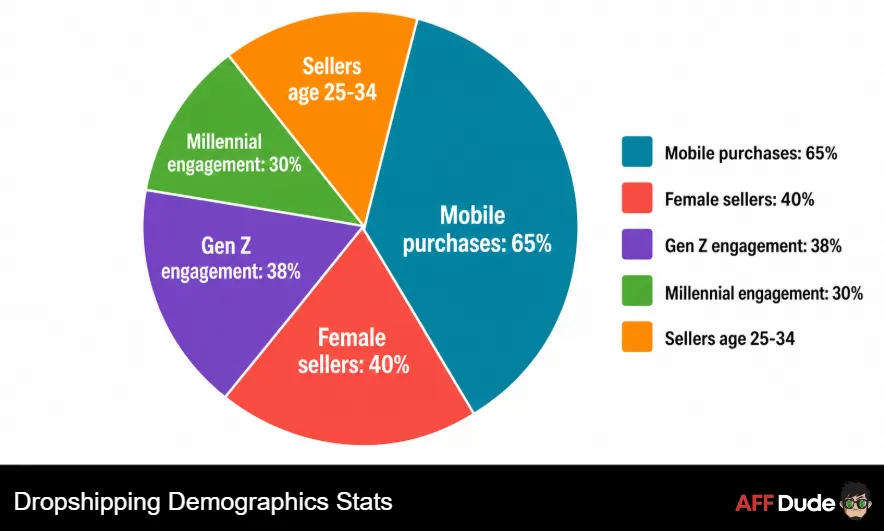
Most dropshippers sit in the 25 to 34 age band. About 40% of new sellers are women, with strong pull toward fashion and wellness niches.
| Demographic | 2026 Data Point |
|---|---|
| Most common seller age | 25 to 34 years |
| Female sellers (new entrants) | About 40% |
| Gen Z digital engagement share | 38% |
| Millennial digital engagement share | 30% |
| Buyer age range (most active) | 18 to 44 years |
| Mobile share of purchases | Over 65% |
Buyers lean mobile-first. Over 65% of dropshipping purchases happen on a phone. And 70% of shoppers say reviews and store design drive their trust in an unfamiliar brand.
Design and social proof are not optional. They are the difference between a click and a sale.
Mobile Commerce Runs the Whole Show Now
Design your store on a laptop? Sure. But your buyer is on a phone.
Over 65% of dropshipping purchases happen on mobile devices. In fast-moving categories, that share runs even higher. The Dropshipping Statistics here all point one way. Mobile-first is the only option that makes sense.
If your checkout is not thumb-friendly, you are lighting ad budget on fire. Test every step on a phone before you spend a dollar.
Automation and AI: The New Standard
The winners in 2026 do not do it all by hand. Automation is now table stakes.
About 79% of top sellers run automated order processing. They report far fewer errors than manual operators. The dropshipping automation software market is worth about 2.5 billion dollars and grows near 15% a year.
- 92% of companies are testing AI personalisation, which can lift conversion 15% to 25%.
- DSers leads app installs at about 185,000, followed by CJdropshipping and Zendrop.
- 75% of stores using automation across multiple tasks report higher profits.
AI now handles product research, ad creative, and customer service. Solo operators run lean stores that once needed a small team.
Straight from Ali: automate the boring stuff, then spend your saved hours on product testing and creatives. The tools are cheap. Time is not.
Regional Breakdown: Where the Money Moves
Geography still shapes this game. Asia Pacific leads on production and volume. North America leads on spend.
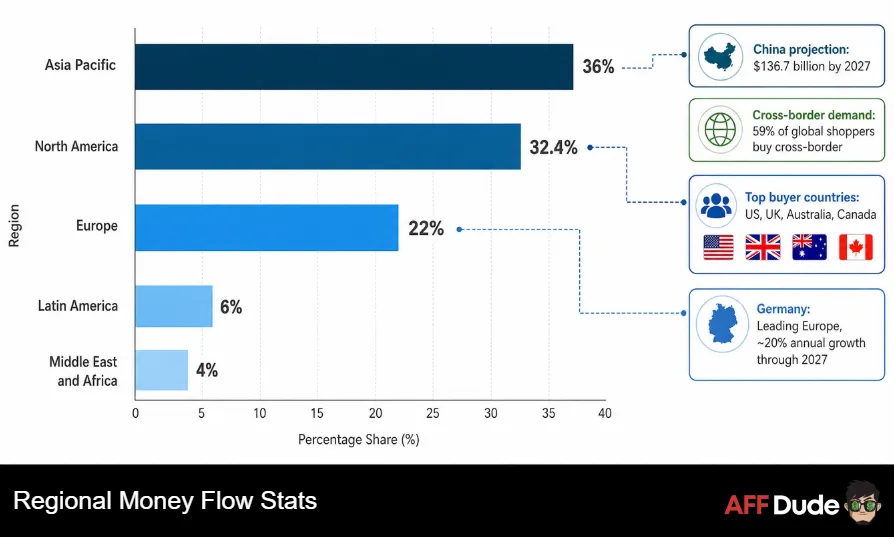
Asia Pacific holds the largest regional share at about 36%. North America follows close at 32.4%. China alone is set to reach 136.7 billion dollars by 2027.
For sellers, cross-border demand is real. About 59% of global shoppers buy from stores in other countries. That opens doors far beyond your home market.
Sustainability Is Now a Buyer Demand, Not a Nice-to-Have
Younger buyers vote with their wallets. And they care where products come from.
About 60% of Gen Z shoppers will pay a premium for sustainable products. That is a real pricing lever, not a slogan.
Sellers who source eco-friendly goods or offer carbon-neutral shipping gain an edge with this crowd. Given Gen Z leads digital engagement at a 38% share, this matters more each year.
Slap a sustainability angle on the right product and you can charge more. That is margin you can actually keep.
Print on Demand: Dropshipping's Branded Cousin
Worth a quick mention because it fixes the biggest dropshipping weakness. Sameness.
Print on demand lets you slap your own designs on products made only after a sale. No inventory, same as classic dropshipping, but the product is uniquely yours.
That solves the copycat problem. Anyone can list the same AliExpress gadget. Nobody can copy your brand and art overnight.
AffDude call: we expect more sellers to blend print on demand with classic dropshipping in 2026. Branding is the only real defence against margin decay.
What We Expect for the Rest of 2026
Twelve years in this game teaches you to read the tea leaves. Here is our honest read on where dropshipping heads next.
Our bottom line? The model is not dead. Lazy dropshipping is. The operators who treat this like a real business keep eating. The rest churn out in months.
So pick a niche you can defend. Vet your suppliers hard. Build a brand, not just a store. Watch your numbers weekly, not yearly. Do that, and the odds shift in your favour.
That is the honest read from 12 years of running traffic and watching this market move. No fluff. Just what the data and the scars taught us, dude.
Dropshipping Statistics 2026: Frequently Asked Questions
Is dropshipping still profitable in 2026?
Yes, for the right operator. Net margins run 15% to 20% for experienced sellers, and top stores hit near 30%. But only 10% to 20% of new stores turn a profit in year one. Profit comes from niche focus, branding, and fast shipping, not luck.
How big is the dropshipping market in 2026?
The global dropshipping market is valued at about 543.53 billion dollars in 2026. It makes up roughly 6.5% of total ecommerce and about 23% of all online sales. Growth runs near 22% a year toward 1.25 trillion by 2030.
What percentage of dropshipping stores fail?
About 90% of stores fail or get abandoned within the first few months. Only 1% to 5% build a lasting, profitable business. Thin margins and poor product picks are the main reasons stores stall.
What is the average dropshipping income per month?
Most active dropshippers earn 1,000 to 5,000 dollars a month. Experienced sellers reach 10,000 to 50,000. Only 1.5% of stores ever cross 50,000 dollars in monthly revenue.
Which platform is best for dropshipping in 2026?
Shopify leads for branded stores, with 12.82% of its stores now dropshipping. AliExpress stays the top sourcing platform at about 65% usage. TikTok Shop is the fastest-growing sales channel, with GMV near 112.2 billion dollars.
What are the most profitable dropshipping niches?
Fashion leads on volume but runs thin margins. Jewellery, health and beauty, and home goods offer stronger margins. Branded, lightweight products in the 10 to 30 dollar cost range give the best profit profile.
How much does it cost to start dropshipping in 2026?
Very little upfront. Startup costs can run up to 80 times cheaper than traditional ecommerce. A basic store often runs under 100 dollars a month, though most sellers need 500 to 2,000 dollars to test products and find a winner.
Is TikTok Shop good for dropshipping?
Yes, and it is the fastest-growing channel right now. TikTok Shop GMV is forecast near 112.2 billion dollars in 2026, up from about 64.3 billion in 2025. Products that demo well on video convert best, with live sessions reaching 8% to 12%.
Sources
We cross-checked these Dropshipping Statistics against trusted data providers and industry research. Full working links below.
- Grand View Research: Dropshipping Market Size and Growth Report
- Statista: Dropshipping Market Statistics
- SellersCommerce: Detailed Dropshipping Statistics 2026
- Global Market Insights: Dropshipping Market Share and Forecast
- TrueProfit: Dropshipping Success Rate and Margins
- ZIK Analytics: Important Dropshipping Statistics for 2026
- Printful: Dropshipping Statistics 2026
- Grand View Research (AliExpress and category data via ZIK): AliExpress Statistics 2026
Recommended Articles