Agentic Commerce Statistics 2026: Market Size & Adoption
 21 min read
AI shoppers now convert 42% better than regular traffic. Twelve months ago they converted 38% worse. That single flip is why every affiliate we know suddenly wants agentic commerce statistics on their desk, and why we spent three weeks pulling every credible 2026 number into one place.
The short version: Half of all shoppers now ask an AI assistant before they touch a search bar, agent-driven purchases sit around $7.7 billion globally, and forecasts put the agentic AI market at $65 billion by 2033. AI-referred traffic to US retail sites has grown 1,324% since tracking started in late 2024. Meanwhile autonomous checkout, the part everyone panicked about, quietly flopped when OpenAI retired Instant Checkout in March.
AffDude has tracked $847M in commissions across 380+ networks. So we know which of these numbers actually touch your payouts and which are conference-slide filler. Below you'll find the market size forecasts (all six of them, and they disagree badly), conversion data, adoption rates, the attribution problem nobody has fixed, and our own projections for 2027.
No hype. Just the numbers that decide whether your traffic still gets paid.
What Agentic Commerce Really Means When You Run Traffic
Forget the boardroom definition. Here is the affiliate version.
A shopper types “get me trail runners under $150, delivered by Friday” into a chatbot. The bot compares options, picks one, and buys. No search results page. No comparison post. No click on your link.
Somewhere in that chain, an affiliate used to eat. Now a machine does the eating.
Agentic commerce covers three separate things, and people mash them together constantly:
Only the third one is properly new. Only the first two currently pay anybody's rent. Keep that separation in your head all the way through, because most stat roundups blur it and the numbers stop making sense.
Field note from the vault: Every time somebody quotes a trillion-dollar agentic number at you, ask which of those three buckets they mean. Nine times out of ten they cannot tell you.
Market Size In 2026: Six Forecasts, Six Wildly Different Answers
We pulled the major 2026 numbers into one place. They do not agree. Not even close.
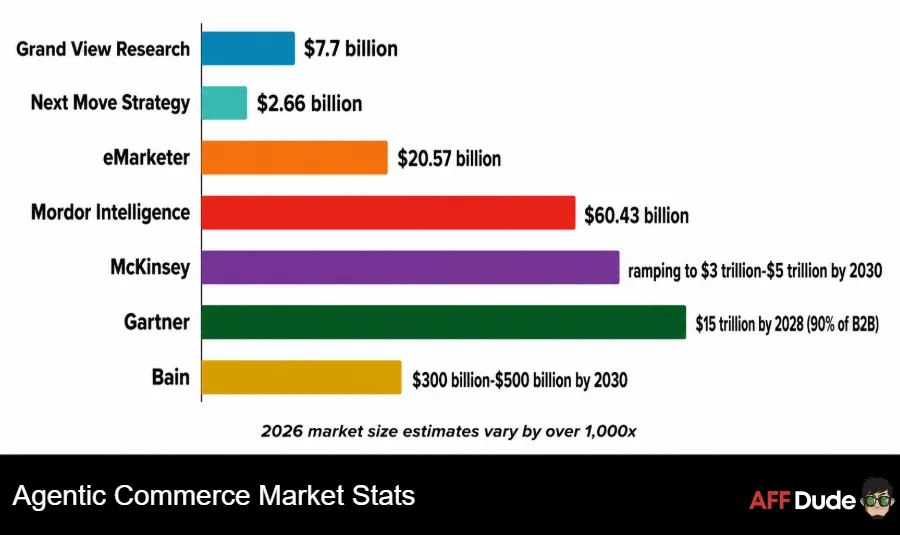
Here is why that matters to you: a network rep will quote whichever figure makes their agentic product look essential. Now you can spot which one they picked.
| Research House | What Gets Counted | 2026 Value | Forward Number | Growth Rate |
|---|---|---|---|---|
| Grand View Research | Full agentic commerce software and services market | $7.7 billion | $65.5 billion by 2033 | 35.7% CAGR |
| Next Move Strategy | Narrower agentic commerce tooling | $2.66 billion | $54.22 billion by 2035 | 39.81% CAGR |
| eMarketer | US retail spend completed inside an AI platform | $20.57 billion | Roughly 1.5% of US ecommerce | Not stated |
| Mordor Intelligence | Agentic AI across all retail and ecommerce ops | $60.43 billion | $218.37 billion by 2031 | 29.29% CAGR |
| McKinsey | Global retail spend redirected through agents | Ramping | $3 trillion to $5 trillion by 2030 | Directional only |
| Gartner | B2B purchasing intermediated by agents | Early stage | $15 trillion by 2028 | 90% of B2B buying |
| Bain | US agentic commerce transaction value | Building | $300bn to $500bn by 2030 | 15% to 25% of ecommerce |
Why Those Market Numbers Disagree So Badly
The gap between $2.66 billion and $5 trillion looks insane. It is not. They measure different things.
eMarketer counts only money that changes hands inside a chat window. Very strict. Very small.
McKinsey counts every pound of retail spend an agent touched anywhere along the way. Very loose. Very huge.
Gartner counts B2B procurement, which dwarfs consumer retail and has almost nothing to do with your Nutra funnel.
Our rule at AffDude: quote the narrow number when you are planning budget, and the wide number when you are explaining urgency to a merchant. Both are honest. Mixing them is not.
Ali's napkin math: Take the eMarketer figure of $20.57 billion in US agentic retail spend. Apply a typical 6% blended affiliate commission rate. That pot would be worth roughly $1.2 billion in commissions annually, if affiliates could actually get attributed. Right now, most cannot. Hold that thought.
AI Referral Traffic: The Growth Curve Blog-Only Affiliates Should Fear
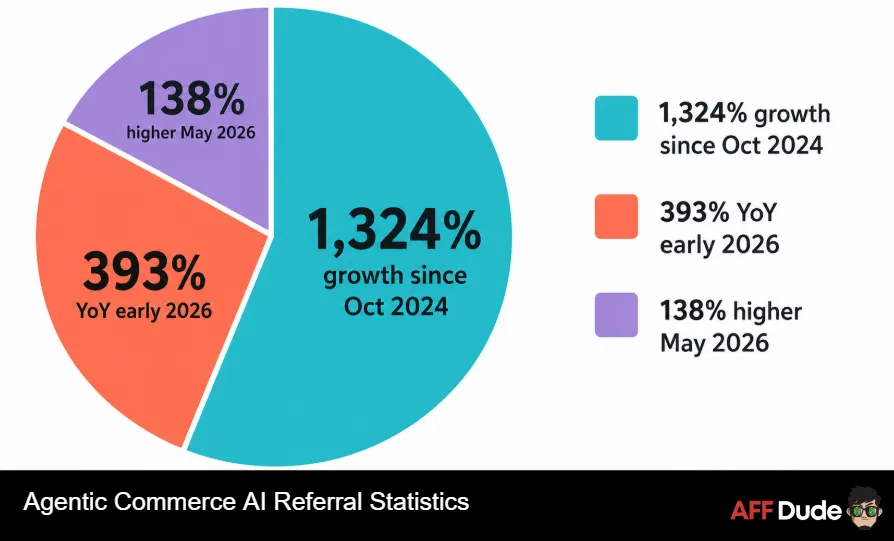
Adobe tracks more than one trillion visits to US retail sites. Their numbers on AI-referred traffic are the cleanest we have found anywhere.
Traffic arriving from AI assistants has grown 1,324% since October 2024, when tracking began. Year on year it ran 393% higher in early 2026, and still sat 138% higher by May 2026.
Growth percentages are cooling. Volume is not. Percentages shrink as a base gets bigger, which is exactly what happens when a channel stops being a novelty.
The Conversion Flip That Rewrote Channel Value
Here is the single most important line in this whole article.
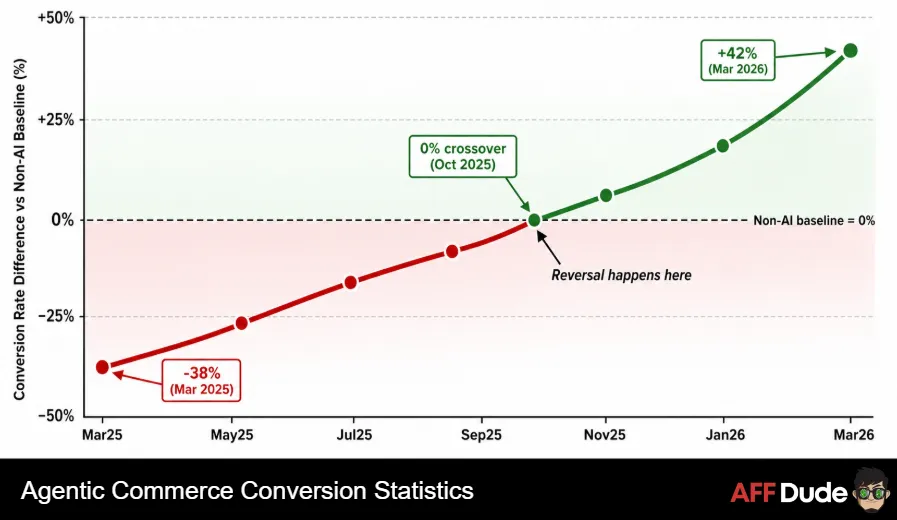
In March 2025, AI-referred visitors converted 38% worse than everyone else. Twelve months later, they converted 42% better. That is roughly an 80-point swing inside one year.
Nothing in performance marketing moves like that. Nothing.
And the supporting metrics back it up rather than contradict it, which matters when a stat looks too good.
| Engagement Metric | AI Traffic vs Non-AI | Direction | What Affiliates Should Read Into Us |
|---|---|---|---|
| Conversion rate | 42% better | Reversed from 38% worse | Bot-sent visitors arrive already sold |
| Revenue per visit | 37% higher | Up sharply | Basket sizes climb, not just order counts |
| Time on site | 48% longer | Up | Deeper reading, better remarketing pools |
| Pages per visit | 13% more | Up | Cross-sell paths stay open |
| Engagement rate | 12% higher | Up | Quality signal, not junk traffic |
| Bounce rate | 17% to 20% band | Versus 27% non-AI | Roughly a third less likely to bail instantly |
| Shopify AI referrals | Near 50% higher conversion | Versus organic search | Average order value also runs 14% higher |
One extra detail nobody talks about. More than half of AI-referred sessions land straight on a product page. Organic search does around 20%.
Translation: the bot already did the comparison stage. Your comparison post did not get the credit.
Consumer Adoption: Shoppers Now Ask A Bot Before They Ask Google
Adoption is the number that turns all of the above from interesting into urgent.
Half of shoppers now use an AI assistant somewhere in the buying journey. Reliance on assistants as the first stop grew 200% in a single year.
| Adoption Signal | 2026 Figure | Year-On-Year Move | Why We Care |
|---|---|---|---|
| Shoppers using an AI assistant in the journey | 50% | Up 67% | Half your audience is bot-influenced |
| Assistant used as first stop | Grew 200% | Single year | Top of funnel moved off search pages |
| Shoppers trusting AI product recommendations | 74% | Rising fast | Trust barrier basically gone |
| Consumers who have shopped with AI | 39% | 85% said experience improved | Repeat behaviour locked in |
| Engaged a third-party AI chat assistant | 21% | Over twelve months | Biggest single agentic surface |
| Used a social platform AI assistant | 17% | Growing | Social affiliates get a second door |
| Used a brand-owned AI assistant | 12% | Growing | Merchants cutting out the middle |
| Traditional search use in shopping journeys | Fell 15% | Down | Marketplace use fell by the same amount |
Read the last row twice. Search and marketplace usage in shopping journeys both dropped 15% year on year. Brand-owned property engagement dropped 7%.
Nothing gets replaced overnight. But every one of those declines lands on somebody's traffic report, and plenty of those reports belong to affiliates.
Straight from the Slack: Three of our members run Amazon review sites. All three reported informational pages down 20% to 35% over the past year. Hands-on testing pages held flat or grew. Same pattern we saw when AI Overviews first landed. Thin content dies first.
Which AI Surfaces Actually Send The Shoppers
Not all bots are equal traffic sources. ChatGPT still leads by a mile, but the gap narrowed hard through 2026.
ChatGPT crossed 900 million weekly active users in early 2026 and handles roughly 2.5 billion prompts a day. Gemini reaches a separate audience through AI Overviews at enormous scale.
The strategic read is simple. Building visibility on one assistant was fine in 2025. In 2026 you need presence across at least four.
The Protocol Stack Running Agent Checkout In 2026
This part gets skipped in most stat articles because it is technical. Skipping it is a mistake, because protocols decide who gets paid.
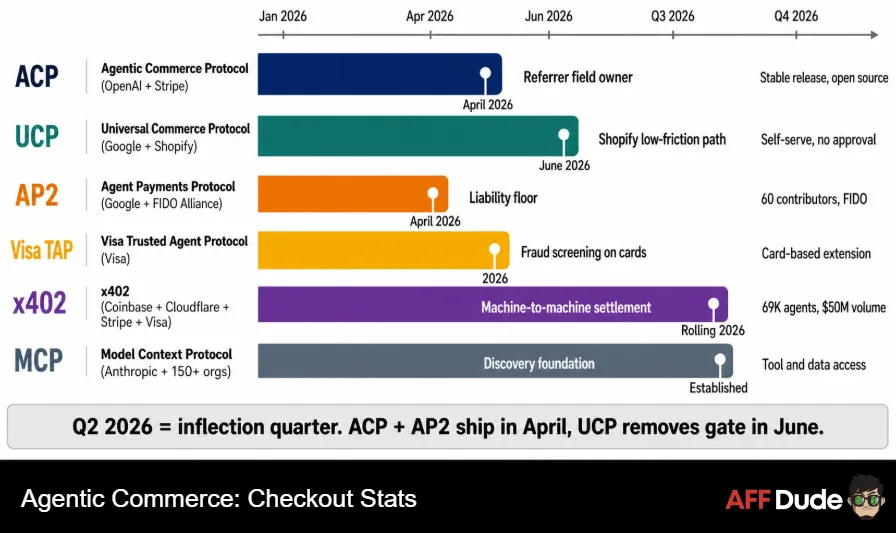
Four standards matter right now. They are layers, not rivals, and a single purchase can touch all four.
| Protocol | Backed By | Layer It Owns | 2026 Status | Affiliate Relevance |
|---|---|---|---|---|
| ACP (Agentic Commerce Protocol) | OpenAI and Stripe | In-chat checkout execution | Stable release cut April 2026, open source | Defines if a referrer field even exists |
| UCP (Universal Commerce Protocol) | Google and Shopify | Product surfacing and cart | Self-serve from June 2026, no approval gate | Lowest-friction path for Shopify merchants |
| AP2 (Agent Payments Protocol) | Google, now FIDO Alliance | Proving who authorised payment | Donated to FIDO April 2026, 60 contributors | Sets liability if an agent buys wrong |
| x402 | Coinbase, Cloudflare, Stripe, Visa | Machine-to-machine settlement | 69,000 active agents, 165 million transactions | Around $50m cumulative volume so far |
| Visa Trusted Agent Protocol | Visa | Agent identity on card rails | Card-based extension shipped 2026 | Fraud screening for agent purchases |
| MCP (Model Context Protocol) | Anthropic, now industry-wide | Tool and data access | 150+ supporting organisations | How agents find merchant capabilities |
Instant Checkout Died. Nobody Told The Headlines
Now for a story most 2026 roundups got flat wrong.
OpenAI launched Instant Checkout with a lot of noise. It let people buy inside ChatGPT. Etsy went live at launch, and a batch of Shopify brands followed.
By March 2026 it was retired. Around a dozen Shopify merchants ever shipped against it. Sales were close to nothing.
OpenAI pivoted to ACP-powered product surfacing with Walmart, Target, Sephora, Nordstrom, Best Buy, Lowe's and Wayfair instead. Shopify launched agentic storefronts across millions of merchants at the same time.
So what actually happened? Buying inside a chat window flopped. Finding products inside a chat window exploded.
Real talk: Every consultant who told you to panic about in-chat checkout in 2025 was wrong about the mechanism and right about the direction. Bots did not replace the merchant site. Bots replaced the research step that sat before it, which happens to be the exact step affiliates own.
The Attribution Break That Hits Affiliate Payouts Hardest
Here is where agentic commerce statistics 2026 stop being trivia and start costing money.
Affiliate marketing runs on cookies, click IDs and last-touch attribution. Every one of those assumes a human clicks a tracked link.
Agents do not click links. They call APIs.
When an agent buys, several things fail at once:
The industry sits on roughly $13 billion of US affiliate spend built on infrastructure agents bypass entirely. That is not a small crack.
Funnel Compression: 14 Clicks Down To Two
The old buying path ran long. Search, click, browse, compare, save, return, add to cart, check out. Fourteen touches on average.
Agent buying runs like so: user states intent, agent evaluates, agent submits payment. Two interactions, maybe three.
Every step that vanished was a step where an affiliate could insert a tracked link. That is the whole problem in one sentence.
There is a genuine upside buried here though. Agent activity gets logged, is API-based, and behaves deterministically. No probabilistic matching. No cross-device guessing.
Done properly, agentic attribution could end up more accurate than cookies ever managed. Networks are already shipping AI-partner attribution tooling. Impact runs multi-touch attribution that rewards chat-side actions when conversion lands elsewhere.
Our call on this one: We expect the first credible agent-referral commission standard to land through a major network rather than a protocol body. Networks have the merchant relationships and the payout rails already. Protocols have neither.
Affiliate Content Is Quietly Feeding The Machines
This stat stopped us cold when we found it.
When ChatGPT discussed the eyewear brand Zenni, almost 70% of cited sites came from affiliate marketing content. Not brand pages. Not news. Affiliate reviews and comparisons.
More than a quarter of OpenAI's content partnerships since 2021 have been with publishers running scaled affiliate commerce content.
Sit with the implication. Affiliate publishers are the training and citation backbone of the exact systems eating affiliate clicks.
We are the ingredient and the meal.
The practical upside: content that gets cited builds brand recall even without a click. Getting mentioned inside an answer is now a measurable outcome. It just is not a trackable one yet.
What Happens To Coupon, Deal And Voucher Sites
Coupon affiliates have been quietly nervous about this, and rightly so.
A chatbot asked to find the cheapest price does in two seconds what a voucher site exists to do. No banner. No pop-up. No last-click cookie drop at the checkout stage.
Last-click coupon attribution has always been the softest spot in affiliate economics. Merchants complain about paying for a sale they had already won. Agents hand merchants a clean excuse to stop paying.
We do not expect coupon sites to vanish. We expect commission rates on them to get squeezed as merchants realise agents cover the same job for free.
The counter-play we like: exclusive negotiated codes that only exist on your property. A bot cannot surface a code that is not published anywhere else. That is the same reason AffDude negotiates lifetime pricing direct with vendors rather than reselling public offers.
Agent Fraud Is Coming And Nobody Has Priced It
Fraud already costs affiliate marketing billions annually. Around 63% of affiliates name it as a major concern.
Now add software that can browse, fill forms and transact at machine speed.
Here is what worries us most, based on patterns we have watched break every previous tracking model:
Networks screening for bot traffic today mostly block agents outright. That is a blunt fix. Block too hard and you reject the highest-converting visitors on your site.
Expect a proper agent-verification standard within eighteen months. Visa already signs agent identity into request headers, which is the early shape of a fix.
Where Agentic Buying Grows Fastest By Region
Geography matters more than most roundups admit, especially if you buy traffic across GEOs.
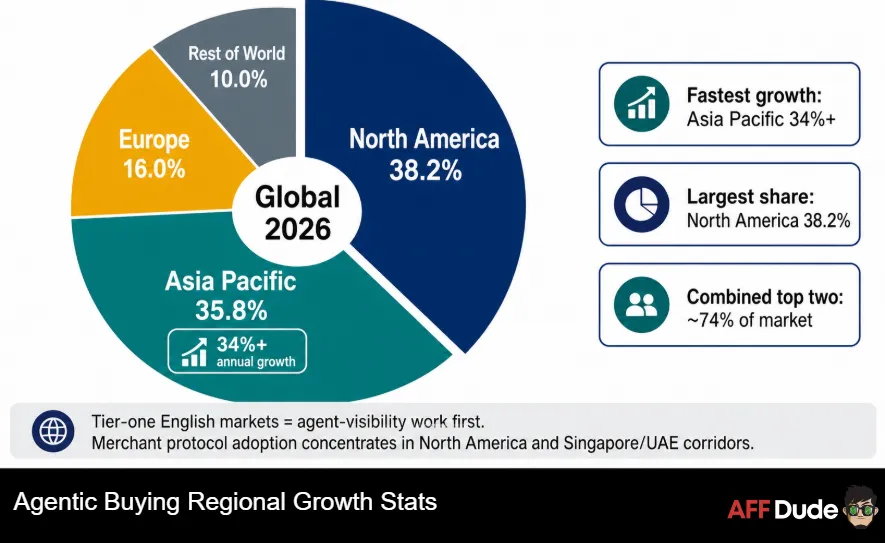
North America held around 38.2% of the global agentic commerce market. No surprise given platform origins and payment rails.
Asia Pacific posts the fastest growth rate of any region, running above 34% annually. Unmanned store rollouts, government AI programmes and high consumer comfort with automation all push in the same direction.
AI adoption rates by country tell a similar story. India leads at 59%, followed by the United Arab Emirates at 58%, Singapore at 53% and China at 50%.
Our take on GEO strategy: tier-one English markets get the agent-visibility work first, because merchant protocol adoption sits there. Emerging markets stay a volume play through conventional channels a while longer.
The Cookie Deadline Colliding With All Of This
Bad timing rarely arrives alone.
Third-party cookie phase-out completes during 2026. Agent traffic breaks tracking at the same moment the old tracking layer gets switched off anyway.
Two separate attribution problems landing in one year is the reason so many affiliate managers look tired right now.
Operator survey data shows 67% plan agentic AI adoption during 2026, up from 23% two years earlier. Most of that adoption targets internal workflows rather than attribution fixes.
Practical advice from our side. Get server-side tracking running now if you have not already. Push for first-party postback integrations with your top three merchants. Both jobs get harder every month you delay them.
Vertical Exposure: Who Gets Hit First And Hardest
Not every affiliate vertical faces the same risk. We ranked the ones our members actually run.
| Vertical | Agent Exposure | Why | Our Read On Near-Term EPC | Play To Run Now |
|---|---|---|---|---|
| Physical products and DTC | Very high | Structured catalogues, clean specs, easy to compare | Pressure on thin comparison pages | Hands-on testing, original photos, teardowns |
| Amazon associates content | Very high | Agents read product feeds natively | Roundup pages squeezed hardest | Move to use-case content and bundles |
| SaaS and B2B software | High | Agent-mediated procurement growing fast | Recurring deals stay sticky | Own migration and integration queries |
| Web hosting and tools | Medium high | Spec comparison suits bots perfectly | Mixed, brand terms hold up | Benchmark data bots cannot fabricate |
| Nutra and supplements | Medium | Compliance limits agent recommendations | Native and paid stay dominant | Advertorials, direct media buys |
| Dating and companion apps | Low medium | Emotional intent resists automation | Holding steady | Social and video traffic |
| iGaming and betting | Low | Regulation blocks agent transactions | Largely insulated near term | Keep SEO and community channels |
| Sweeps and CPA leadgen | Low | Form fills, not purchases | Minimal direct impact | Watch agent-driven form abuse |
The pattern is obvious once laid out. The more a purchase can be reduced to a spec sheet, the faster a bot takes over the deciding.
Verticals built on emotion, regulation or relationship stay human for longer.
Merchant Readiness: Most Of Them Are Wide Open
Merchants are not ready, and knowing exactly how unready gives you negotiating room.
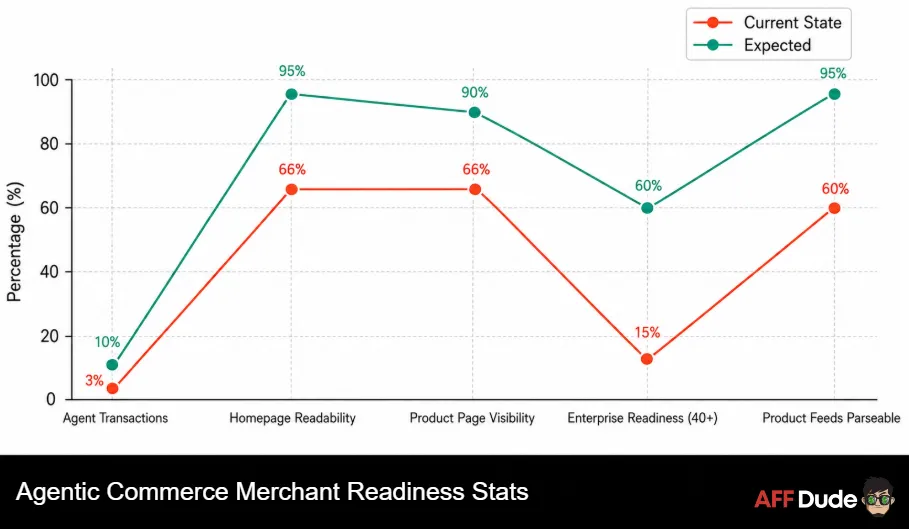
Around 85% of surveyed enterprises scored below 40 out of 100 on agentic readiness. They lack the structured data and protocol plumbing agents need.
Roughly 34% of retailer homepage content cannot be read by AI models at all. Product pages average about 66% visibility.
Only around 3% of transactions currently involve an agent. But 33% of consumers expect at least a tenth of their buying to be AI-driven within a year.
Demand is running ahead of supply. That gap is where money sits.
Bench test from our side: We ran agent-readability checks across 40 merchant sites in our network list. Roughly six in ten had product feeds an agent could parse cleanly. The rest had pricing buried in scripts. If you are negotiating a private deal, that audit hands you free bargaining room.
Branded Agents Are Beating Everyone Else
Merchants running their own shopper agents pulled ahead noticeably.
Brands deploying shopper agents grew sales 6.2% against 3.9% without. That works out to 59% higher sales growth.
AI and agents drove 20% of all retail sales across the 2025 holiday period, worth $262 billion. Agent-powered service conversations jumped sharply and autonomous actions taken by those agents rose 142%.
Meanwhile AI service agent adoption inside customer service teams went from 39% to 66% in a year.
Why should an affiliate care? Because merchants with branded agents have budget, urgency and a reason to pay for qualified traffic. Those are the programmes worth pitching.
The $15 Trillion B2B Side Almost Nobody Covers
Consumer agentic commerce gets the headlines. B2B is where the actual money moves.
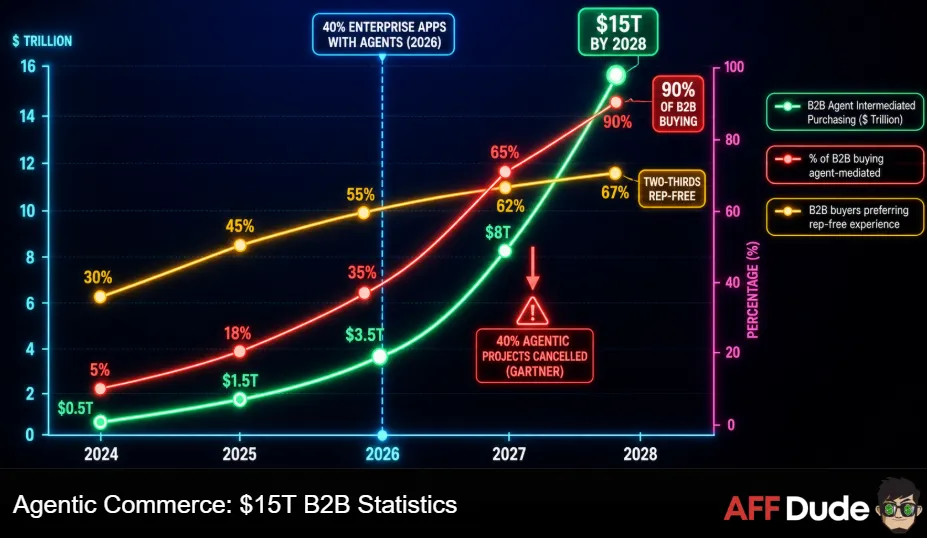
Agents are expected to intermediate $15 trillion in B2B purchasing by 2028, covering around 90% of B2B buying.
Two-thirds of B2B buyers already prefer a rep-free buying experience. Some 40% of enterprise applications will carry task-specific agents by the end of 2026.
For SaaS affiliates and PartnerStack operators, that shift cuts both ways:
Worth noting the cold water too. Gartner reckons 40% of agentic commerce projects get cancelled by 2027. Enterprise pilots fail constantly.
How To Check If Your Own Site Is Agent-Readable
Enough theory. Here is the test we run on our own properties every quarter.
Open a chatbot. Ask it a question your money page is built to answer. See if you get cited.
Sounds crude. Works better than most paid tools currently on sale.
Run the same prompt across four assistants, not one. Share moved hard through 2026, and a citation on ChatGPT tells you nothing about Gemini.
Then check the mechanical stuff:
Roughly a third of retailer homepage content sits invisible to AI models. Plenty of affiliate sites score worse than that.
Fixing markup is cheap. Losing citations to a competitor who fixed theirs first is not.
Two-minute job: Ask a chatbot to name the best tool in your main category. Note every site it cites. That list is your real competitor set now, and it rarely matches your rank tracker.
AffDude Projections: Our Numbers For 2026 And 2027
Everything above came from outside data. This next bit is ours.
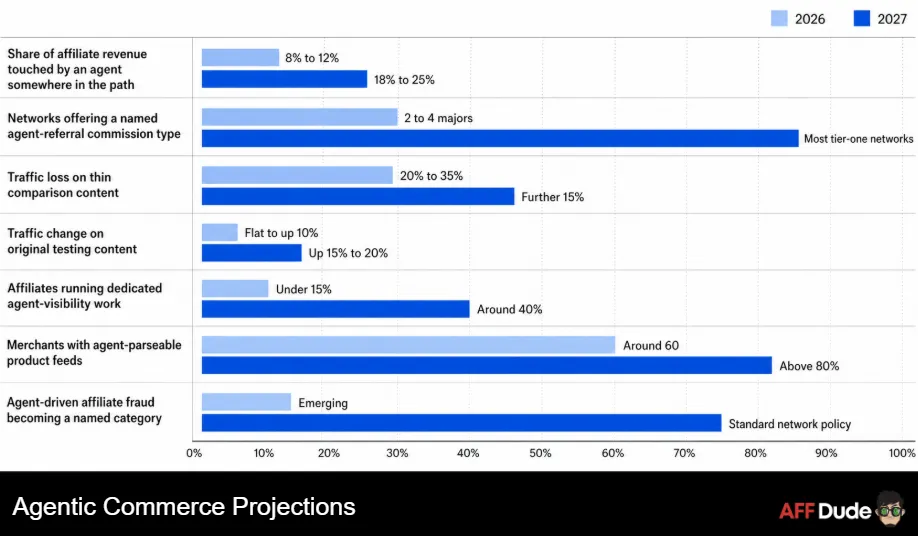
These are calls, not certainties. We are putting confidence levels on each so you can weight them yourself.
| What We Expect | Our 2026 Call | Our 2027 Call | Confidence | Reasoning Behind It |
|---|---|---|---|---|
| Share of affiliate revenue touched by an agent somewhere in the path | 8% to 12% | 18% to 25% | Medium high | Tracks consumer adoption curve with a lag |
| Networks offering a named agent-referral commission type | 2 to 4 majors | Most tier-one networks | High | Attribution tooling already shipping |
| Traffic loss on thin comparison content | 20% to 35% | Further 15% | High | Matches what our members already report |
| Traffic change on original testing content | Flat to up 10% | Up 15% to 20% | Medium | Cited content compounds brand recall |
| Affiliates running dedicated agent-visibility work | Under 15% | Around 40% | Medium | Adoption follows tooling availability |
| Merchants with agent-parseable product feeds | Around 60% | Above 80% | Medium high | Protocol self-serve removed the gatekeeping |
| Agent-driven affiliate fraud becoming a named category | Emerging | Standard network policy | Medium | Fraud follows volume, always has |
What We Are Changing In Our Own Playbook
Talk is cheap. Here is what actually changed on our side of the desk.
We stopped writing pure spec roundups. A bot writes those better and faster than we ever could.
We started publishing raw test data instead. Payout screenshots, EPC tables, refund logs. Machines cannot invent those.
Three concrete shifts worth stealing:
We also started asking every network rep one question: how do you attribute an agent-mediated sale? Most cannot answer yet. The ones who can are getting more of our volume.
Dude's honest warning: Do not rebuild your whole business around agents in 2026. Around 3% of transactions involve one today. Prepare, do not panic. The affiliates who blew up chasing early trends outnumber the ones who got rich from them, and we have watched both since 2013.
Five Numbers Worth Memorising
If you remember nothing else from this whole breakdown, keep these five:
- AI traffic converts 42% better than non-AI, up from 38% worse a year earlier
- Half of shoppers now use an assistant somewhere in the buying journey
- Around 70% of sites cited in one major brand query came from affiliate content
- Roughly 3% of transactions involve an agent today, against 33% of consumers expecting far more
- Agents get pegged to intermediate $15 trillion in B2B buying by 2028
Agentic Commerce Statistics Queries in 2026: Quick Answers
How big is agentic commerce in 2026?
Around $7.7 billion globally on the widest software and services measure, or $20.57 billion of US retail spend if you count only purchases completed inside an AI platform. Forecasts reach $65.5 billion by 2033.
Do AI shoppers actually convert?
Yes, better than anyone else now. AI-referred visitors convert 42% better than non-AI traffic and generate 37% more revenue per visit.
Will AI agents kill affiliate marketing?
No, but agents break the tracking layer affiliate marketing sits on. Cookies, click IDs and last-touch attribution all assume a human click that agents never make.
How many people shop with AI in 2026?
Half of shoppers use an assistant somewhere in the journey. Around 39% have shopped with AI directly, and 85% of them said the experience improved.
Which AI platform sends the most retail traffic?
ChatGPT still leads with roughly 68% of chatbot web traffic, down from 87.2% a year earlier. Gemini climbed to about 18.2% over the same stretch.
What is the Agentic Commerce Protocol?
An open standard from OpenAI and Stripe covering how agents and merchants complete checkout. It sits alongside UCP for product surfacing and AP2 for payment authorisation.
Is in-chat checkout working yet?
Not really. Instant Checkout was retired in March 2026 after around a dozen merchants shipped against it. Product surfacing inside chat grew instead.
Which affiliate verticals face the most agent risk?
Physical products, Amazon content and spec-driven comparisons. iGaming, sweeps and dating stay insulated longer thanks to regulation and emotional intent.
Where We Got Our Numbers
Every figure above came from the sources below. We check them ourselves rather than recycling other roundups. If a number moves, we update the article.
- Grand View Research: Agentic Commerce Market Report
- Adobe Analytics: AI Traffic and Retail Visibility Data
- Salesforce: Holiday Shopping and Agent Sales Data
- Salesforce: 2026 Retail and AI Assistant Adoption Research
- eMarketer: Affiliate Marketing and AI Citation Analysis
- Gartner: Top Predictions For IT Organisations
- Mordor Intelligence: Agentic AI In Retail And Ecommerce
- Next Move Strategy Consulting: Agentic Commerce Market
- Juniper Research: Agentic Commerce Research Suite
- Digital Commerce 360: AI Referred Traffic Growth
- Rye: Affiliate Commissions In Agentic Commerce
- Search Engine Journal: Adobe AI Traffic Report Analysis
- Agentic Plug: Protocol Adoption Tracker
- Adam Silva Consulting: State Of Agentic Commerce 2026
- SQ Magazine: AI Assistant Market Share Data
The Dude Abides
Agentic commerce is not the end of affiliate marketing. It is the end of lazy affiliate marketing, which frankly was overdue.
Bots got good at summarising specs. Bots are still terrible at testing a network's payout speed, catching a shady offer, or telling you which tracker actually holds up under real volume.
That work stays human. So does the money attached to it.
We will keep updating these numbers as they move. Same as we have done since 2013.
Recommended Articles