
Content Marketing Statistics in 2026 point to one thing. The game changed shape, not size. Global content marketing revenue crosses $107 billion this year.
Around 82% of businesses run content as a core play now, not a side hustle. AI sits in nearly every content room, with 87% of marketers using it to write and edit. Video keeps winning, and short clips lead on return. Here comes the twist. Google clicks are drying up fast.
About 68% of searches end without a single tap. So traffic and visibility split apart. Below we break down the numbers that matter, plus our own calls on what happens next.
The 2026 Content Numbers Worth Bookmarking
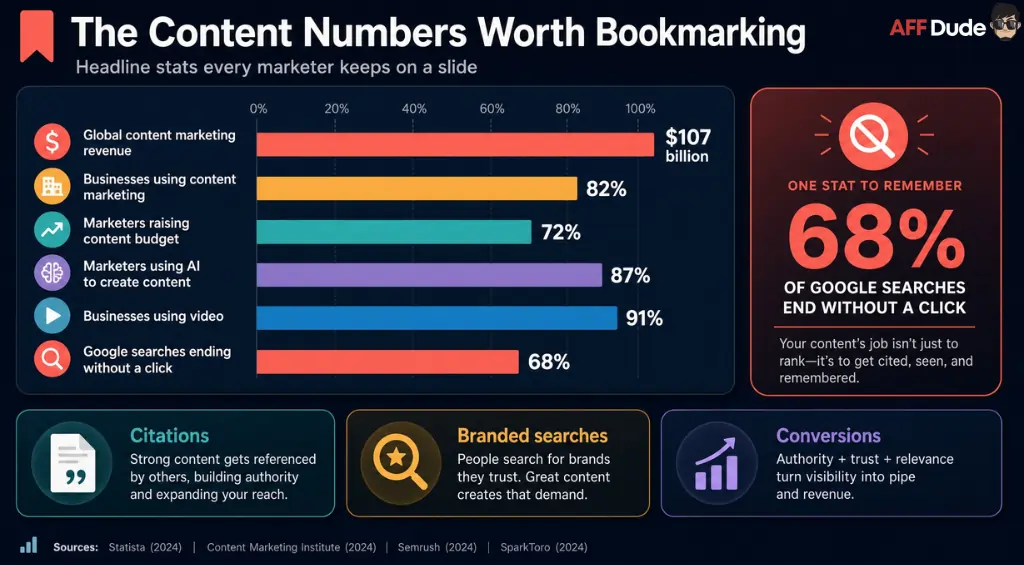
Let's start with a clean scoreboard. We've pulled the headline figures marketers keep asking us about. No fluff, just the stats you'd want on a slide when your boss asks why content still deserves a budget.
These are the numbers we keep coming back to in strategy calls.
| Metric | 2026 figure | Why you should care |
|---|---|---|
| Global content marketing revenue | $107 billion | Still growing double digits year on year |
| Businesses using content marketing | 82% | Now a default channel, not a test |
| Marketers raising content budget | 72% | Average bump sits near 14% |
| Marketers using AI to create content | 87% | AI is baked into the workflow |
| Businesses using video | 91% | Video moved from bonus to baseline |
| Google searches ending without a click | 68% | Rankings no longer equal traffic |
Read that last row again. Sixty-eight percent. That single number reshapes almost every content plan we build in 2026.
AffDude take: If your only content KPI is sessions, you're grading yourself on a test Google quietly cancelled. Track citations, branded searches and conversions too. We shifted our own reporting a year ago, and it saved us from a very awkward board meeting.
How Big Is The Content Money Pool Right Now
Content marketing is not small money anymore. Global content marketing revenue lands around $107 billion in 2026. Back in 2018 that figure sat near $37 billion. So we've roughly tripled spend in under a decade.
Zoom out to the wider industry, counting software, agencies and services, and estimates run far higher. Several market reports put the broad category above $500 billion for 2026. The gap comes down to what each report counts. Pure content services sit near $107 billion. Add tools, martech and paid distribution, and the number balloons.
North America still eats the biggest slice, roughly 37% to 42% of global spend. Asia Pacific grows fastest. We expect that gap to keep closing through 2027 as mobile-first markets pour money into creator and video content.
Our own read on the number pool for 2026:
The takeaway is simple. Content now ranks as one of the largest single lines in most marketing budgets. So expect more scrutiny, more measurement and more pressure to prove return.
Budgets Are Climbing, Not Getting Cut
Every year someone predicts content budgets will shrink. Every year they mostly grow. 2026 keeps the streak alive.
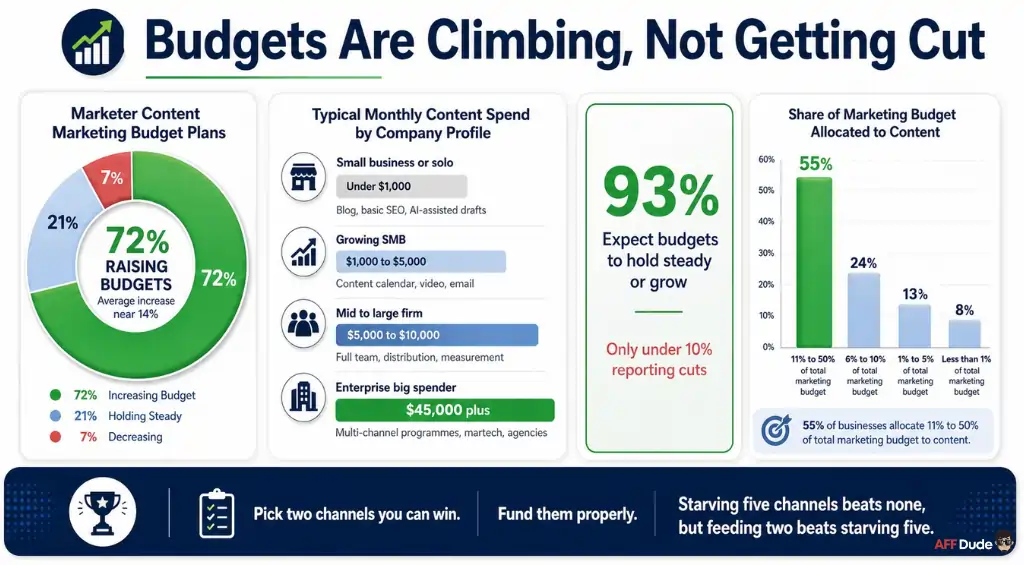
Around 72% of marketers plan to raise their content marketing budget this year. The average increase sits near 14%. Roughly 93% expect budgets to hold steady or grow. Only a small slice reports cuts, usually under 10%.
Company size shapes the spend. Most small businesses stay under $1,000 a month. Mid to large firms play a different game entirely.
| Company profile | Typical monthly content spend | Common focus |
|---|---|---|
| Small business or solo | Under $1,000 | Blog, basic SEO, AI-assisted drafts |
| Growing SMB | $1,000 to $5,000 | Content calendar, video, email |
| Mid to large firm | $5,000 to $10,000 | Full team, distribution, measurement |
| Enterprise big spender | $45,000 plus | Multi-channel programmes, martech, agencies |
Here's a signal we like. The share of firms spending over $45,000 a month keeps rising year on year. Big brands aren't pulling back. They're doubling down and treating content like a proper growth engine.
One more figure. Around 55% of businesses now hand content between 11% and 50% of their whole marketing budget. So for over half the market, content stopped being a side project.
AffDude take: Budget growth means nothing without a spending plan. Two thirds of content teams admit they don't know where to put resources. Pick two channels you can win. Fund them properly. Starving five channels beats none, but feeding two beats starving five.
AI Runs The Content Room Now
Here comes the biggest shift. AI went from novelty to office furniture in about two years.
Roughly 87% of marketers use AI for content creation in 2026. Around 94% plan to use AI for blog content specifically. Two years ago, 65% of marketers didn't use AI for blog work at all. That refusal group has crashed to about 5%.
Among B2B marketers, adoption runs even higher. Close to 95% use AI-powered marketing apps. Of those using AI for content, 87% say productivity jumped.
But here's the honest bit nobody puts on a sales deck. Usage raced ahead of measurement. Around 67% of content marketers use AI daily, yet only 19% track AI-specific results. So most teams push more output without knowing if AI actually improves outcomes.
| AI content stat | 2026 figure | Our reading |
|---|---|---|
| Marketers using AI for content | 87% | Near universal, no going back |
| Planning AI use for blogs | 94% | Drafting and outlines lead the pack |
| B2B teams reporting better productivity | 87% | Speed gains are real and measurable |
| Teams tracking AI-specific results | 19% | The blind spot of the year |
| Production cost drop from AI | 30% to 40% | Cheaper output, tougher competition |
Cheaper content sounds great until everyone gets it. AI cut production costs by 30% to 40%. So mid-size firms now publish at enterprise speed. The result? A flood of samey content. Quality and original data became the real edge.
We're calling it now. By late 2026, winning teams won't be the ones producing most. They'll be the ones producing proprietary data, sharp opinions and content AI can't copy from a prompt. Our own best-performing pages this year all shared one trait. Original numbers you couldn't get anywhere else.
AffDude take: Use AI for the boring 60%. Research, first drafts, outlines, meta tags. Keep the human on the 40% that wins, which means the angle, the data, the voice. A page that reads like a prompt output ranks like one too.
Video Ate The Feed And Kept Eating
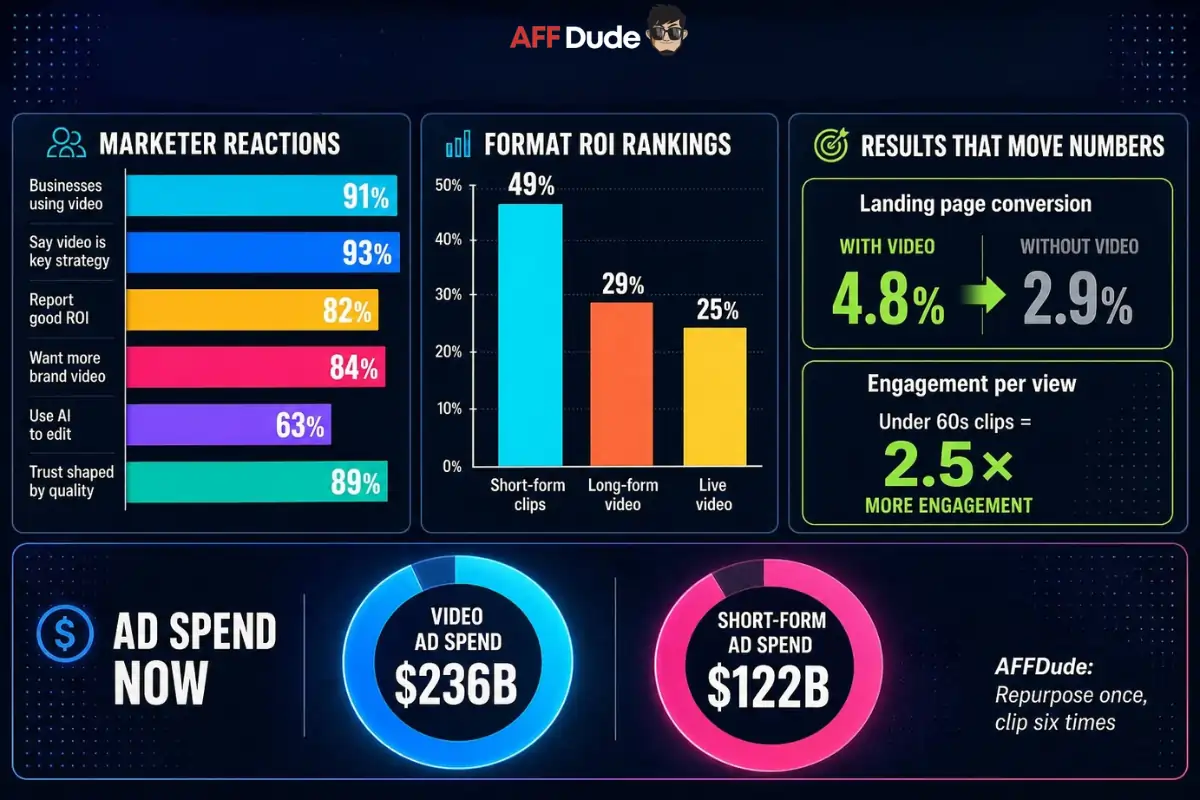
Video stopped being optional. Around 91% of businesses use video as a marketing tool in 2026. That matches an all-time high. About 93% of marketers say video plays a key role in strategy.
The ROI story got interesting though. Roughly 82% of video marketers report a good return this year. Sounds strong, and it is. But a year earlier that figure sat at 93%. So we saw an 11-point drop.
Why the dip? Simple. More teams making video means more teams making bad video. When everyone jumps in, average quality falls. Teams with an actual plan still crush it.
Short clips lead the pack. Around 49% of marketers name short-form video ROI as the best of any format. Long-form video takes 29%, and live video 25%. All three top slots go to video.
| Video stat | 2026 figure | Marketer takeaway |
|---|---|---|
| Businesses using video | 91% | Table stakes, not a differentiator |
| Video marketers reporting good ROI | 82% | Strong, but quality now decides it |
| Short clips as top ROI format | 49% | Under 60 seconds wins on engagement |
| Consumers wanting more brand video | 84% | Demand keeps outrunning supply |
| Video marketers using AI to create or edit | 63% | Production costs dropping fast |
A few more that matter. Clips under 60 seconds pull about 2.5 times more engagement per view than any other content type. Landing pages with video convert better too, roughly 4.8% against 2.9% without. So video isn't just an awareness toy. Video moves the needle on sales pages.
Consumer appetite stays huge. Around 84% want more video from brands. And 89% say video quality shapes how much they trust a brand. Sloppy video now costs you trust, not just views.
Video ad spend keeps climbing too, heading past $236 billion globally in 2026. Short-form ad spend alone nears $122 billion.
AffDude take: Your old blog posts are a video goldmine. We turn one long guide into six short clips. Same research, six new placements. Making under four videos a month? Start by repurposing what you already ranked for.
Zero-Click Search Broke The Old Traffic Game
Now the section that keeps SEOs up at night. And honestly, it should.
Around 68% of Google searches now end without a click. Ten years ago that figure sat near 45%. The steepest jump came in the last two years, driven by AI answers stuffed straight into results.
AI Overviews now show up on a big chunk of searches, somewhere between 25% and 48% depending on which tracker you trust. When one appears, the click rate collapses. Searches with an AI Overview hit an 83% zero-click rate. In Google's newer AI Mode, that climbs to about 93%.
So nearly 30% of marketers already report falling search traffic as people lean on AI answers. That's not a scare story. It shows up in dashboards right now.
| Search behaviour stat | 2026 figure | What it signals |
|---|---|---|
| Google searches ending without a click | 68% | Traffic and rankings decoupled |
| Zero-click rate when AI Overview appears | 83% | Answers resolve on the page itself |
| Zero-click rate in AI Mode | 93% | The next wave of click loss |
| Marketers reporting lower search traffic | Nearly 30% | Already visible in analytics |
| Branded query click lift with AI Overviews | Around 18% | Brand strength now pays back |
Not all doom though. Two bright spots deserve attention.
First, branded searches actually gain. When an AI Overview names a clear brand next to a source link, clicks lift by roughly 18%. So building brand recognition pays off in a zero-click world. People search your name, then click you.
Second, AI search referrals grow fast. Visits from AI engines jumped about 42.8% year on year, from 15.6 billion to 27.4 billion. Those visitors often convert better because they've already read a summary and want depth. One forecast has AI search visitors passing traditional search by 2028. We think that timeline could arrive sooner if AI Mode keeps scaling at current speed.
So smart teams shifted from search engine optimisation alone to answer engine optimisation and generative engine optimisation. The goal changed. You want to be the source AI cites, not just a blue link nobody clicks.
AffDude Recommendation: Stop grading top-of-funnel “how to” posts on traffic. Those became citation plays, not traffic plays. Grade them on brand mentions and AI citations. Save traffic hopes for comparison and buying-intent pages, where clicks still flow.
What Content Actually Pays Back
Let's talk money returns. Because “engagement” doesn't pay salaries.
The classic stat still holds. Content marketing generates about three times more leads than outbound, at roughly 62% lower cost. That cost gap widens as AI trims production while paid channels get pricier.
For B2B, content averages around a 3:1 return. Top performers hit 4.33:1 or better. SEO-led content posts some of the strongest numbers, with certain firms reporting returns north of 700% on organic search over time.
But measurement stays messy. About 87% of content teams track traffic. Only 31% track revenue attribution. So most teams count clicks, not cash. Closing that gap ranks as the single biggest upgrade most programmes can make in 2026.
A quick reality check on blogs. Businesses with a blog pull around 55% more website visitors. Yet with 68% of searches going click-free, raw ranking matters less than before. A blog now earns its keep by feeding AI answers, building authority and pushing internal links to your money pages.
AffDude Insight: Can only fix one thing this year? Connect content to revenue. We tie every pillar page to a tracked conversion goal. Not perfect, but far better than reporting “traffic went up” while sales stayed flat.
Where Content Gets Seen In 2026
Making content is only half the job. Getting it in front of people is the other half. And distribution got harder this year.
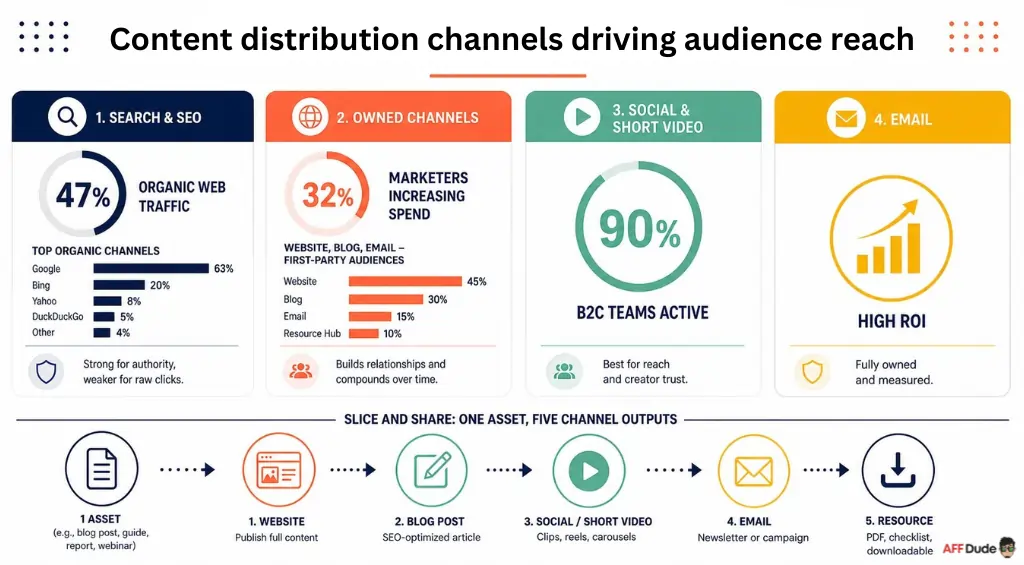
Organic search still drives a big share of web visits, close to 47% of all traffic. But that number now hides the zero-click problem. A visit only counts if someone clicks. So organic reach and organic traffic no longer mean the same thing.
Owned channels earn fresh attention. Around 32% of marketers plan to raise spend on owned media this year, meaning website, blog and email. The logic is sharp. When third-party cookies fade and paid reach gets costly, first-party audiences become the safest bet.
Social stays the top distribution engine for reach. About 90% of B2C teams use social to share content. Short video carries most of that weight now. Here's how the main channels stack up for content teams in 2026:
Our own distribution rule stays boring but works. Publish once, then slice that one asset across five channels. A single data study becomes a blog post, a video, an email, a social carousel and a podcast talking point. Same research, five doors in.
AffDude take: Distribution beats production in 2026. We'd rather post three great pieces and push them hard than publish ten and pray. Build a repeatable slice-and-share routine, and your output does five times the work.
The Challenges Slowing Content Teams Down
Not every stat is a win. Some point straight at problems worth fixing.
Resource confusion tops the list. Around two thirds of content marketers admit they don't know where to put budget and effort. So money gets spread thin across channels that never get a fair test.
Measurement gaps come next. With 87% tracking traffic but only 31% tracking revenue, most teams can't prove content pays. That gap gets brutal in budget season. A number you can't defend is a number that gets cut.
Then comes content saturation. AI made publishing cheap, so the web fills with samey posts. Standing out costs more effort now, not less. Original angles and real data became the price of entry.
Search volatility rounds it off. With AI answers reshaping results, a page ranking well one month can lose visits the next. So teams need channel spread, not a single traffic source they can't control.
AffDude Insight: Every challenge above shares one fix. Focus. Fewer channels, deeper content, tighter measurement. We've watched teams triple output and halve results by chasing everything. Do less, better, and track what actually earns money.
B2B Versus B2C: Two Different Playbooks
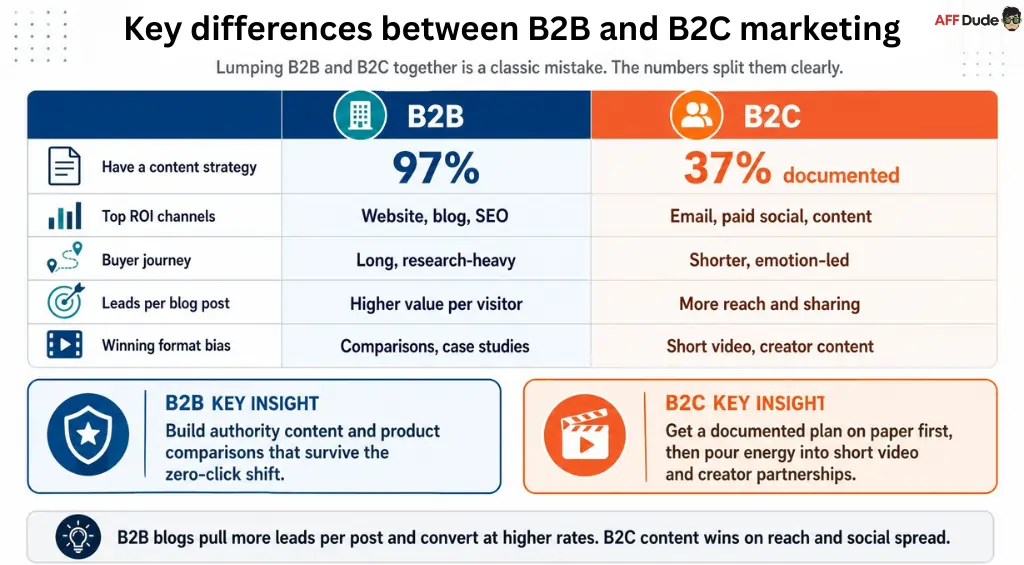
Lumping B2B and B2C together is a classic mistake. The numbers split them clearly.
Around 97% of B2B marketers run a content strategy. But only about 37% of B2C marketers have a documented one. So most consumer brands wing it, which feels wild given how competitive that space runs.
Buyer behaviour differs too. Roughly 95% of B2B buyers aren't actively purchasing at any moment. So content that only chases high-intent traffic fights over a tiny slice. Brands building familiarity early tend to make the shortlist later.
| Signal | B2B | B2C |
|---|---|---|
| Have a content strategy | 97% | 37% documented |
| Top ROI channels | Website, blog, SEO | Email, paid social, content |
| Buyer journey | Long, research-heavy | Shorter, emotion-led |
| Leads per blog post | Higher value per visitor | More reach and sharing |
| Winning format bias | Comparisons, case studies | Short video, creator content |
B2B blogs punch above their traffic weight. They pull more leads per post and convert at higher rates, even with lower visits. B2C content wins on reach and social spread instead.
Our advice splits accordingly. B2B teams should build authority content and product comparisons that survive the zero-click shift. B2C teams should get a documented plan on paper first, then pour energy into short video and creator partnerships.
Podcasts, Email And The Quiet Winners
Video and AI hog the headlines. But a few formats quietly deliver strong returns.
Podcasts keep growing. Worldwide listeners passed 584 million in 2025, up nearly 7% year on year. Forecasts point to over 650 million by 2027. Around a quarter of marketers now use audio in their content mix. And 61% of Gen Z buyers say they visited a company site after hearing a podcast plug.
Email stays a workhorse. A big share of marketing leaders report earning $10 to $36 back for every $1 spent. Some report far more. Better still, only about 21% now skip measuring email return, down from 36% two years ago. So email accountability keeps improving fast.
Creator and influencer content is the loud quiet winner. Investment here grows over 60% in 2026. US influencer spend alone passes $10 billion, growing near 15.7%. And 90% of chief marketers believe social and creator content drives more engagement than old-school ads.
Interactive content deserves a mention too. Quizzes, calculators and tools pull around 52% more engagement than static pages. People spend longer with them. We use them as citation magnets and lead capture in one.
AffDude take: Don't chase every format. Pick ones your audience already uses. A finance crowd loves calculators and email. A beauty crowd lives on short video. Match the format to the human, not to the trend cycle.
What AffDude Expects For The Rest Of 2026
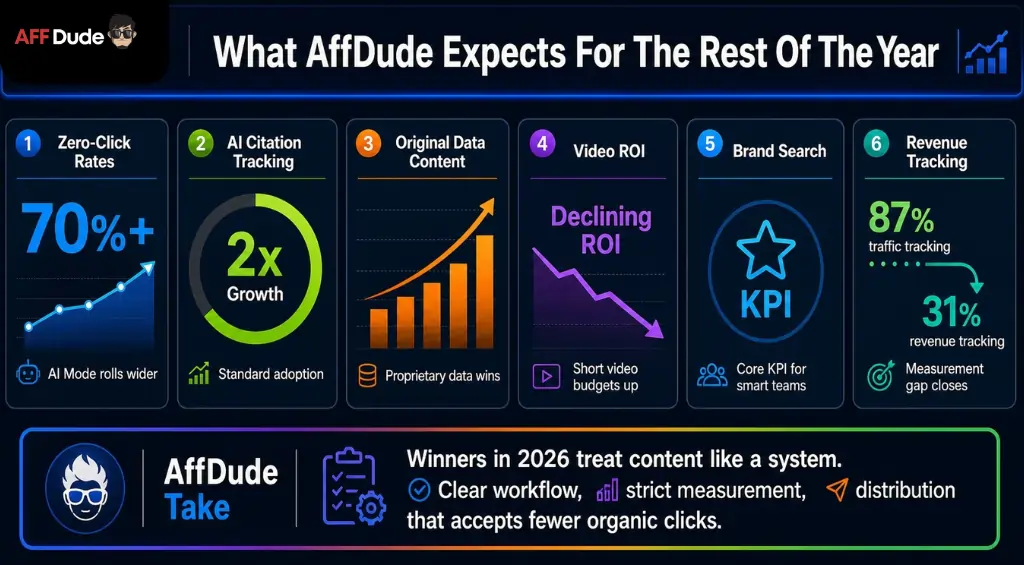
Here come our own calls. Based on years of running content across affiliate and performance niches, plus what these numbers show, this is where we think 2026 lands.
Our forecast for the year ahead:
We also expect content teams to drop the “publish everything” habit. Fewer pages, more depth. When AI can spin up a thousand thin posts in an hour, thin posts stop working. Depth, data and a real point of view win.
One last prediction. Measurement will finally catch up to output. The gap between teams tracking traffic (87%) and teams tracking revenue (31%) feels too painful to survive another year of budget reviews. Expect that revenue number to jump.
AffDude take: Winners in 2026 aren't the loudest publishers. They're the ones treating content like a system. Clear workflow, strict measurement, distribution that accepts fewer organic clicks. Build the system, and the stats above start working for you.
Content Marketing Statistics 2026 FAQ
How big is the content marketing industry in 2026?
Global content marketing revenue reaches about $107 billion in 2026. Counting the wider category of tools, agencies and paid distribution, industry estimates run past $500 billion. North America holds the largest share at around 37% to 42%.
What percentage of marketers use AI for content in 2026?
Around 87% of marketers use AI for content creation. Close to 94% plan to use AI for blog content. Among B2B teams, roughly 95% use AI-powered marketing tools. Yet only 19% track AI-specific results, which stays the big blind spot.
Is video still worth it in 2026?
Yes. About 91% of businesses use video, and 82% report a good return. Short clips lead, named the top ROI format by 49% of marketers. Landing pages with video convert far better, near 4.8% against 2.9% without.
What does zero-click search mean for content marketing?
Around 68% of Google searches now end without a click. When an AI Overview appears, that rate hits 83%. So rankings no longer guarantee traffic. Content now aims to earn AI citations and branded searches, not just clicks.
Does content marketing still generate leads?
Very much so. Content generates about three times more leads than outbound at roughly 62% lower cost. B2B teams average a 3:1 return, and top performers hit 4.33:1 or higher. SEO-led content posts some of the strongest long-term returns.
Which content format has the best ROI in 2026?
Short-form video takes the crown, named best by 49% of marketers. Long-form video follows at 29% and live video at 25%. Blogs, email and podcasts still deliver strong returns when tied to clear goals.
The Bottom Line On Content Marketing Statistics 2026
Pull it all together and the story writes itself. Content spend keeps rising. AI sits in every workflow. Video is baseline, not bonus. And the click economy quietly broke, so visibility now beats raw traffic.
These content marketing statistics 2026 reward teams who adapt fast. Build brand. Publish original data. Measure revenue, not just sessions. Do that, and the shift working against lazy publishers starts working for you instead.
Recommended Articles

Sources
- Statista – Content marketing revenue worldwide
- HubSpot – State of Marketing statistics
- Content Marketing Institute – research reports
- Wyzowl – State of Video Marketing
- Semrush – AI search and SEO research
- SparkToro – Zero-click search study 2026
- Similarweb – Zero-click marketing data
- Contently – AI Overviews and organic traffic
- Litmus – State of Email report
- Backlinko – podcast and content research
- eMarketer – video ad spend forecasts
- Kantar – creator and influencer content data
Affiliate Disclosure: This post may contain some affiliate links, which means we may receive a commission if you purchase something that we recommend at no additional cost for you (none whatsoever!)