Website Statistics 2026: Global Web Growth and Usage Data
 21 min read
1.49 billion websites exist in 2026. Only 217.6 million are actually active. The rest are parked domains, dead side projects and holding pages nobody has touched in years.
The audience side is healthier. Six billion people are online now, 63% of their sessions come off a phone, Google is clearing 101 billion visits a month, and roughly half of everything hitting your logs is a bot rather than a person.
We have run affiliate sites since 2013, so we skipped the recycled roundup route. Every figure in these Website Statistics comes from 2026 reporting, cross checked against what our own properties record daily. Where two sources disagreed, both numbers are printed. Where the read is ours, we labelled it.
One shift matters more than the rest. 70.6% of AI driven visits arrive with no referrer and get filed under Direct, so most publishers are quietly undercounting the channel that converts best.
Why We Pulled These Numbers Together
AffDude lives and dies on web traffic. Our rank data, our deal pages, our ad spy tables: all of it rides on how the open web actually behaves.
We have watched the web double, get faster, get slower, then get swarmed by bots. So a lazy stats post did not cut it for our readers.
We gathered the total number of websites, active site counts, user numbers, platform share, speed benchmarks and security data from 2026 reporting. Then we lined all of it up against what our own properties record every day.
Two rules kept us honest. Where outside measurements disagreed, we showed both instead of picking the prettiest one. Where we made a call, we labelled it as ours.
Twelve Numbers That Frame The Web In 2026
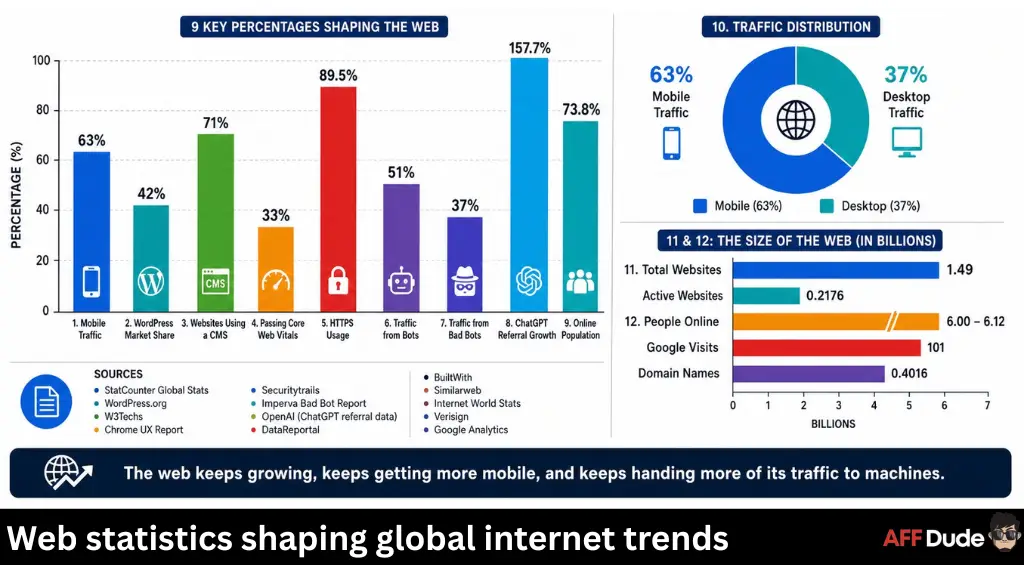
Those twelve lines explain most of what follows. The web keeps growing, keeps getting more mobile, and keeps handing more of its traffic to machines.
How Big Is The Web Market Right Now
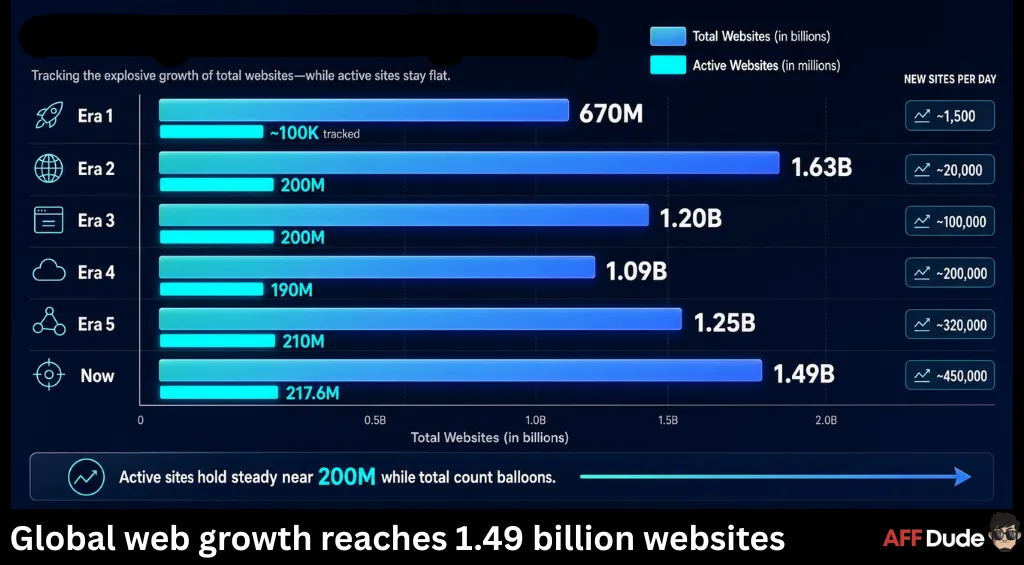
Nobody counts every site the same way, so the headline number swings hard. Netcraft and Siteefy both landed near 1.49 billion total sites by June 2026.
Only about 15% of those sit active. The rest are parked domains, dead projects, or holding pages nobody updates.
Domain growth tells a calmer story. Registered domain names reached roughly 401.6 million, and .com still dwarfs everything with over 160 million registrations.
Below is how the web scaled up, year by year, with our own read on the trend.
| Year | Total Websites | Active Websites | New Sites Per Day | What Shifted That Year |
|---|---|---|---|---|
| 2013 | Around 670 million | Not fully tracked | Under 100,000 | Mobile browsing starts overtaking early desktop habits |
| 2018 | Around 1.63 billion | Around 200 million | About 200,000 | Peak raw count before a multi year dip |
| 2021 | Around 1.20 billion | Around 200 million | About 250,000 | Total count contracts as dead domains get pruned |
| 2023 | Around 1.09 billion | Around 190 million | About 252,000 | Active share holds while parked domains fall away |
| 2025 | Around 1.25 billion | Around 210 million | About 380,000 | AI site builders push new launches sharply higher |
| 2026 | 1.49 billion | 217.6 million | About 703,000 | Fastest net growth on record, most of it inactive |
Two things jump out of that table. The total count bounces around because measurement methods change, not because the web shrinks.
But the active count barely moves. Around 200 million maintained sites have competed for attention for years now.
Dude's call: we expect the active site figure to clear 230 million during 2027, purely because AI builders let anyone ship a page in minutes. Most of those will still go stale inside a year.
Where All These Websites Actually Live
Server geography quietly shapes speed, cost and even legal risk. The United States hosts about 33% of sites whose server location is known, with Germany a distant second near 14.7%.
Infrastructure keeps consolidating too. Cloudflare alone sat in front of roughly 16.2% of every detected site in mid 2026, growing by millions of sites in a single month.
Language follows the same top heavy pattern. English covers about 49.2% of web content, so nearly half the web speaks one tongue while thousands of others share the rest.
That concentration cuts both ways for affiliates. Cheaper shared infrastructure keeps launch costs low, yet a single provider outage can knock a chunk of the web offline at once.
Who Is Actually Online In 2026
The audience side hit a milestone this year. More than 6 billion people use the internet, roughly 73.8% of everyone alive.
Growth added around 294 million users over the past year. Still, over 2.1 billion people remain offline, mostly across Southern Asia and Africa.
Access is nowhere near even. Northern Europe sits near 97.7% penetration, the United States near 93.1%, while parts of Africa hover under 50%.
The device split matters more for us than the headcount. Mobile web traffic share now runs at about 63%, up from roughly 52% five years ago.
The mobile number is the one most affiliates still underplay. If two in three visitors land on a phone, a slow desktop build costs you real money.
Ali's read: treat mobile as the default and desktop as the bonus. Our phone sessions convert lower per visit, so we chase them on volume and speed, not fancy layouts.
The Platforms Eating All The Traffic
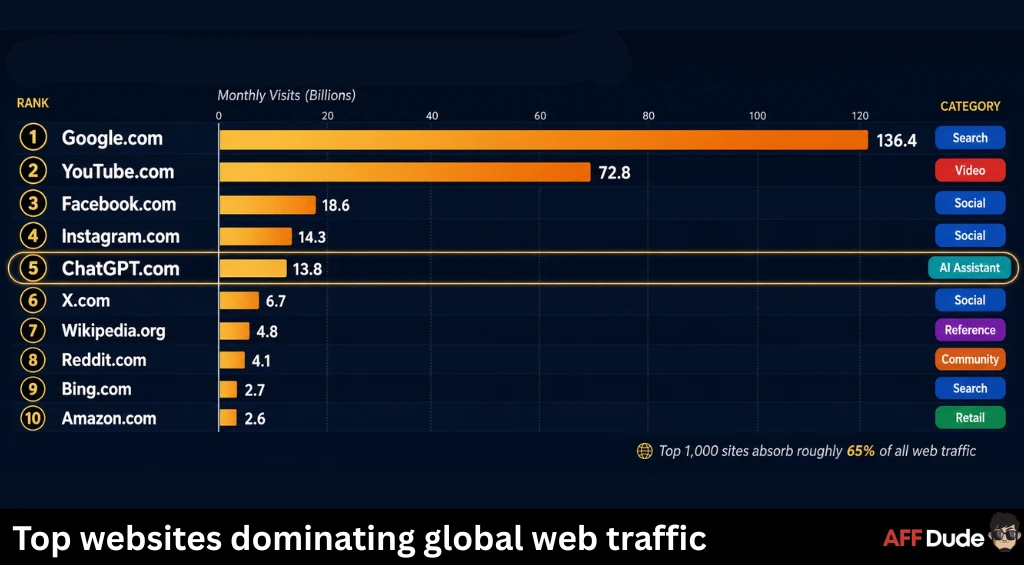
Traffic pools at the top harder than most people realise. The top 1,000 sites soak up roughly 65% of all web visits.
Google stayed untouchable in 2026, pulling past 101 billion monthly visits. It draws more traffic than the next several sites combined.
The real story sits lower down. ChatGPT muscled into the global top five, the fastest site in web history to reach that level.
Below are the most visited websites worldwide by monthly visits in 2026.
| Rank | Website | Monthly Visits | Category | Our Note |
|---|---|---|---|---|
| 1 | Google.com | About 101 billion | Search | Still the front door of the internet |
| 2 | YouTube.com | About 53 billion | Video | Skews heavily mobile, near 68% |
| 3 | Facebook.com | About 9.1 billion | Social | Big but sliding on younger users |
| 4 | Instagram.com | About 6.2 billion | Social | Where creator affiliate offers still land |
| 5 | ChatGPT.com | About 5.6 billion | AI assistant | Went launch to top five in under three years |
| 6 | X.com | About 4 billion | Social | Traffic volatile through 2026 |
| 7 | Wikipedia.org | About 4 billion | Reference | Cited constantly inside AI answers |
| 8 | Reddit.com | About 4 billion | Community | Grew strongly, feeds AI answers and training |
| 9 | Bing.com | About 1.9 billion | Search | Distant second in search, propped by AI |
| 10 | Amazon.com | About 2.5 billion | Retail | Still the affiliate revenue anchor |
Notice what climbed. ChatGPT, Reddit and Wikipedia all rose because AI answers lean on them constantly.
Notice what stalled. The classic social giants held their spots but stopped growing at the old pace.
The scale of the leaders is hard to picture. Google processes over 16 billion searches a day, which feeds better data, which brings more users, which feeds more data again.
The gap between the top and everyone else is brutal. A median website pulls only about 20,000 visits a month, while the giants trade in billions. Most sites live in that long tail, so realistic goals beat chasing headline numbers.
AffDude scoreboard: we reckon at least two AI assistant sites sit in the global top ten by late 2027. Search is not dying, but it shares the table now.
What Powers All These Sites
Under the hood, the build story shifted in 2026 without much noise. About 71% of sites run a content management system, while 29% run on custom code or none.
WordPress still leads by a mile. It powers roughly 42% of every website and holds close to 60% of the CMS market.
The twist is direction. WordPress slipped off its 2022 peak for the first sustained stretch in two decades, ceding ground to hosted builders.
Hosted platforms are winning new launches. Over half of new online stores now open on a builder rather than self hosted software.
| Platform | Share Of All Websites | CMS Market Position | Best Fit | Our Verdict |
|---|---|---|---|---|
| WordPress | About 42% | Around 60% of CMS market | Content sites, blogs, flexible builds | Still the safest long term bet for affiliates |
| Shopify | About 5.1% | Leading hosted store builder | Ecommerce and DTC brands | Fastest route to a live store |
| Wix | About 4.3% | Fastest growing major builder | Small business sites, quick launches | Fine for simple, weak for scale SEO |
| Squarespace | About 2.4% | Design led builder | Portfolios, service sites | Pretty out the box, limited control |
| Joomla and Drupal | Under 3% combined | Fading open source pair | Legacy and enterprise builds | Skip unless you inherit one |
| No CMS or custom | About 29% | Not applicable | Apps, coded builds, big brands | Where modern JavaScript stacks now pull developers |
Performance is where the platform gap bites. WordPress passes a full Core Web Vitals pass rate on only about 43% of mobile sites.
Builders like Duda and Shopify score far higher on the same tests. Speed became a real competitive edge, not a nice to have.
Ecommerce muddies the picture further. WooCommerce, the WordPress store plugin, still runs close to a third of the top million online shops, so WordPress reach stretches well past plain blogs.
Our number: across our own WordPress properties, a fast host plus aggressive caching lifted our mobile pass rate well past the platform average. Cheap hosting is the silent killer of affiliate speed.
Speed Still Decides Who Converts
Now comes the part that pays your bills. Average website load speed sits near 2.5 to 3.2 seconds on desktop and around 8.6 seconds on mobile.
That mobile figure is a problem. Google data shows 53% of phone users abandon a page that takes over three seconds.
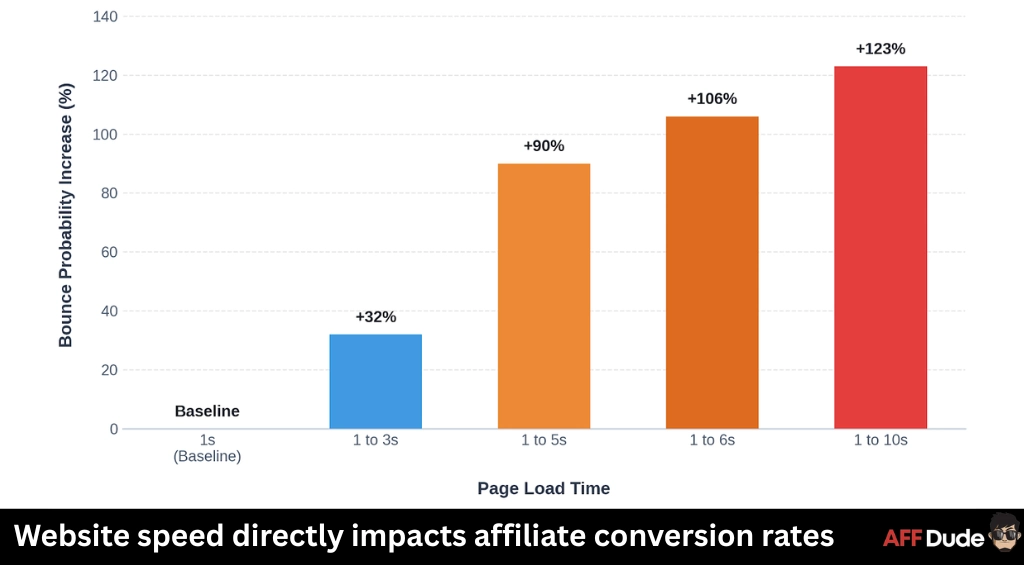
The bounce curve is brutal and well documented. Push load time from one second to ten, and bounce probability climbs by roughly 123%.
Conversion tracks the same line in reverse. Faster pages convert, slower pages leak, and the drop compounds every extra second.
| Load Time | Bounce Probability Increase | User Reaction | Conversion Impact |
|---|---|---|---|
| 1 second | Baseline, near 7% bounce | Feels instant | Best conversion band |
| 1 to 3 seconds | Up about 32% | Mild impatience creeps in | First real drop begins |
| 1 to 5 seconds | Up about 90% | Frustration builds | Significant losses start |
| 1 to 6 seconds | Up about 106% | Many give up | Conversions fall hard |
| 1 to 10 seconds | Up about 123% | Majority leave | Catastrophic abandonment |
The website conversion rate benchmarks stayed modest across the board. Ecommerce averages land between 1.4% and 3%, with B2B near 2.2% and B2C ecommerce near 2.9%.
Page weight keeps working against everyone. The average page now ships more than 2.3MB, which mobile networks punish.
Straight talk: speed is the cheapest conversion win most affiliates ignore. We audit load time before touching copy, because a fast bad page beats a slow good one every time.
The Web Got Locked Down
Security stopped being optional years ago, and 2026 made that concrete. HTTPS adoption rate reached about 89.5% of all sites, and 92% to 94% of the most visited ones.
Encrypted traffic now sits between 95% and 99% globally. Free certificates and browser warnings finished the job the industry started a decade back.
But the padlock cuts both ways. Roughly 71% of malware now travels over encrypted connections, hiding inside traffic that looks trustworthy.
The bigger shift is who visits your site at all. Automated bot traffic share reached about 51% of everything, with bad bots near 37%.
| Security Metric | 2026 Figure | Trend | What It Means For You |
|---|---|---|---|
| HTTPS by default | 89.5% of all sites | Near universal now | Run without it and browsers shame you |
| Encrypted global traffic | 95% to 99% | Effectively total | Plain HTTP is functionally dead |
| Automated bots | 51% of web traffic | Rising each year | Half your logs are not human |
| Bad bots | About 37% of traffic | Growing | Scrapers and stuffers hit you daily |
| Bot login attempts | 94% on large networks | Very high | Credential stuffing runs constantly |
| WordPress vulnerabilities 2025 | 11,334 found | Up 42% | Plugins cause 85% to 91% of them |
| Ransomware attacks 2025 | 7,419 recorded | Up 32% | Small sites get caught in wide nets |
| DDoS attacks mitigated 2025 | 47.1 million | Up 121% | Peak attack hit 31.4 terabits per second |
The WordPress numbers deserve a flag, since most affiliates run it. Plugins, not the core, drive the vast majority of those holes.
Certificate rules also tightened. Maximum SSL validity drops toward six months in 2026 and roughly 47 days by 2029, so manual renewal is over.
The Dude reckons: if you run WordPress, plugin hygiene is your real security budget. We prune unused plugins quarterly and auto update the rest, because a dead plugin is an open door.
AI Changed Where Traffic Comes From
This is the section nobody had in their 2024 stats post. AI stopped being a novelty and started moving real web traffic.
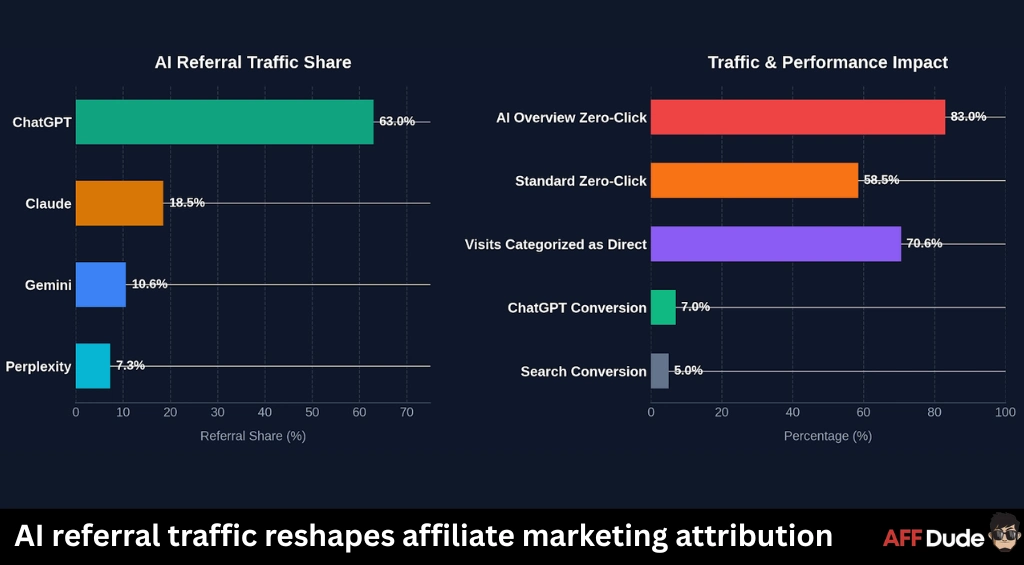
The catch is attribution. Around 70.6% of AI driven visits arrive with no referrer, so analytics files them under Direct.
That single quirk hides the real size of AI referral traffic from most dashboards. Your AI visitors are often taller than your reports admit.
Then May 2026 changed the game. One ChatGPT link update sent referrals up 157.7% in a week, with homepage visits up 354.7%.
AI referral traffic to United States retail sites grew 693% year on year over the 2025 holiday period.
Quality is the real headline. ChatGPT visitors converted near 7% against Google's 5%, spent longer, and viewed more pages.
The flip side is zero click search. Around 58.5% of United States searches now end with no click, and that jumps near 83% when an AI overview appears.
| AI Traffic Metric | 2026 Figure | Why Affiliates Should Care |
|---|---|---|
| AI visits shown as Direct | 70.6% | Your AI traffic gets badly undercounted |
| ChatGPT referral share | About 63% | Still the leader, but no longer alone |
| Claude referral share | About 18.5% | New number two, growing fastest |
| AI retail referral growth | Up 693% year on year | Holiday intent traffic is exploding |
| AI referral conversion lift | About 31% higher | Fewer visits, far better buyers |
| United States zero click rate | 58.5% of searches | Visibility now beats the click |
| ChatGPT weekly active users | About 900 million | The audience is genuinely massive |
The audience behind all this grew fast. ChatGPT reached about 900 million weekly active users in early 2026, more than double its count a year earlier.
The lesson is not that clicks vanished. The lesson is that a mention inside an AI answer now carries weight even without a visit.
Ali's read: we optimise for AI citations now, not just blue links. Our AI referred sessions convert better than cold organic, so we feed the answer engines clean tables and clear facts.
Where Website Traffic Comes From In 2026
Traffic sources still decide how a site lives or dies. Organic search remained the biggest single channel, sending roughly 53% of all website visits.
Direct visits came next, then referral, then paid and social. Social media punches below its reputation here, driving only about 4% to 5% of web traffic despite billions of daily users.
The buying journey tells a sharper story than raw sessions. Shopping starts split 44% on a search engine, 41% on a store or marketplace, and 14% on social.
The takeaway is simple. Search still feeds most sites, but AI answers and marketplaces now sit between you and the click more than ever.
Dude's call: we still build for organic search first, since it out sends every other channel combined. But we now treat AI visibility as the second pillar, not an afterthought.
The Money Layer: Ecommerce Websites In 2026
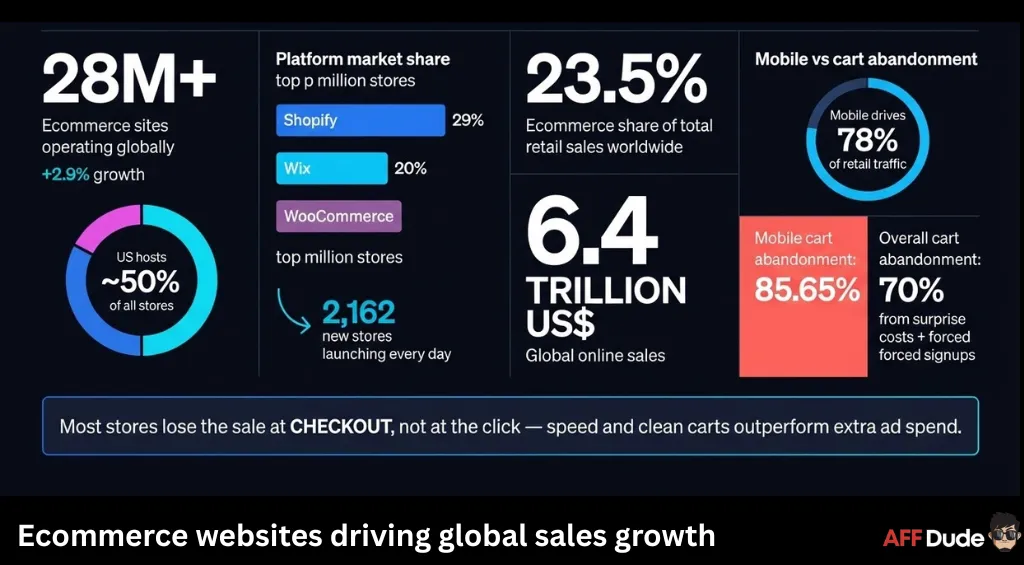
Ecommerce is where all this traffic turns into cash. Around 28 million ecommerce sites now trade worldwide, up about 2.9% on 2024.
The United States hosts roughly half of them. Shopify powers close to 29% of online stores, with Wix near 20% of the rest.
The build platforms matter because they set your ceiling on speed and checkout quality. WooCommerce still runs a big slice of the top million stores on WordPress.
That abandonment gap is the quiet killer. Most stores lose the sale at checkout, not at the click, so speed and a clean cart earn more than extra ads.
Our number: on our own deal pages, trimming checkout steps and killing forced account creation lifted completed sales more than any traffic push we ran that year.
What This Means For Affiliate Sites
Enough charts. Below is how these Website Statistics turn into actual affiliate decisions on our end.
Mobile is your primary audience, full stop. Build for the phone first, then let desktop inherit the layout.
Speed is a revenue lever, not a vanity metric. A page that loads under two seconds simply earns more per visit than a slow one.
None of this is guesswork on our side. It comes straight from running content sites through every one of these shifts since 2013.
Frequently Asked Questions
How many websites are there in 2026?
Around 1.49 billion sites exist worldwide by mid 2026, but only about 217.6 million sit active. The rest are parked domains or abandoned projects.
How many people use the internet in 2026?
Between 6.0 and 6.12 billion people are online, near 73.8% of the global population. Growth added roughly 294 million users over the past year.
What percentage of web traffic is mobile?
Mobile devices carry about 63% of all web traffic in 2026, up from roughly 52% five years ago. Desktop now sits as the minority channel.
Which is the most visited website in 2026?
Google leads with over 101 billion monthly visits, ahead of YouTube near 53 billion. ChatGPT climbed into the global top five for the first time.
What platform powers the most websites?
WordPress powers about 42% of all websites and holds close to 60% of the content management system market. Its share slipped slightly off the 2022 peak.
How fast should a website load in 2026?
Aim for under two seconds. Google data shows 53% of mobile users leave a page that takes over three seconds to load.
Is AI really sending traffic to websites?
Yes, and more than dashboards show. About 70.6% of AI visits arrive without a referrer, and AI referred visitors convert roughly 31% better than other channels.
What do these Website Statistics mean for a small site?
Build mobile first, chase load speed, keep plugins lean, and structure data for AI answers. Those four moves cover most of the 2026 shift for a lean affiliate site.
Our Forecast For 2027 And Beyond
Based on our own traffic plus everything above, below is where we think the web lands next.
We could be wrong on the WordPress call. The ecosystem is huge, and huge things move slowly, so a flat line stays just as likely as a slide.
Recommended Articles

Sources We Used
- DataReportal Digital 2026 Global Overview
- Siteefy how many websites report
- Statista most visited websites worldwide
- Statista internet penetration worldwide
- W3Techs CMS usage statistics
- Similarweb generative AI referral research
- Imperva Bad Bot Report
- Cloudflare Radar
- Patchstack State of WordPress Security
- HTTP Archive Web Almanac