Keyword Research Statistics 2026: AI, Search Intent & SEO Data
 21 min read
Keyword research in 2026 looks nothing like the volume-chasing game it used to be. Google now handles roughly 14 billion searches a day, yet close to two-thirds of them end with no click at all.
AI Overviews answer the question before anyone scrolls. So the old move, find a fat search volume and write around it, quietly stopped paying.
The operators winning now read intent first and volume second. We run affiliate and SaaS sites for a living, and these Keyword Research Statistics match what our own traffic reports keep screaming. Below is the 2026 data, plus what we think it means for your next content bet.
Why We Wrote This (And Why You Can Trust These Numbers)
We do keyword research every single day, not as a theory but as the thing that decides which posts we publish and which ones we bin.
Our free Keyword Density Checker gets used more than 6,000 times a month. Our team maps queries for SaaS and affiliate sites before a single word gets drafted. We watch what ranks, what gets cited, and what quietly dies.
So when we pulled together the numbers for this year, we did not copy one blog and reword it. We cross-checked Ahrefs, Semrush, Pew Research Center, BrightEdge, Similarweb, and Statista. Then we stripped out the noise.
You will notice sources disagree, sometimes wildly. One says 58% of searches get no click. Another says 69%. We explain those gaps instead of hiding them, so you know what each figure actually counts.
No fake stats. No rounding tricks to make a headline pop. Just what the data says, plus our own read on where all of this is heading.
How Much Do People Actually Search In 2026?
Search demand is not shrinking, and that myth needs to die quietly.
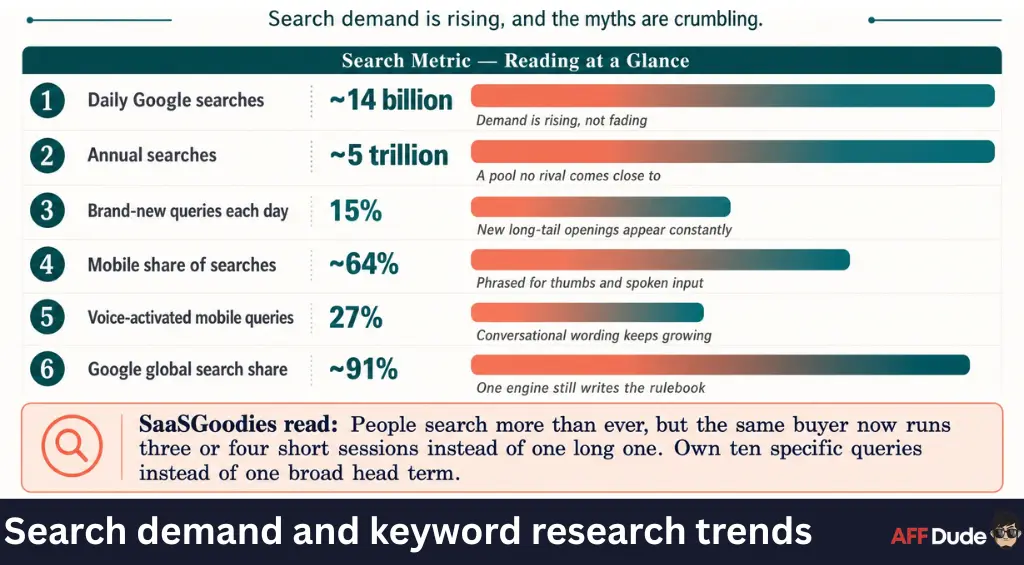
Google processes around 14 billion queries a day. Over a year, that works out near 5 trillion searches. Google confirmed the annual figure itself.
The engine still owns about 91% of the global search market. Bing, Yahoo, and the rest split the scraps.
The single most useful number for keyword research sits right here: 15% of daily searches have never been typed before. Fresh phrasing appears every day, and most of it runs long and specific.
Mobile now drives close to 64% of all search traffic. People search with their thumbs, in the moment, using messy natural language.
That messiness is a gift for anyone doing keyword research. Long, spoken-style queries are exactly the specific phrases that still convert and still dodge the AI Overview squeeze. The more casual the search, the more precise the intent behind it.
Voice keeps climbing too. Around 27% of mobile queries are now spoken, and the installed base of voice assistants has passed 8.4 billion devices worldwide.
| Search Metric | 2026 Reading | Why It Matters For Keyword Research |
|---|---|---|
| Daily Google searches | around 14 billion | Demand is rising, not fading |
| Annual searches | around 5 trillion | A pool no rival comes close to |
| Brand-new queries each day | 15% | New long-tail openings appear constantly |
| Mobile share of searches | around 64% | Phrase for thumbs and spoken input |
| Voice-activated mobile queries | 27% | Conversational wording keeps growing |
| Google global search share | around 91% | One engine still writes the rulebook |
SaaSGoodies read: People search more than ever, but the same person now runs three or four short sessions instead of one long one. That fragmentation is why single high-volume terms feel weaker each year. You capture more of a buyer by owning ten specific queries than one broad head term.
Zero-Click Searches And The AI Overview Squeeze
This is the shift that reset the whole game. Ranking is no longer the same as getting traffic.
Somewhere between 58% and 65% of Google searches now end without a single click. The rate sat near 50% back in 2019, so the climb has been steep and steady.
Google AI Overviews are the accelerator. They pull an answer to the top of the page, and the reader takes it without leaving.
The appearance rate is where sources fight hardest. Measurements range from 15% of queries to 48%, depending on who counts and how. For informational and question-style searches, the share runs far higher than the blended average.
When an AI Overview shows up, the click-through rate on the top organic result drops between 34% and 58%. Same ranking, far fewer clicks.
Pew Research Center found something even sharper. When an AI summary appears, 26% of users end the session entirely, clicking nothing at all.
| Search Behaviour Metric | 2026 Value | Plain-English Read |
|---|---|---|
| Searches ending with no click | 58% to 65% | The default outcome now |
| AI Overview appearance on queries | 15% to 48% | Higher for informational search |
| Position-1 CTR drop when AIO shows | 34% to 58% | Ranking without the click |
| Sessions ended after an AI summary | 26% | Users stop, satisfied |
| Users clicking a cited AIO source | around 1% | Citation is visibility, not traffic |
| Extra clicks for brands cited in AIO | plus 35% | The one bright spot |
| Searches with no click in AI Mode | 93% | Blue links barely exist here |
Being cited inside an Overview buys brand awareness, not clicks. Only about 1% of users tap a source link. Yet brands that do get cited still earn roughly 35% more clicks than those left out entirely.
Google AI Mode is the harsher cousin. When a search runs through that conversational interface, 93% of them end without a click, because organic listings barely appear.
The number we keep watching: Only around 38% of pages cited inside AI Overviews also rank in Google's top 10. More than 80% of AI-cited pages do not sit in the top 10 at all. Citation and ranking have split into two separate games. Your keyword research now has to aim at both.
Long-Tail Keywords: Where The Real Wins Live
If one truth defines smart keyword research in 2026, it is this. The money hides in the long tail.
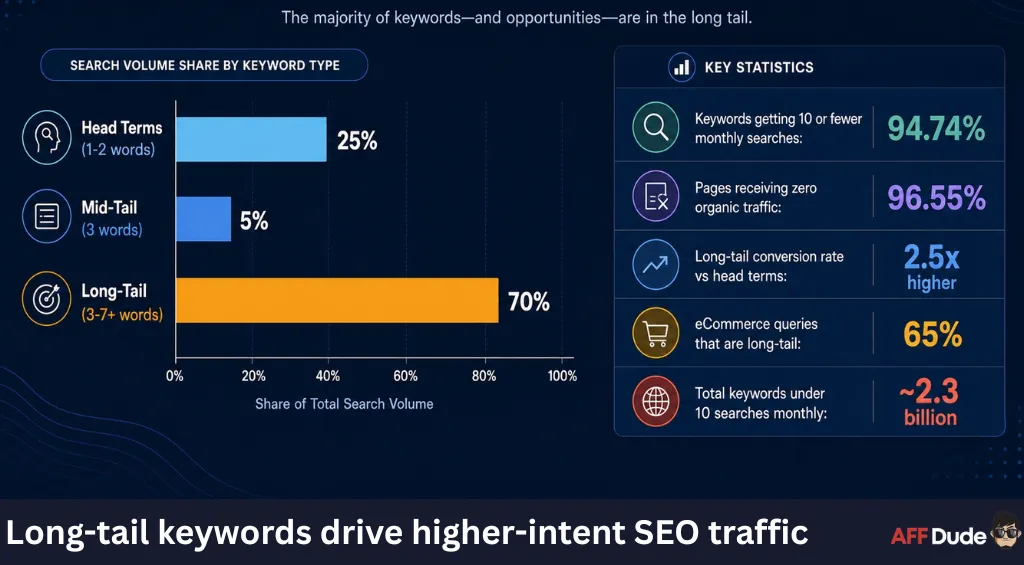
Long-tail keywords, meaning phrases of three or more words, account for roughly 70% of all search traffic. Some datasets push that figure past 80%.
The distribution runs brutal at the top and generous at the bottom. About 94.74% of all keywords get 10 or fewer monthly searches. Roughly 2.3 billion keywords sit under that 10-search line.
Head terms hog attention but not results. One and two-word keywords soak up around 65% of raw search volume, yet make up only a quarter of keyword variety.
Here is the stat that should reframe your content plan: 96.55% of pages get zero organic traffic. Most of that failure traces back to chasing terms nobody can realistically rank for.
| Keyword Bucket | Word Count | Share of Search Traffic | Buyer Signal |
|---|---|---|---|
| Head terms | 1 to 2 words | volume-heavy, low yield | Browsing, early research |
| Mid-tail | 3 words | steady middle | Comparing options |
| Long-tail | 3 to 7-plus words | around 70% combined | Ready to act |
Specificity is the whole point. Someone typing “best SaaS affiliate program for beginners” already knows what they want, while someone typing “software” clearly does not.
That intent gap shows up in conversions. Long-tail terms convert at roughly 2.5 times the rate of head terms. In eCommerce, about 65% of queries are already long-tail.
Picture a real cluster from our own sites. One broad term like “email marketing tools” brings huge volume and even bigger competition. Ten phrases like “email marketing tools for Shopify stores” each bring a trickle instead.
Stack those ten together and they beat the broad term on both traffic and revenue, because every visitor already knows what they want. That is the long-tail keyword strategy in one picture.
| Long-Tail Data Point | 2026 Figure |
|---|---|
| Keywords with 10 or fewer monthly searches | 94.74% |
| Total keywords under 10 searches a month | around 2.3 billion |
| Pages getting zero organic traffic | 96.55% |
| Long-tail conversion vs head terms | 2.5x higher |
| eCommerce queries that are long-tail | 65% |
| Share of all traffic from long-tail | around 70% |
Our estimate: Across the SaaS review sites we run, long-tail pages pull three to four times the revenue per visitor of broad head-term pages, even though the head pages get more raw clicks.
AI Overviews mostly eat the broad informational terms and leave commercial long-tail queries alone. That makes the tail safer, not just cheaper. We expect the gap to widen through 2027.
Search Intent Beats Search Volume Now
Volume used to be king, and in 2026 intent wears the crown instead.
Google's ranking has become good enough to read the reason behind a query. Content that mismatches intent will not rank, no matter how clean the writing looks. This is why search intent matching now beats raw volume as a targeting filter.
Four buckets of intent exist: informational, navigational, commercial, and transactional. Getting the bucket right matters more than the search number attached to it.
A 500-search transactional phrase can out-earn a 50,000-search informational one. Volume without intent matching is just wasted targeting.
Local intent is a giant, quiet slice. Around 46% of all Google searches carry local intent, and some 2026 readings put it above 50% for the first time. “Near me” and “open now” style searches grew about 38% year on year.
Those local searches convert offline hard. Roughly 78% of local mobile searches lead to an offline purchase.
Where we land on intent: Sort every keyword by intent before you ever look at the volume column. We tag each target as answer, compare, or buy. The compare and buy tags get priority, because those clicks survive the AI Overview era and pay the bills. Volume becomes a tiebreaker, not a starting point.
Click-Through Rates By Position: The Curve Bent
Ranking number one still helps, it just helps a lot less than the old charts once promised.
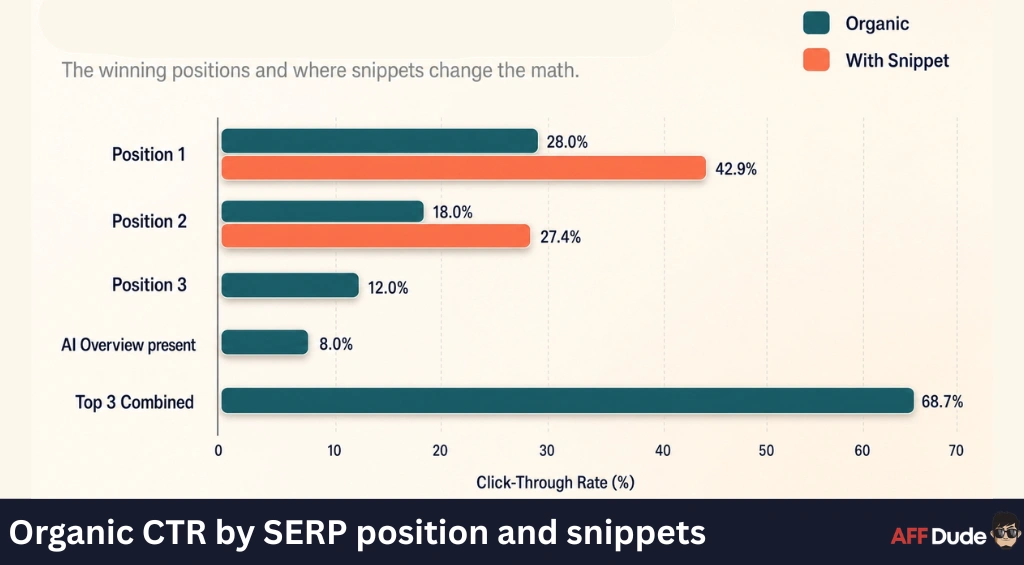
A clean position-one organic result now pulls about 28% of clicks. Back in 2022 the same slot pulled 31.7%. The drop traces straight to AI Overviews and other page features.
The top three organic results together still take around 68.7% of all clicks. Landing on the first screen remains the whole ball game.
Featured snippets flip the maths in your favour. A snippet in first position pulls a 42.9% click-through rate, higher than a plain number-one result.
But snippets are getting rarer. As AI Overviews spread across 2025, featured snippet visibility fell sharply, with one large study recording a 64% drop over six months.
| SERP Position | Clean Organic CTR | With Featured Snippet |
|---|---|---|
| Position 1 | around 28% | 42.9% |
| Position 2 | around 18% | 27.4% |
| Position 3 | around 12% | data thin |
| Top 3 combined | 68.7% | not applicable |
| Any AI Overview present | click rate near 8% | not applicable |
Nearly all snippets come from pages already ranking well. About 99.58% of featured snippets sit inside the top 10 organic results. You cannot skip the ranking work and grab the box.
Question keywords open the snippet door. Around 8% of searches are phrased as questions, and those trigger snippets and Overviews far more often.
Our call on snippets: Winning the snippet now beats winning plain position one, because the snippet often survives even when an AI Overview crowds the page. Format a tight 40 to 60 word answer right under each question heading. We treat that as a keyword research output, not an afterthought. Question phrasing feeds both snippets and AI citations.
AI Search Is A Brand New Keyword Surface
Keyword research used to mean Google only. Now it means Google plus the answer engines.
AI search tools like ChatGPT, Perplexity, and Gemini now handle an estimated 12% to 18% of English informational queries. A year earlier that share sat under 2%.
ChatGPT alone reports around 800 million weekly users and close to 2 billion queries a day. Perplexity processes roughly 780 million queries a month.
Traffic from these engines stays small but mighty. Google still sends about 87.63% of all search referrals, while ChatGPT, Gemini, Claude, and Perplexity together account for well under 1%.
The volume gap hides a quality gap. Visitors arriving from AI answers convert far better than plain organic clicks.
| Traffic Source | Conversion Rate | Read On Intent |
|---|---|---|
| Traditional organic search | around 1.76% | The baseline |
| ChatGPT referral | around 15.9% | Highest intent of the lot |
| Perplexity referral | around 10.5% | Citation-forward, transparent |
| Claude referral | around 5% | Smaller pool, strong buyers |
| Blended AI search | around 14.2% | Roughly four times organic |
A ChatGPT visitor converts about 31% higher than a non-branded organic one. People arrive having already read a summary, so they show up decision-ready.
This is why “prompt volume” is becoming a keyword metric. Semrush tracks topic demand across AI engines using a database of more than 261 million prompts and responses. Ahrefs launched Brand Radar to watch brand mentions across six AI indexes.
The engines do not agree with each other, which is the tricky part. Only around 11% of domains get cited by both ChatGPT and Perplexity. Ranking on one says nothing about the other.
Here is the practical read for your research. You now track two demand signals, not one. Keyword volume tells you what people type into Google, while prompt volume tells you what they ask an answer engine. The topics overlap heavily, but the phrasing splits apart.
Google queries stay terse and keyword-shaped, while AI prompts run long and full of context. This split is why generative engine optimisation has moved onto the same worksheet as classic keyword planning.
SaaSGoodies projection: We think prompt-level research becomes standard practice for serious teams by late 2026. About 92% of marketers say they plan to optimise for AI search, yet only around 40% do it today. That gap is a first-mover opening.
Get your named stats, direct answers, and clear entities in place now, before rivals treat AI citations as a keyword target too.
Keyword Research Tools And What They Cost In 2026
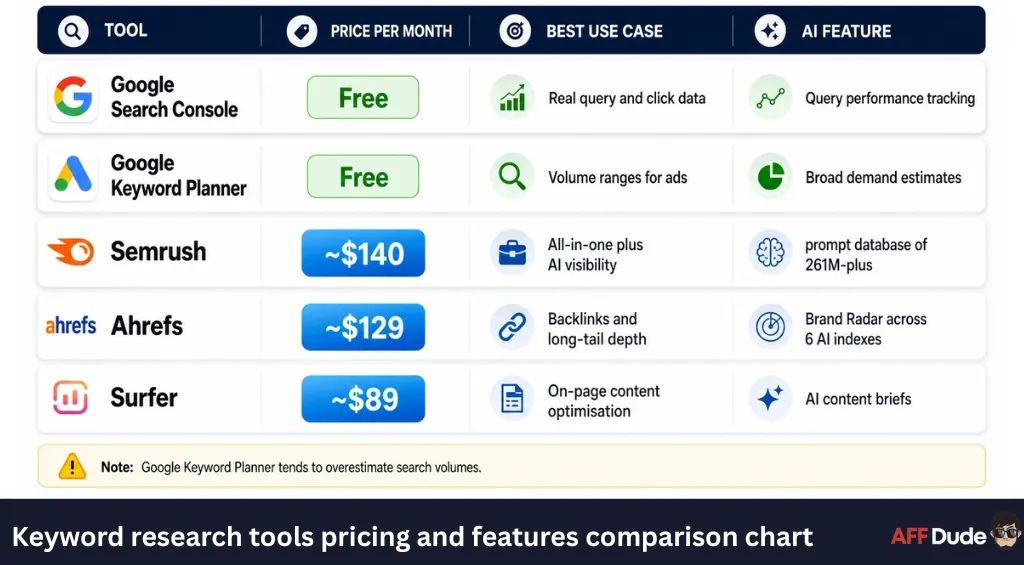
The tools people use for keyword research sit inside a fast-growing SEO software market.
Estimates put that market near 86 billion dollars in 2025, climbing toward roughly 97 billion in 2026. Forecasts stretch it past 270 billion by the mid-2030s, at a compound growth rate around 13.6%.
Semrush pulled in about 377 million dollars in annual revenue for 2024, with recurring revenue growing near 20% year on year. Ahrefs, Moz, and BrightEdge round out the heavy hitters.
Pricing crept up as AI features got baked in. Ahrefs starts near 129 dollars a month, Semrush near 140, and Surfer near 89.
A free layer still deserves respect too. Google Search Console gives real click and impression data straight from Google, and it costs nothing.
| Keyword Research Tool | Entry Price / Month | Best Used For | 2026 AI Feature |
|---|---|---|---|
| Google Search Console | Free | Real query and click data | Query performance tracking |
| Google Keyword Planner | Free | Volume ranges for ads | Broad demand estimates |
| Semrush | around $140 | All-in-one plus AI visibility | 261M-plus prompt database |
| Ahrefs | around $129 | Backlinks and long-tail depth | Brand Radar across 6 AI indexes |
| Surfer | around $89 | On-page content optimisation | AI content briefs |
One warning worth printing on a mug. Google Keyword Planner overestimates search volumes about 54.28% of the time. Treat any tool number as a direction, not a promise.
Cross-check tool volume against Search Console, where you can see the real clicks a keyword already brings. The gap between the two often runs eye-watering.
Our read on tools: No single tool wins in 2026. We pair Ahrefs or Semrush for finding candidate terms with free Search Console data for reality checks, then add an AI visibility tracker for prompt research. Around 64% of marketers now invest in SEO tooling, and AI features are why renewal rates keep holding. Expect every major tool to fold prompt volume in beside keyword volume within the next year.
The Money Question: Does Keyword Research Still Pay?
Short answer: more than ever, if you aim it right.
B2B companies running proper keyword-led SEO report returns between 702% and 1,389% from organic search. Those are strategy numbers, not lottery tickets.
Generative engine work shows early promise too. GEO efforts return around 3.71 dollars for every dollar spent in reported cases.
Princeton research on AI citations found that adding named statistics to a page lifted its visibility inside AI answers by roughly 41%. Quotations and citations added similar gains.
That single finding shapes how we write every stats post now. Numbers, named entities, and direct answers are the raw material AI engines pull from. This article follows that same rulebook on purpose.
There is a catch worth naming plainly. These returns land only when intent and content match. Pour the same budget into high-volume head terms and the numbers invert fast, because you pay to compete and still lose the click to an AI answer. The ROI lives in the match, not the volume. Aim badly and even great writing bleeds money.
Our estimate on ROI: For the affiliate and SaaS niches we operate in, the strongest returns land on commercial long-tail clusters, not single big terms. One well-targeted “best X for Y” page can out-earn a broad guide ten times its size. We expect that pattern to sharpen as AI Overviews keep eating the broad top-of-funnel clicks.
How We Run Keyword Research For Our Own Sites
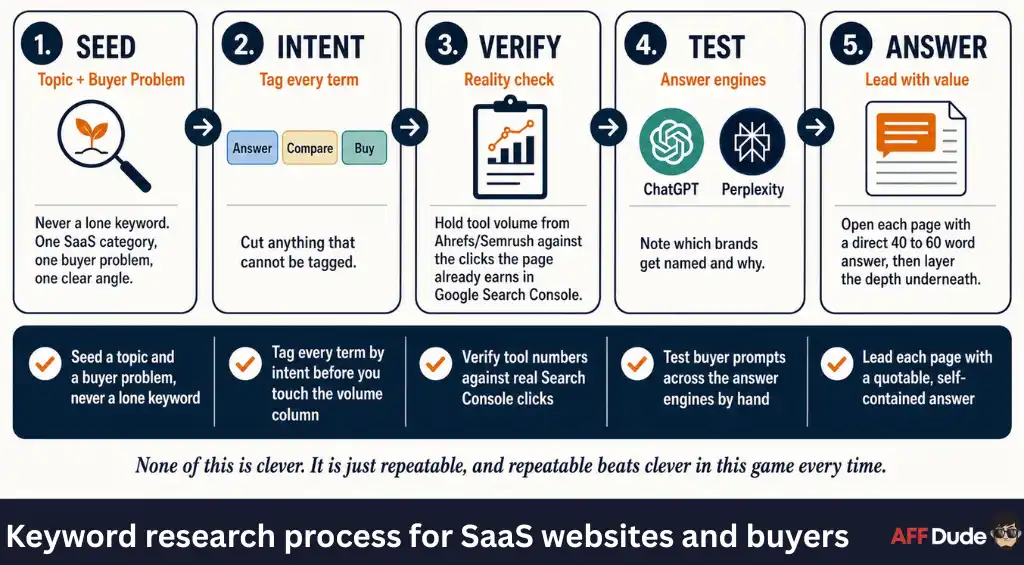
People ask what our actual process looks like, so here it is, stripped of jargon.
We start with a seed topic, never a lone seed keyword. One SaaS category, one buyer problem, one clear angle. That habit keeps the research pointed at a real reader instead of a spreadsheet cell.
Next we pull a wide list from Ahrefs or Semrush, then drop every term straight into intent buckets. Answer, compare, or buy. Anything that cannot be tagged gets cut on the spot.
Then comes the reality check. We open Google Search Console and hold tool volume against the clicks a page already earns. That one step saves us from chasing phantom numbers roughly half the time.
After that we run the top buyer prompts through ChatGPT and Perplexity ourselves. We note which brands get named and why. Those prompts then become targets, sitting right beside the keywords.
Finally we build each page around a direct 40 to 60 word answer, then layer the depth underneath. One structure serves snippets, Overviews, and human readers all at once.
None of this is clever. It is just repeatable, and repeatable beats clever in this game every time.
Why The Numbers Disagree (And How To Read Them)
Half of understanding these Keyword Research Statistics is knowing why two trusted sources print different figures.
Take zero-click rates as one example. One study counts only Google.com sessions. Another folds in image and news searches. Same topic, different denominators, different headline.
AI Overview appearance runs messier still. One tracker watches nine industries. Another watches a keyword sample skewed toward informational terms. So 15% and 48% can both be honest.
Daily search volume swings from 8.5 billion to over 16 billion across sources. We land near 14 billion because the most recent readings and Google's own 5-trillion-a-year figure point there.
When numbers clash, we do three things. We name the range instead of faking precision. We favour the most recent data. And we state a reasoned position rather than pretending one number is gospel.
How we handle conflicts: Never quote a single scary stat without its range. A 93% zero-click figure from AI Mode is true, but does not describe normal Google search. Match every number to the surface it measures, then plan against the range, not the outlier.
FAQs About Keyword Research Data
What percentage of searches are long-tail keywords in 2026?
Long-tail keywords make up roughly 70% of all search traffic, with some datasets putting the figure above 80%. About 94.74% of all keywords get 10 or fewer monthly searches, which is where most realistic ranking chances live.
How many searches get zero clicks?
Between 58% and 65% of Google searches now end without a click, depending on the study and what it counts. Inside Google AI Mode, that figure jumps to about 93%.
Do AI Overviews really cut traffic?
Yes, on informational queries especially. When an AI Overview appears, the top result loses between 34% and 58% of its clicks, and 26% of users end the session without clicking anything.
Is keyword volume from tools accurate?
Not fully. Google Keyword Planner overestimates volumes about 54.28% of the time, so treat tool figures as directional. Google Search Console gives the real click data for terms you already rank for.
Does keyword research still matter with AI search?
More than ever. AI engines pull answers from content built on clear intent, named data, and direct phrasing, so keyword and prompt research now feed both Google rankings and AI citations.
Which converts better, AI search or organic clicks?
AI search visitors convert far higher, around 14% blended versus 1.76% for traditional organic. They arrive having already read a summary, so intent runs strong even though the volume stays small.
What We Think Happens Next: The 2026 To 2027 Read
Time to put our own numbers on the table. These are our calls, built on the data above and our own site reporting.
The short version. Keyword research did not die in 2026. It grew up.
The lazy version, chase a big number and write a thin post, is finished. The version that works reads intent, targets the long tail, builds for both Google and the answer engines, and backs every claim with real data.
That is how we run our own sites, and the numbers keep proving it right. Match the query, earn the citation, and treat the tail like the main event. The rest sorts itself out.
Recommended Articles

Sources
- Ahrefs, Long-Tail Keywords Study
- Semrush, Zero-Click & AI Search Research
- BrightEdge, AI Overviews Research
- Pew Research Center, Google AI Summaries Study
- Similarweb, Search Behaviour Data
- First Page Sage, CTR by Ranking Position 2026
- Fortune Business Insights, SEO Software Market
- StatCounter, Search Engine Market Share
- DataReportal, Digital & Voice Usage
- Statista, Search & Keyword Market Data
- Backlinko, Search & SEO Statistics