Affiliate Marketing Statistics 2026: $19.4B Market and Climbing
 18 min read
Affiliate marketing in 2026 is bigger, richer, and a lot more crowded than it was even a year ago. Global spend hit roughly $19.4 billion. US spending crossed $13.8 billion.
Affiliate now ranks as the third-biggest performance channel, sitting right behind paid search and paid social. Around 90% of ecommerce brands run a program. Creators are eating a fat slice of the pie. And AI chatbots? They've started quietly rewriting how shoppers find products.
We pulled the freshest Affiliate Marketing Statistics into one place, added our own read on the numbers, and cut the fluff. Here's what counts this year.
AffDude take: We've run and audited affiliate programs for years. The headline we'd underline in 2026? The channel got serious. Cheap tricks die faster now. Quality partners and clean tracking win.
Affiliate Marketing Statistics 2026 at a Glance
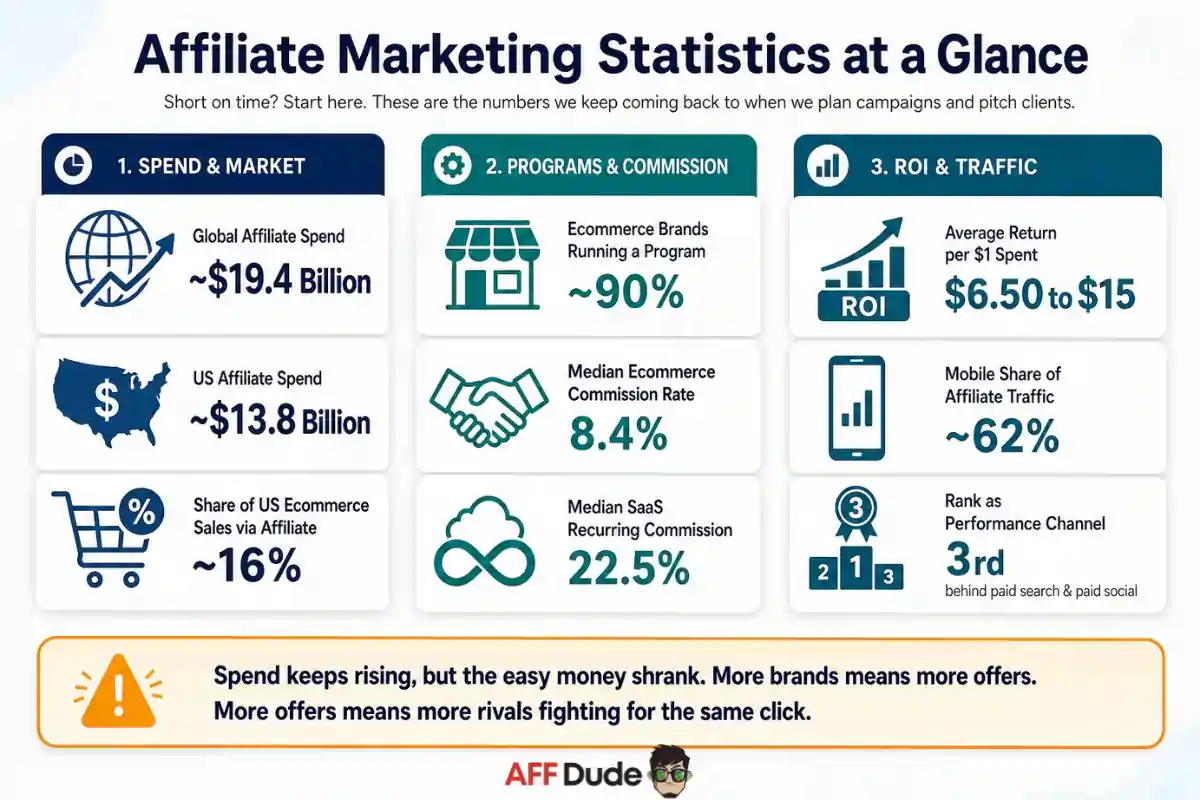
Short on time? Start here. These are the numbers we keep coming back to when we plan campaigns and pitch clients.
| Metric | 2026 Figure |
|---|---|
| Global affiliate spend | ~$19.4 billion |
| US affiliate spend | ~$13.8 billion |
| Share of US ecommerce sales driven by affiliate | ~16% |
| Ecommerce brands running a program | ~90% |
| Average return per $1 spent | $6.50 to $15 |
| Median ecommerce commission rate | 8.4% |
| Median SaaS recurring commission | 22.5% |
| Mobile share of affiliate traffic | ~62% |
| Affiliate's rank as a performance channel | 3rd (behind paid search, paid social) |
One thing jumps out. Spend keeps rising, but the easy money shrank. More brands means more offers. More offers means more rivals fighting for the same click.
How Big the Money Got in 2026
Global affiliate spend landed near $19.4 billion this year. That's up from about $17.1 billion in 2025. On current pace, the channel touches $22 billion by 2027.
You'll see wildly different market-size numbers floating around. Some say $17 billion. Some say $24 billion. Others quote $31.7 billion by 2031. Why the gap? They measure different things. One counts channel spend. Another counts the software and platform layer that powers partner programs. The platform market alone sat near $23.8 billion in 2026.
So which number do we trust for the channel itself? Around $19.4 billion. We think real spend edges slightly higher once closed programs like Amazon and Walmart get folded in, because those sit outside open-network reporting.
AffDude take: Ignore the scary $70 billion “by 2034” headlines. Fun for LinkedIn. Useless for planning. Look at spend this year and next. That's your real ceiling.
US spend crossed $13.8 billion in 2026, up almost 12% year on year. North America still leads global spend by a mile. But growth outside the West runs hotter, which brings us to region.
Zoom out and the pattern is clear. Affiliate posted double-digit growth for years running. Ecommerce expansion powers most of it. Brands love that they pay only for results, so budgets keep flowing toward performance-based channels when other ad costs climb.
Where the Spend Actually Lands by Region
Money clusters. North America takes the biggest bite. Europe holds a strong second. Asia-Pacific stays small but grows fastest, powered by mobile-first shoppers in India and China.
The UK punches above its weight. Affiliate spend there rose sharply, and over half of British brands planned to grow their affiliate budgets this year.
We reckon APAC's share creeps past 20% before 2028. Cheap smartphones, big populations, and rising ecommerce make that near certain from where we sit.
What Brands Are Really Paying Affiliates
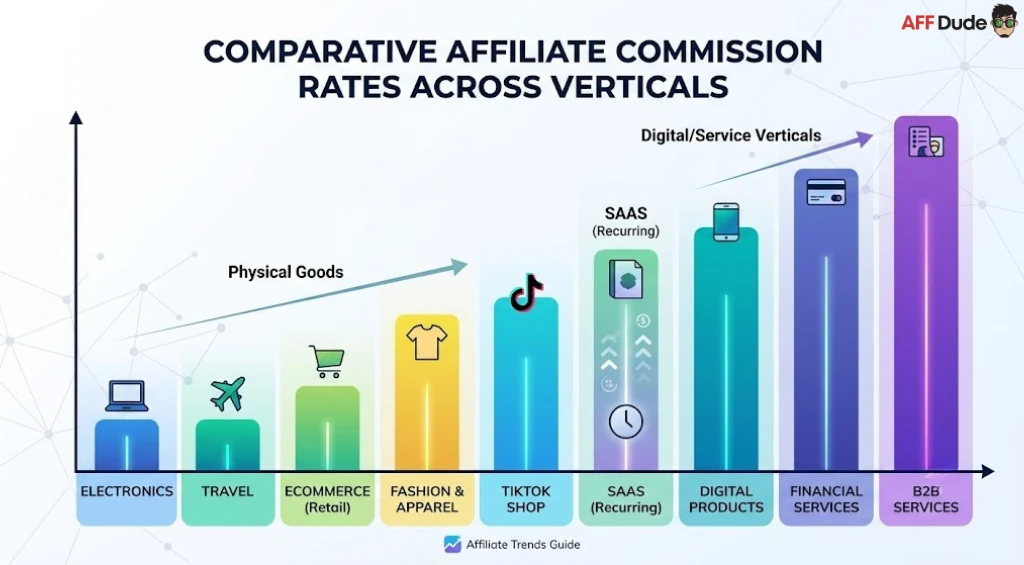
Commission rates split hard by vertical. Physical goods pay thin. Software and finance pay fat. Here's the 2026 picture, pulled from network-level data across the biggest platforms.
| Vertical | Typical Commission (2026) |
|---|---|
| SaaS (recurring) | 20% to 30% first year; 22.5% median |
| Digital products / info products | 50% to 75% |
| Financial services (lead-gen) | $52 average flat bounty |
| B2B services | $187 per qualified lead |
| Fashion & apparel | 8% to 15% |
| Ecommerce (broad retail) | 8.4% median |
| Electronics | 2% to 8% |
| Travel | ~4.2% |
| TikTok Shop products | 5% to 20% |
Notice the pattern. High-margin, high-trust products pay best. Commodity products with slim margins pay peanuts.
The biggest shift this year sits inside SaaS. Around 71% of SaaS programs now pay recurring commission structures. That matters more than the headline percentage.
Why? A recurring program earns 3.4 times more partner-driven revenue over 36 months than a one-time bounty at the same acquisition cost. One good referral pays you monthly for years. We've watched a single SaaS referral quietly out-earn a hundred one-off retail sales.
AffDude Recommendation: If you're picking programs in 2026, chase recurring over one-time. The percentage looks smaller. The lifetime cheque looks huge. Boring compounding beats flashy one-offs every single time.
Who's Really Making Money in Affiliate
Time for a reality check. The income gap in this game is brutal. Most affiliates earn little. A tiny group earns almost everything.
| Earnings Tier (Annual) | Share of Affiliates |
|---|---|
| Under $10,000 | ~57% |
| $10,000 to $100,000 | ~31% |
| $100,000 or more | ~11.7% |
| Over $1 million | ~1% |
Roughly 10% of affiliates pull in close to 90% of the revenue. That's not a bug. That's how skewed reward channels work.
Most beginners earn nothing for the first several months. Traffic takes time to build. No traffic, no commissions. The median for anyone active a year or more sits somewhere between $20,000 and $80,000.
Here's the honest bit nobody likes. Around 95% of affiliates quit before they hit real money. Not because affiliate marketing broke. Because building an audience is slow, unglamorous graft.
AffDude Insight: The 5% who stick around share three habits. They pick a real niche. They build an email list. They treat it like a business, not a side hobby. Do those three and you beat most of the field.
Highest-Earning Affiliate Niches This Year
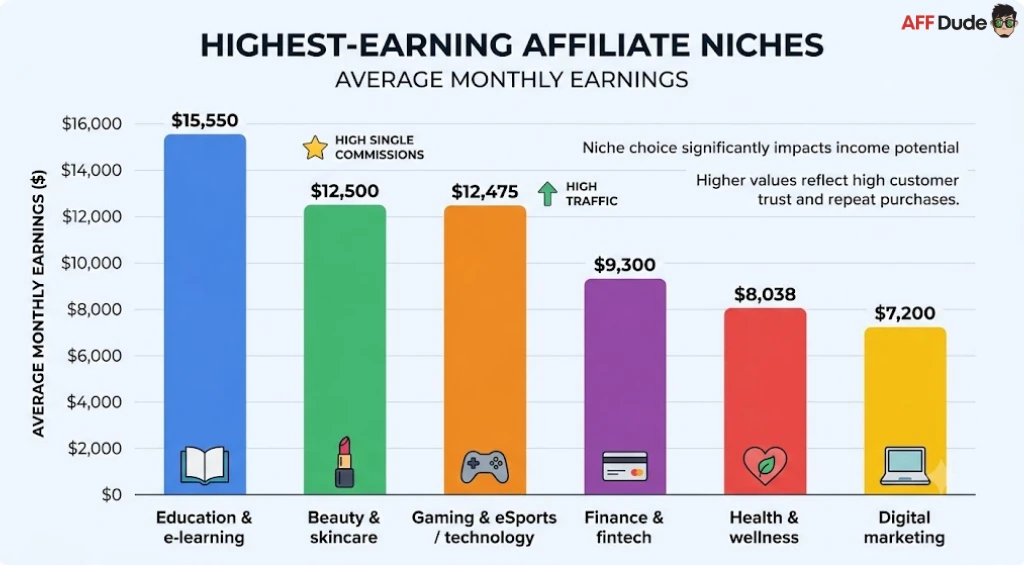
Niche choice sets your ceiling before you write a single word. The gap between the top niche and an average one runs about six-fold. Pick wrong and you cap your income on day one.
| Niche | Average Monthly Earnings (2026) |
|---|---|
| Education & e-learning | ~$15,551 |
| Beauty & skincare | ~$12,500 |
| Gaming & eSports / technology | ~$12,475 |
| Finance & fintech | ~$9,300 |
| Health & wellness | ~$8,038 |
| Digital marketing | ~$7,200 |
Why do these pay so well? High customer value. Repeat purchases. And buyers who need real trust before they commit.
Beauty and skincare also produce the fattest single commissions, averaging around $1,743 at the top end. Technology pulls the heaviest traffic, near 110,000 monthly visitors per affiliate on average.
Our call for 2026? AI tools and SaaS quietly became the sharpest niche going. Recurring pay, endless new products, and a buyer base that renews monthly. We'd bet on that vertical hard over the next two years.
The Creator Takeover Nobody Can Ignore
Creators stopped being a “nice extra”. They became the growth engine. Brands now shift budget toward people who can drive awareness and conversions inside one video.
The numbers back it up. Creator affiliate revenue grew about 71% year on year, the fastest of any creator income stream. Affiliate now makes up roughly 11% of total influencer earnings, and that share keeps rising.
Here's the stat that reframes everything. A creator with 10,000 to 100,000 followers drives about $0.42 in affiliate revenue per follower each month. A traditional display affiliate drives just $0.11. That's a 3.7-fold gap for the same audience size.
Repetition compounds. One-off shout-outs waste money. The creators who win build a relationship with an audience over months.
TikTok Shop deserves its own line. US sales through it reached about $23.4 billion in 2026, up nearly half year on year. Video content now drives around 55% of all affiliate traffic. The global influencer market sits near $34 billion.
Editors take: If you're a brand still paying flat fees to creators in 2026, stop. Move to performance deals tied to sales. If you're a creator, pick 3 brands you actually rate and go deep. Eight touches beat eighty one-offs.
What Shoppers Think About Affiliate Links
Trust drives every commission. So how do buyers actually feel about affiliate recommendations in 2026? Better than you'd guess, as long as you stay honest with them.
Around 65% of consumers say they're more likely to buy a product recommended by a creator or blogger they follow. Nearly 38% trust an influencer's affiliate link more than a link from a non-influencer. That's the payoff for building a real audience.
Disclosure helps rather than hurts. About 71% of Gen Z followers say they appreciate clear sponsorship and affiliate labels. Roughly two-thirds of consumers check disclosures before they buy. Hiding the fact you earn a commission backfires now.
What do we read into that? Openness sells. The old “hide the link” playbook is dead. A clear disclosure plus a genuine opinion converts better than a sneaky pitch. We've tested both ways. Honesty wins, every time.
How AI Answer Engines Rewrote the Rules
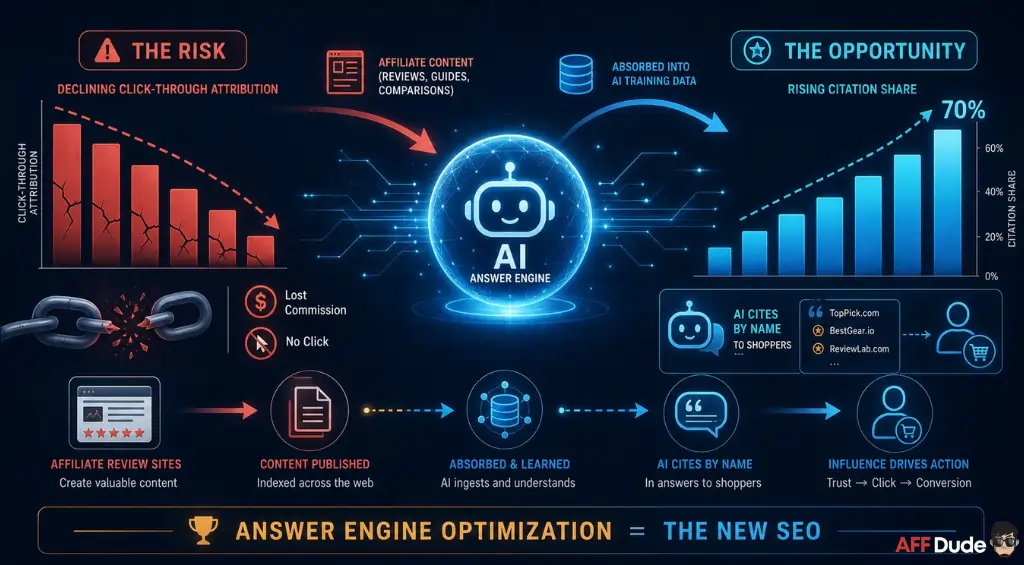
This is the plot twist of 2026. Generative AI chatbots now sit between shoppers and products. People ask ChatGPT what to buy. And that changes the affiliate game at its roots.
Two things happen at once, and they pull in opposite directions.
First, the risk. When a chatbot answers a “which product is best” question, the shopper never clicks a tracked link. No click, no commission. The attribution chain snaps. Shopping-related queries on ChatGPT grew faster than any other query type over the past year.
Second, the opportunity. Those chatbots learn from somewhere. And a lot of that “somewhere” is affiliate content. Almost 70% of the sites ChatGPT cited when discussing one eyewear brand came from affiliate marketing content. Review sites and shopping guides became trusted training fuel.
So affiliate content still shapes what shoppers buy. It just does it one layer removed, inside the AI answer. We think the winners here write content so good that AI answer engines quote it by name. Get cited, stay relevant.
Affiliate Networks That Run the Show
Most affiliate money flows through a handful of big platforms. Knowing who owns what saves you time when you pick a home for your program.
| Network | 2026 Scale & Notes |
|---|---|
| Amazon Associates | ~46% of network market share; unmatched product reach, lower payouts |
| Awin (inc. ShareASale) | 270,000+ publishers; $16B advertiser revenue; strong in Europe |
| ClickBank | $7.3B lifetime payouts; 100,000+ affiliates; digital products |
| Impact.com | Fastest-growing at ~42% YoY; enterprise and SaaS focus |
| CJ Affiliate | Second-largest by sites; 167% growth in cross-device conversions |
| PartnerStack | Leading SaaS and B2B partner network |
Amazon still owns nearly half the network share. One company. Half the market. Its commissions run lower than open-network rates, but the trust and product range keep it a safe first stop.
Content creators became the fastest-growing publisher type. On Awin their revenue share jumped from 15.9% to 19.5% in a single year. About 72% of advertisers now run two or more networks at once to spread their reach.
Our advice? Most affiliates end up using several networks anyway. Start on Amazon to learn the ropes. Add a vertical-specific network like PartnerStack or Impact once you know your niche.
Cookies Died and Tracking Changed Forever
The 30-day cookie is basically gone. Browsers block third-party cookies by default. Around two-thirds of users switch off cookies on new sites. So the whole tracking model had to change.
Shorter windows favour affiliates who influence buyers close to the moment of purchase. Think loyalty, cashback, and email partners. Content affiliates who plant a seed early can lose credit when the window's tiny.
Fraud stays the ugly cousin nobody wants to mention. Estimates put 5% to 15% of affiliate spend at risk, and around 17% of affiliate traffic shows some fraud signal. Cookie stuffing, fake leads, and bot click farms lead the pack.
The good news? AI fraud screening actually works now. Network-level detection cut invalid traffic from 11.2% of clicks in 2024 to 7.7% in 2026. That's real progress in two years.
AffDude Recommendation: Ask any network you join one question first. How do you track when cookies are blocked? If they mumble, walk away. Server-side and first-party tracking are non-negotiable in 2026.
Traffic Sources That Actually Convert
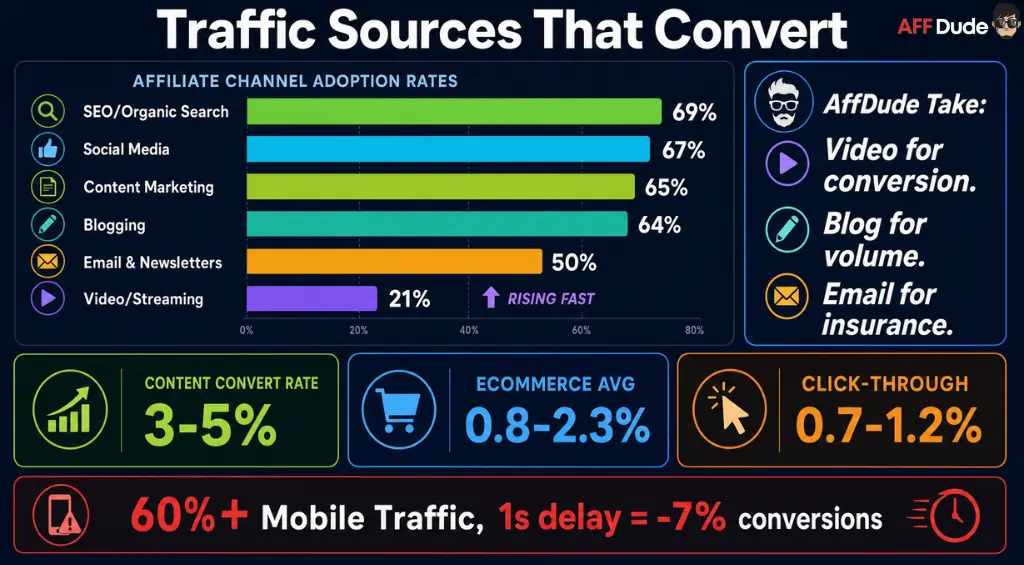
Where does affiliate traffic come from? And more importantly, what turns into sales? Here's the channel mix affiliates rely on this year.
| Channel | Affiliate Adoption (2026) |
|---|---|
| SEO / organic search | ~69% |
| Social media | ~67% |
| Content marketing | ~65% |
| Blogging | ~64% |
| Email & newsletters | ~50% |
| Video / streaming | ~21% and rising fast |
Organic search still drives over half of all affiliate traffic. Nearly 80% of affiliates rely on SEO in some form. Blogs remain the most sustainable long-term source because search intent is buyer intent.
Now the conversion side. Content affiliates convert at about 3% to 5%. Broad ecommerce sits lower, near 0.8% to 2.3%. Click-through on affiliate links runs a modest 0.7% to 1.2%.
Mobile matters more than most people plan for. Over 60% of affiliate traffic now comes from phones. A one-second delay on mobile can cut conversions by 7%. Slow pages bleed money.
Email quietly stays the secret weapon. Affiliates who use email earn markedly more than those who skip it. An owned list can't be throttled by an algorithm update overnight.
AffDude take: Video for conversion. Blog for volume. Email for insurance. Run all three and you stop being one Google update away from disaster. We've seen too many single-channel affiliates wiped out overnight.
Compliance Got Teeth in 2026
Rules stopped being optional. Regulators now hand out real penalties, and networks bake compliance into their terms. Ignore this and you risk your whole income.
The FTC can fine undisclosed endorsements anywhere from $5,000 to over $100,000 per violation. Some influencers copped six-figure penalties for misleading affiliate promotions this year. Platforms responded fast. TikTok now auto-applies an affiliate badge. Instagram and YouTube flag paid links with clear tags.
Privacy law tightened too. GDPR, CCPA, and CPRA all demand a lawful basis for tracking data. About 58% of programs now run FTC audits, and roughly 74% use formal brand-safety standards. Finance affiliates face extra oversight from stricter marketing rules.
None of this should scare you off. It just rewards operators who play straight. We see compliance as a moat. The players cutting corners get fined and dropped. The clean ones inherit their traffic.
AffDude take: Compliance feels boring until a fine lands. Disclose clearly, respect consent, and keep your claims true. It costs you nothing and protects everything you've built.
Why High-Ticket and B2B SaaS Win Long-Term
Not all commissions are equal. A $20 retail sale and a $2,000 software subscription need very different efforts for very different rewards. In 2026 the smart money chases lifetime value, not quick wins.
B2B SaaS programs produce the highest lifetime value ratios of any vertical, between 4.2 and 9.5 times. A referred enterprise customer sticks around for 28 to 36 months on average. That's recurring revenue that keeps paying long after the work is done.
High-ticket verticals like software, finance, and premium services flip the maths. You need far fewer conversions to hit real income. Promoting a $2,000 subscription beats grinding out hundreds of tiny sales.
Earnings per click tells the same story. Broad ecommerce floors around $0.08 to $0.35 per click. Software and finance blow past that thanks to bigger payouts and recurring structures.
Our read? The affiliates quietly building recurring, high-ticket portfolios in 2026 will look like geniuses by 2028. Slow to start. Impossible to catch once compounding kicks in.
Affdude’s 2026 to 2027 Affiliate Projections
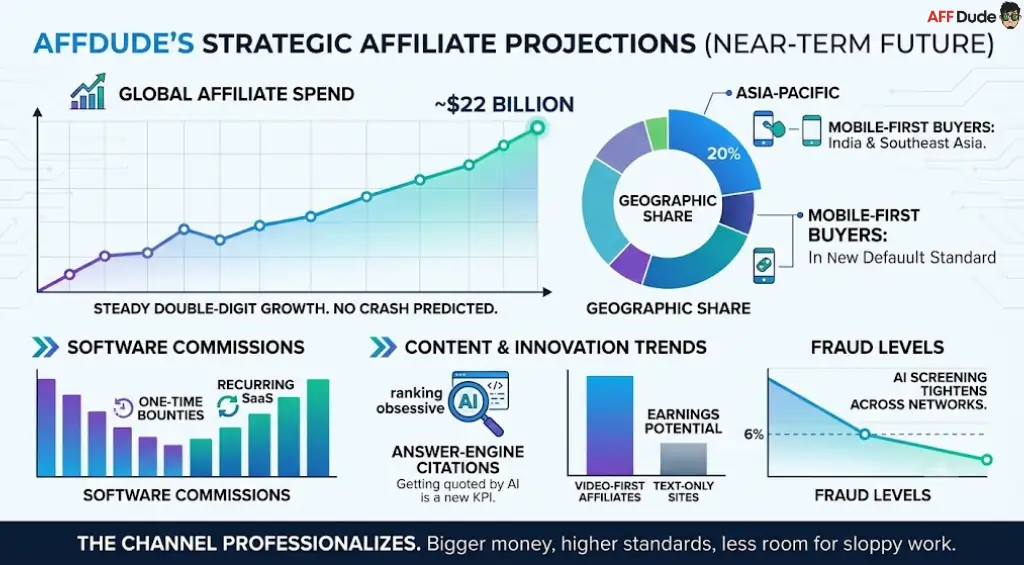
Now for the part you won't find copy-pasted everywhere. These are our own calls, built from years of running programs and reading the numbers every year.
Could we be wrong on the edges? Sure. But the direction feels locked. The channel keeps professionalising. Sloppy players keep getting squeezed out.
The affiliate marketing statistics tell one consistent story across every source we checked. Bigger money. Higher standards. Less room for lazy work. That suits anyone willing to put in the reps.
The Bottom Line for Affiliates in 2026
Let's tie it together. The channel is healthier than ever, but it plays by grown-up rules now. Spend keeps climbing past $19 billion. Brands keep piling in. And the buyers? They still trust an honest recommendation more than any advert.
Here's the short version of what we'd do if we were starting fresh today.
The affiliates who treat this like a business win. The ones chasing shortcuts fade out. That split gets sharper every year, and 2026 made it obvious.
We've watched this channel grow up from scrappy banner links into a serious performance engine. The money is real. The bar is higher. And honestly? That's the best news for anyone willing to do the work properly.
AffDude take: Bookmark this page. We refresh our affiliate data every year, and the direction never wavers. Bigger money, higher standards, and fat rewards for the patient few who keep showing up.
FAQs Related to Affiliate Marketing Market
How big is affiliate marketing in 2026?
Global affiliate spend reached about $19.4 billion in 2026, with the US alone accounting for roughly $13.8 billion. Affiliate now ranks as the third-largest performance marketing channel, behind paid search and paid social.
What is the average ROI on affiliate marketing?
Brands report earning between $6.50 and $15 in revenue for every $1 spent. Top programs push that toward a 1,400% return, which keeps affiliate one of the most cost-efficient channels going.
Which affiliate niche pays the most in 2026?
Education and e-learning lead with average monthly earnings around $15,551, followed by beauty and skincare, gaming and technology, and finance. High customer value and repeat purchases drive those numbers.
Do most affiliates make money?
No. Around 57% earn under $10,000 a year, and roughly 10% of affiliates capture close to 90% of the revenue. Most quit before building enough traffic to earn well.
Is affiliate marketing still worth it in 2026?
Yes, if you treat it seriously. Over 90% of ecommerce brands run a program, spend keeps rising, and recurring SaaS commissions reward patience. The bar is higher now, which actually favours committed operators.
How is AI changing affiliate marketing?
AI chatbots now answer product questions directly, which can break the click-based tracking model. Yet affiliate content also feeds those chatbots, so strong reviews still shape buying decisions. Getting cited by AI answer engines is the new frontier.
Sources
- eMarketer, Affiliate Marketing FAQ 2026
- Statista, Affiliate Marketing Spend Data
- Forrester, 2026 Affiliate Marketing Forecast
- Awin, Report 2026 and Power 100
- Impact.com, 2026 Partnership Benchmark Report
- PartnerStack, SaaS Affiliate State of the Industry
- Grand View Research, Affiliate Marketing Platform Market
- IAB, Performance Marketing Standards
- Influencer Marketing Hub, Commission and Creator Data
- Authority Hacker, Affiliate Income Survey
- Performance Marketing Association, Spend and Fraud Data
Recommended Articles