
Semrush just turned into a billion-dollar Adobe company, and the figures behind that deal are honestly a little nuts. The SEO software giant closed 2025 with $443.6 million in revenue, $471.4 million in annual recurring revenue, and more than 10 million marketers who have logged into the platform at some point. Then Adobe slid $1.9 billion in cold hard cash across the table to own all of it.
Every figure here was pulled straight from the filings, dashboards, and growth curves that actually matter. These Semrush Statistics for 2026 hand you the real scoreboard: revenue, paying customers, keyword and backlink data, and where the Adobe era takes the whole thing next. No filler, just the numbers that move a budget.
Semrush By The Numbers: The 2026 Scoreboard
Let us start with the headline figures. If you only remember one table from this whole piece, make it this one.
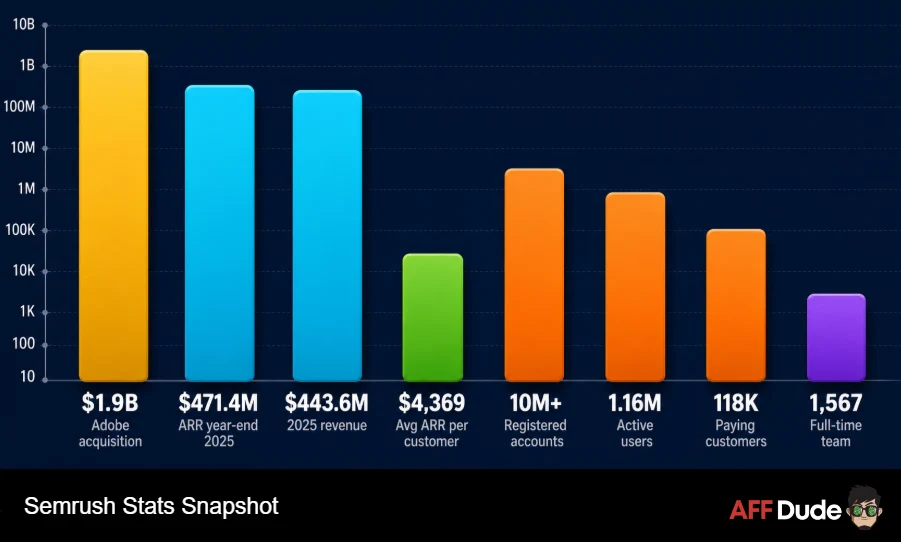
These are the stats that matter when you sit down to size up the biggest name in the SEO software market. We keep this scoreboard pinned when we brief affiliates on which tools deserve their budget.
| Metric | 2026 Figure |
|---|---|
| 2025 revenue | $443.6 million (up 18% year on year) |
| Annual recurring revenue (year-end 2025) | $471.4 million (up 15%) |
| Total registered accounts (all time) | Over 10 million |
| Active users worldwide | Around 1.16 million |
| Paying customers | Roughly 118,000 |
| Average ARR per paying customer | $4,369 |
| Keywords in database | Over 27 billion across 142 databases |
| Backlinks tracked | Over 43 trillion |
| Tools on the platform | 55-plus |
| Full-time team | 1,567 people |
| Adobe acquisition value | $1.9 billion, all cash |
Two things jump out right away. First, Semrush crossed the $470 million ARR mark while staying a subscription business at heart. Second, the value per account keeps climbing even when the customer count stays roughly flat.
Hold that second thought, because it explains a lot of what follows. Semrush is not chasing more logos anymore. It is squeezing more money out of the logos it already has. That single strategy shift shows up in almost every number below.
The $1.9 Billion Adobe Deal, Explained Simply
Here is the story that reshaped everything. Adobe agreed to buy Semrush in an all-cash deal worth about $1.9 billion. The price came to $12.00 per share.
That number carried a premium of roughly 77% over where the stock had been trading. On the day of the news, Semrush shares shot up around 74%. Best single day the stock ever had.
Investors had good reason to celebrate. Semrush went public in 2021, and the share price had drifted sideways for a while before Adobe came knocking. A 77% premium is a proper payday.
Shareholders approved the merger early in 2026. Regulators signed off soon after, including the German competition authority. Adobe then closed the deal in 2026, and Semrush stopped trading on the New York Stock Exchange.
So Semrush is no longer a public company. It is a wholly owned Adobe subsidiary now, folded into Adobe Experience Cloud. A new chief executive, Bill Wagner, took the wheel through the handover.
Why did Adobe want it so badly? A few reasons stand out:
This was also Adobe's first big buyout since its failed attempt to grab Figma for $20 billion. That earlier deal collapsed under regulatory pressure. The Semrush deal, much smaller and cleaner, sailed through without the same drama.
Our AffDude read on the Adobe buyout: big enterprise owners tend to push prices up over time. We saw it with Marketo and we saw it with Figma after the fact. We expect Semrush entry plans to creep higher within 12 to 18 months. If you rely on the tool, lock an annual rate while you still can. That is the kind of call we make from actually paying these bills every month.
How Semrush Revenue Climbed To $443 Million
Semrush did not appear overnight. Revenue has climbed every single year since the company went public in 2021, and long before that too.
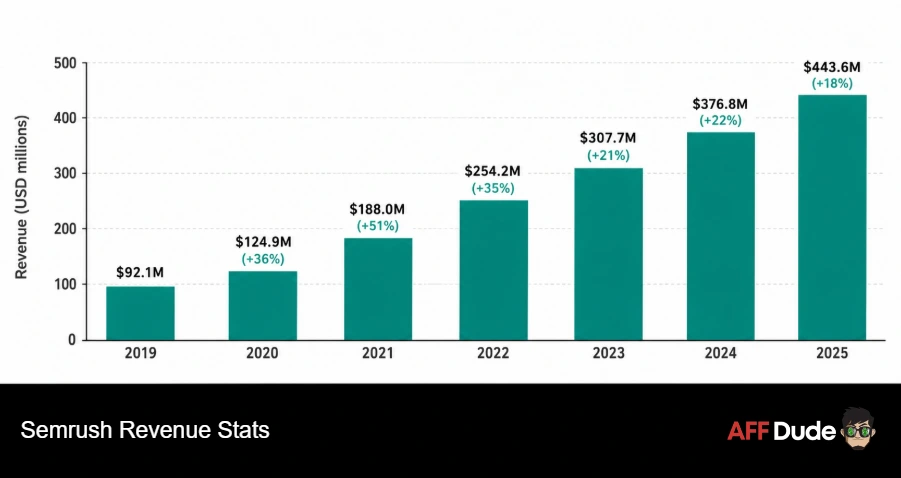
Back in 2019 it booked $92.1 million. By 2025 that figure had nearly quintupled. That kind of run is rare for any online visibility management platform at this scale.
Here is the full climb, year by year.
| Year | Annual Revenue | Year-on-Year Growth |
|---|---|---|
| 2019 | $92.1 million | n/a |
| 2020 | $124.9 million | 36% |
| 2021 | $188.0 million | 51% |
| 2022 | $254.2 million | 35% |
| 2023 | $307.7 million | 21% |
| 2024 | $376.8 million | 22% |
| 2025 | $443.6 million | 18% |
Notice the pattern in that table. Growth in percentage terms is cooling, but the dollar gains stay huge. Semrush added close to $67 million in fresh revenue during 2025 alone.
That is the mark of a company moving from a growth sprint into a steady, profitable jog. Percentage growth always slows once the base gets big. What counts is the raw dollars, and those keep piling up.
On a non-GAAP basis, income from operations reached $53.3 million for 2025, a healthy 12% margin. The company did post a small operating loss on a strict GAAP basis, driven by stock compensation and deal costs. Under the surface, though, the core engine prints cash.
Free cash flow told the same happy story. Semrush generated $42.9 million of it in 2025, up from $35.3 million the year before. Cash and short-term investments closed the year at $269.3 million.
Regionally, the United States remains the biggest single market by a wide margin. US-based clients brought in over $170 million of revenue, close to 45% of the total. The United Kingdom is a steady contributor, and the rest of the world is the fastest-growing slice.
Annual Recurring Revenue And What One Customer Is Really Worth
Revenue gets the headlines, but annual recurring revenue is where SaaS people look first. It shows the predictable, subscription-based income Semrush can bank on.
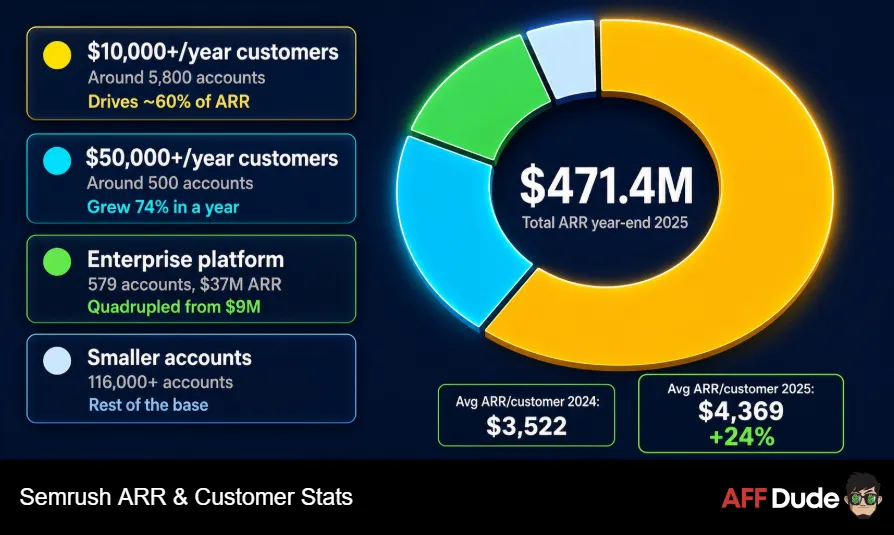
ARR reached $471.4 million by the end of 2025, a 15% gain on the year prior. Dollar-based net revenue retention sat at 104%, meaning existing customers spent a little more than they had a year earlier.
That retention figure is quietly important. Anything above 100% means the customer base grows in value even if not one new account signs up. Semrush keeps its users and sells them more over time.
Now the part we find most interesting. The average customer keeps getting more valuable, fast.
| Metric | 2024 | 2025 |
|---|---|---|
| Average ARR per paying customer | $3,522 | $4,369 |
| Customers paying over $10,000 a year | Around 4,400 | Around 5,800 |
| Customers paying over $50,000 a year | 291 | Around 500 |
| Enterprise platform ARR | $9 million | $37 million |
| Enterprise customer count | Around 200 | 579 |
Average revenue per paying account jumped about 24% in a single year. Big accounts drove that lift. Customers paying more than $10,000 grew 31%, and the $50,000-plus club swelled by over 74%.
The enterprise story is the loudest signal in the whole dataset. Names like Amazon, JPMorgan Chase, and TikTok pay serious money for Semrush. Enterprise ARR quadrupled to $37 million across 579 accounts.
That is a huge jump from around $9 million the prior year. Adobe surely noticed. A tool that lands Fortune 500 marketing teams is exactly what fits inside an enterprise software empire.
Our estimate on customer value: if the up-market push holds, we think average ARR per paying customer clears $5,000 during 2026. Adobe's enterprise sales muscle only speeds that up. The small accounts are simply not the growth engine anymore, and the numbers make that obvious.
Free Users Versus Paying Customers: The Real Split
Here is a stat that surprises people. Semrush has been tried by more than 10 million marketers over its lifetime. Very few of them actually pay.
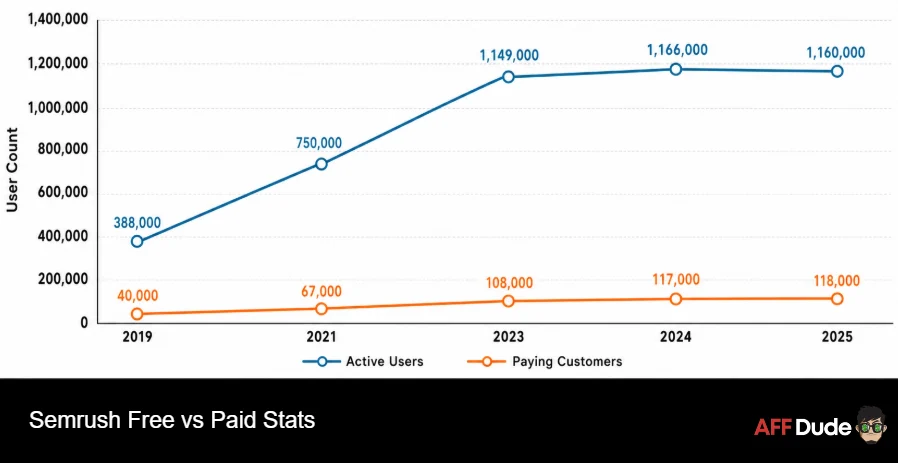
Roughly 1.16 million people use Semrush in an active month. Of those, about 118,000 hold a paid subscription. Everyone else sits on free access.
So the free-to-paid gap is enormous. Around 90% of active users never open their wallet. That split is normal for freemium SaaS, and it is also the funnel Semrush milks for upgrades.
| Year | Active Users | Paying Customers | Free Share |
|---|---|---|---|
| 2019 | 388,000 | Around 40,000 | About 90% |
| 2021 | Around 750,000 | Around 67,000 | About 91% |
| 2023 | 1,149,000 | Around 108,000 | About 91% |
| 2024 | 1,166,000 | Around 117,000 | About 90% |
| 2025 | Around 1.16 million | Around 118,000 | About 90% |
One honest note on these numbers. A few trackers claim Semrush now counts 135,000 paying customers. We think that figure looks generous. We lean on the count near 118,000, since it matches the company's own reporting far better than the higher guesses do.
The lesson for marketers is simple. Semrush wins by pulling free users into paid tiers, then nudging paid users into pricier plans. The free tool is the hook. The upgrade is the whole business model.
Around 90% of current subscribers reportedly started on a free account before paying. That funnel works. It is also why the free version stays deliberately limited, so you feel the ceiling quickly and reach for a card.
There is a wider read here for anyone building a business online. A giant free base with a small paid core is not a weakness. It is a moat. Every free user feeds product data, brand reach, and a warm list to upsell. Semrush turned freemium into a machine, and the paid numbers prove the machine runs.
AFFDude projection on the user base: we expect paying customers to push past 125,000 by the end of 2026. Growth in raw headcount is slow, so the real money keeps coming from making each account worth more, not from adding a flood of new names.
Inside The Data Engine: Keywords, Backlinks And Domains
None of the revenue happens without data. Semrush runs one of the largest crawling operations outside the search engines themselves.
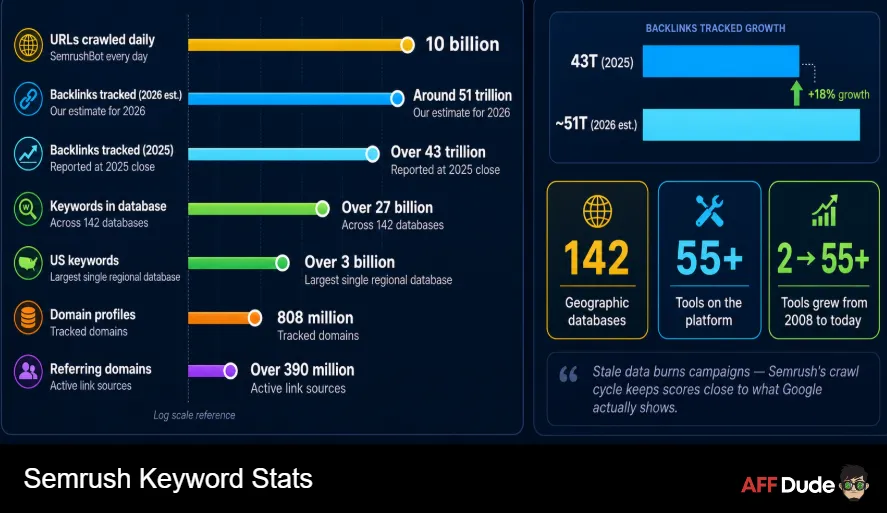
The keyword research tools sit on top of more than 27 billion keywords, spread across 142 geographic databases. The United States alone accounts for over 3 billion of them.
Backlinks are the other pillar. Semrush tracked over 43 trillion links across 808 million domain profiles at the 2025 close. Our own reading of the crawl growth puts the 2026 figure nearer 51 trillion links.
Its crawler, SemrushBot, chews through around 10 billion URLs every day. That relentless pace is how the backlink analysis database stays fresh enough to actually trust for client work.
| Data Point | Figure |
|---|---|
| Keywords in database | Over 27 billion |
| Geographic keyword databases | 142 |
| US keywords | Over 3 billion |
| Backlinks tracked (2025) | Over 43 trillion |
| Backlinks tracked (our 2026 estimate) | Around 51 trillion |
| Domain profiles | 808 million |
| Referring domains | Over 390 million |
| URLs crawled daily | 10 billion |
Why should you care about raw database size? Because bigger data means fewer blind spots. More keywords to target, more links to audit, more competitor gaps to spot before your rivals do.
Semrush refreshes each regional keyword database on a regular cycle. That keeps volume and difficulty scores close to what Google actually shows. Stale data is the fastest way to burn a campaign, so freshness matters as much as size.
The platform grew from just 2 tools in 2008 to 55-plus today. That spread across SEO, PPC, content, and social is the whole pitch. One dashboard instead of five separate subscriptions and five separate bills.
The Team And Milestones Behind The Growth
Behind those numbers sit real people and a long build. Semrush started in 2008 as a tiny browser add-on for keyword data. It looked nothing like the marketing suite you log into today.
The company grew slowly at first, then hit the gas. It listed on the New York Stock Exchange in 2021 under the ticker SEMR. That IPO gave it the cash to buy up smaller tools and widen the product line.
By the end of 2025 the team had reached 1,567 full-time employees and contractors. They work across several countries, with a strong base in the United States plus offices in Europe. The head office sits in Boston.
Tool count tells the growth story on its own. Semrush shipped 2 tools in 2008 and offers 55-plus today. Each new tool pulled in a fresh slice of marketers who never came for keyword data alone.
That steady product expansion is exactly why the digital marketing tools crowd treats Semrush as a default. It quietly became the platform people open every day without thinking twice. Adobe paid $1.9 billion for that habit.
Semrush Against Ahrefs And Moz In 2026
We list SEO tools for a living, so people always ask us the same thing. How does Semrush stack up against the other giants?
Short version: Semrush is the broad all-rounder. Ahrefs owns backlink depth. Moz keeps things simple and cheap. Each has a lane, and picking the wrong one wastes real money.
Here is the head-to-head on the points that actually change your daily workflow.
| Factor | Semrush | Ahrefs | Moz |
|---|---|---|---|
| Best at | All-in-one marketing suite | Backlink depth and speed | Simple, education-first SEO |
| Entry price (annual billing) | Around $117 per month | Around $129 per month | Around $99 per month |
| Keyword database | Over 27 billion | Very large, keyword-strong | Smaller, link-focused |
| Extra user seats | $45 to $100 each | Credit-based sharing | Included in tiers |
| Owner | Adobe | Independent | Ziff Davis |
| Standout feature | AI visibility tracking | Fastest new-link finding | Domain Authority metric |
Pricing is where affiliates flinch. Semrush charges per user, so a team of five stacks up fast. Extra seats run $45 on the Pro plan, $80 on Guru, and $100 on Business.
The whole SEO software market keeps expanding, with growth pegged near 12.9% a year through 2030. Semrush holds the widest feature set of the three, which is why it still commands the premium price at the entry level.
One shift worth flagging loudly. With the Adobe buyout done, Ahrefs is now the largest fully independent SEO platform left standing. That matters if you care about staying off a big enterprise billing system with its own pricing habits.
For most affiliates we advise, the choice comes down to breadth versus depth. If you juggle SEO and paid ads, Semrush earns its keep. If link building is your entire game, Ahrefs often wins on data. Moz suits smaller sites watching the budget closely.
What Semrush Costs You In 2026
Let us talk plain money, because the sticker price stings. Semrush runs three main tiers, and none of them counts as cheap.
On top of that, the Semrush app store carries 60-plus add-ons. Those run anywhere from $19 to $349 per month each. The bill climbs quicker than most people budget for, especially once seats and add-ons pile on.
The billing model catches people out too. Annual plans quote a lower monthly figure but charge the full year upfront. Miss that detail and the first invoice is a shock.
The AI Visibility Bet Semrush Is Making
This is the piece Adobe actually paid for. Search is changing under our feet, and Semrush is betting the farm on AI visibility tracking.
Traditional rankings mean less every year. Google AI Overviews now appear in a large share of searches, and zero-click results eat well over half of US queries. People get their answers without ever clicking through to a site.
Semrush saw that coming and built for it early. AI search traffic grew hundreds of percent during 2025, and the company shipped tools to track brand mentions inside AI answers.
The AI product line went from almost nothing to real money at speed:
Together, AI products and the enterprise platform made up $63 million of ending ARR. That is the fastest-growing slice of the entire business, and it is only getting started.
Adobe wants this because AI agents increasingly decide which brands get found and bought. Owning the data that tracks that behaviour is a serious edge in the years ahead.
Generative engine optimisation, often shortened to GEO, is the phrase everyone in our circles now uses. It means optimising to show up inside AI answers, not just blue links. Semrush grabbed a clear head start on the tooling for it.
Our Projections For Semrush Through The Rest Of 2026
Semrush stopped reporting public numbers once Adobe closed the deal and pulled it off the exchange. So from here, the figures come from our own research and reading of the trend, not from quarterly filings.
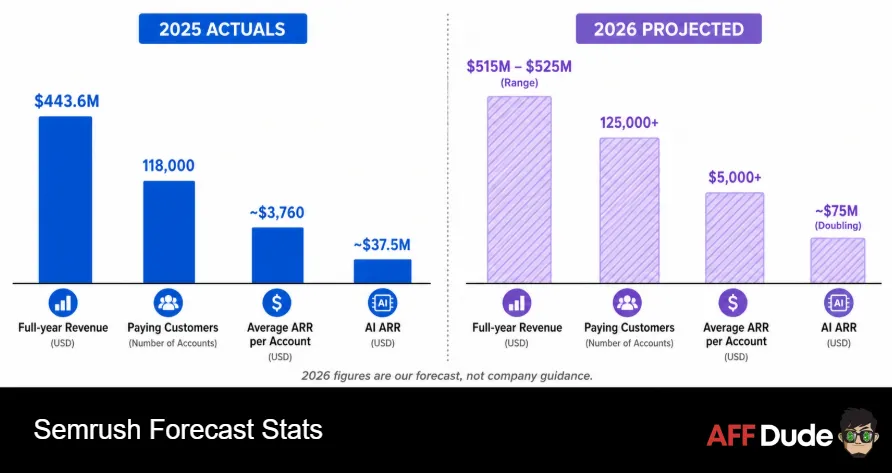
Here is where we think things land, framed as our calls rather than gospel:
We could be off on the exact figures. Any honest forecast admits that. But the direction feels rock solid, and we would bet on it.
Bigger accounts, higher prices, deeper AI features. That is the playbook a company like Adobe runs almost every time it buys a growing tool. History rhymes here.
There is a risk case too. Integration into a giant like Adobe can slow product speed and annoy loyal solo users. If Semrush loses its scrappy edge, independent rivals will happily scoop up the frustrated crowd. We are watching that closely.
What The Adobe Era Means For Affiliates
Time to make this useful for you, the person actually running campaigns. Numbers are fun, but strategy pays the bills at the end of the month.
A few practical calls from our side of the desk:
We have listed and tested SEO tools across every vertical that runs traffic, from nutra to iGaming to SaaS. Semrush stays a strong pick for most affiliates, especially anyone juggling SEO and paid search in one dashboard.
Here is the usage reality we see most often. Newer affiliates buy the biggest plan out of fear and waste half of it. Experienced ones buy Pro, wring every feature out of it, and only step up when a client account demands more. Be the second type. Your margins will thank you, and so will your future self at renewal time.
The Adobe deal does not change the tool overnight. Your logins still work, your projects still load, your data still refreshes. What it changes is the direction of travel, and that is worth budgeting for now rather than later.
The bottom line on these Semrush Statistics for 2026 is straightforward. A near half-billion-dollar business, a $1.9 billion exit to Adobe, and a hard pivot toward AI-era search. Smart affiliates will keep using the tool while keeping one eye firmly on the price tag.
Sources We Trusted
We cross-checked every figure against primary filings and the most reliable data trackers in the industry. Here are the sources worth your time if you want to dig into the raw data yourself:
- Semrush Investor Relations and financial results
- Adobe newsroom, acquisition completion notice
- Backlinko, Semrush user and revenue data
- DemandSage, Semrush statistics report
- Search Engine Journal, Adobe acquisition coverage
- CNBC, Adobe and Semrush deal report
- Grand View Research, SEO software market size
- Statista, SEO and digital marketing tools data
Recommended Articles

Affiliate Disclosure: This post may contain some affiliate links, which means we may receive a commission if you purchase something that we recommend at no additional cost for you (none whatsoever!)