
Two hundred million people call themselves creators. About 4 percent earn six figures. Everything worth knowing about the creator economy lives in that gap.
The creator economy market size lands somewhere between $250 billion and $314 billion heading into 2026, depending on who's counting and what they count. Growth sits near 22 to 23 percent a year. Fast enough that your budget should care.
We've run offers and paid creators since 2013, so these creator economy statistics come from our own payout data first, then the research shops we actually trust. No recycled press releases.
What's below: creator earnings broken down by income band, platform payout rates per 1,000 views across YouTube, TikTok, Reels and Shorts, current brand deal rates by follower tier, influencer marketing spend figures for 2026, where affiliate marketing and social commerce fit into the revenue mix, AI adoption numbers, and the burnout data nobody puts in a sales deck.
How Big Is The Creator Economy in 2026?
Big. Silly big. And still growing faster than most ad channels.
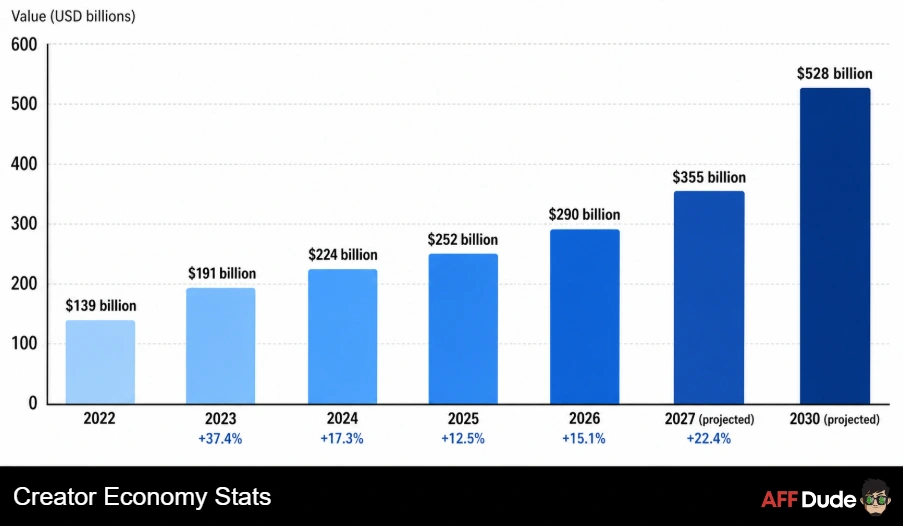
The data shops don't fully agree on one figure. Some peg 2026 at around 250 billion dollars. Others push it past 313 billion. The split comes down to what each one counts: pure creator income, or the whole stack of tools, agencies, and commerce riding along.
Our working number sits at about 290 billion dollars for 2026. That blends the cautious camp with the bullish one. It feels right based on what we watch move through networks and brand budgets.
One thing everyone agrees on: the direction. Up and to the right, hard.
| Year | Global creator economy value | Year-on-year growth |
|---|---|---|
| 2022 | $139 billion | n/a |
| 2023 | $191 billion | 37.4% |
| 2024 | $224 billion | 17.3% |
| 2025 | $252 billion | 12.5% |
| 2026 (our call) | $290 billion | 15.1% |
| 2027 (projected) | $355 billion | 22.4% |
| 2030 (projected) | $528 billion | n/a |
Goldman Sachs floated a bolder line: a total addressable market near 480 billion dollars by 2027. Read that as the ceiling, not the floor. Even the modest forecasts have the market clearing half a trillion by 2030.
North America still runs the show with roughly a third of global value. Asia is the growth rocket, led by short-form video and cheap mobile data.
Dude's read: The valuation debate is a distraction. Pick any credible model and the growth rate lands between 22 and 26 percent. Any channel compounding that fast deserves your budget, full stop.
A Quick Look At How We Got Here
The creator economy didn't appear overnight. It compounded.
Back in 2020, most creators earned pocket change and platforms held all the cards. Ad splits were thin. Brand deals went to celebrities. Tooling was clunky.
Then three things stacked up fast:
The result? A market that roughly doubled in value in four years. Creator-focused startups pulled in over 767 million dollars in funding across 2023 to 2024, a 49 percent jump. Money follows momentum, and the momentum is obvious.
What changed most is control. Creators stopped being cheap content and started being the distribution layer for entire brands. That shift is why the money keeps flowing in.
How Many Content Creators Are There Right Now?
More than you'd guess. And most aren't making rent from it.
Counts of content creators worldwide range from about 207 million to as high as 303 million in 2026. The wide band is a definition problem. Post a Reel twice a week and some surveys count you in.
Strip out the hobbyists and the picture tightens fast:
So the “everyone's a creator” headline is true on paper. The “everyone's getting paid” version is not.
Here's the part we like. The barrier to entry has never been lower. A phone, a niche, and consistency will get you further in 2026 than a studio did in 2018.
Short-Form Video Runs The Attention Game
Want to know where eyeballs sit? Short vertical video. It's not close.
The video streaming segment leads the whole creator market, holding around 52 percent of total value. TikTok, Reels, and Shorts eat the day for hundreds of millions of people.
A few things worth knowing about short-form video content in 2026:
The catch we keep flagging: short-form is the front door, not the cash register. It builds the audience. Something else has to convert it.
The Money Split: Who Actually Earns What
This is the part the guru courses skip. The creator economy is K-shaped. A thin top tier eats most of the money. A huge bottom tier splits crumbs.
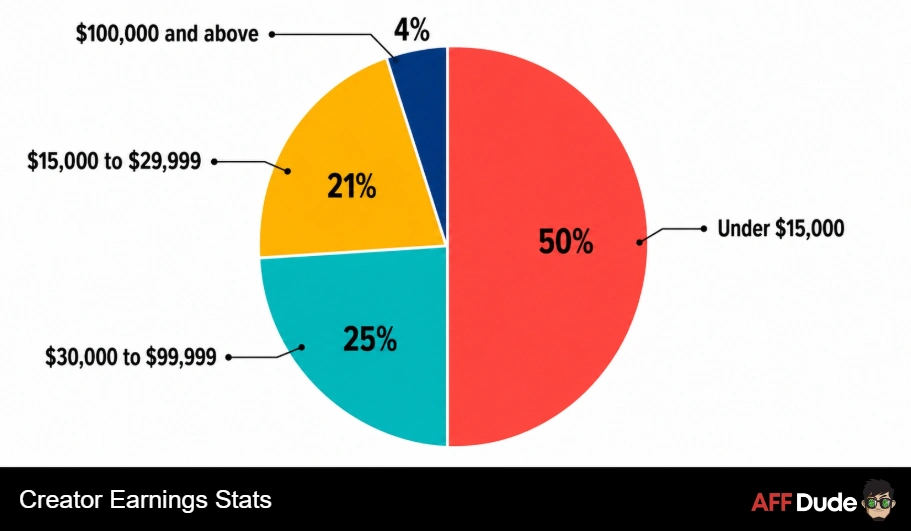
Here's how yearly income breaks down across creators:
| Annual earnings band | Share of creators | What it really means |
|---|---|---|
| Under $15,000 | About 50% | Side money, not a salary |
| $15,000 to $29,999 | About 21% | Part-time grind |
| $30,000 to $99,999 | About 25% | The emerging middle class |
| $100,000 and above | About 4% | Running a real business |
About 71 percent of creators earn under 30,000 dollars a year. Half sit below 15,000. That's the reality behind every “quit your job” thumbnail.
Now flip to the top. Established full-time creators post a median income near 133,000 dollars. The top 10 percent on some membership platforms average over 48,000 dollars a month. Same game, wildly different scoreboard.
The middle band is the one to watch. That emerging middle class decides if this becomes a real career path or stays a winner-takes-most casino.
Straight from the Dude: Follower count is a vanity trap. We've seen 8,000-follower accounts out-earn 400,000-follower ones. Niche, offer, and email list beat raw reach every single time.
What The Average Creator Really Takes Home
Averages lie here, so watch closely.
Survey pools put the average annual creator income near 44,000 dollars. Sounds decent. But the median tells the truth, and it's far lower.
Per brand campaign, the average payout is about 11,400 dollars. The median? Just 3,000 dollars, and it slipped from 3,500 the year before. When the average runs nearly four times the median, a small group is dragging the number skyward.
Our take on the earnings curve:
That last point is the cheat code. Successful creators run seven income streams. Strugglers run two. The gap is not luck.
It also takes time. The average creator needs about six and a half months to earn their first dollar. Patience is a strategy here, not a weakness.
Where Creator Money Actually Comes From
Platform ad cash is not the main event. Not even close.
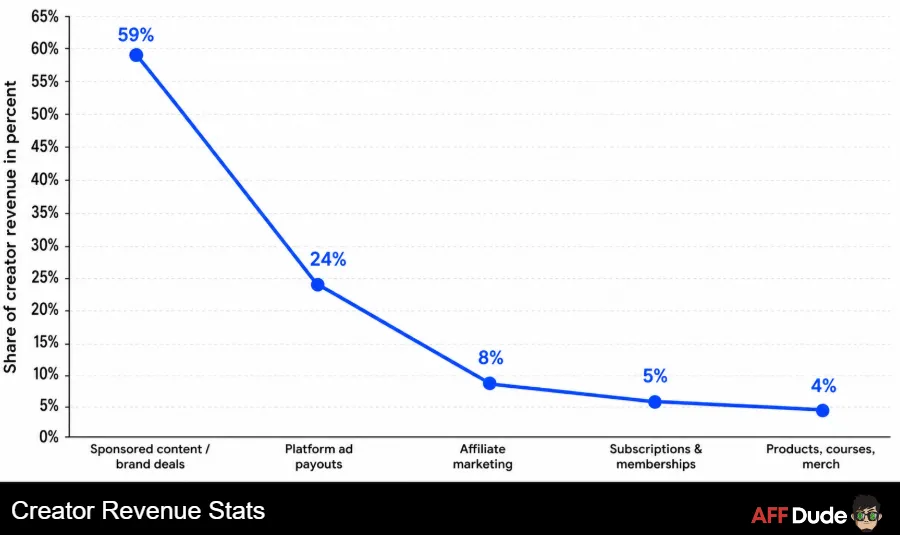
Brand deals carry the load. Sponsored content revenue share makes up the fat slice of creator income, with platform payouts a distant second.
| Income source | Share of creator revenue (2026) | Reliability |
|---|---|---|
| Sponsored content / brand deals | About 59% | High, but lumpy |
| Platform ad payouts | About 24% | Low per view |
| Affiliate marketing | About 8% | Scales with trust |
| Subscriptions & memberships | About 5% | Sticky, recurring |
| Products, courses, merch | About 4% | Highest margin |
Roughly 69 percent of creators name brand deals as their top income source. Yet reliance on them is easing. The share earning mainly from brand deals dropped about 10 points since 2023.
Why does this matter to us affiliate folk? Because affiliate marketing is the quietest, most durable line on that table. It scales with audience trust, not with a one-off cheque. Build the trust, bank the commissions monthly.
The pros treat brand deals as spiky cash and affiliate plus products as the base salary. Smart. One is a feast-or-famine cycle. The other pays while you sleep.
Platform Payouts Ranked: What Each Pays Per 1,000 Views
Here's where creators get a nasty shock. The platform payout rates vary by more than 100 times between the top and bottom.
YouTube pays like an adult. Short-form apps pay like a tip jar. The trade-off is reach.
| Platform | Direct pay per 1,000 views (2026) | How the money moves |
|---|---|---|
| YouTube (long-form) | $2 to $12 (finance & tech $8 to $20+) | Ad rev-share, about 55% to creator |
| Facebook (in-stream video) | $1 to $4 | Unified Content Monetisation |
| TikTok Creator Rewards | $0.40 to $1.00+ | RPM on 1-minute-plus qualified views |
| YouTube Shorts | $0.02 to $0.13 | Pooled Shorts ad fund |
| Instagram Reels | $0 to $0.05 | No open rev-share; bonuses invite-only |
| X (Twitter) | Low and shrinking | Ad pool cut 50 to 80% |
YouTube has paid creators over 100 billion dollars between 2021 and 2025. The platform pulled in over 60 billion dollars of revenue in 2025 alone. That's entertainment-industry scale.
TikTok's move was clever. Creator Rewards pays 10 to 25 times more than the dead Creator Fund it replaced. Still pennies per view, but the reach is unmatched. One clip can hit millions overnight.
Instagram? It pays creators almost nothing direct. The value there is brand deals and shoppable formats, not ad splits. Meta keeps hinting at a Reels ad share, but as things stand creators earn zero from the platform itself.
The Dude's playbook: Treat TikTok and Reels as the top of your funnel, not the till. Grow the audience there. Cash out on YouTube long-form, email, and affiliate offers. We've watched this two-step turn tiny channels into real income.
Brand Deal Rates By Creator Size
Every marketer asks the same thing: what do I pay a creator? The honest answer is “it depends.” But the bands are real, and they hold up across 2026 benchmark data.
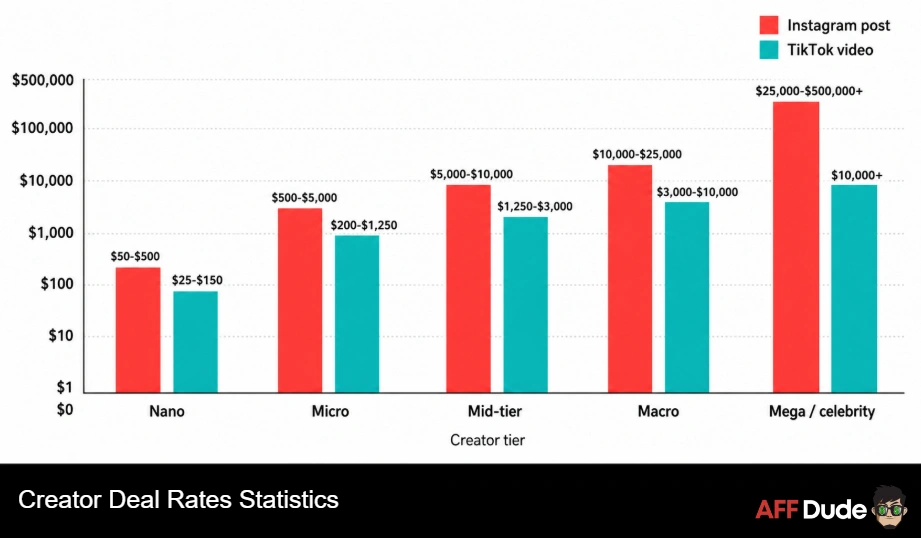
Here are the brand deal rates by tier we see quoted most often. Treat them as guardrails, not gospel.
| Creator tier | Followers | Instagram post | TikTok video | Sweet spot for |
|---|---|---|---|---|
| Nano | 1K to 10K | $50 to $500 | $25 to $150 | Niche trust, top engagement |
| Micro | 10K to 100K | $500 to $5,000 | $200 to $1,250 | Best value per dollar |
| Mid-tier | 100K to 500K | $5,000 to $10,000 | $1,250 to $3,000 | Scaled reach |
| Macro | 500K to 1M | $10,000 to $25,000 | $3,000 to $10,000 | Big awareness pushes |
| Mega / celebrity | 1M+ | $25,000 to $500,000+ | $10,000+ | Launches, prestige |
Reels and video cost 2 to 3 times a static post. Stories run about half a feed post. Usage rights and exclusivity push the number up fast.
One more thing. Follower count sets the baseline, not the final price. A finance nano with 5,000 engaged followers can out-charge a lifestyle account ten times the size. Audience quality wins.
The Micro-Creator ROI Edge
Here's the trend that quietly reshaped brand spending in 2026.
Brands are ditching celebrity reach for micro and nano influencers. Around 73 percent of brands now prefer micro and mid-tier creators. About 39 percent name nano accounts as their most likely partner.
The logic is dead simple:
Mega-influencer engagement has slid around 30 percent since 2022. Reach without trust just burns budget. The brands winning right now run ten to twenty micro campaigns instead of one splashy celebrity post.
For anyone building a creator brand, this is good news. You don't need a million followers. You need a tight niche and an audience that actually listens.
Influencer Marketing Spend Keeps Climbing
The brand money behind all this is stacking up quick.
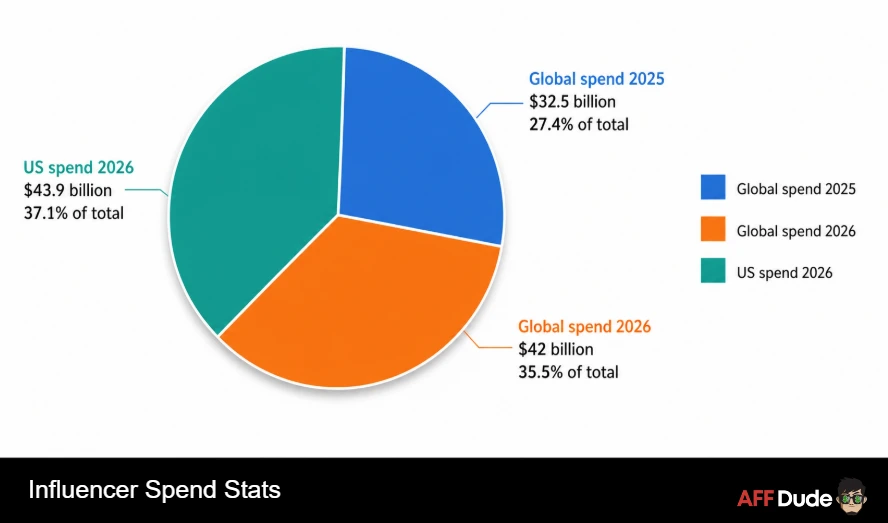
Influencer marketing spend hit roughly 32.5 billion dollars in 2025, up more than 35 percent in a single year. Our read puts 2026 near 40 to 44 billion dollars globally.
In the US, ad spend on sponsored creator content alone is tracking toward about 43.9 billion dollars in 2026. That's a 26 percent jump on the year before.
A few numbers that back the momentum:
The money isn't just growing. It's being trusted to perform. When two-thirds of marketers expect payback inside 30 days, that's a channel earning real respect.
Social Commerce And The TikTok Shop Boom
Content and shopping just merged. Fully.
TikTok Shop drove about 15.82 billion dollars in US sales, folding commerce straight into the feed. People watch, tap, and buy without leaving the app.
For affiliates, this is a proper gift. Creators earn affiliate commissions of 5 to 20 percent on TikTok Shop sales, depending on category. That turns every product mention into a live storefront.
What social commerce changes for creators:
We've long said the future of affiliate is video plus commerce. The 2026 numbers are catching up to that call. Short clips selling real products at real margins is where a lot of new money sits.
AI Is Now Baked Into Creator Workflows
This shift happened fast. Two years ago AI tools were a novelty. Now they're plumbing.
Somewhere between 86 and 91 percent of creators use generative AI content tools in 2026. Editing, thumbnails, scripts, and asset generation top the list.
The interesting split: six-figure earners use AI about twice as often as low earners. The tools don't replace the human. They let a small team ship like a studio.
Our honest take, from testing this across our own content:
AI is table stakes now, not an edge. The edge is what you add that a model cannot fake. Original data, real screenshots, and lived experience are the new moat.
Creator Demographics: Who's Behind The Camera
The typical creator in 2026 is younger and more entrepreneurial than most brands assume.
Here's the shape of the crowd:
That last stat is the tell. Serious creators stop renting attention and start building assets. A product, a course, a membership: something they own outright.
It also reframes who you're partnering with. A creator is not a billboard anymore. Many run lean media businesses with contractors, tools, and their own IP. Treat them like partners and the results follow.
Podcasts And Long-Form Audio Are Quietly Booming
Everyone obsesses over video. Audio keeps printing money in the background.
Podcasts pull loyal, high-intent listeners who stick around for the whole episode. That kind of attention is gold for sponsors and affiliate offers alike.
Why audio works so well for creators:
We rate podcasts as one of the most underpriced plays in the creator space right now. Fewer creators compete for ears than for eyeballs. The audience that does show up is easier to sell to, because they already chose to listen for the long haul.
Pair a podcast with an email list and a couple of affiliate offers, and you've got a tidy, durable income stack that doesn't live or die by an algorithm.
The Ugly Side: Burnout And Quitting
Nobody puts this in the sales deck. We will.
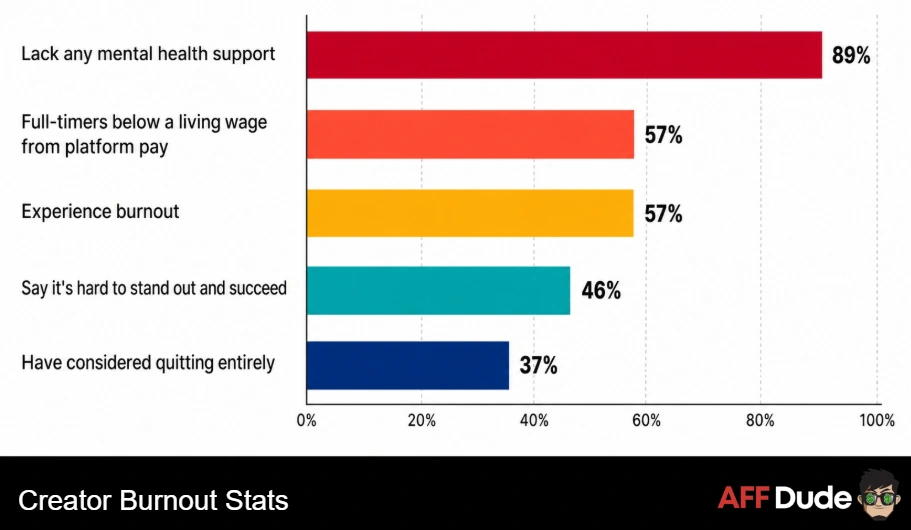
Creating full-time is brutal. The content treadmill never stops. And the money for most is thin.
| Creator pain point | Share affected |
|---|---|
| Experience burnout | 52% to 62% |
| Full-timers below a living wage from platform pay | About 57% |
| Say it's hard to stand out and succeed | About 46% |
| Have considered quitting entirely | About 37% |
| Lack any mental health support | About 89% |
Burnout is a business risk, not a mood. When output drops, income drops with it. The creators who last build systems, not sprints.
Some communities are already adjusting. Around 21 percent of community operators deliberately cut their programming to protect against overload. Slowing down to keep going is now a real tactic.
The fix most pros land on is the same one we push: get off the hamster wheel of platform reach and build something you own.
The Newsletter And Membership Money
Owned audiences are where 2026 money hides.
Reach happens on social. Revenue happens on turf you control. Creators are pulling their best fans into owned audience channels like newsletters, private communities, and membership products.
The pull is control. One algorithm change can halve your reach overnight. An email list doesn't care what any platform does on a Tuesday.
What the shift looks like in the data:
Tools like Patreon, Circle, and simple newsletters do the heavy lifting. The goal is the same for everyone: turn a rented audience into an owned one.
Where Smart Creators Are Moving Their Money
The clearest 2026 signal is a quiet migration toward independence.
Platform dependence is the biggest structural risk in the game. A creator can have huge reach and almost no business control. The pros are fixing that on purpose.
Their playbook, boiled down:
For affiliate marketers, this is the opening. An owned audience plus honest reviews plus the right offer is a compounding machine. That's the AffDude model, and the data keeps proving it out.
The Regional Picture in 2026
Money isn't spread evenly across the map.
The US is both the biggest spender and the biggest earner. If you run English-language offers, that concentration works in your favour. It's where the payouts and the buyers cluster.
Governments are noticing too. India lined up a billion-dollar fund to back creators and creative tech. When states start writing cheques, you know the sector has arrived.
Creator Funding And Investor Interest
Investors don't chase dying markets. They're all over this one.
Creator-focused startups pulled in more than 767 million dollars across 2023 to 2024, a 49 percent jump. AI tools led those rounds.
Where the venture money is landing:
The creator monetisation platform market alone is growing over 20 percent a year. That's a signal. The infrastructure around creators is becoming a real industry, not a side hustle.
FAQs Realated to Creator Economy in 2026
How big is the creator economy in 2026?
The creator economy is worth roughly 250 billion to 314 billion dollars in 2026, depending on what gets counted. Our blended working figure is about 290 billion dollars. Growth runs near 22 to 23 percent a year, with forecasts of 528 billion dollars by 2030.
How many creators are there worldwide?
Around 200 to 207 million people identify as creators in 2026, with some counts running to 303 million. Of those, about 50 million are professional or semi-professional, and roughly 2 million work full-time.
What percentage of creators make six figures?
Only about 4 percent of creators earn over 100,000 dollars a year. Half earn under 15,000 dollars, and about 71 percent earn under 30,000 dollars. The economy is heavily top-weighted.
Which platform pays creators the most?
YouTube long-form pays the most per view, at 2 to 12 dollars per 1,000 views, and far higher in finance and tech niches. TikTok and Instagram pay little directly. The real money on short-form comes from brand deals and affiliate offers.
How much do brands pay creators per post?
Nano creators charge about 50 to 500 dollars per Instagram post. Micro creators run 500 to 5,000 dollars. Macro creators land between 10,000 and 25,000 dollars. Mega and celebrity deals start at 25,000 dollars and climb into six figures.
Is affiliate marketing a good income stream for creators?
Yes, and it's growing. Affiliate makes up about 8 percent of creator revenue now and rising. It scales with audience trust and pays recurring commissions, which makes it steadier than one-off brand deals.
Where is the creator economy heading?
Toward owned audiences, diversified income, and micro-creator deals. Subscriptions, memberships, and affiliate commissions grow while ad-only models shrink. AI becomes standard, so original work and real data are the new edge.
What We Reckon For The Rest Of 2026
We've watched this game since 2013. Here's our honest call on where these Creator Economy Statistics point next.
The pattern holds across every vertical we touch. Chase shortcuts and you burn out. Build trust, own your audience, diversify income, and treat it like a business. That's what the numbers reward.
Sources We Trust
We built this piece from our own payout data plus figures from data shops known for solid creator research. Cross-check anything here:
- Grand View Research: Creator Economy Market Report
- Goldman Sachs Research: Creator Economy TAM Analysis
- Precedence Research: Creator Economy Market Size
- Influencer Marketing Hub: Creator Earnings and Benchmark Data
- Adobe: Creators Toolkit Report on AI adoption
- DemandSage: Creator Economy Statistics
- Statista: Creator Economy Data Hub
- CreatorIQ: State of Creator Compensation
Recommended Articles
Affiliate Disclosure: This post may contain some affiliate links, which means we may receive a commission if you purchase something that we recommend at no additional cost for you (none whatsoever!)