
The AI video generation market sits at $847 million to $946 million in 2026. Around 63% of video marketers now build or edit clips with AI. Machine made clips account for roughly 10% of all digital video this year.
Meanwhile 59% of a fresh TikTok feed is low effort AI filler. We have run paid traffic since 2013 and tested these tools with real budget.
So we pulled every credible 2026 number, cross checked them, then added our own calls. No guru fluff. Just the AI video generation statistics that move your margin.
The 2026 AI Video Generation Stats We Keep Quoting In Slack
Every Tuesday somebody in our Slack asks the same thing. Is AI video worth the spend yet? Here is the short table we paste back.
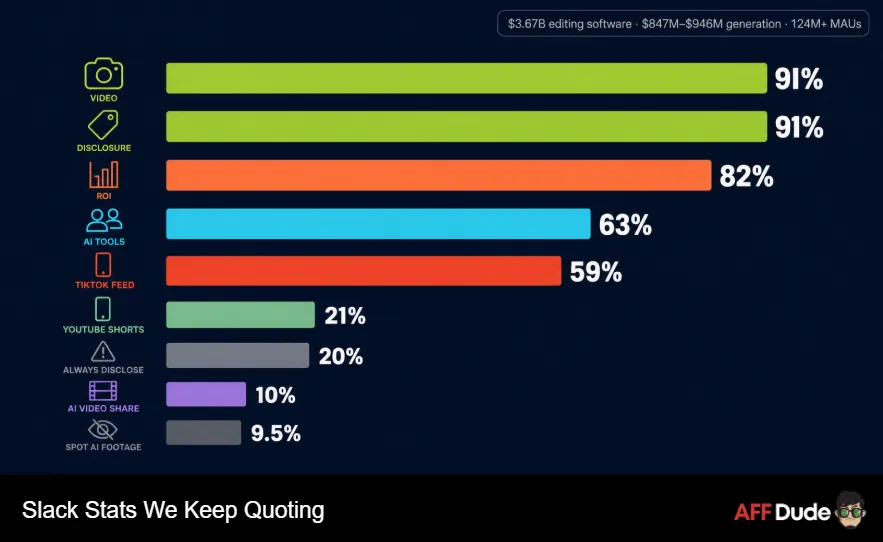
We picked these figures because each one changes a media buying decision. Nothing here is filler.
| Metric (2026) | Figure | Why It Matters To You |
|---|---|---|
| Global AI video generator market | $847M to $946M | Still small, still doubling fast |
| Wider AI video generation and editing software market | $3.67 billion | Editing tools dwarf pure generation |
| Video marketers using AI tools | 63% | Up from 51% a year earlier |
| Businesses using video as a marketing channel | 91% | Back to an all time high |
| Share of all digital video made by AI | About 10% | Near zero three years ago |
| Monthly active users on AI video platforms | 124 million plus | Consumer demand is real |
| People who can reliably spot AI footage | 9.5% | Detection by eye is dead |
| Fresh TikTok feed classed as AI filler | 59% | Organic reach is getting noisy |
| Fresh YouTube Shorts feed classed as AI filler | 21% | Shorts is the cleaner surface |
| Consumers wanting AI video labelled | 91% | Disclosure is now a brand issue |
| Brands that always disclose AI use | 20% | Huge gap between demand and practice |
| Marketers reporting good ROI from video | 82% | Down from 93% the year before |
How We Put This Data Set Together
Quick word on method, because most stats posts skip it. We started running CPA offers in 2013.
Since then we have tested well over a thousand tools and vetted hundreds of networks. Our members run traffic daily and report back.
For this piece we pulled every 2026 reading we could verify from market research houses, annual marketer surveys and platform level audits. Then we compared them against what our own members were seeing.
Where two sources clashed, we kept both numbers and explained the gap. We did not average them into a tidy lie.
Anything marked as our own call is exactly that. A judgement from people who buy media, not a citation dressed up as one.
124 Million People Now Use These Tools Every Month
Consumer scale is the part most affiliates underestimate. Monthly active users across AI video platforms passed 124 million in 2026.
Compare that to adoption curves we watched in other categories. AI writing tools took roughly three years to hit similar numbers.
Small business behaviour tells the same story. Over 60% now touch AI video tools weekly, with most spending under fifty dollars a month.
Businesses with fewer than fifty staff make up around 46% of all sign ups on these platforms.
So the buyer profile is not a Hollywood studio. It is a two person team trying to ship ten clips this week.
How Big Is The AI Video Generation Market In 2026?
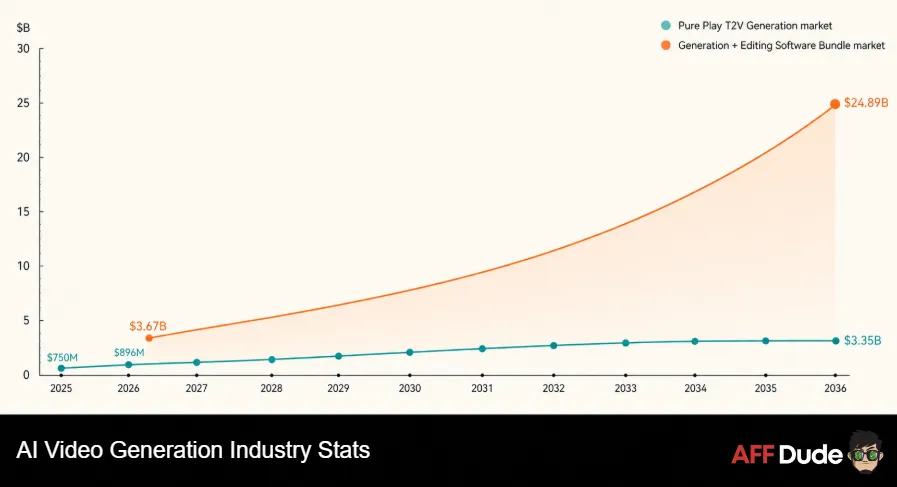
Pure play text to video generation revenue lands between $847 million and $946 million in 2026. Two respected houses put the same year at different points. One tracked 2025 at $716.8 million with an 18.8% growth rate. Another logged 2025 at $788.5 million and pegged 20.3% growth through 2033.
Both roads end in similar places. Long range calls sit around $3.35 billion by 2034 and $3.44 billion by 2033.
Now widen the lens. Bundle generation with AI powered editing software and the 2026 number jumps to $3.67 billion. Push out a decade and that pot reaches $24.89 billion.
Here is what we take from a gap that wide. Generation alone is still a niche line item. Editing, captioning and repurposing is where the money already lives.
Ali on the market size: ignore the headline market size. Watch the price per finished asset instead. That number decides your creative volume, and creative volume decides your CPA.
AI Video Generation Market Size, Region And Segment Breakdown
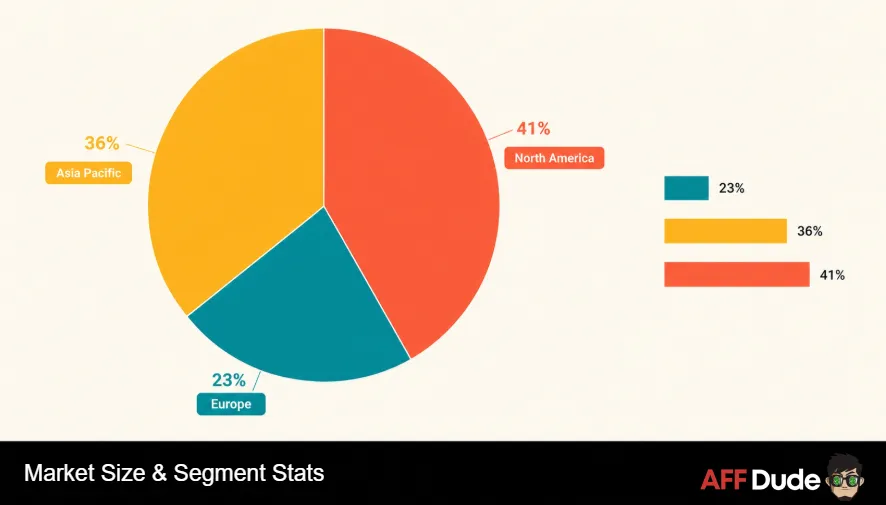
Regional splits also disagree, and for a boring reason. Analysts count different products under the same label.
| Cut Of The Market | 2026 Reading | Growth Signal | AffDude Note |
|---|---|---|---|
| Global pure generation revenue | $847M to $946M | 18.8% to 20.3% annual | Two credible reads, both rising |
| Generation plus editing software | $3.67 billion | 21.4% annual to 2036 | The realistic total pot |
| North America share | 41% | Largest single region | Highest CPMs, highest payouts |
| Europe share | 23.1% | Steady | Tightest disclosure rules incoming |
| Asia Pacific share | 20.9% to 31% | Fastest volume growth | Cheap models, huge creator base |
| Large enterprise share | 50.9% | Majority holder | Budgets, not speed |
| Small and mid sized business growth | 21.1% annual | Fastest growing buyer group | Where affiliates actually sit |
| Text to video share of creation methods | 46.3% | Dominant input | Cheapest way to test hooks |
| Image to video share of orders | 32.6% | Rising fast | Better product accuracy |
| Media and entertainment segment share | 23.87% | Largest vertical | Sets quality expectations |
One line stands out. Small teams are growing faster than enterprises at 21.1% a year. That is our crowd, and pricing is being built around us now.
Why Two Forecasts Never Agree On The Same Year
We get asked about this constantly, so let us settle it. Market reports count categories, not tools.
Our rule is simple. Quote the narrow number when talking about generation. Quote the wide number when budgeting a full content stack. Mixing both in one sentence is how bad decks get made.
AI Video Adoption Rate: Who Is Actually Pressing Generate
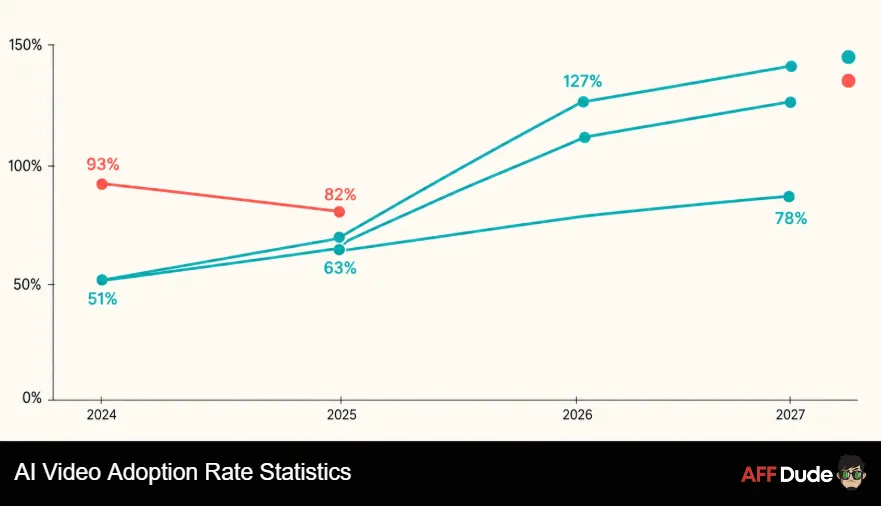
The AI video adoption rate moved faster than almost any tool category we have tracked. In one year, marketers using AI for video jumped from 51% to 63%.
Meanwhile 91% of businesses run video as a marketing channel. Around 93% call video important to overall strategy.
Wider surveys put roughly 78% of marketing teams using AI generated clips in at least one campaign cycle. Enterprise spend on AI video platforms grew 127% year on year in 2025.
Here is the awkward part. Reported ROI satisfaction fell from 93% to 82% across the same period.
More people making video does not mean more people making good video. Volume went up. Average quality went down. Satisfaction followed.
Video Ad Spend In 2026 And The Slice AI Owns
Now zoom out to the money moving through paid channels. Digital video ad spend reaches roughly $223.5 billion in 2026.
Short form video ad spend alone accounts for about $122.5 billion of that pot. More than half.
Generated creative claims a projected $9.1 billion globally this year. Call it 12% of all digital video advertising.
Read those three numbers together and the story is obvious. AI is not replacing video budgets. It is quietly eating the production line underneath them.
Buy side intent backs this up. Around 86% of ad buyers already use or plan to use generative tools for video creative.
Roughly 52% of B2B marketers named AI video their top new technology adoption for the year.
The Dude's honest call: production budget is shifting into media budget. Teams saving 70% on creative are pushing that money straight into distribution.
Avatar Video Is The Quiet Money Maker
AI avatar video platforms get far less attention than cinematic generation. Revenue says they deserve more.
The avatar segment was valued around $6.06 billion in 2024. Growth calls sit above 40% annually through 2030.
Use cases are boringly practical. Around 35% of corporate training videos produced in 2026 use avatars rather than filmed presenters.
Three years earlier that figure was 8%.
Language coverage is the real weapon. Leading avatar tools now support 175 or more languages from a single English script.
For anyone running offers across multiple regions, that changes the maths completely. One script becomes twenty localised assets.
Speed: The Thirteen Day Problem Is Gone
Cost gets the headlines, but speed changed our workflow more. A 60 second asset used to take about 13 days from brief to delivery.
Generated clips under ten minutes now render in under five minutes. The same content took four to six hours through traditional production.
That collapse matters for one specific reason. Creative fatigue on paid social runs on a weekly clock.
If your refresh cycle is slower than your fatigue cycle, you lose money. Simple as that.
PowerPoint to video is the fastest growing input method at about 21.8% annual growth. Boring, but it feeds a lot of B2B funnels.
AI Video Production Costs Versus The Old Way
AI video production costs are the part that genuinely shocked us. A traditional finished minute ran around $4,500 in agency land. A 60 second asset took roughly 13 days from brief to delivery.
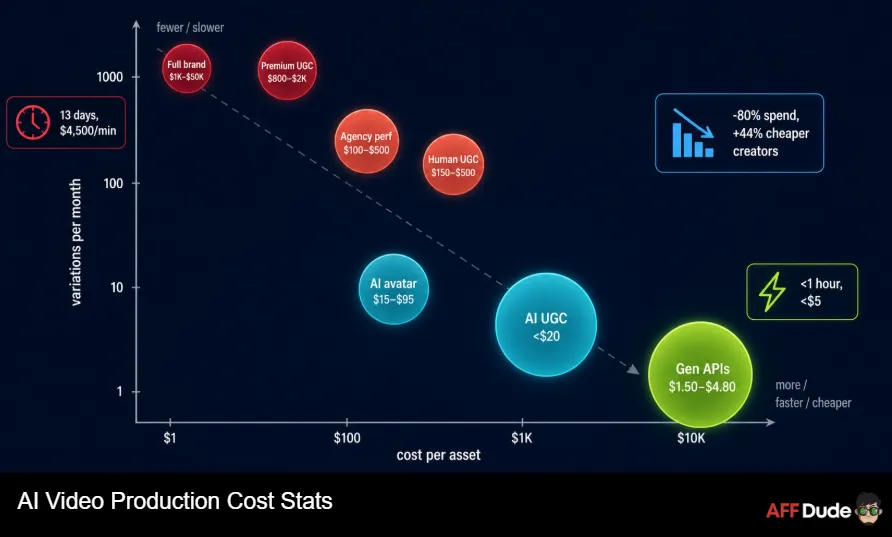
Now compare that to a generated clip at a couple of dollars per minute. Reported savings on switching to AI assisted workflows reach 80%.
Creator sourced clips got cheaper too. Average creator rates fell 44% year on year to about $198 per deliverable.
| Production Method | Cost Per Finished Minute | Turnaround | Variations Per Month | Best Use Case |
|---|---|---|---|---|
| Full brand production | $1,000 to $50,000 | 2 to 6 weeks | 1 to 3 | Hero brand film |
| Agency performance video | $100 to $500 per ad | 3 to 10 days | 5 to 15 | Evergreen offer pages |
| Human creator UGC | $150 to $500 per asset | 4 to 7 days | 5 to 20 | High trust social proof |
| Premium creator UGC | $800 to $2,000 per asset | 5 to 10 days | 2 to 6 | Proven conversion angles |
| AI avatar platforms | $15 to $95 monthly | Under 1 hour | 50 to 300 | Talking head offers |
| Generative model APIs | $1.50 to $4.80 | Minutes | 200 to 1,000 | Hook and B roll testing |
| AI UGC ad output | Under $20 per asset | Under 1 hour | 100 plus | Volume creative testing |
Read the far right column, not the far left. Cost per asset is not the real prize. Variations per month is.;
The Dude verdict on speed: a $500 agency ad delivered tomorrow beats a $200 creator clip delivered in five days. Speed compounds when you are burning creative every week.
Cost Per Generated Second: The Number Media Buyers Should Track
Cost per generated second is where budgets get decided in 2026. Charges run per second of finished output, so the maths stays simple.
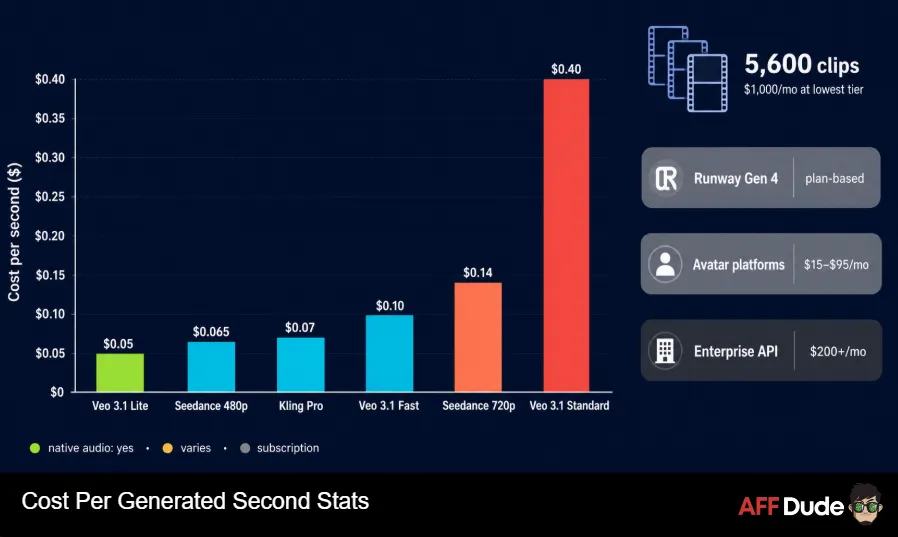
Entry tiers start near five cents a second. Flagship tiers reach forty cents. That is roughly an eight times spread across the same task.
| Model Tier | Cost Per Generated Second | 60 Second Clip | Native Audio | Where We Would Use It |
|---|---|---|---|---|
| Veo 3.1 Lite | $0.05 | $3.00 | Yes | Bulk hook testing |
| Veo 3.1 Fast | $0.10 | $6.00 | Yes | Mid funnel creative |
| Veo 3.1 Standard | $0.40 | $24.00 | Yes | Winning ad scaling only |
| Kling (Pro tier) | About $0.07 | About $4.20 | Varies | Best value cinematic |
| Seedance 2.0 (480p) | $0.065 | $3.90 | Varies | Cheap B roll volume |
| Seedance 2.0 (720p) | $0.14 | $8.40 | Varies | Product close ups |
| Runway Gen 4 family | Subscription led | Plan dependent | Add on | Client deliverables |
| Avatar platforms | Seat based | $15 to $95 monthly | Yes | Talking head offers |
| Enterprise API plans | Custom | $200 monthly plus | Yes | Automated pipelines |
Run the maths on a real budget. At the cheapest tier, $1,000 a month buys over 5,600 eight second clips.
No creator on earth ships that volume. That is the actual shift.
Who Is Winning The Generative Video Model Race
The tool ranking reshuffled hard during 2026. Runway hit roughly $300 million annualised revenue and a $5.3 billion valuation.
Kling took around 22% of a $1.1 billion model market by revenue. Runway took roughly 27%. Together they hold about half.
On the avatar side, HeyGen ran from $1 million annualised revenue in early 2023 to about $100 million by late 2025. Synthesia raised a $200 million round and still earns more per customer.
That last bullet matters more than it looks. Switching costs are already forming in a two year old category.
The Sora Shutdown And What It Cost Everyone
You cannot write honest AI video generation statistics for 2026 without covering this one. Sora hit a million downloads in under five days after launch.
Then the economics caught up. Reported running costs vastly outpaced consumer revenue, and OpenAI wound down the consumer app during 2026.
Third party tools had already wired Sora into their pipelines. Some rebuilt on other models within weeks.
Three lessons we now apply to every tool we list:
Straight from the vault: we stopped recommending single model workflows in 2026. Every tool in our catalogue now needs a fallback model, or it does not get listed.
AI Generated Video Ads: Real Performance Numbers
Now the part affiliates actually care about. Do AI generated video ads actually convert?
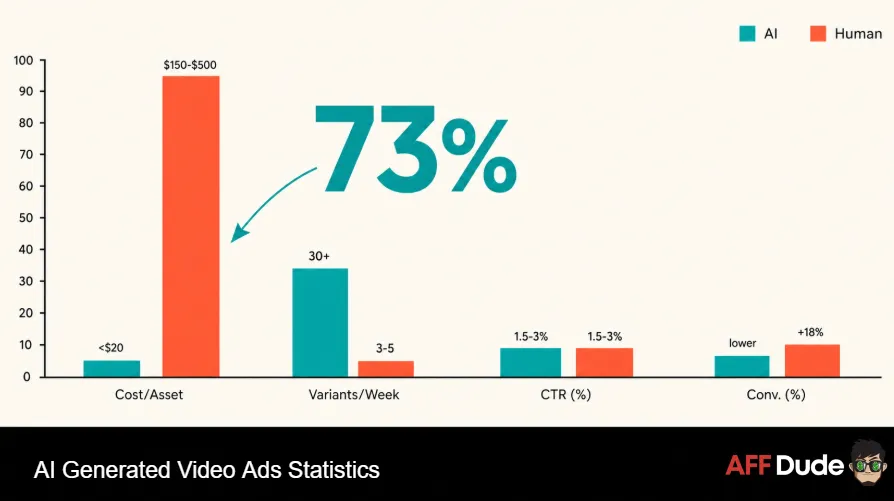
Field data says roughly yes, with caveats. AI built UGC typically lands at 85% to 110% of a strong human clip on click through rate.
Like for like tests show AI creative running about 12% higher click through in some accounts. Other tests show real creators converting 18% better on the same spend.
Both results can be true. Click through and purchase are different jobs.
| Metric | AI UGC Creative | Human Creator UGC | What We Have Seen |
|---|---|---|---|
| Cost per asset | Under $20 | $150 to $500 | 73% average saving |
| Turnaround | Under 1 hour | 4 to 7 days | Testing cycle collapses |
| Click through rate on Meta | 1.5% to 3% | 1.5% to 3% | Roughly level with a strong hook |
| Relative click through | 85% to 110% of human | Baseline | Script drives the gap |
| Purchase conversion | Lower on trust led offers | Up to 18% higher | Humans still win at the close |
| Variants testable per week | 30 plus | 3 to 5 | Volume is the real edge |
| Cost per acquisition impact | Falls with volume testing | Falls with proven angles | Hybrid beats either alone |
| Best vertical fit | Sweeps, apps, utilities | Nutra, beauty, finance | Trust level decides |
| Disclosure requirement | Mandatory on Meta and TikTok | Not applicable | Label it, do not hide it |
| Creative fatigue speed | Fast | Slower | Refresh weekly, not monthly |
Script Beats Avatar Every Single Time
One stat from ad testing deserves its own section. Script quality accounts for around 80% of a UGC video's performance.
A brilliant avatar cannot save a weak hook. A decent avatar with a sharp opening line will outperform it easily.
One skincare test made the point brutally. Three variants using the same tight promise in the first line hit 4.2% click through on TikTok. The other nine averaged 1.1%.
Total spend on those twelve videos was six dollars.
So stop shopping for prettier models. Write forty hooks instead, then let spend pick the winner.
Where Video Still Beats Every Other Format
Before anyone writes off video as saturated, look at the conversion data. Landing pages carrying video convert at about 4.8% against 2.9% without.
Some tests report conversion lifts up to 86% on pages with embedded video.
Email performs even better. Video in email drives around 9.1% conversion against 5.4% without.
Product pages tell a similar story. Pages with video achieve roughly 65% higher average conversion.
About 85% of consumers say a video has persuaded them to buy something.
So the format still works. What changed is how cheaply your competitors can now produce it.
Worth pinning somewhere: video was never the moat. Distribution and trust were. AI just removed the last excuse for not shipping video at all.
The Quality Ceiling Nobody Mentions In Tool Reviews
Every vendor demo looks brilliant. Then you run 200 generations and reality lands.
Our members report a usable hit rate somewhere between 20% and 40% on first pass generations. The rest get binned.
Factor that into your cost maths. A three cent second becomes an effective nine cent second after failures.
Even so, the economics still crush traditional production by a wide margin.
Two other constraints show up repeatedly:
- Only 5% to 10% of tested ad creatives ever become winners, generated or filmed
- Creative quality drives around 56% of sales lift, more than targeting or placement
That second figure is the one to tattoo somewhere. Generation gives you volume. Only judgement gives you a winner.
AI Slop On Social Feeds: The Saturation Problem
Here is where the numbers get ugly for organic affiliates. Roughly 59% of clips served to a brand new TikTok account qualify as low effort AI filler.
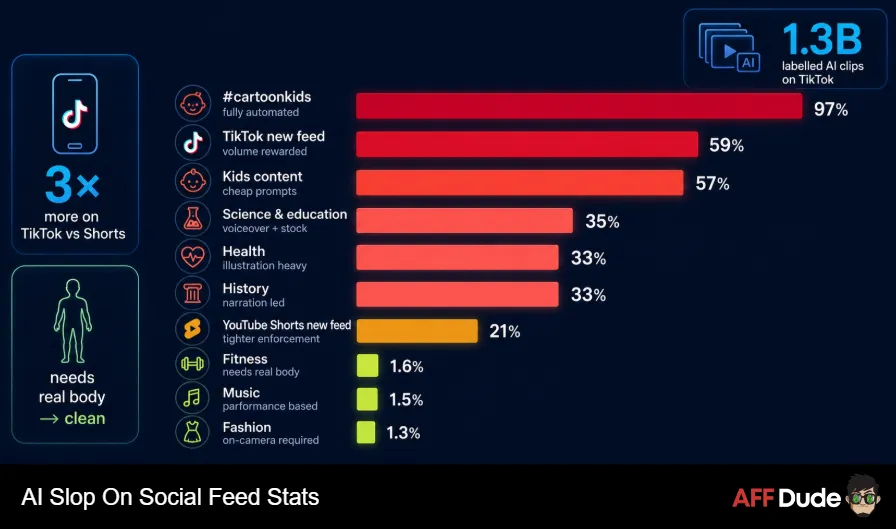
YouTube Shorts sat at 21% in the same testing. TikTok serves close to three times more.
Category level splits explain why some niches feel unusable now.
| Platform Or Category | Share Classed As AI Filler | What Drives It | Affiliate Impact |
|---|---|---|---|
| TikTok new account feed | 59% | Volume rewarded over quality | Organic reach diluted |
| YouTube Shorts new account feed | 21% | Tighter enforcement | Cleaner surface to build on |
| Kids content | 57% | Cheap animation prompts | Avoid entirely, brand risk |
| #cartoonkids tag | 97% | Fully automated pipelines | Dead zone |
| Science and education | 35% | Voiceover plus stock visuals | Harder to stand out |
| Health | 33% | Illustration heavy formats | Compliance risk rising |
| History | 33% | Narration led content | Low trust signals |
| Fitness | 1.6% | Physical demonstration needed | Human presence still wins |
| Music | 1.5% | Performance based | Low saturation |
| Fashion | 1.3% | On camera styling required | Best organic opportunity |
| Videos labelled AI by TikTok | 1.3 billion | Automatic detection at scale | Labels are now default |
Spot the pattern. Categories needing a real body on camera stayed clean. Categories built on narration got flooded.
Media buyer reality check: if your niche shows above 30% filler, treat organic as a slow lane. Put budget into paid placement and email while you build authority.
Can Anyone Still Spot AI Footage? Barely
Detection collapsed faster than most people expected. Only about 9.5% of viewers reliably tell generated footage from filmed footage.
Yet 83% of consumers believe they can spot it. Confidence far outruns accuracy.
That gap creates a strange risk. Audiences punish clips they merely suspect are synthetic.
Around 36% say suspected AI content lowers brand trust. Roughly 78% say they trust video featuring real people more.
So the penalty does not depend on being caught. It depends on feeling off.
The Disclosure Gap Nobody Is Fixing
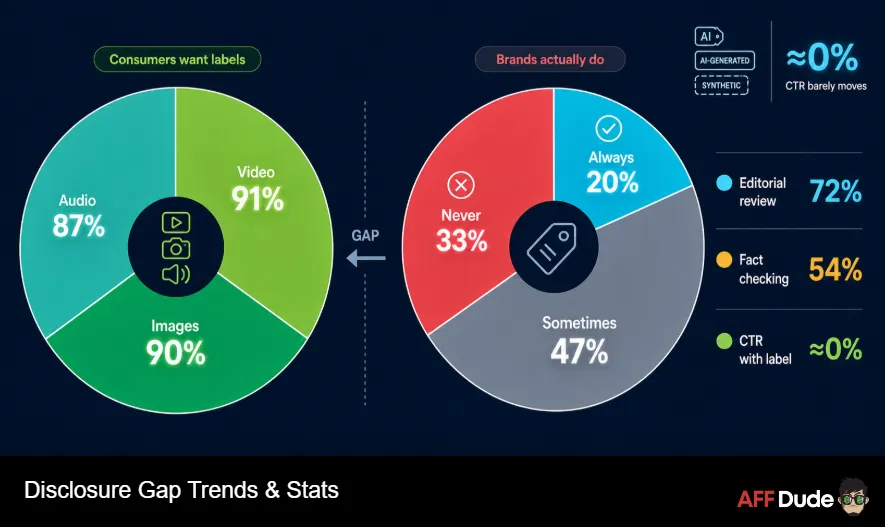
Consumers made their position obvious. Labelling demand sits at 91% for video, 90% for images and 87% for audio.
Brand behaviour tells a different story. Only 20% of organisations always disclose AI use. Another 33% never disclose at all.
Quality control is patchy too. About 72% run human editorial review, but only 54% add fact checking.
Meta and TikTok already require AI labelling on ad creative. Early data suggests the label barely dents click through in most categories.
Which means the fear is mostly imaginary. Label it, keep the creative sharp, move on.
Regulation: What Changes For Video In 2026
Synthetic media disclosure rules under the European AI Act land during 2026. Synthetic media needs clear marking.
Platform policy moved first anyway. TikTok has already labelled 1.3 billion clips as AI generated.
YouTube removed several large automated channels with billions of combined views during 2026.
Practical takeaways for anyone running offers across regulated markets:
Where AI Video Actually Prints Money For Affiliates
We have run these tools across sweeps, dating, nutra and SaaS offers. Results split cleanly by trust requirement.
Low trust, high volume offers respond brilliantly. High trust, high ticket offers still need a human face.
Our working split, based on what our members report and what we run ourselves:
Notice the pattern again. Generation wins on volume. Humans win on trust.
What we would actually do: build creative in two lanes. Lane one is cheap generated testing at scale. Lane two is a small set of human clips reserved for proven winners.
Where AI Video Still Breaks
Nothing in this category is finished yet. Being honest about failure points saves budget.
The last one bit real operators during 2026. Build assuming your model provider might vanish.
Our Own Read On The Next Twelve Months
Time for our calls. These are not lifted from any report. They come from what we track across our catalogue and our members.
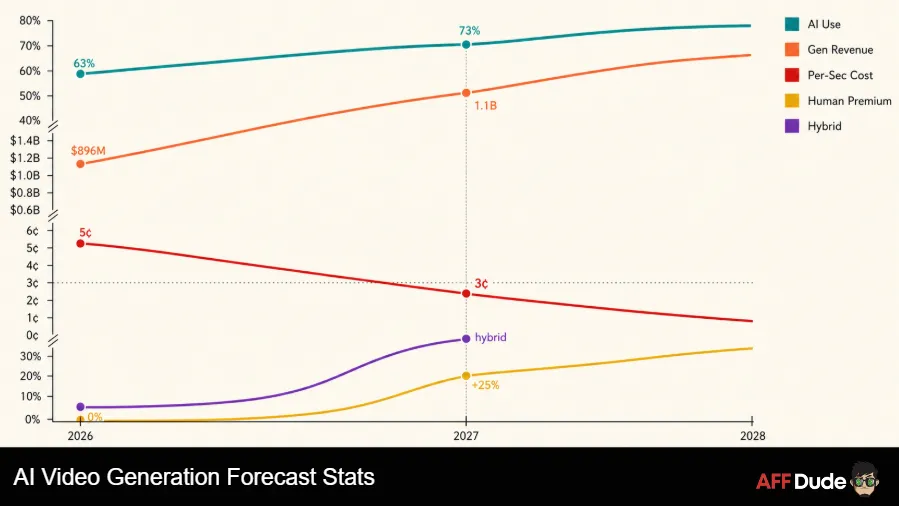
We would put decent confidence behind the first three. The disclosure call is the riskiest one on the list.
Our reasoning is simple. Every previous quality crisis on a platform ended with enforcement, not self correction.
What All Of This Means For Affiliate Sites
Most stats posts stop at market size. Ours has to answer a harder question. What changes on your site next month?
Three shifts hit affiliates hardest, and none of them are theoretical.
First, review video became cheap enough that everybody makes it. Your competitor now ships a clip per product page.
Second, feed saturation means organic short form is a slower lane than it was two years ago. Paid and email carry more weight now.
Third, trust became the scarce asset. Real screenshots, real accounts and real payout proof outrank polished renders.
Here is what we changed on our own properties during 2026:
None of this is complicated. Use machines for volume and people for proof.
The AffDude Playbook For AI Video In 2026
Enough numbers. Here is how we would spend a month.
Total generation spend for that cycle sits under fifty dollars. Creator spend only enters after the data picks the angle.
That order matters. Most people buy the creator first, then guess the hook. Reverse it.
Sources We Used For These AI Video Generation Statistics
Every figure above was cross checked across the sources below. Where two houses disagreed, we said so rather than picking the prettier number.
- Fortune Business Insights
- Grand View Research
- Meticulous Research
- Wyzowl State of Video Marketing
- Kapwing TikTok AI Filler Report
- Kapwing AI Video Disclosure Data
- Fractl AI Trust Study
- Animoto State of Video
- YipitData B2B Spend Analysis
- Statista
- eMarketer
- Gartner
- IAB
- Nuremberg Institute for Market Decisions
- Sovran Video Ad Production Benchmarks
Recommended Articles

Affiliate Disclosure: This post may contain some affiliate links, which means we may receive a commission if you purchase something that we recommend at no additional cost for you (none whatsoever!)