


A blogger checks the Ezoic dashboard after a slow month, and the numbers just sit there. Support replies feel scripted. Site speed still lags. Something is off, but the cause stays unclear.
Then the research starts, and it gets messier. One forum swears by Mediavine. Another insists Raptive. Traffic thresholds, RPM promises, payment terms — every ad network tells a different story.
So which Ezoic alternatives actually fit a small or mid-sized site? That depends on monthly traffic, niche, and how much control a publisher wants over ad placements.
The top Ezoic alternatives below are compared on approval requirements, real earning potential, and setup effort — useful for beginners and experienced creators alike.
Why the 250,000-User Rule Made Ezoic Alternatives Urgent for Small Publishers

In February 2026, Ezoic raised its entry requirement from 10,000 monthly users to 250,000. The change removed platform access for a large share of its publisher base almost overnight.
Sites drawing between 5,000 and 249,999 monthly users lost eligibility regardless of revenue history, niche, or account standing. Ezoic framed the decision around ad inventory quality and platform efficiency.
For smaller publishers, the consequence was immediate and practical. Ad code needed replacing while traffic kept arriving.
Three pressures made the search for Ezoic alternatives urgent:
Sequencing matters here. Publishers who apply to a new ad network before removing Ezoic keep earnings flowing through the handover period.
What follows compares eight ad networks by traffic threshold, revenue share, and payout terms, beginning with the options built for that displaced 5,000 to 250,000 band.
How These Ezoic Alternatives Were Scored (Methodology)
Ad network rankings often rest on advertised figures rather than measured outcomes. The eight Ezoic alternatives below were assessed against four criteria that publishers can verify independently:
Traffic eligibility sits outside the scoring itself, because qualification depends entirely on site size rather than network quality.
The 8 Top Ezoic Alternatives, Ranked
| Top Ezoic Alternatives | Placement Control | Setup Complexity |
|---|---|---|
| Newor Media | Shared with team | Low, script based |
| Raptive | Network controlled | Low, managed onboarding |
| Monumetric | Network controlled | Medium, plugin install |
| Setupad | Publisher configurable | High, wrapper setup |
| Mediavine | Network controlled | Low, plugin driven |
| MonetizeMore | Publisher retained | High, GAM integration |
| Adsterra | Fully publisher controlled | Very low |
| Media.net | Publisher controlled | Low, code paste |
1. Newor Media
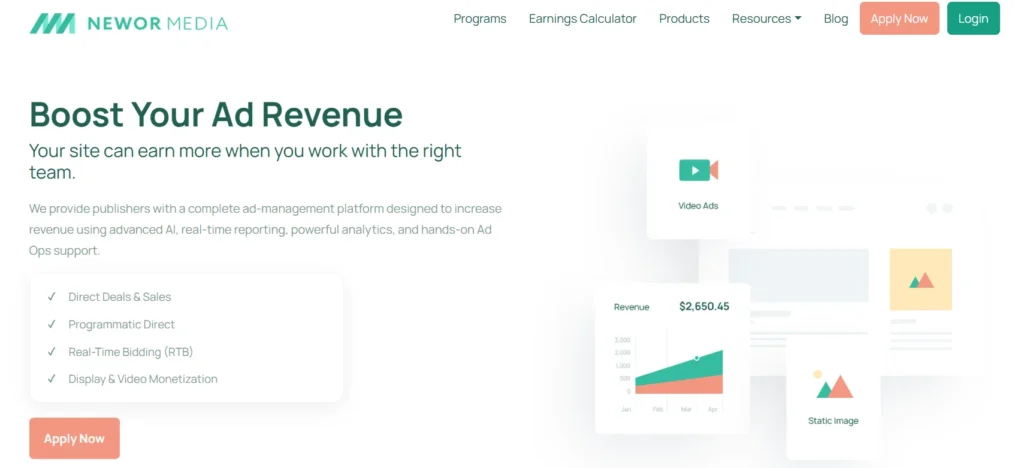
Newor Media is a US based managed ad platform that routes display inventory through header bidding auctions across multiple premium demand partners. Publishers keep their own ad server relationships while Newor handles yield management, placement testing, and demand routing.
The platform sits directly in the segment Ezoic vacated in February 2026. Sites drawing between 5,000 and 250,000 monthly users fall outside Ezoic eligibility, and Newor accepts applications at the lower end of that band without niche restrictions.
Onboarding uses a script insertion and an ads.txt update rather than nameserver control, so DNS ownership stays with the publisher. Support runs through assigned account managers instead of ticket queues, which suits creators leaving automated platforms.
| Specification | Detail |
|---|---|
| Traffic minimum | 5,000 monthly users |
| Monetisation model | Managed header bidding |
| Ad formats | Display, video, native |
| Integration method | Script plus ads.txt |
| Support structure | Dedicated account manager |
| Niche restrictions | None applied |
Best for: Publishers between 5,000 and 250,000 monthly users who lost Ezoic access and want managed header bidding without niche limits or nameserver handover.
2. Raptive

Raptive, formerly AdThrive and CafeMedia, functions as a full service ad management partner for independent content creators. Its team designs layouts, negotiates demand, and runs ongoing optimisation, leaving publishers free to concentrate on content.
In October 2025 the company retired its Rise program and folded entry level publishers into a single Insider tier. The consolidation cut the qualifying threshold by 75 percent and opened the network to mid sized sites previously locked out.
Geographic mix carries more weight here than raw volume. Applications are judged on the share of traffic arriving from Tier 1 markets alongside content originality, site build quality, and domain age. Food, travel, and lifestyle creators make up much of the roster.
| Specification | Detail |
|---|---|
| Traffic minimum | 25,000 monthly pageviews |
| Tier 1 requirement | 50% under 100,000 |
| Larger site threshold | 40% above 100,000 |
| Domain age | Six months minimum |
| Entry tier name | Insider |
| Analytics requirement | Google Analytics configured |
Best for: Established creators above 25,000 pageviews with majority US, UK, Canadian, Australian, or New Zealand audiences who prefer hands off management and premium demand access.
3. Monumetric

Monumetric occupies the space between self serve platforms and premium managed networks, accepting sites well below Raptive or Mediavine thresholds. Founded in 2012, it holds Google Certified Publishing Partner status and manages operations for over 1,500 publisher sites.
Implementation is unusually hands on. The team requests site access, installs a plugin, and configures placements directly, typically specifying five or six units per page including footer and video slots.
Pricing tiers follow traffic volume. The entry Propel level carries a one time setup charge that disappears once a site crosses into the Ascend band, making the network more cost efficient for growing blogs than for brand new ones.
| Specification | Detail |
|---|---|
| Traffic minimum | 10,000 monthly pageviews |
| Entry tier name | Propel |
| Setup fee | $99 one time |
| Fee waiver point | Above 80,000 pageviews |
| Payment terms | Net 60 |
| Supported platforms | WordPress, Blogger |
Best for: Growing blogs in the 10,000 to 80,000 pageview range that want managed placement and can absorb a setup fee plus a net 60 payment lag.
4. Setupad
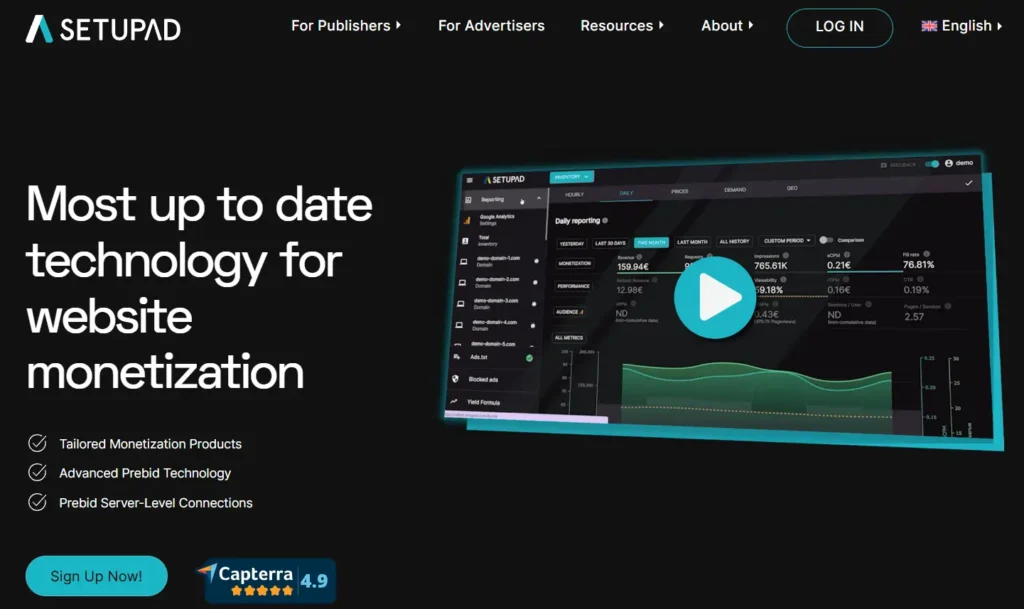
Setupad is a Latvia based header bidding specialist built for publishers who want visibility into the auction rather than a sealed optimisation layer. Its wrapper runs Prebid alongside server side connections and exposes bid level reporting that most managed networks withhold.
Three service models are available: a fully managed option, a self serve wrapper, and a SaaS arrangement for large publishers operating their own Google Ad Manager instance with direct sales.
Revenue splits are negotiated per publisher rather than fixed, and consent management arrives bundled at no extra charge, which matters for sites serving EU readers under GDPR. The tradeoff is an entry bar that excludes most smaller publishers.
| Specification | Detail |
|---|---|
| Traffic minimum | 100,000 monthly visitors |
| Headquarters | Riga, Latvia |
| Core technology | Prebid header bidding |
| Platform share | Capped at 20% |
| Included tooling | Free consent platform |
| Preferred markets | US, UK, Australia |
Best for: Mid to large publishers above 100,000 monthly visitors, particularly European sites needing GDPR tooling and granular bid transparency instead of fully automated optimisation.
5. Mediavine

Mediavine rebuilt its eligibility model in January 2026, replacing the long standing session threshold with a revenue based one. Applicants to the main network now qualify on annual ad earnings rather than raw traffic volume.
Journey by Mediavine serves as the on ramp. It opens at a low session count, runs through the Grow plugin, and upgrades sites automatically once trailing twelve month earnings clear the main network bar.
Revenue share climbs across named performance tiers, so publishers scaling quickly retain a larger cut over time. The Grow plugin is mandatory for traffic verification, and its script weight is worth testing against Core Web Vitals before committing.
| Specification | Detail |
|---|---|
| Journey minimum | 1,000 monthly sessions |
| Main network entry | $5,000 annual revenue |
| Journey revenue share | 70 percent |
| Automatic upgrade trigger | $5,000 trailing earnings |
| Required plugin | Grow by Mediavine |
| Traffic metric used | Tier 1 sessions |
Best for: Content creators at nearly any size, from 1,000 sessions upward, who want one network with a defined progression path and rising revenue share tiers.
6. MonetizeMore
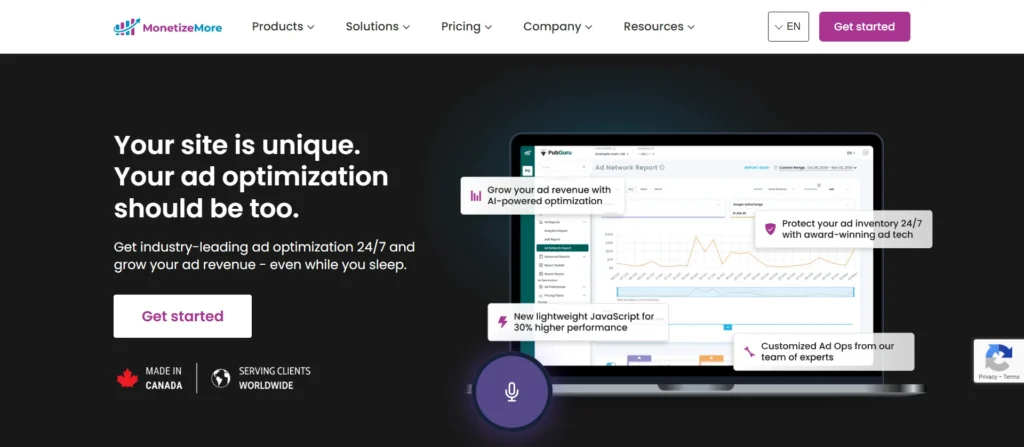
MonetizeMore operates at the enterprise end of publisher ad tech, pairing managed ad operations with proprietary software rather than acting as a conventional network. The company launched in 2010 and holds Google Certified Publishing Partner status.
Its PubGuru wrapper runs parallel header bidding auctions across dozens of demand partners, with AI assisted floor pricing and unified reporting drawn through the Google Ad Manager API. A separate product, Traffic Cop, screens invalid traffic to reduce clawbacks and policy strikes.
Publishers keep ownership of their ad server and network accounts rather than routing inventory through the vendor, which appeals to teams running direct sales. Entry requirements sit well above most alternatives covered here.
| Specification | Detail |
|---|---|
| Revenue requirement | $5,000 monthly revenue |
| Pageview alternative | 2 million monthly |
| Pricing model | Performance revenue share |
| Core product | PubGuru wrapper |
| Fraud protection | Traffic Cop |
| Founded | 2010 |
Best for: Larger publishers and media teams already running Google Ad Manager who need invalid traffic protection, floor optimisation, and retained ownership of their ad stack.
7. Adsterra

Adsterra takes a different route from managed display networks, running as a self serve marketplace with fast approval and no volume gate. Publishers register, add a placement, and begin serving within hours rather than weeks.
Format breadth is the main attraction. Beyond standard display, the network supplies popunder, in page push, native units, interstitials, and direct link options that monetise traffic types premium networks price poorly or decline outright.
That flexibility carries a user experience cost. Aggressive formats lift short term yield while raising bounce risk, so publishers protecting search rankings usually restrict placements to display and native. Tier 2 and Tier 3 audiences perform noticeably better here than on US focused platforms.
| Specification | Detail |
|---|---|
| Traffic minimum | None required |
| Approval speed | Same day typically |
| Business model | Self serve marketplace |
| Signature formats | Popunder, push, native |
| Geographic strength | Tier 2, Tier 3 |
| Referral program | 5 percent lifetime |
Best for: New sites, international audiences, and publishers declined elsewhere who need immediate monetisation and will manage format selection carefully to protect user experience.
8. Media.net
Media.net built its business on contextual advertising drawn from the Yahoo and Bing search advertiser pool, which makes it structurally distinct from the programmatic display networks elsewhere in this comparison. Ads match page content rather than browsing history.
That contextual foundation has gained relevance as cookie deprecation and privacy regulation erode behavioural targeting. Sites covering finance, technology, insurance, and legal topics tend to see the strongest returns, since search advertiser bids in those categories run high.
Approval is manual and standards are strict, with a clear preference for original English language content serving North American and British readers. Ad units can be styled to match site design, helping preserve layout consistency.
| Specification | Detail |
|---|---|
| Demand source | Yahoo, Bing advertisers |
| Targeting type | Contextual, not behavioural |
| Approval process | Manual review |
| Preferred markets | US, UK, Canada |
| Content language | English required |
| Unit customisation | Colour, layout matching |
Best for: English language sites in high value niches such as finance, insurance, or technology seeking cookie independent contextual demand alongside or in place of AdSense.
Matching Ezoic Alternatives to Your Traffic Band
Traffic volume determines which Ezoic alternatives will accept an application, making it the first filter to apply. Thresholds are published in different units, so conversion matters before comparing:
Sessions, pageviews, and users produce different numbers from identical traffic, so verify which metric a network measures.
How to Migrate From Ezoic to an Alternative Without Losing Revenue
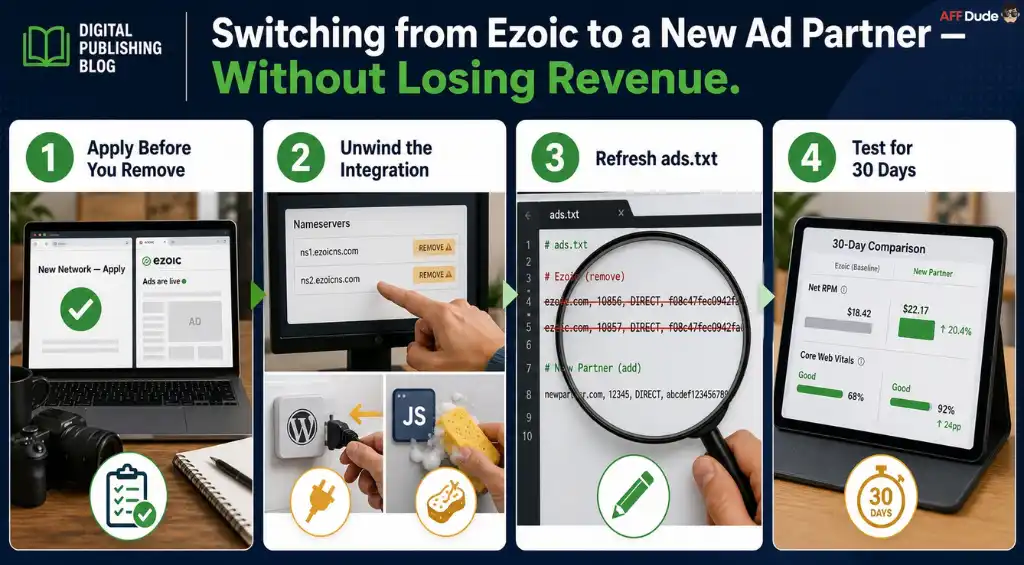
Migration order protects earnings. Removing Ezoic before securing approval elsewhere leaves a site unmonetised for the length of a review cycle:
Seasonality skews shorter tests, so avoid judging results inside a single fortnight.
Final Thoughts on Ezoic Alternatives
Traffic thresholds shift. Networks restructure their tiers. The platform that suits a site today may not suit it at double the volume, and that is normal rather than a sign of a mistake.
What holds steady is the method. Apply before removing anything. Measure net earnings after revenue share. Watch how ad scripts affect page speed and reader behaviour, not just the dashboard total.
Most publishers land somewhere reasonable within a month or two of testing. Give the process a little patience, and the right fit tends to become clear on its own.
Recommended Articles

Affiliate Disclosure: This post may contain some affiliate links, which means we may receive a commission if you purchase something that we recommend at no additional cost for you (none whatsoever!)