

The renewal quote lands and the number has moved again. Setup fees, overage lines, a support tier that costs extra. Everflow works, but the invoice stops matching what a network actually earns per click.
Then the research starts and it gets murky. Some affiliate tracking platforms bill per conversion, some per click, some hide caps in the contract. Feature lists look identical until a migration goes wrong.
Affiliate managers, network owners, and SaaS partner teams all hit this point. The best Everflow alternatives below were compared on cost, tracking depth, and how hard it is to leave. The gap between them shows up after the contract is signed.
How We Tested Every Everflow Alternative in This Ranking
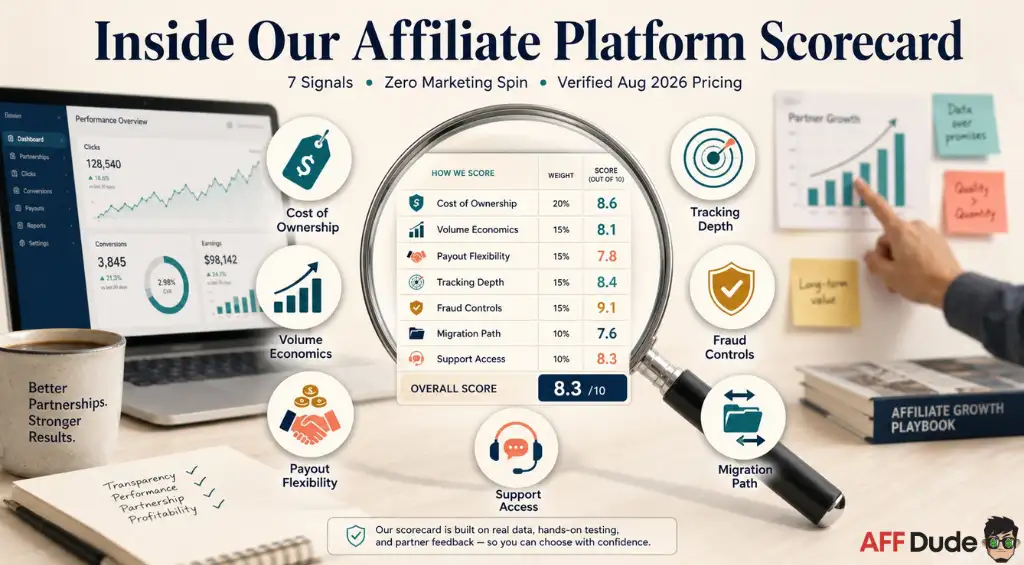
Rankings here rest on a fixed scorecard rather than vendor marketing pages. Each platform was scored against the same seven signals, using pricing pulled from official sites in August 2026 and cross-checked against recent G2 and Capterra reviews.
The seven signals:
Feature claims lacking confirmation in public documentation or a live trial were left out of the scoring. Where a vendor publishes pricing only on request, that gap is stated plainly in the tool section rather than estimated.
The at-a-glance table below applies these signals across all seven Everflow alternatives.
7 Best Everflow Alternatives at a Glance
| Best Everflow Alternatives | Primary Vertical | Program Stage |
|---|---|---|
| impact.com | Enterprise retail brands | Multi-program maturity |
| Affise | CPA and mobile networks | Scaled catalogs |
| Tapfiliate | Ecommerce and subscription | Early program launch |
| PartnerStack | B2B SaaS | Post-ARR growth |
| Trackier | Ad networks, iGaming | High-impression volume |
| TUNE | Networks, agencies | Established operations |
| Scaleo | iGaming operators | Mid-market networks |
1. impact.com: The Everflow Alternative Built for Multi-Program Partner Ecosystems
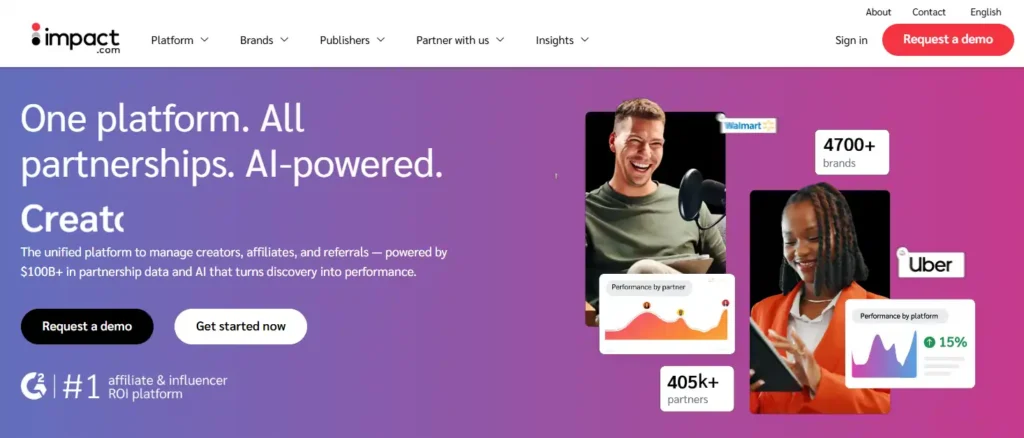
impact.com sits at the enterprise end of the Everflow alternatives market, built to run affiliates, creators, referral partners, and B2B publishers through one attribution and payout layer. Founded in 2008 and formerly known as Impact Radius, the platform handles attribution, automated payouts, contracts, and fraud detection across web, mobile, and offline conversions.
For brands leaving Everflow because partner types keep multiplying, the appeal is consolidation. Its marketplace gives brands access to vetted publishers, creators, and referral partners, filterable by audience, category, and performance history.
Pricing is quote-led rather than published, which changes how procurement works compared to self-serve affiliate tracking software.
impact.com Key Features
Best for: Brands running several partner types at once who need one attribution system and can absorb enterprise pricing plus a sales-led procurement cycle before launch.
2. Affise

Affise targets affiliate networks and media buying teams that outgrew basic tracking. Since 2017, over 1,000 companies have used the platform to manage performance campaigns across web and mobile.
The product splits in two. Affise Performance covers cross-device attribution for networks with customizable postbacks, real-time analytics, and integrated fraud prevention, while Affise Mobile Attribution handles installs, in-app events, re-engagements, and uninstalls on iOS and Android with SKAN and raw data export support.
That split matters for networks weighing Everflow alternatives with a mobile arm attached.
Affise Key Features
Best for: Established CPA networks and media buying teams with sizeable offer catalogs, particularly those tracking mobile installs alongside web conversions under one contract.
3. Tapfiliate
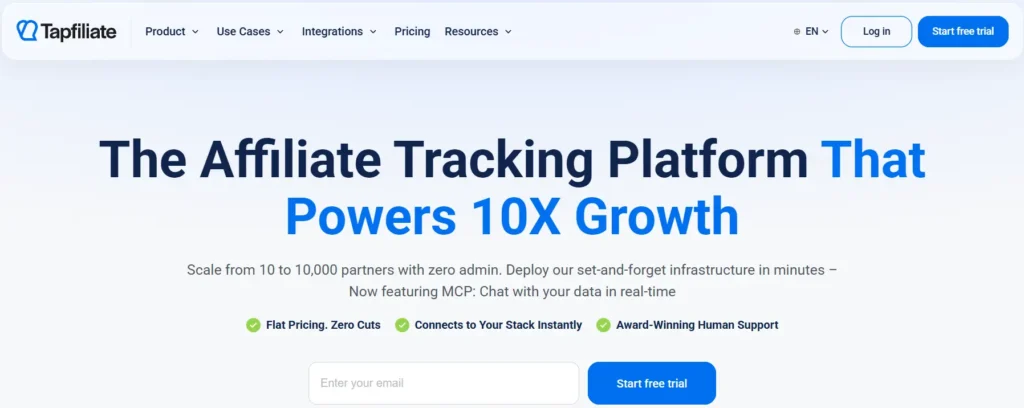
Tapfiliate takes the opposite position to enterprise trackers. It is affiliate tracking and management software aimed at ecommerce stores, SaaS companies, and subscription services that want a program live without developer involvement.
Setup speed is the headline claim. Over 30 pre-built integrations cover Shopify, WooCommerce, BigCommerce, Stripe, PayPal, Zapier, and Squarespace, with most accounts connected in under 30 minutes.
Billing avoids the revenue-share model common in this category. Tapfiliate charges a flat monthly subscription with no success fees or revenue cuts.
Tapfiliate Key Features
Best for: Ecommerce and subscription brands with modest volume that want predictable flat-fee affiliate tracking software and a program running the same week.
4. PartnerStack

PartnerStack was built for software companies rather than retail programs. It functions as a partner relationship management platform for affiliate, referral, and reseller programs, aimed at B2B SaaS brands rather than influencers or bloggers.
Its differentiator is supply. The marketplace holds over 115,000 active B2B SaaS partners, and the platform covers recruitment, onboarding, activation, tracking, and commission management in one system.
Long B2B sales cycles get specific handling. Partner-generated leads keep attribution through a six-month cycle when the click and the closed deal sit months apart.
PartnerStack Key Features
Best for: B2B SaaS teams running affiliate, referral, and reseller motions together, especially those wanting partner supply from an existing marketplace rather than cold recruitment.
5. Trackier
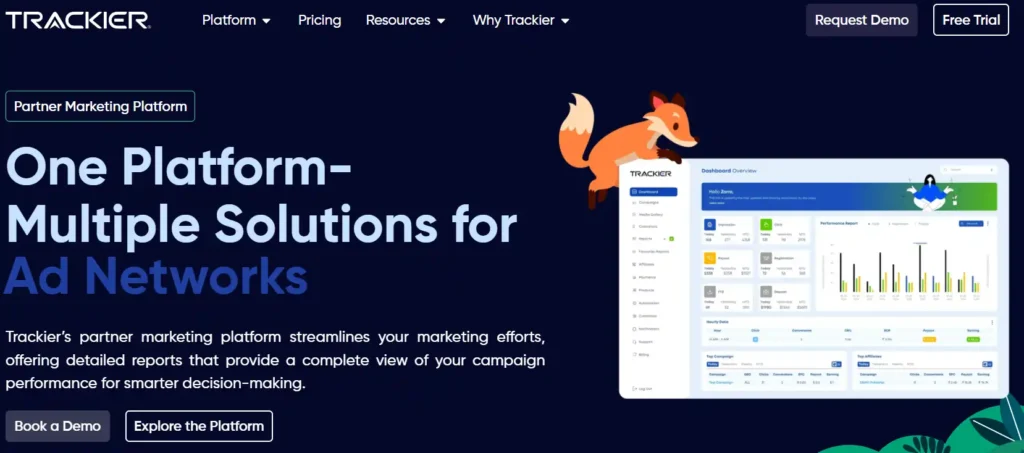
Trackier serves ad networks, agencies, and advertisers managing publisher relationships at volume. The platform covers campaign creation, automation, measurement, and optimization in one place, with fraudulent click data and conversion insights surfaced directly in account reporting.
Reporting depth is the draw for network operators. Real-time KPIs sit alongside comparison reports, goal reports, and CAP reports, with automatic publisher alerts on critical status changes.
Volume handling is documented too. Trackier processes over 20 billion events per month across its customer base.
Trackier Key Features
Best for: Ad networks and agencies running high-impression campaigns who want per-conversion billing, white-label publisher panels, and mobile attribution without a second vendor.
6. TUNE

TUNE has the longest operating history in this lineup. The company launched in Seattle in 2009 as HasOffers, a tool for running self-owned affiliate networks, and later became a full partner marketing platform spanning mobile, web, and multiple ad channels.
Control is the selling point. It is a fully customizable, white label SaaS solution for building and growing partner programs and affiliate networks, positioned for marketers who want flexibility and ownership of their data. Named customers include Shopify, Groupon, Chewy, Credit Sesame, Rackspace, and Grammarly.
TUNE Key Features
Best for: Networks and advertisers with technical resource in-house who value API depth, white-label control, and data ownership over quick onboarding.
7. Scaleo
Scaleo focuses tightly on three buyer groups. The platform is aimed at iGaming operators, affiliate networks, and media buying teams, merging performance and partnership channels into a single dashboard for analysis.
It operates as a white-label SaaS provider, so end users see the partner program as part of the client's own site.
Support terms are unusually specific for this category. Each client gets a dedicated Customer Success Manager, with a stated average response time of 2 minutes and a 95% satisfaction rate.
Scaleo Key Features
Best for: iGaming operators and mid-market networks wanting white-label tracking with hands-on account support and a documented migration path off an existing platform.
How to Migrate Off Everflow Without Losing Conversion History
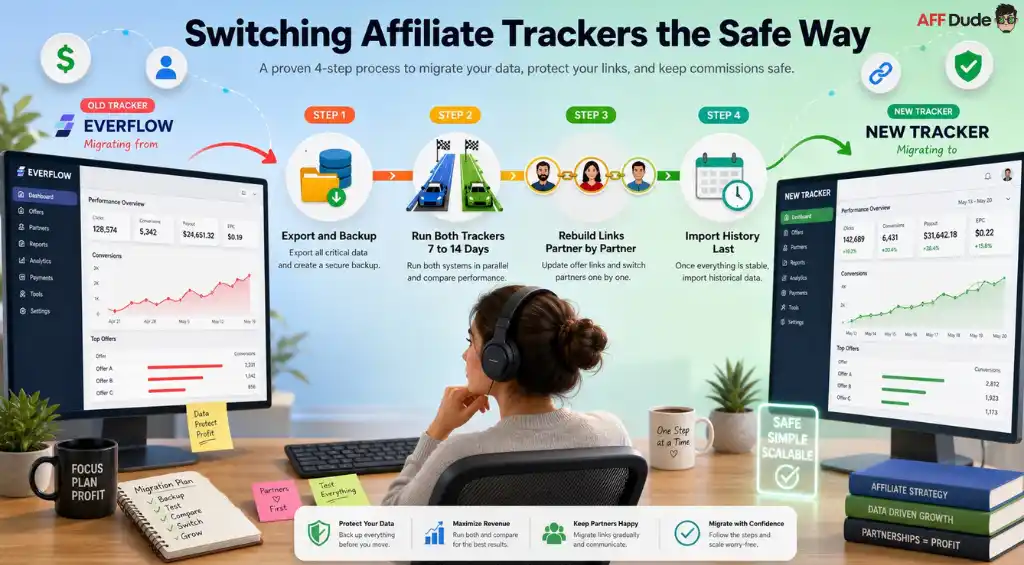
Conversion history is the asset at risk during a tracker switch. Partner payouts, offer-level EPCs and advertiser reconciliation all depend on it, so the sequence below protects that data before anything gets rerouted.
Run the migration in four stages:
Budget two to four weeks for a mid-sized network. Rushing the parallel window is where most data gaps appear.
Contract terms decide how smooth that timeline runs, which brings us to the red flags worth checking first.
Final Cost and Migration Verdict on Everflow Alternatives
Most platform switches fail on economics, not features. The tracking works fine either way. What shifts is how a vendor bills as volume climbs, and how much friction sits in the exit clause.
Run the numbers against real click and conversion counts, not projections. Test parallel tracking before cancelling anything. The Everflow alternatives here span very different price floors, so the right fit depends on program size and payout complexity rather than a scorecard.
Take the trial period seriously. A quiet migration is worth more than a fast one.
Recommended Articles

Affiliate Disclosure: This post may contain some affiliate links, which means we may receive a commission if you purchase something that we recommend at no additional cost for you (none whatsoever!)