7 Best Print on Demand Affiliate Programs: Our 2026 Picks
 13 min read
You scroll past a creator's story showing a hoodie she never printed, boxed, or shipped. Below it sits a referral link, and by Friday that link has earned her more than the hoodie would have. Where is that payout actually coming from?
Merch platforms are now competing over sellers, not shoppers. Every new store someone opens keeps paying its host month after month, so print on demand affiliate programs have quietly become one of the steadier corners of creator monetization.
AFFDude's Take: The interesting part is who gets referred. A shopper buying one shirt pays you cents. A person who opens a storefront can pay you for as long as they keep selling, which is a very different bet.
How AFFDude Tested and Ranked These Print on Demand Affiliate Programs
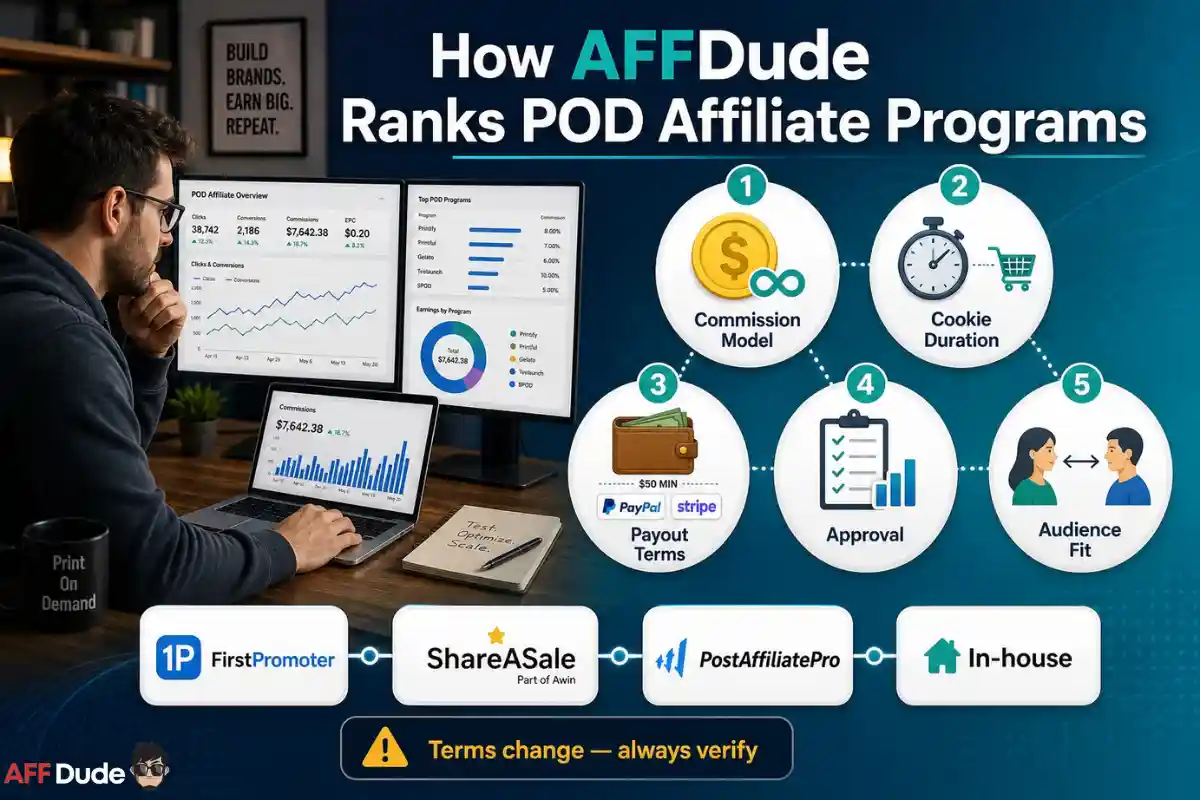
Ranking a merch referral program on commission percentage alone is misleading, because the number that matters is what a referred account pays out across its full tracking window.
Our evaluation started with each program's published terms, then checked those terms against the network or tracking platform actually running the program, since in-house dashboards, FirstPromoter, ShareASale, and PostAffiliatePro all handle attribution differently.
Five factors carried the most weight:
Terms in this category change without notice, and several platforms negotiate custom rates with larger partners.
Everything below reflects publicly available program information at the time of writing, so verify current figures in the program dashboard before building content around a specific rate.
7 Top Print on Demand Affiliate Programs
| Top Print on Demand Affiliate Programs | Best Audience Fit | Strongest Traffic Source |
|---|---|---|
| Printify | Aspiring store owners | Long-form SEO content |
| Printful | Brand-focused sellers | YouTube tutorials |
| Gelato | International merchants | Multi-language blogs |
| Redbubble | Design shoppers | Pinterest and social |
| Zazzle | Gift and event buyers | Seasonal search content |
| Spreadshirt | European shoppers | Coupon and deal sites |
| FedEx Office | Local business owners | B2B blog content |
1. Printify Affiliate Program
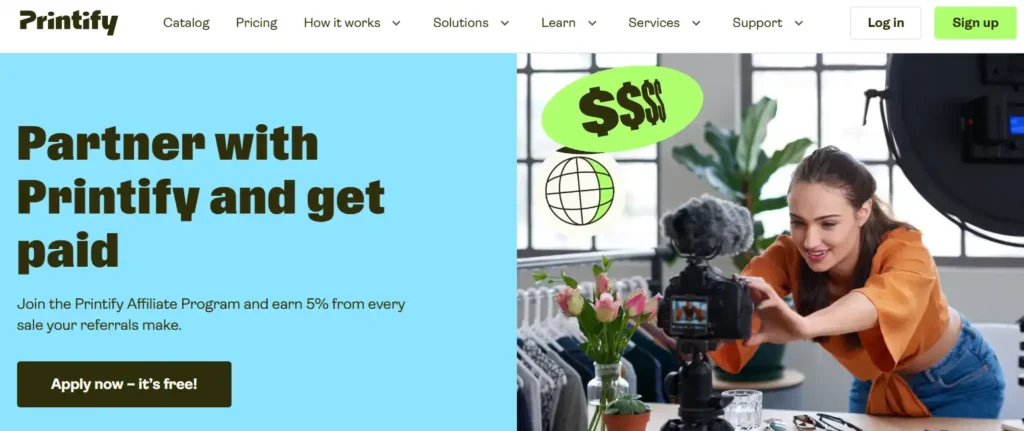
Printify approaches affiliate payouts differently from a standard retail referral. Rather than a single cut on one order, earnings keep accruing as long as the referred merchant keeps placing orders, so one strong conversion produces a revenue stream instead of a one-off deposit.
The company runs a network model rather than its own factories, working with print partners around the world to produce and ship the goods. That structure makes it a natural fit for content aimed at Shopify, Etsy, and eBay sellers comparing fulfillment options.
Among print on demand affiliate programs, this one rewards patience. Earnings scale with how actively your referral sells, not with impulse merch buyers.
| Detail | Specification |
|---|---|
| Commission | 5% on each sale a referral makes, for 12 consecutive months |
| Cookie window | 90 days |
| Referral cap | None |
| Tracking | Managed in-house through the FirstPromoter platform with real-time click and conversion reporting |
| Payout method | Monthly via PayPal |
| Eligible partners | Bloggers, influencers, YouTube creators, and marketing agencies with an interest in print on demand |
Application note: Applications go directly to Printify rather than a third-party network, and you need an active website, blog, or social presence focused on ecommerce, design, or entrepreneurship.
Why Choose Printify?
Best for creators publishing seller-focused tutorials and platform comparisons. The long cookie and year-long attribution suit SEO content, though the base rate sits below several competitors.
2. Printful Affiliate Program
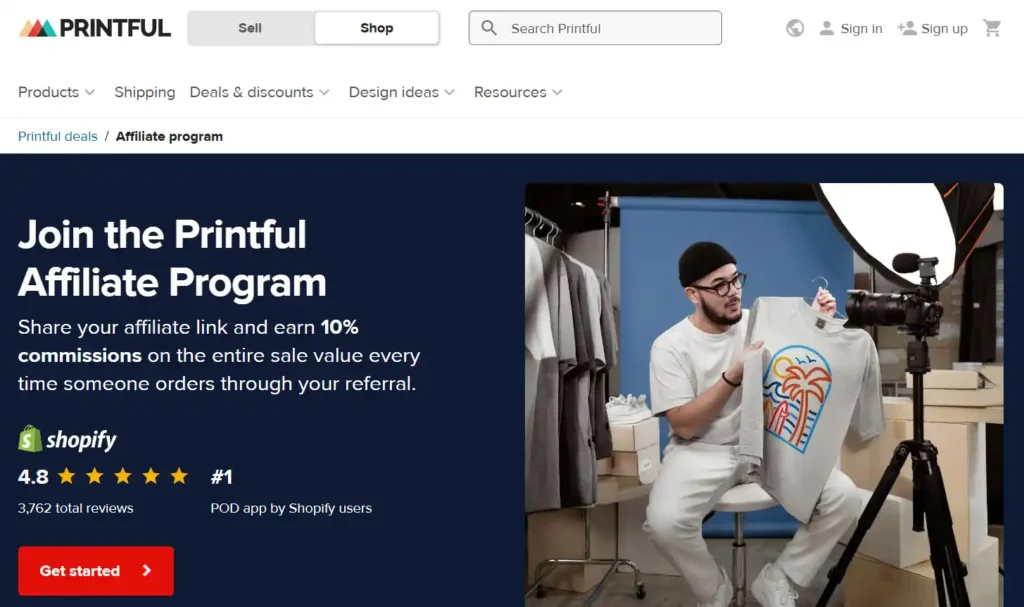
Sellers who prioritize print quality and branding options often land on Printful, and its referral terms mirror that positioning. Payouts are calculated on the full value of a referred order rather than on a narrow product subset, which lifts effective earnings on larger carts.
Founded in 2013, the company operates its own fulfillment centers across the US, Europe, and Mexico, giving it tighter production control than marketplace-style platforms.
The payout ceiling here ranks among the highest in print on demand affiliate programs, but attribution is tight. Tutorials, platform comparisons, and email sequences that move readers to act quickly outperform passive product roundups on this one.
| Detail | Specification |
|---|---|
| Commission | 10% of the entire sale value per referred order |
| Earning period | 12 months per referred customer, starting once their first order has been printed and shipped |
| Cookie window | 30 days from click |
| Minimum payout | $25, withdrawn in USD via PayPal |
| Payout speed | Processed 1 to 3 business days after request, monthly or on demand once the threshold is met |
| Application review | 2 to 5 business days |
| Excluded orders | Sample orders, free trial upgrades, and repeat Growth subscriptions do not qualify |
Bonus structure: A $25 bonus applies the first time a referral subscribes to Printful Growth.
Why Choose Printful?
Strong pick for designers, YouTubers, and ecommerce educators whose audience is ready to launch. Highest standard rate here, offset by a short tracking window that punishes slow-converting traffic.
3. Gelato Affiliate Program
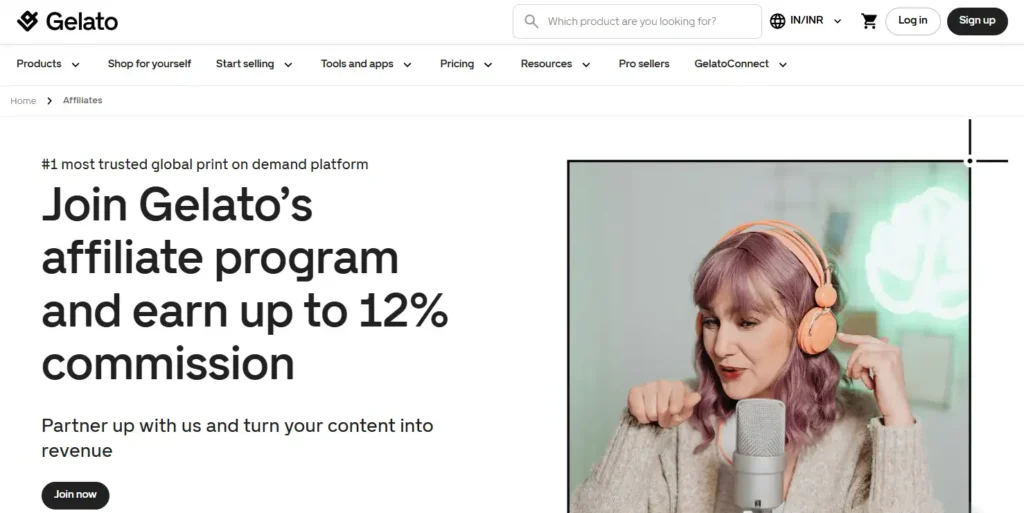
Global reach is Gelato's defining feature. Local production across more than 100 print partners worldwide lets it deliver products almost anywhere within an average of 72 hours, which removes the cross-border shipping friction that sinks conversions for international audiences.
Its payout model follows referred merchant revenue rather than individual consumer orders, so the platform functions less like a retail affiliate offer and more like a SaaS referral arrangement built around active sellers.
Publishers with European, Asian, or multi-region traffic often find this the most practical of the print on demand affiliate programs, since referrals are not boxed in by a single-country fulfillment footprint.
| Detail | Specification |
|---|---|
| Commission | Up to 15% of print revenue from referred merchants |
| Earning period | 12 months following signup |
| Referral cap | None |
| Cost to join | Free |
| Reporting | Dashboard shows referred merchants, total revenue for the pay period, and total revenue to date |
| Ideal partner profile | Affiliates fluent in print on demand and ecommerce who regularly share tools with their audience |
Compliance rules to know: Every domain using your affiliate link must be listed in your affiliate profile, and cookie stuffing, misleading links, and pop-ups are prohibited. Bidding on Gelato trademarked terms, including variations and misspellings, is not allowed on Google, Facebook, or other networks.
Why Choose Gelato?
Suits publishers with international or EU-heavy traffic. Merchant-revenue commissions reward referring active sellers, and the distributed print network handles cross-border delivery better than single-region competitors.
4. Redbubble Affiliate Program
Not every referral audience is made of sellers. Some are shoppers hunting for a specific design, and Redbubble is built for exactly that traffic.
Launched in Melbourne in 2006, the marketplace lets independent artists upload artwork that gets printed onto apparel, stationery, home decor, and accessories, with the platform handling manufacturing, fulfillment, and shipping.
The catalog skews toward niche fandoms, illustration styles, and subculture designs, which produces long-tail search demand that mainstream retailers rarely satisfy.
Within a roundup of print on demand affiliate programs, this is the buyer-side option. Design roundups, fandom gift guides, and Pinterest boards convert here far better than business tutorials aimed at store owners.
| Detail | Specification |
|---|---|
| Model | CPS, paying on sales of print-on-demand products made from user-submitted artwork |
| Commission | Up to 10% |
| Cookie window | 30 days |
| Minimum payout | None |
| Payment | Monthly via bank transfer or PayPal |
| Accepted traffic | Social media and banner placements |
| Network | Impact Radius, with approval typically taking 1 to 3 business days |
Paid traffic caution: Conditions apply to PPC campaigns, so contacting Redbubble support before launching paid ads is advisable. Non-converting clicks can also cost you your place in the program.
Why Choose Redbubble?
Right fit for art, fandom, and gift-guide publishers with shopper traffic. Zero payout threshold lowers the entry barrier, but the rate is modest and clicks must convert.
5. Zazzle Affiliate Program
Zazzle's partner setup, now branded as the Ambassador Program, was rebuilt around creators who both design and promote, which sets it apart from marketplaces that treat the two roles separately.
The catalog is the real differentiator. Alongside customizable apparel and home decor, the marketplace carries licensed brand partners including Disney, Warner Bros, Hallmark, and National Geographic, giving affiliates searchable product angles most print on demand affiliate programs cannot match.
Occasion-driven content performs best here. Weddings, holidays, graduations, and personalized gifting all carry clear purchase intent, and the customization layer gives readers a reason to buy through your link rather than a generic retailer.
| Detail | Specification |
|---|---|
| Commission | 15% referral commission on products sold, whether yours or another creator's |
| Promotion types | Separate rates apply to cross-promotion (other creators' designs) and self-promotion (your own designs) |
| Cookie window | 45 days, with the first 14 days acting as a priority window for your referral |
| Attribution rule | After the 14-day priority period, a click on another referral link reassigns commission credit |
| Approval | Manual review |
| Product feed | Data feed access covering the top 500K products |
| Creative assets | Standard brand banners plus rotating promotional banners, with additional sizes available on request |
| Payments | Processed monthly once the minimum threshold is met |
Link accuracy matters: Using the wrong link type can break tracking, so Zazzle recommends its share button to keep your Ambassador ID attached.
Why Choose Zazzle?
Ideal for gifting, wedding, and seasonal content sites. Licensed brand inventory and a long tracking window give affiliates unusually broad coverage across high-intent occasion searches.
6. Spreadshirt Affiliate Program
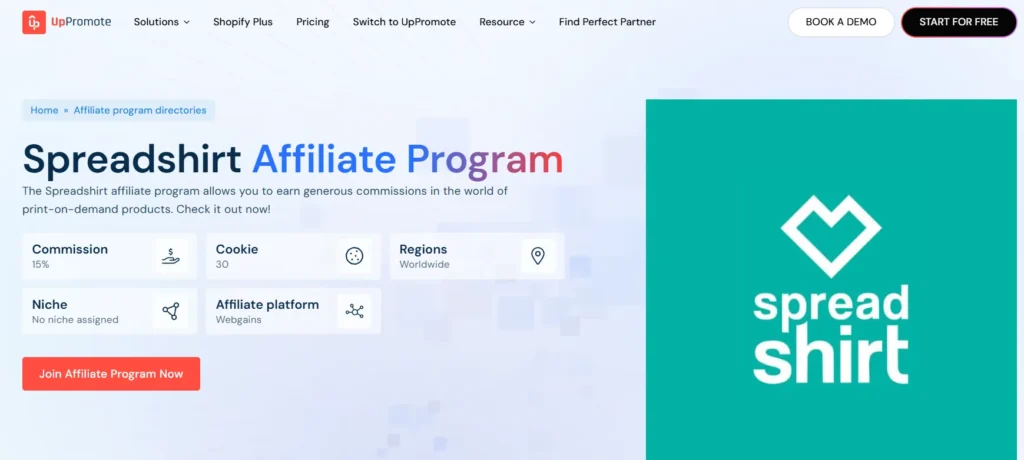
Spreadshirt serves the customization market rather than the store-builder market. Its range covers roughly 250 individually printable products, and customers can pick from around 3 million existing motifs, upload their own images, or add custom text.
The brand has operated in Europe since the early 2000s and holds far stronger name recognition there than in the US, which shapes where referral traffic actually converts.
Terms are administered regionally through affiliate networks instead of a single global program. Unlike most print on demand affiliate programs, that setup asks you to match the right country feed to your audience, rewarding publishers with concentrated European or UK readership.
| Detail | Specification |
|---|---|
| Commission range | 5% to 15% per valid sale, varying by network region and platform type |
| Cookie window | 40 days in the UK, 30 days in other regions |
| Minimum payout | $25 |
| Payment schedule | Weekly through Webgains via check, PayPal, ACH, or wire transfer |
| Regional programs | Germany, UK, France, Denmark, Norway, Sweden, Finland, and the Netherlands |
| Cost to join | Free through the networks |
| Best-fit publishers | Bloggers, influencers, and voucher or coupon sites in fashion, lifestyle, design, and customization niches |
Restrictions: Cashback and loyalty sites are not accepted. Cookie dropping, email spam, and brand hijacking are prohibited, and supplied creatives cannot be altered.
Why Choose Spreadshirt?
Best suited to European and UK publishers in fashion or customization niches. Weekly payouts and a low threshold help cash flow, though rates shift by region.
7. FedEx Office Affiliate Program
FedEx Office sits at the commercial printing end of this category rather than the merch end. The program spans a network of more than 1,900 digitally connected locations, covering large format printing, direct mail, signage, posters, banners, and business cards.
Brand recognition does the heavy lifting on conversion. Readers already know the name, which shortens the trust gap that newer platforms have to close through reviews and social proof.
Placed alongside merch-focused print on demand affiliate programs, this one monetizes a different reader entirely: the small business owner, real estate agent, or event organizer who needs physical marketing materials rather than an online storefront.
| Detail | Specification |
|---|---|
| Commission | 5.5%, single-tier and fixed |
| Model | CPS |
| Network | Commission Junction, with secure reporting tools for tracking performance |
| Cookie window | 30 days per program directory listings, though FlexOffers lists a 7-day duration for its FedEx Office placement |
| Minimum payout | None |
| Payment | Monthly via bank transfer or PayPal |
| Cost to join | Free |
| Affiliate tools | Regularly updated banner and text links plus customizable vanity promotion codes |
Verify before you build: cookie duration is reported differently across network listings, so confirm the window inside the CJ dashboard for the specific placement you join.
Why Choose FedEx Office?
Fits B2B, small business, and local marketing sites. Trusted brand and vanity promo codes convert well, but the rate and tracking window are modest.
How to Get Approved for a Print on Demand Affiliate Program
Approval is rarely automatic. Most merch platforms review applications manually, and reviewers are looking for one thing: evidence that your audience contains people who would open a store or buy custom products.
That evidence does not have to be a high-traffic blog. A YouTube channel covering side hustles, an active Pinterest account posting design content, a newsletter aimed at Etsy sellers, or a small niche site with a handful of published reviews all qualify as a relevant platform.
What gets rejected is a blank domain, a parked page, or an application with no promotional plan attached.
A few practical points that shorten the process:
Review times vary by platform, from a couple of business days to longer for programs run through third-party networks. Rejection is usually not permanent, and reapplying after publishing relevant content is normal.
Print on Demand Affiliate Program Mistakes AFFDude Sees Most Often
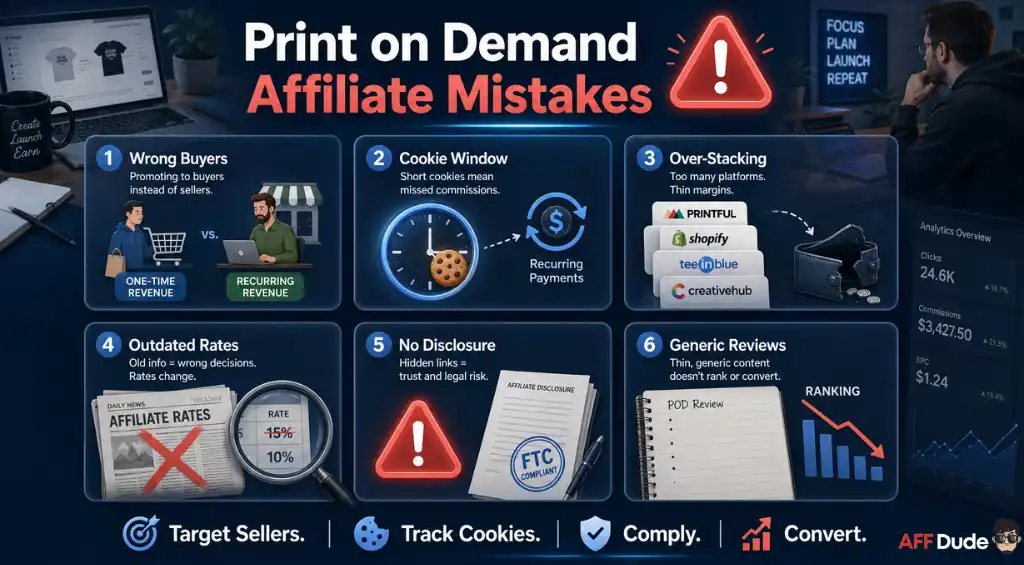
The most expensive mistake is promoting to the wrong side of the marketplace. Content aimed at shoppers looking for a funny t-shirt earns a small one-time cut. Content aimed at people researching how to start a merch business refers sellers, and sellers keep ordering. Same effort, very different revenue curve.
Close behind is ignoring the tracking window. Affiliates often build campaigns around a program's headline rate without checking how long the cookie lasts or whether commissions stop after a fixed number of months.
A program paying a lower percentage on recurring orders can outperform a higher one-time rate, depending on how often referred accounts reorder.
Other recurring problems:
Where AFFDude Leaves the Print on Demand Payout Question
Seven platforms, seven very different payout structures. The programs covered here split cleanly between those paying on referred sellers and those paying on individual shoppers.
The distinction that matters most is durability. A modest percentage tied to an active merchant often outearns a higher one-time rate, which is why the tracking window deserves as much attention as the commission itself.
Before committing content to any print on demand affiliate program, verify the current terms in the network dashboard and match the model to the audience you already reach.
Recommended Articles