


You go looking for what PartnerStack costs and land on a page with no numbers, just a button asking you to book a demo. Reddit fills in the rest: a monthly fee, plus a cut of what your partners earn. Is that cut buying anything you could not get elsewhere?
That question is why PartnerStack alternatives get searched at all. Partner programs now split into two different jobs, affiliate tracking and partner management, and the tools under them price those jobs in very different ways.
AFFDude's Take: Pricing gets the attention, but attribution history is the harder piece. Partners are portable. Twelve months of click data usually is not, and that tends to show up late in the process.
The Real Cost Question Behind Every PartnerStack Alternative Search

Most people comparing PartnerStack alternatives are not asking what a platform costs. They are asking what the total fee stack costs once a program is actually running.
PartnerStack does not publish rates. Access starts with a demo, and the quote that comes back is built from more than one line item.
There are usually three layers to account for:
That third layer is what changes the math. A subscription is fixed and forecastable. A percentage of payouts grows as your program succeeds, so your best-performing month is also your most expensive one.
This is why the fee comparison only works when it is modelled at your program size, not at a single price point. Two platforms can look close on paper and land thousands apart once payout volume is applied.
How AFFDude Stress-Tested Every PartnerStack Alternative on This List
This section explains the benchmark behind the rankings, so you can judge whether our criteria match your program.
Feature lists were treated as claims, then checked against vendor documentation, billing integration docs, and reviewer complaints on G2 and Capterra from 2026. Where a vendor and its reviewers disagreed, we sided with the reviewers.
Seven signals decided the order:
Time to first tracked conversion also mattered. Platforms that let a team launch the same day scored above platforms gated behind onboarding calls.
The heaviest weight went to the signal buyers underestimate most: attribution accuracy after the first billing cycle.
7 Best PartnerStack Alternatives in 2026
| Best PartnerStack Alternatives | Attribution Trigger | Scaling Cost Driver |
|---|---|---|
| Rewardful | Stripe customer object | Tracked revenue volume |
| impact.com | Cross-device event graph | Commission percentage fee |
| FirstPromoter | Billing provider events | Plan tier only |
| Kiflo | CRM deal record | Program tier level |
| Partnero | Link and coupon signup | Plan tier only |
| Tolt | Stripe checkout event | Flat, affiliate-independent |
| Trackdesk | Postback, pixel, coupon | Revenue-based tiers |
1. Rewardful
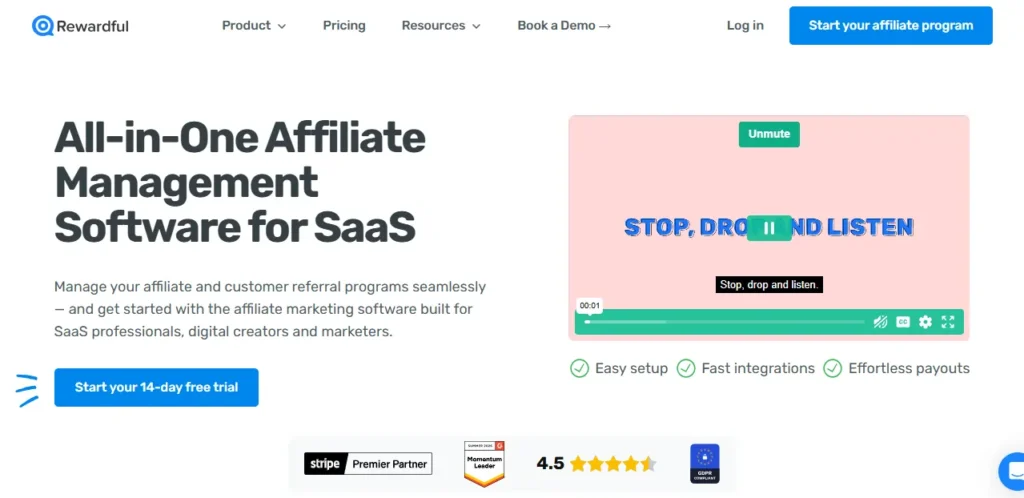
Rewardful was among the first affiliate platforms built directly on Stripe's event stream, which is why it keeps appearing on PartnerStack alternatives shortlists aimed at early-stage SaaS. Attribution follows the customer record rather than a single checkout click.
The trade-off is scope. Rewardful stays inside affiliate and referral tracking, so reseller programs, deal registration and channel enablement fall outside its coverage. Teams that want a partner marketplace motion will outgrow it.
For founders weighing affiliate management software against a full PRM, Rewardful answers the narrower question cleanly: can commissions stay accurate through renewals, upgrades and refunds without a manual reconciliation each month.
Rewardful Key features
Best for: Bootstrapped SaaS founders on Stripe who want recurring commission tracking live quickly and have no reseller, co-sell or channel enablement requirements to satisfy.
2. impact.com
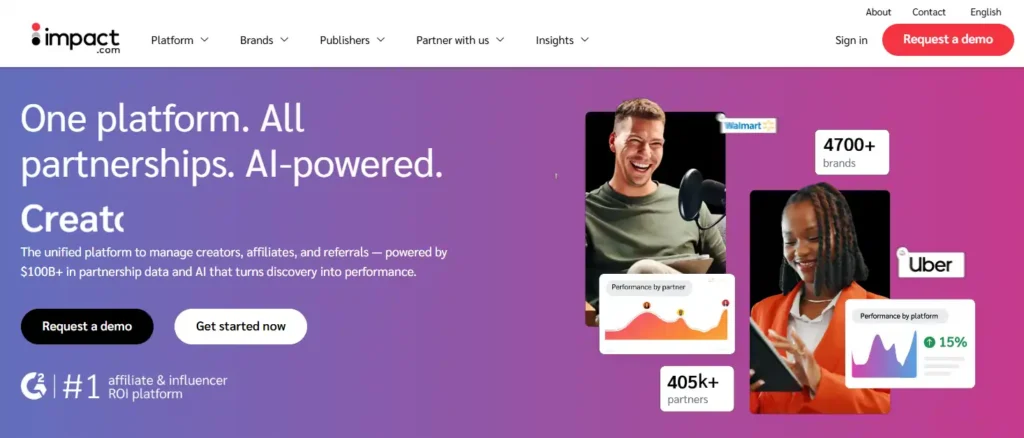
Scale is what separates impact.com from most PartnerStack alternatives. The platform manages affiliates, influencers, publishers and B2B partners inside one attribution layer, with contracting and payments handled natively rather than bolted on.
Its cross-channel attribution is the technical draw. Where lighter affiliate tracking software sees one conversion path, impact.com reconciles activity across devices, channels and partner types, which matters once paid media and partner traffic overlap.
Cost structure is where teams pause. A percentage sits on top of generated commissions, so program success raises platform spend. For a lean subscription business, that combination of breadth and fee model often reads as overbuilt.
impact.com Key features
Best for: Enterprise and mid-market brands running multi-channel partnerships at volume, particularly retail, B2C and publisher programs where partner discovery matters as much as tracking.
3. FirstPromoter
Billing-event accuracy is the argument for FirstPromoter, and it is the reason this platform leads most PartnerStack alternatives comparisons written for subscription companies. Commissions calculate from what the billing provider reports rather than from a click that fired months earlier.
Consider a customer who signs up in January, upgrades in March, then churns in June. FirstPromoter recalculates the reward at each of those events. Platforms that lock payouts at signup leave that math to a spreadsheet.
The scope stays deliberately narrow. This is affiliate and referral infrastructure, so channel teams needing deal registration and partner enablement should look toward the PRM side of the market instead.
FirstPromoter Key features
Best for: SMB and mid-market subscription businesses on Stripe or Paddle that treat commission accuracy through the full billing lifecycle as the deciding evaluation criterion.
4. Kiflo

Where affiliate tools track clicks, Kiflo tracks pipeline. Founded in Paris in 2019, it sits on the PRM side of the PartnerStack alternatives market and targets B2B SaaS teams running referral, reseller and affiliate motions from one partner portal.
Two-way sync with HubSpot and Salesforce is the structural difference. Partner-registered leads and deals land in the CRM your sales team already works inside, which keeps reps out of a second system.
Recent development has pushed past classic portal-and-commission territory into account mapping and co-sell, positioning Kiflo as a lighter option than enterprise PRM suites while covering the same core channel workflows.
Kiflo Key features
Best for: Growing B2B SaaS partnership teams that need CRM-synced deal registration and reseller workflows without committing to an enterprise PRM rollout lasting months.
5. Partnero

Speed of launch defines Partnero's position among PartnerStack alternatives. Program configuration happens the same day, with no demo gate standing between a team and a working affiliate dashboard.
Coverage spans affiliate, referral and coupon-based campaigns, with white-label portals and automated payouts included. An AI-assisted builder handles initial program structure, which shortens setup for teams without a dedicated partnerships hire.
Depth is the honest caveat. Partnero serves SaaS and ecommerce as a generalist, so subscription lifecycle handling stays shallower than platforms reading billing events directly. Support responsiveness also appears repeatedly in reviewer feedback as an area to weigh.
Partnero Key features
Best for: Small teams and ecommerce operators who value same-day launch and transparent payout economics over deep subscription billing intelligence or enterprise channel features.
6. Tolt
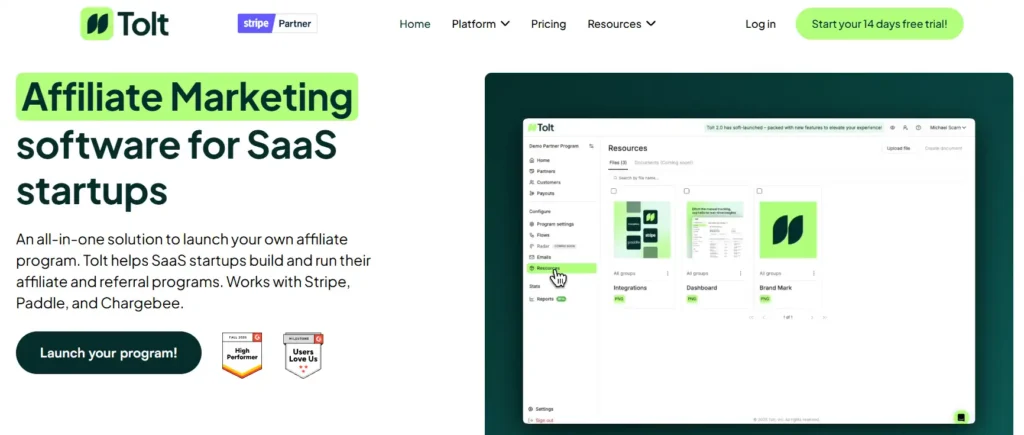
Tolt takes the minimalist route through this category. Built for Stripe-powered SaaS startups, it strips affiliate management software down to tracking, portal and payouts, which keeps setup measured in minutes.
Flat pricing with no per-affiliate charge is the commercial hook. Recruiting a large roster of micro-affiliates raises no incremental platform cost, an appealing structure next to percentage-based fee models common across PartnerStack alternatives.
Simplicity carries a ceiling. Capterra reviewer data skews entirely toward small businesses, and complex commission rules or unusual subscription behaviour tend to expose the limits of the configuration layer.
Tolt Key features
Best for: Early-stage Stripe SaaS teams launching a first affiliate program who want predictable flat costs and can work within straightforward commission structures.
7. Trackdesk

Trackdesk approaches the PartnerStack alternatives question from the performance marketing side rather than the SaaS side. Launched in 2022, it was built in-house by affiliate marketers, and the tracking architecture reflects that origin.
Multi-method attribution is the technical strength. Server-to-server postbacks, pixels, coupon codes, deep links and platform click IDs from Google, Meta and TikTok all feed the same attribution engine, which suits programs blending paid media with partner traffic.
Commission modelling runs wider than most competitors here, covering RevShare, CPA, CPL, CPS, hybrid, tiered and multi-level structures configurable per partner or per offer.
Trackdesk Key features
Best for: Performance-driven programs with mixed traffic sources, multiple brands, or commission models beyond simple revenue share, particularly teams migrating off a platform that caps clicks.
A Parallel-Tracking Method for Testing Any PartnerStack Alternative
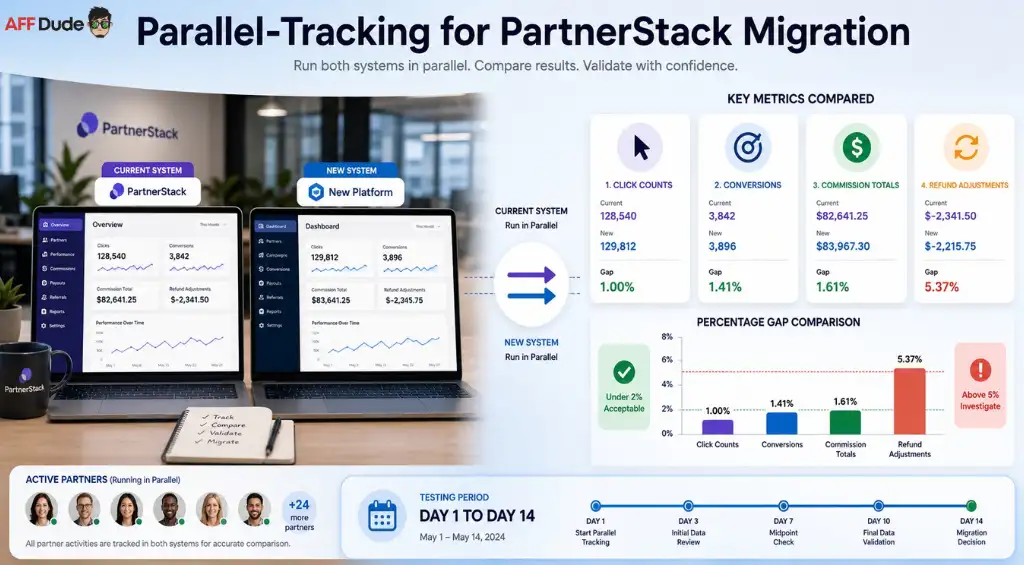
Before switching platforms, run both systems side by side. Parallel tracking is the cleanest way to prove a PartnerStack alternative counts conversions the same way your current setup does.
The method is straightforward. Install the new platform's tracking script alongside PartnerStack's, generate duplicate referral links for five to ten active partners, and let both record the same traffic for 14 days.
Then compare four numbers across the two dashboards:
A gap under roughly 2% is normal and comes down to timing and deduplication logic. A gap above 5% means the two platforms disagree on attribution rules, and you should find out which rule differs before cutting over.
Run the test through a full billing cycle if your program has recurring commissions, since month-two renewals are where discrepancies appear.
Once tracking reconciles, the harder question is what history moves with you.
Final Read on PartnerStack Alternatives
The tools here split along a clear line. Some track conversions and pay affiliates. Others manage resellers inside a sales pipeline. Programs stall when a team buys one and needs the other.
Work out which motion you actually run before shortlisting any PartnerStack alternative. Then model the fee stack against your own payout volume, since a platform that looks affordable at launch can shift once partners start performing.
Run the parallel tracking test before you cut over. Attribution gaps surface early when you look for them, and rarely afterward.
Recommended Articles

Affiliate Disclosure: This post may contain some affiliate links, which means we may receive a commission if you purchase something that we recommend at no additional cost for you (none whatsoever!)