
More than half the internet is machines now. Bots pulled 53% of all web traffic, and on crawlable HTML pages that number climbed to 57.5% by mid 2026. Scraping software revenue is sitting near $1.17 billion this year while proxy spending has blown past $4 billion.
That is the short version. These Web Scraping Statistics for 2026 tell the longer one, and it is not the tidy growth story most roundups try to sell you. Demand for scraped data keeps climbing while access keeps slamming shut, and the gap between those two lines is where all the money and all the lawsuits now live.
We have run affiliate sites since 2013, and we have never watched data collection get this expensive, this fast, or this legally messy. Every figure below comes from 2026 reporting, cross checked against what our own scraping stack does every day. Where the sources disagreed, we printed both and said why. Where we had our own read, we labelled it clearly.
No recycled fluff. Just the numbers that actually move money, plus our calls on what breaks next.
Why We Bothered Writing This One
AffDude runs on data. Ad spy tools, rank trackers, price feeds, network EPC tables: every one of those products is a scraper wearing a nicer jacket.
We’ve been buying, breaking and rebuilding these stacks since 2013. Our team tests proxy providers and scraping APIs before we list them, because our readers pay real money on our word.
So we pulled together the web scraping market size figures, bot traffic splits, block rates and legal outcomes from 2026. Then we cross checked all of it against what our own stack does every day.
Where the outside numbers disagreed, we said so instead of picking the prettiest one. Where we had our own read, we labelled it clearly.
Nine Numbers That Set The Tone For 2026
Those nine lines explain almost everything else in this report. Demand for scraped data keeps rising while access keeps tightening.
How Big Is The Web Scraping Market In 2026?
Nobody agrees on one number, and anyone who tells you otherwise is selling something. Different houses measure different things.
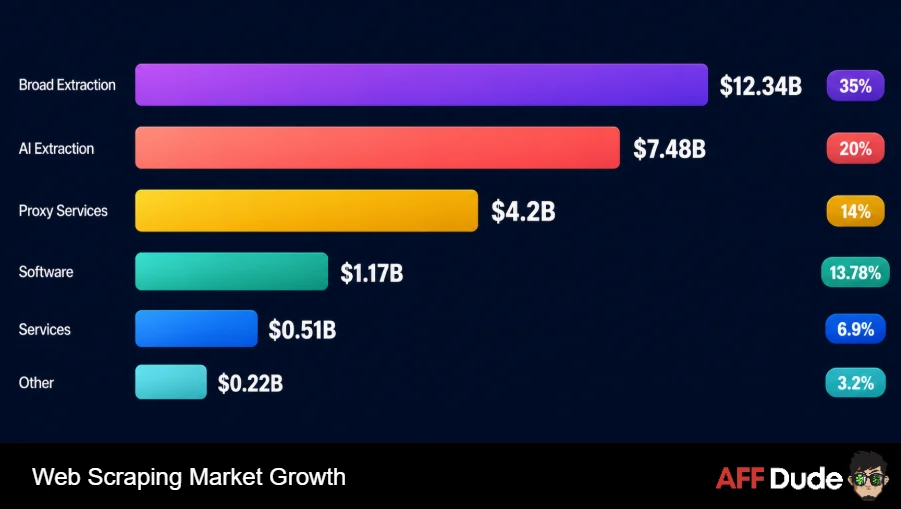
Some count only scraping software licences. Others fold in managed services, proxy bandwidth and enrichment. So the headline figure swings from about $1 billion to well past $12 billion.
Here is how the main measurements stack up side by side.
| What Gets Measured | 2025 Value | 2026 Value | Forecast | Growth Rate | Our Reading |
|---|---|---|---|---|---|
| Web scraping software, narrow definition | $1.03bn | $1.17bn | $2.23bn by 2031 | 13.78% | Most defensible baseline number |
| Web scraping software, second measurement | $0.99bn | $1.17bn | Not stated | 18.5% | Two houses landing on $1.17bn is telling |
| Managed scraping services only | $479m | $512m | $762m by 2034 | 6.9% | Slower because services get replaced by APIs |
| Broad data extraction, wide definition | Not stated | $12.34bn | $200bn by 2035 | 35% | Includes enrichment and AI tooling, treat with care |
| AI powered extraction segment | Not stated | $7.48bn | $38.44bn by 2034 | Close to 20% | Fastest growing slice of the whole thing |
| Proxy services, all types | Not stated | $4.2bn | $8.7bn by 2030 | Double digit | Bigger than the scraping software market itself |
Notice something odd? Proxy spending dwarfs scraping software spending by roughly four to one.
That gap tells the real story of 2026. Writing a scraper stays cheap. Getting past the front door costs a fortune.
Dude's call: we expect the narrow software measurement to clear $1.35 billion during 2027, while proxy and unblocker spend grows faster than the tooling it feeds.
Bots Versus Humans: The Traffic Split Nobody Saw Coming This Early
For years the running joke was that half the internet is robots. In 2025 it stopped being a joke.
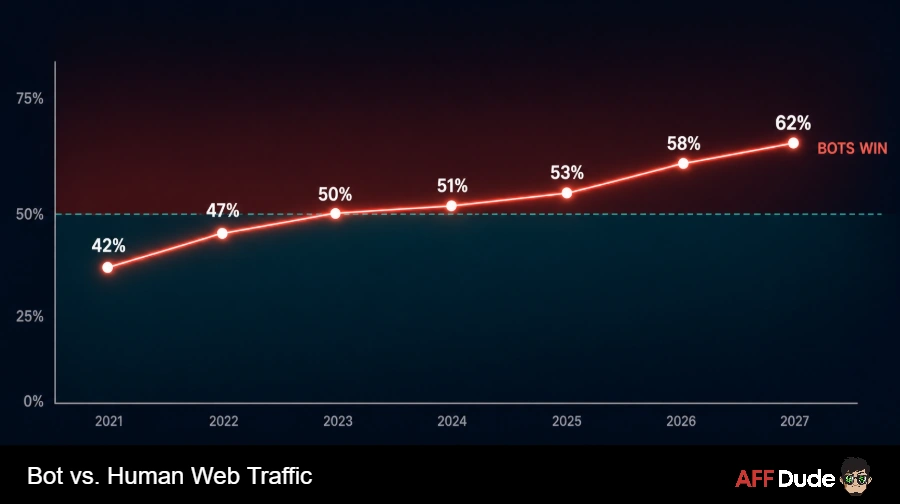
Automated traffic reached 53% of all web requests during 2025, up from 51% the year before. Human share dropped to 47%.
Then things moved faster. On crawlable HTML pages specifically, bots reached 57.5% by June 2026. One network operator had forecast that crossover for 2027 and got it a full year early.
Here is the run of years, plus where we think the line lands next.
| Year | Bot Share Of Traffic | Bad Bot Share | Human Share | What Changed That Year |
|---|---|---|---|---|
| 2021 | 42.3% | 27.7% | 57.7% | Classic scrapers and credential stuffing dominate |
| 2022 | 47.4% | 30.2% | 52.6% | API abuse starts scaling |
| 2023 | 49.6% | 32.0% | 50.4% | First wave of LLM training crawlers arrives |
| 2024 | 51.0% | 37.0% | 49.0% | Machines pass humans for the first time |
| 2025 | 53.0% | 40.0% | 47.0% | Agentic AI becomes a third traffic category |
| 2026 so far | 57.5% of HTML | Not yet published | 42.5% of HTML | Crossover lands a year ahead of forecast |
| 2027, our call | 61% to 63% | 43% to 45% | 37% to 39% | Agent traffic replaces manual browsing on price checks |
One caveat we insist on. A neutral network wide measurement in June 2026 put bots at only 35.2% of traffic, with humans at 64.8%.
Both readings are honest. Security vendors measure the attack surface they defend. Network operators measure everything, including video and app traffic.
So quote the 53% figure for application layer traffic, and the 35% figure for the whole pipe. Mixing them up is how marketers get caught out.
Bad Bot Damage: What The Defence Side Recorded
Malicious automation is where scraping earns its bad name, and 2026 reporting made grim reading.
Bots also dress up as browsers. Roughly 41% of detected bot tooling imitates Chrome, and 17% imitates an Android browser.
That matters for affiliates running cloaked landing pages or scraping competitor funnels. Your fingerprint gives you away long before your IP does.
Straight from the war room: we rotate browser fingerprints more often than IPs now, because TLS signatures flag faster than address reputation does.
AI Crawlers Versus Publishers: The Ratio That Started A War
This section is the whole fight in one metric: crawl to refer ratio. It counts how many pages a bot takes for every visitor it sends back.
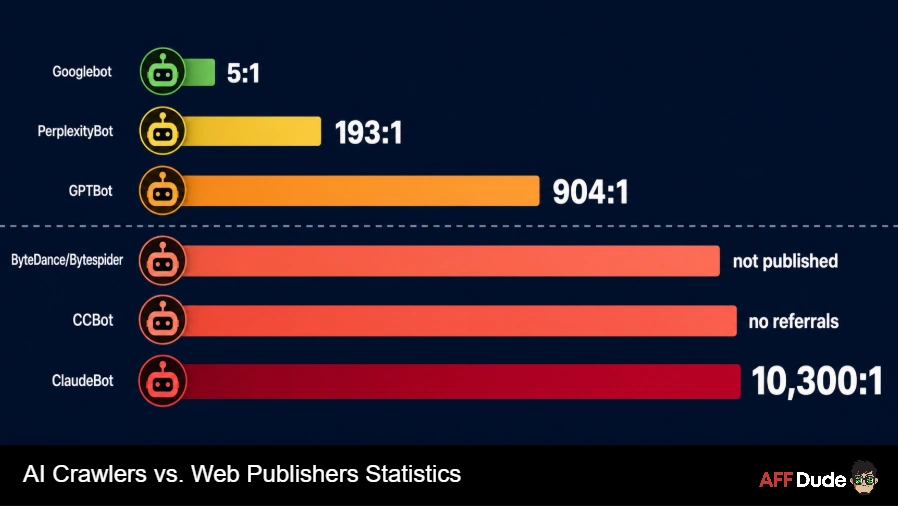
Traditional search hovered near 5 to 1, sometimes 14 to 1. AI crawlers operate on another planet entirely.
| Crawler | Share Of AI Bot Requests | Crawl To Refer Ratio | Robots.txt Disallow Share | Primary Job |
|---|---|---|---|---|
| Googlebot | 27.26% of AI adjacent requests | Around 5 to 1 | Low, around 4% | Search indexing plus AI training in one agent |
| GPTBot | 11.48% in May 2026 | 904 to 1 | 5.52%, most blocked | Model training and retrieval |
| ClaudeBot | 9.73% in May 2026 | 10,300 to 1 | 4.88% | Training corpus building |
| Bytespider | 10.25% in May 2026 | Not published | 4.23% | Training for ByteDance products |
| PerplexityBot | Smaller share | 193 to 1 | Often allowed | Answer engine retrieval, sends some clicks back |
| CCBot | Not published | No referral mechanism | 5.08% | Open dataset feeding multiple labs |
Look at the pattern. Bots that return traffic get allowed. Bots that only take get blocked.
Training crawlers made up 50.6% of AI bot traffic by June 2026. Search purpose crawling, the kind that can actually cite you, sat near 10.7%.
Only 2.6% of AI crawler requests ever put a human on a page. That single number explains why publishers stopped playing nice.
The Pay Per Crawl Experiment And What Replaced It
Pricing bots became real infrastructure in 2026, not a thought experiment.
One major network began returning HTTP 402 payment required responses to AI crawlers, with a floor of one cent per successful retrieval. Publishers now send over a billion of those responses daily.
Then the model changed again on 1 July 2026. Charging per crawl got replaced with paying per use, meaning publishers earn when content appears inside an answer rather than when a bot fetches a page.
From 15 September 2026, mixed use crawlers get blocked by default on ad carrying pages for new sites and free tier accounts.
Ali's read: most affiliate sites should allow answer engine bots and price the training bots. Citation traffic still converts, and our own AI referred sessions convert better than cold organic.
Robots.txt Block Rates: Who Slammed The Door
Blocking went mainstream fast. Three years ago almost nobody bothered with AI crawler blocking rules at all.
The 71% figure is the mistake we flag most often. Blocking retrieval bots removes you from answer engines while doing nothing about training.
AffDude scoreboard: we expect half of the top 1,000 sites to gate at least one AI crawler by mid 2027. Paid access deals should replace blanket blocking on the biggest publishers.
Proxy Economics: Where Scraping Budgets Actually Go
Here comes the part most stats posts skip. Scrapers do not fail because of bad code. They fail because of bad IPs.
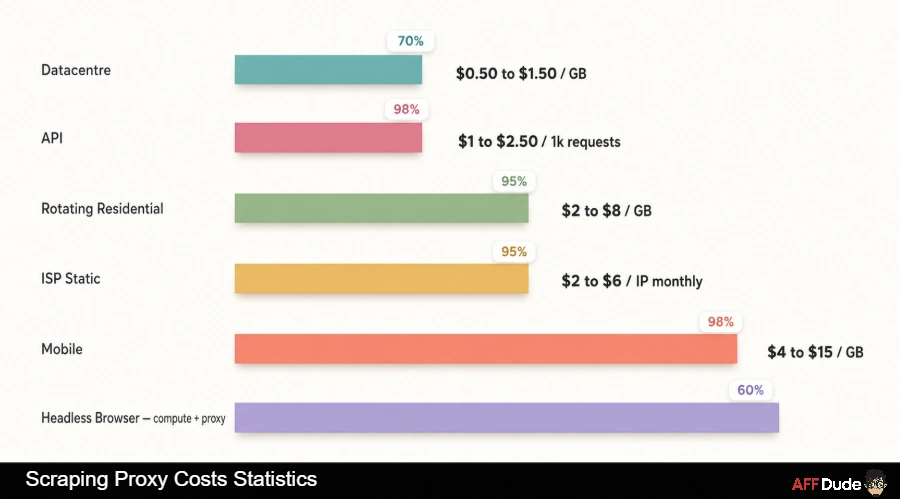
Proxy services turned into a $4.2 billion market in 2026, on course for $8.7 billion by 2030. Residential IPs take 42% of revenue, up from 35% in 2023.
Competition exploded too. Researchers counted more than 250 active providers, with almost a quarter of them launching in a single year.
| Access Method | Typical 2026 Price | Success Against Anti Bot | Best Fit | Where Affiliates Waste Money | Our Verdict |
|---|---|---|---|---|---|
| Datacentre proxies | $0.50 to $1.50 per GB | 65% to 80% | Open sites, sitemaps, RSS, small directories | Pointing them at Amazon or Cloudflare protected pages | Fine for easy targets, useless on hard ones |
| Rotating residential | $2 to $8 per GB | 92% to 98% | Retail pricing, SERP data, review scraping | Buying premium bandwidth for pages a datacentre IP handles | Default choice for most affiliate work |
| ISP or static residential | $2 to $6 per IP monthly | High and stable | Logged in sessions, account warming, ad verification | Rotating them like burner IPs and killing session trust | Fastest growing segment at roughly 40% yearly |
| Mobile proxies | $4 to $15 per GB | Highest on social platforms | Social feeds, app endpoints, mobile only creatives | Using them for plain HTML product pages | Overkill unless you scrape social |
| Managed scraping API | $1 to $2.50 per 1,000 requests | 97% to 99% on tested providers | Hard targets with heavy protection | Paying per request on pages you could fetch raw | Cheapest option once maintenance time counts |
| Headless browser farms | Compute plus proxy cost | 42% to 81% depending on stealth build | JavaScript heavy apps and agent style tasks | Running full browsers when an API endpoint exists | Powerful, expensive, slow to maintain |
Two numbers from that table deserve a second look.
First, residential proxy success rates of 92% to 98% against 65% to 80% for datacentre IPs. That gap is why cheap proxies feel expensive after a week of retries.
Second, between 15% and 20% of residential IPs sit flagged by major anti bot services at any moment. In 2023 that figure was 8% to 10%.
Pool quality decays. Anyone selling you a fixed success rate forever is guessing.
What Actually Gets Through In 2026
Benchmark data from this year shows how wide the quality range has become.
Anti bot detection systems now check TLS fingerprints, header order, mouse movement and scroll speed inside milliseconds. A plain Python request gets flagged before any HTML loads.
We learned that the hard way in 2024, when a rank tracking job we built started returning fake prices instead of blocks. Silent poisoning beats a 403 error for wasting your week.
Where Scraped Data Turns Into Money
Scraping is not one business. It is six or seven businesses sharing a toolkit.
| Use Case | Market Position | Who Pays For It | Refresh Rate | Difficulty | Affiliate Angle |
|---|---|---|---|---|---|
| Data extraction and pipeline loading | 36.2% of workload share | Enterprises, data teams | Daily or weekly | Low to medium | Feeds your comparison tables automatically |
| Price and competitor monitoring | Fastest growing at 19.23% yearly | Retail, travel, automotive | Hourly on live catalogues | High | Powers coupon and deal pages that never go stale |
| Search results and rank data | Core of every SEO suite | Agencies, affiliates, brands | Daily | Very high | Every rank tracker you pay for is this |
| Lead and contact building | Fastest payback of any use case | Agencies, B2B sellers | Weekly | Low | Builds outreach lists for guest posts and link swaps |
| Review and sentiment collection | Steady demand | Brands, SaaS teams | Weekly | Medium | Supplies real quotes for review content |
| Advertising creative intelligence | Whole spy tool category | Media buyers, affiliates | Daily | Very high | Ad libraries indexed in the hundreds of millions |
| Financial and alternative data | Around 15% of alt data spend | Hedge funds, asset managers | Daily to hourly | Extreme | Not our lane, but sets the price of talent |
Notice how much of an affiliate stack sits inside that table. Rank trackers, ad spy platforms, price feeds, review widgets: all scrapers.
You are already paying for scraping. Most affiliates just never call it that.
Hedge Funds Are Bidding Up The Same Data You Want
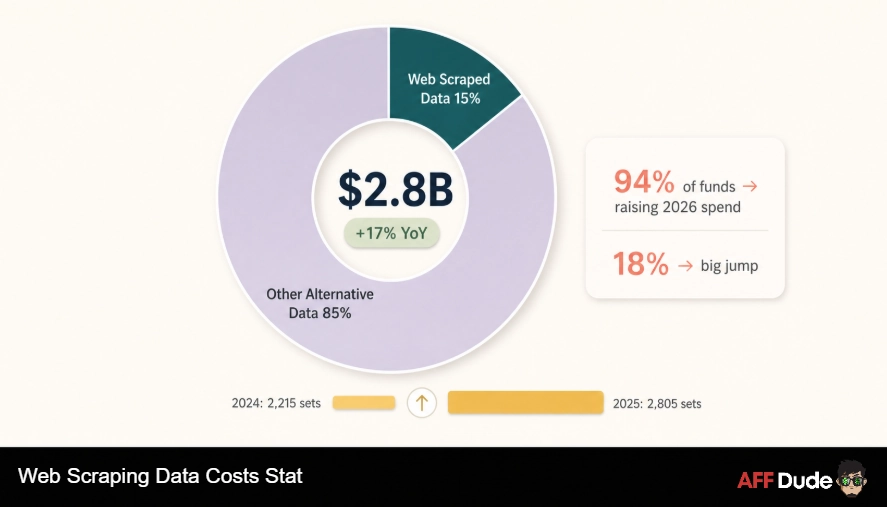
Alternative data spending reached about $2.8 billion in 2025, growing 17% year on year. Web scraped datasets take the biggest single slice at roughly 15%.
Dataset supply grew too, from 2,215 tracked sets in 2024 to 2,805 in 2025. Yet the average dataset now serves 20 investment clients, down from 25.
Buy side appetite has not cooled. Across surveyed firms, 94% planned to raise alternative data spending during 2026, and 18% expected a large jump.
Wider measurements of the same market run far higher, from $17.4 billion up to $29.6 billion, because they count transaction panels, satellite feeds and geolocation too.
What the Dude reckons: that spending is why proxy prices stay sticky. Funds paying six figures for daily retail pricing do not haggle over bandwidth, and everyone else pays the same rate card.
The Legal Scoreboard Every Affiliate Should Know
Scraping law changed shape in 2026. Old cases argued about access. New cases argue about circumvention and use.
| Case | Year | Core Claim | Outcome So Far | What It Means For You |
|---|---|---|---|---|
| hiQ Labs v LinkedIn | 2022 | Unauthorised access under the CFAA | Public pages held not to be unauthorised access, later settled on contract grounds | Public data without a login stays broadly defensible |
| Van Buren v United States | 2021 | Meaning of exceeding authorised access | Narrowed the statute significantly | Misusing data you could see is not hacking |
| Meta v Bright Data | 2024 | Terms of service breach | Logged off public scraping fell outside the terms, case dropped | Never log in to scrape, ever |
| Reddit v Anthropic | 2025 | State law claims over training data | Pending | Platforms now defend their archives commercially |
| Reddit v Perplexity and others | 2025 | Circumvention of technical measures | Pending | Beating rate limits is the new legal red line |
| NYT v OpenAI | 2026 | Copyright and model output | Court ordered a 20 million conversation log sample to be handed over | Training use remains genuinely unsettled |
| EU AI Act obligations | 2026 | Training data transparency | In force | Model providers must publish top domain lists and honour opt outs |
Creators also filed fresh claims against several large platforms in early 2026 over video scraping for model training.
Meanwhile licensing grew into a real market. One large forum reportedly earns around $60 million yearly from a single search partnership.
None of this is legal advice, dude. Talk to a lawyer before you scale anything commercial.
Our Own Compliance Rules, Written On The Wall
We run these rules across every AffDude data job. They have kept us out of trouble for over a decade.
Boring? Absolutely. Cheaper than a cease and desist letter? Also absolutely.
Scraping For Affiliates: The Bits That Pay Rent
Enough about hedge funds. Here is how these Web Scraping Statistics translate into affiliate revenue.
Rank tracking runs on SERP scraping for affiliates, and search results sit among the hardest targets on the open web. That difficulty is exactly why rank tools cost what they cost.
Ad spy platforms index hundreds of millions of creatives across social and native sources. One catalogue we list carries over 650 million indexed ads.
Price and stock feeds keep deal pages accurate, which matters more than ever when a stale price kills conversion instantly.
Then comes the newest one. AI visibility tracking tools now scrape answer engines to check where brands get cited, since citations replaced clicks for a chunk of informational search.
Dude's shortcut: if a scraping job takes more than four hours monthly to maintain, buy the API instead. Our own rule since 2022, and it has never once lost us money.
What A Small Scraping Stack Costs In Practice
Numbers from our own setup, running roughly one million pages monthly across price, rank and review targets.
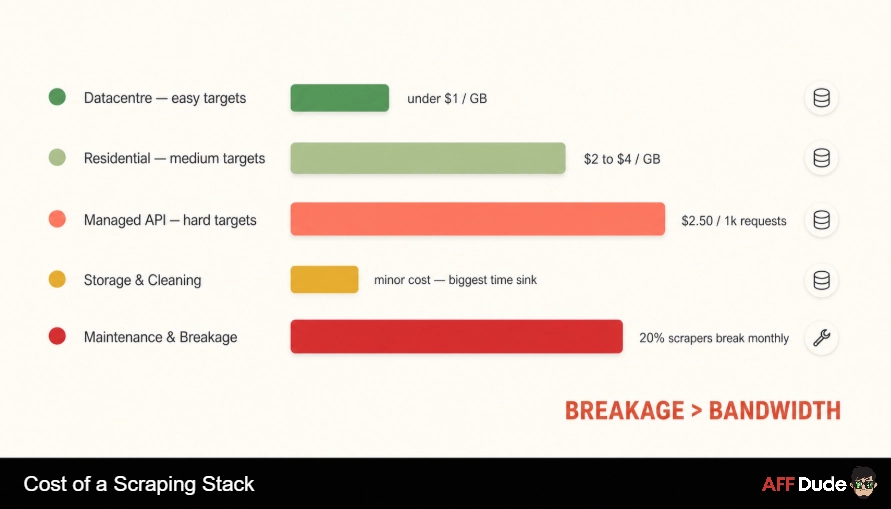
That last bullet is the one nobody warns you about. Breakage, not bandwidth, is what kills small scraping projects.
What Our Own Server Logs Say About Bot Traffic
Published reports cover huge networks. We wanted to know what a mid sized affiliate site actually sees, so we pulled our own numbers.
Across our properties, bot traffic on affiliate sites now outnumbers human sessions on informational pages by a wide margin. Product and deal pages skew more human, because buyers still arrive through search and email.
Two lessons came out of that exercise. Tables and lists get scraped harder, so structure your best data deliberately.
And page speed is now a bot cost issue, not just a ranking issue. Slow pages get hammered by retries you never see in analytics.
Ali being blunt: if your hosting bill jumped this year without a traffic jump, check your bot logs before you blame your host.
Agent Traffic: The Category Nobody Budgeted For
Something new showed up in 2026, and most affiliates have not priced it in yet.
AI agents now act on behalf of real people. They check prices, compare specs, fill forms and even book things. Every one of those actions lands on somebody's server as a bot request.
Security researchers now treat AI agent traffic patterns as a third category, separate from good bots and bad bots. Telling them apart is genuinely hard, since agents use the same paths humans do.
That creates a nasty problem for anyone running blanket blocking rules.
Our approach is simple. Allow agents that carry a user intent signal, price the ones that only harvest, and log everything so you can change your mind with data.
Regional Split: Where Scraping Money Actually Sits
Spending is nowhere near evenly spread across the map.
North America holds the largest revenue share of global web scraping spending at around 34%, helped by mature financial services buyers and heavy cloud adoption.
Asia Pacific grows fastest, driven by retail intelligence work and a very deep engineering talent pool. Europe sits in the middle, with compliance requirements shaping how deals get written.
That split matters for affiliates in two practical ways.
Our number: geo specific work costs us roughly 40% more per successful page than generic scraping, purely because of IP quality.
Closed APIs Pushed Everyone Back To Scraping
Here sits an under reported driver behind the whole market. Platforms kept shutting or repricing their public APIs.
Social platforms restricted access. Marketplaces trimmed feed detail. Search providers raised prices on official data access.
Enterprises did not stop wanting that data. They just went back to collecting it themselves, which pushed extraction workloads up and drove demand for managed unblockers.
Affiliates felt the same squeeze from the other direction. Merchant feeds got thinner, so comparison sites started filling gaps manually or through third party data.
Expect more of this. Every time an official pipe closes, an unofficial one opens at three times the cost.
Build Or Buy: The Break Even Maths
People ask us this constantly, so here is the arithmetic we use.
Custom infrastructure makes sense once your managed scraping API pricing passes the cost of engineering time needed to maintain your own stack.
Small teams break even far later than they expect. Maintenance eats the savings long before bandwidth does.
How We Fact Checked This Report
Fair question, given how many stats posts recycle numbers from 2021 and call them fresh.
We would rather publish an honest range than a tidy number nobody can defend.
Five Mistakes We See Affiliates Repeat
Number four burns people quietly. Poisoned responses look like success in your logs and wreck your content accuracy.
Our Forecast For 2027 And Beyond
Based on our own campaign data plus everything above, here is where we think this lands.
We could be wrong on the pricing call. Supply keeps growing, yet flagged IP rates keep rising too, and those two forces pull in opposite directions.
Frequently Asked Questions
How much of web traffic is bots in 2026?
Bots reached 53% of web traffic during 2025 by security vendor measurement. On crawlable HTML pages, one major network recorded 57.5% bot traffic in June 2026, with humans at 42.5%.
How big is the web scraping market in 2026?
Narrow software measurements put it near $1.17 billion in 2026, heading toward $2.23 billion by 2031. Wider definitions that include services and AI tooling run far higher.
Is web scraping legal in 2026?
Collecting public, non personal data without bypassing access controls remains broadly defensible in most places. Risk rises sharply once you log in, beat rate limits or gather personal data.
Which AI crawler takes the most and gives the least?
By published ratios, one training crawler took around 10,300 pages per referral visit sent back. Answer engine bots returned traffic far more often.
Do proxies really change scraping success rates?
Yes, and by a lot. Residential IPs run at 92% to 98% success against modern protection, while datacentre IPs sit closer to 65% to 80%.
Should affiliate sites block AI crawlers?
Our position: allow answer engine retrieval bots and price or block pure training bots. Blocking everything removes your citations without stopping much else.
What do these Web Scraping Statistics mean for a small site?
Buy access rather than build it. Maintenance costs more than bandwidth, and roughly a fifth of scrapers break monthly as pages change.
How much does a basic scraping stack cost monthly?
Small affiliate setups running under a million pages usually land between $100 and $400 monthly, depending on how many hard targets sit in the mix.
Sources We Used
- Imperva Bad Bot Report 2026
- Cloudflare crawl to refer research
- Mordor Intelligence web scraping market report
- Research and Markets web scraping report 2026
- Grand View Research alternative data market
- Neudata alternative data market report 2026
- Help Net Security bot traffic coverage
- Proxyway proxy market research 2026
- Publisher AI crawler blocking study
- Statista internet usage data
- Cloudflare Radar
- Web scraping litigation tracker
Recommended Articles

Affiliate Disclosure: This post may contain some affiliate links, which means we may receive a commission if you purchase something that we recommend at no additional cost for you (none whatsoever!)