

The invoice arrives, and the numbers stop making sense. Impact.com charges a platform fee, a percentage of partner payouts, and often a yearly contract on top. Small brands and solo marketers feel that squeeze first.
Then the research starts. One site calls it an affiliate network. Another calls it partnership management software. Reviews contradict each other. Pricing pages hide behind demo forms.
Impact alternatives exist at every level: lightweight tracking apps, Shopify-friendly tools, and full partner platforms built for enterprise teams. Each one trades something away — price, control, reporting depth, or support.
The best Impact alternatives below are sorted by who actually needs them, not by popularity.
Why Growing Brands Outgrow Impact.com and Start Testing Impact Alternatives

Brands rarely leave Impact.com over product quality. They leave because the platform's structure stops matching the size and shape of their partner program. Understanding those breaking points makes comparing Impact alternatives far easier.
Three pressures appear most often:
Program maturity matters as well. A brand managing 40 hand-picked partners mainly needs recruitment and reliable payouts, while contract automation and multi-channel attribution sit idle.
Once the real pressure point becomes clear, whether price, technical fit, or day-to-day complexity, the shortlist narrows fast. Pricing deserves the closer look that follows.
The 7 Best Impact Alternatives
| Best Impact Alternatives | Best For | Key Differentiator |
|---|---|---|
| Rewardful | Stripe based SaaS | Fastest setup time |
| PartnerStack | B2B SaaS ecosystems | Built in partner marketplace |
| FirstPromoter | Subscription billing sync | Deep Stripe and Paddle integration |
| Awin | Global publisher access | Large established affiliate network |
| Everflow | Enterprise performance marketing | Advanced fraud prevention and tracking |
| Partnero | Mid market brand programs | Balanced automation and customisation |
| Tapfiliate | Ecommerce and SaaS mix | Multiple program types and integrations |
1. Rewardful
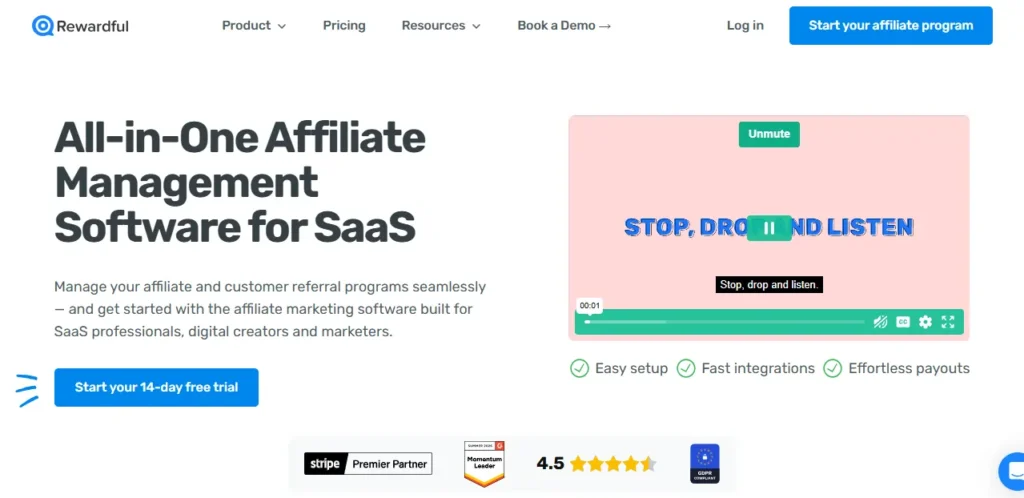
Rewardful is affiliate and referral software built on top of subscription billing, aimed at SaaS teams charging through Stripe or Paddle. A two way Stripe sync reads live billing events, so upgrades, downgrades, refunds, and cancellations adjust commissions without manual reconciliation.
Setup follows a short path: connect the billing account, define commission rules, drop a script onto the site, then invite partners into a hosted dashboard. Programs often go live the same day rather than after a procurement cycle.
Rewardful positions itself directly at brands leaving Impact.com over sales calls and evaluation friction. Recruitment stays the honest ceiling, since reach depends largely on the audience a company already owns.
Rewardful Core capabilities
| Attribute | Detail |
|---|---|
| Software category | Affiliate and referral platform for SaaS |
| Native billing platforms | Stripe, Paddle |
| Partner experience | Hosted affiliate dashboard with link and coupon assets |
| Common migration sources | Impact.com, PartnerStack, Tapfiliate |
Best for: Subscription SaaS teams billing through Stripe or Paddle who want a working affiliate program running within a day, without enterprise sales friction.
2. PartnerStack
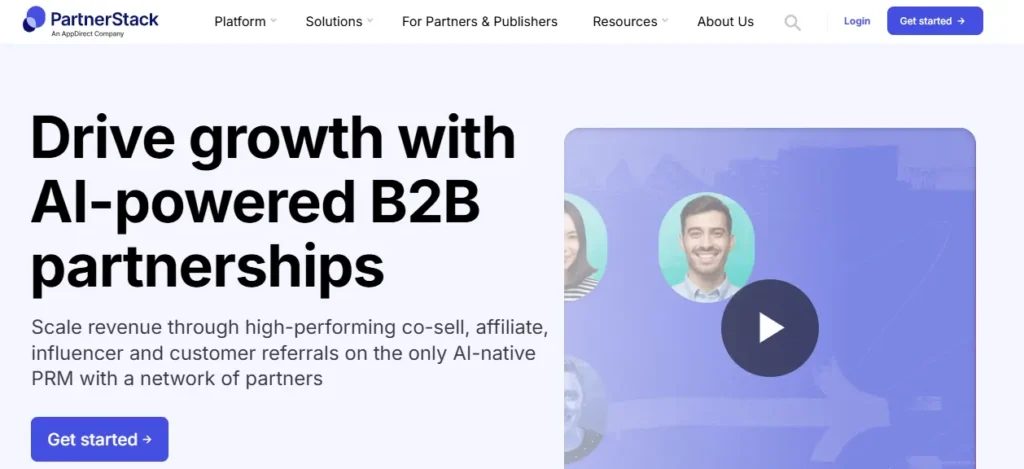
PartnerStack began as GrowSumo in Toronto in 2014 and now operates as a partner ecosystem Impact alternative rather than a plain affiliate tracker. Brands run affiliate, referral, reseller, and agency programs inside one system.
The main draw sits in its attached B2B network, where software buyers discover programs and partners apply directly. Deal registration, partner tiers, co selling workflows, and consolidated payouts run alongside standard link tracking.
Fit narrows quickly though. Companies whose partners are resellers or agencies extract real value from the PRM layer, while smaller affiliate programs may carry overhead resembling what pushed them away from Impact.com in the first place.
PartnerStack Core capabilities
| Attribute | Detail |
|---|---|
| Founded and headquarters | 2014, Toronto, Canada |
| Former company name | GrowSumo |
| Platform category | Partner relationship management with attached network |
| Primary industry served | B2B software and SaaS |
Best for: Later stage B2B software companies with a dedicated partnerships team, running reseller, agency, or co selling motions alongside a standard affiliate channel.
3. FirstPromoter
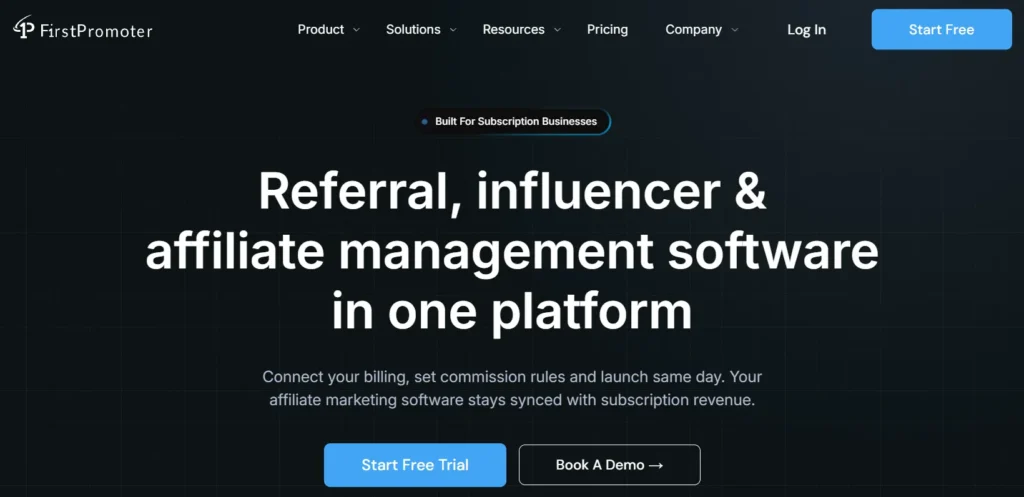
FirstPromoter runs affiliate, referral, and influencer programs from one dashboard, with tracking anchored to billing activity. Renewals, upgrades, downgrades, cancellations, and reactivations update commissions in real time, which suits recurring revenue models far better than one off conversion logic.
Native connections across Stripe, Paddle, Recurly, Chargebee, and Braintree absorb the reconciliation work that spreadsheets usually handle. Fraud controls flag self referrals and suspicious leads before any commission gets recorded, and manual approval thresholds add a second checkpoint.
One published customer result: JustCall reached $2.4M in ARR with roughly 1,000 affiliate partners within three years of launching on the platform.
FirstPromoter Core capabilities
| Attribute | Detail |
|---|---|
| Software category | Affiliate, referral, and influencer management |
| Native billing integrations | Stripe, Paddle, Recurly, Chargebee, Braintree |
| Reported adoption | 3,000+ SaaS companies |
| Commission configuration | Per billing event, period, or customer lifetime |
Best for: SaaS companies launching a first structured program who already know their likely partners and need commission accuracy tied tightly to real billing outcomes.
4. Awin
Awin operates as an affiliate network rather than self serve tracking software, which makes it a structurally different choice from Impact alternatives on this list. Founded in 2000 and headquartered in London, the business came under Axel Springer and PubliGroupe ownership in 2007, with ShareASale joining the group after a 2017 acquisition.
Advertisers plug into an established publisher base covering content sites, cashback and loyalty platforms, comparison engines, and creators. The network layer handles publisher vetting, commission validation, and consolidated payments.
Retail and travel brands gain most here, since the publisher mix skews consumer. B2B software programs generally find the audience match weaker.
Awin Core capabilities
| Attribute | Detail |
|---|---|
| Founded | 2000 |
| Headquarters | London, United Kingdom |
| Ownership | Axel Springer and PubliGroupe |
| Sister network | ShareASale, acquired 2017 |
Best for: Consumer facing retail and travel brands that want publisher reach and network managed compliance more than granular self serve control over tracking configuration.
5. Everflow

Everflow launched in May 2016, founded by a team fresh from exiting Moolah Media, one of the earliest mobile affiliate networks. That lineage shows in the product, which treats affiliate, influencer, in app, referral, and media buying partnerships as one attribution problem rather than separate tools.
Reporting runs deeper than most of the category. Placement level analytics, repeat purchase revenue, and side by side comparison against paid media give program managers measurement that matches how finance teams think.
Named customers include Playtika, Moen, and Golden Hippo. Depth assumes in house analytics capability, so smaller teams tend to underuse what they pay for.
Everflow Core capabilities
| Attribute | Detail |
|---|---|
| Founded | May 2016 |
| Platform category | Partner marketing and performance tracking |
| Reported brand count | 1,200+ |
| Stack integrations | Google Ads, Meta, HubSpot, Salesforce, Shopify |
Best for: Data literate growth teams running several partnership types at once who need attribution depth and global payout rails rather than a ready made partner marketplace.
6. Partnero
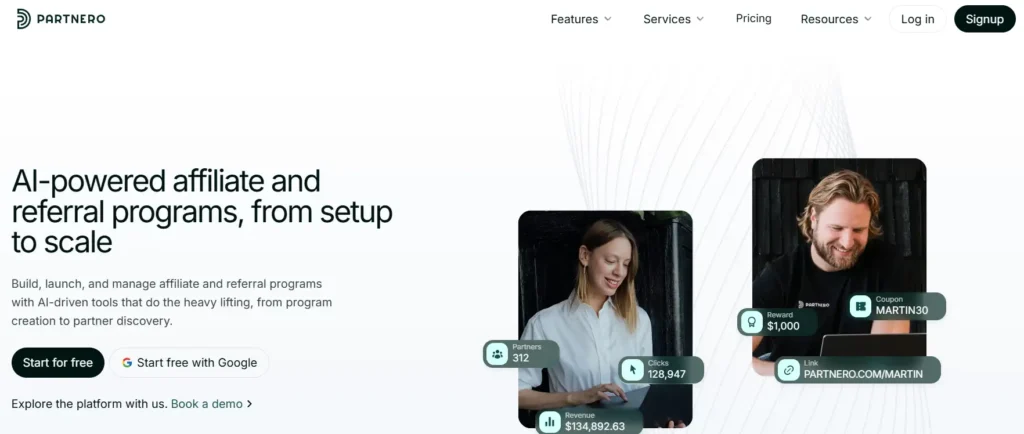
Partnero arrived in 2021 from The Remote Company, a group with a long track record building email and web products. The platform runs affiliate, referral, influencer, and newsletter referral programs from a single dashboard, which appeals to teams tired of stacking separate subscriptions.
Tracking connects natively to Stripe, Paddle, Shopify, and WooCommerce, so conversions attribute without manual matching. A white label partner portal carries brand identity throughout the partner experience, and payouts move through PayPal and Wise.
Recent product direction leans heavily on an AI layer that builds program structures from a plain language business description and surfaces relevant affiliates with contact details and relevance scores.
Partnero Core capabilities
| Attribute | Detail |
|---|---|
| Founded | 2021 |
| Parent company | The Remote Company |
| Reported adoption | 3,000+ businesses |
| Payout methods | PayPal, Wise, managed payouts |
Best for: Founder led SaaS and ecommerce teams wanting affiliate plus referral coverage in one tool, with brand controlled partner experience and minimal setup overhead.
7. Tapfiliate
Tapfiliate, an Amsterdam based platform operating since 2014, suits programs straddling more than one business model. Subscription products and ecommerce stores sit comfortably under a single account, which is unusual at this tier of the market.
White labelling remains its strongest trait. Partner dashboards, signup pages, and automated emails carry brand identity rather than vendor branding, a real advantage for programs recruiting creators and publishers directly.
Integration coverage is broad, spanning Stripe, Paddle, Shopify, WooCommerce, BigCommerce, and Squarespace, backed by a REST API and Zapier. Usage limits apply on lower tiers, so click and conversion volume deserves modelling before commitment.
Tapfiliate Core capabilities
| Attribute | Detail |
|---|---|
| Operating since | 2014 |
| Headquarters | Amsterdam, Netherlands |
| Integration breadth | Stripe, Paddle, Shopify, WooCommerce, BigCommerce, Squarespace |
| Typical program profile | Mixed SaaS and ecommerce portfolios |
Best for: Brands running affiliate programs across both subscription and ecommerce revenue, where partner facing branding and flexible commission rules outweigh the need for a built in network.
The Switching Math: Migration Cost of Moving Off Impact to an Alternative
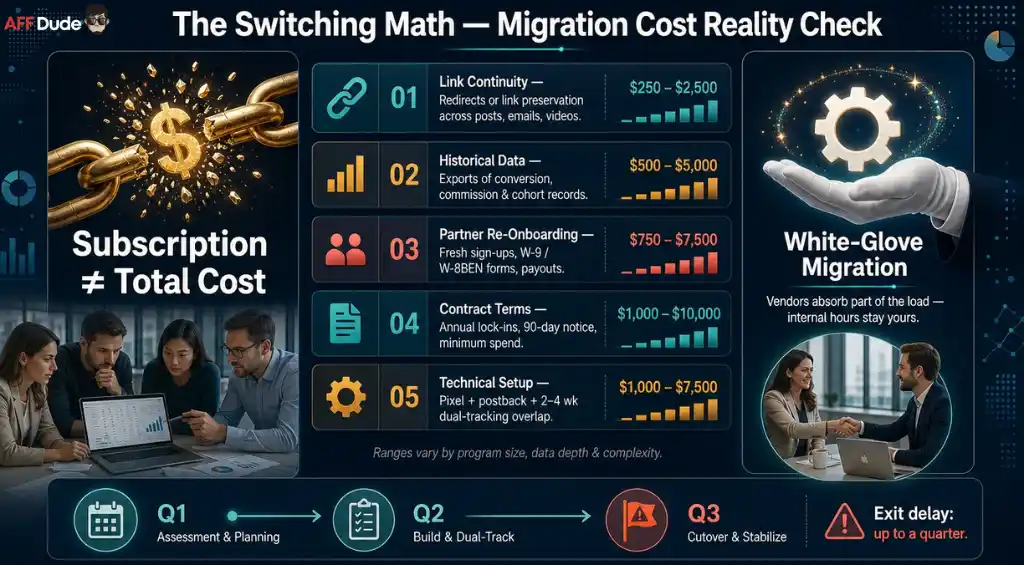
Migration costs sit outside the subscription line item, which is why teams underestimate them. Mapping the work upfront keeps a switch from eroding the savings that prompted it.
Five costs carry real weight:
Vendors offering assisted or white-glove migration absorb parts of that load, though the internal hours remain yours.
Those one-time costs feed directly into the longer cost picture below.
Moving Forward
Each of these platforms brings a different balance of simplicity, automation, and scale to partner and affiliate programs. The right fit depends on your billing stack, team size, and how much control you want over tracking and payouts.
Teams using Stripe or Paddle often start with lightweight, billing native tools for speed. B2B SaaS companies with complex partner models lean toward dedicated partner ecosystem platforms. Larger brands and networks turn to enterprise grade solutions for depth, fraud controls, and global reach.
When evaluating Impact Alternatives, focus on the option that matches your current stage and workflow, then refine as your program grows.
Recommended Articles

Affiliate Disclosure: This post may contain some affiliate links, which means we may receive a commission if you purchase something that we recommend at no additional cost for you (none whatsoever!)