

An agency lands a new client, sets up the tools, and then eats the software bill quietly. Nobody talks about that part. The vendor gets paid twice while the agency margins shrink. So why are agencies still paying full price for tools they bring clients to?
That question is pushing more teams to look at agency partner programs, where tools hand back recurring commission, discounted seats, or white label access instead of a one time referral fee. Search interest keeps climbing as agencies hunt for revenue that does not need new clients.
AFFDude Take: Most of these programs look identical on the landing page. The difference shows up in the tier rules and the payout terms. Worth reading closely before you sign anything.
What Agency Partner Programs Actually Pay For
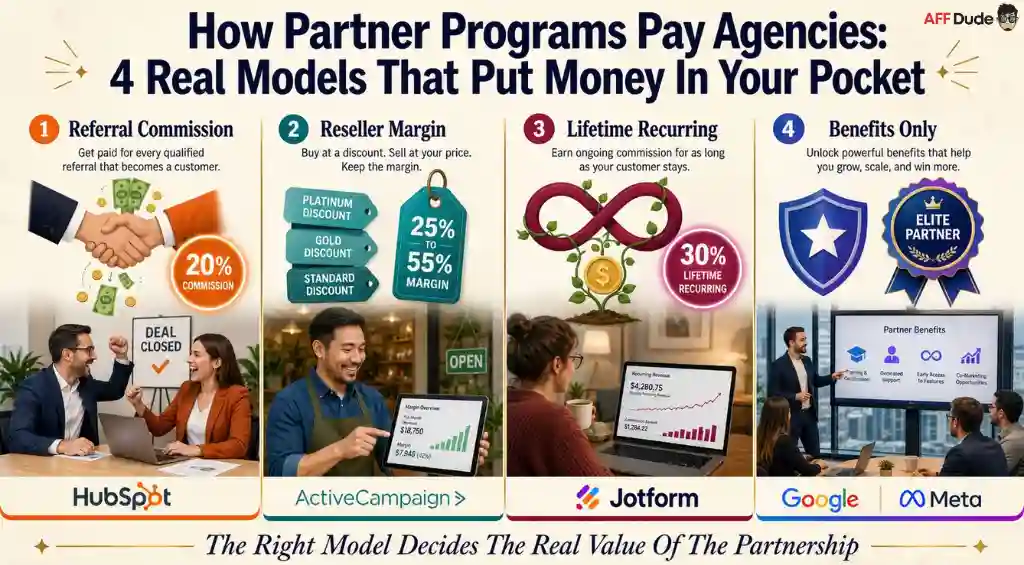
Not all agency partner programs pay cash. Some pay commission on referred revenue. Others pay in access, credentials, and lead flow. Knowing which model you are joining decides how you value the relationship.
Across the software category, four payment types show up:
A benefits-only program can still earn more than a paying one when the badge wins pitches or the directory sends inbound work. The money shows up in your service revenue instead of a monthly payout.
Attribution decides whether any of it reaches you, which is where the next section starts.
7 Best Agency Partner Programs in 2026
| Best Agency Partner Programs | Payout Model | Attribution Window |
|---|---|---|
| Shopify Partner Program | Activity based earnings | Partner Dashboard tracking |
| HubSpot Solutions Partner | 20% recurring share | Deal registration, 3 years |
| ActiveCampaign Agency Partner | 25% to 55% discount | Account volume based |
| Semrush Agency Partners | Flat sale payouts | 120 day cookie |
| Kinsta Agency Partner | $500 plus 10% | Lifetime, direct signups |
| GetResponse MAX Agency | Up to 60% recurring | Route and tier |
| WP Engine Agency Partner | 8% to 12% tiered | Up to 12 months |
1. Shopify Partner Program
Shopify sits behind millions of merchant storefronts, and its partner ecosystem was built for the studios doing the build work rather than for content publishers. Joining costs nothing and opens unlimited development stores, which is the practical hook for most ecommerce agencies.
The earning routes split several ways: merchant referrals, store builds handed over from a development store, plus separate lanes for apps and themes. Earnings move with partner activity and merchant plan, so agencies should read the route they plan to use instead of assuming one rate covers everything.
Among agency partner programs, this one rewards migration specialists and Shopify Plus implementation partners most. Non-commerce agencies get little from it, and app competition inside the ecosystem is heavy.
| Detail | Value |
|---|---|
| Joining cost | Free |
| Tracking | Partner Dashboard |
| Earning routes | Referrals, builds, apps |
| Ecosystem fit | Ecommerce only |
Best for: Ecommerce build agencies, migration specialists, and Shopify Plus implementation partners who already ship merchant stores and want revenue lanes attached to that existing work.
2. HubSpot Solutions Partner Program
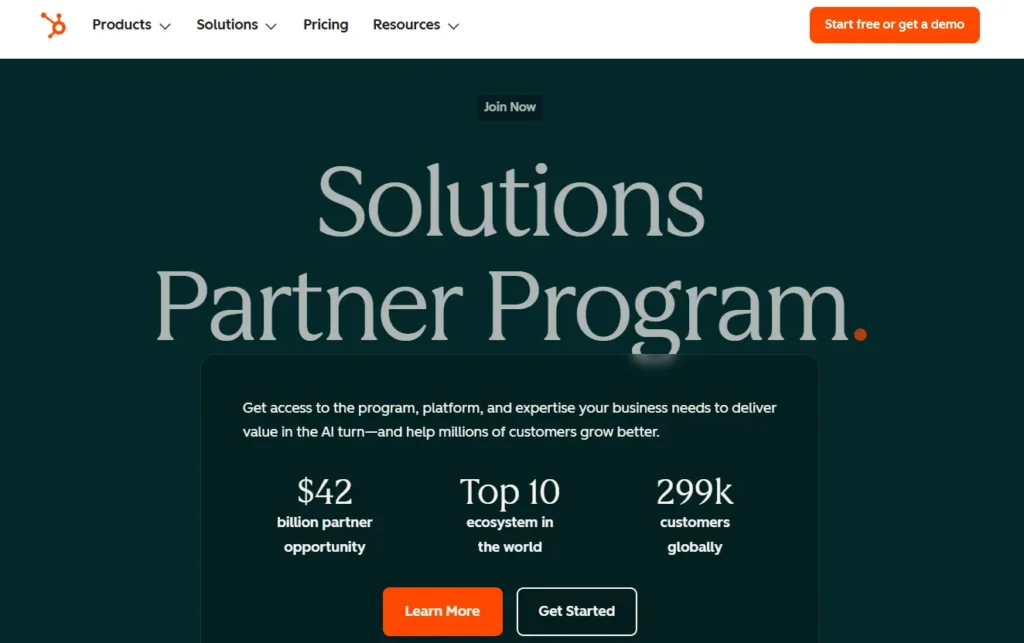
Built around service firms rather than publishers, the HubSpot Solutions Partner Program suits CRM implementers, RevOps consultancies, and inbound teams managing client portfolios on the platform.
Attribution here runs through shared deals and registration instead of a click cookie, which fits sales cycles involving several stakeholders across months. The membership fee is waived once a partner's qualifying software spend reaches the same level, so active implementers effectively join free.
Certifications carry weight in this ecosystem. Tier badges appear in client pitches, and the Solutions Directory feeds inbound work, with partner matching extended to gold tier and above from January 2026. Smaller shops should weigh the certification load before committing.
| Detail | Value |
|---|---|
| Commission | 20% recurring |
| Payout window | Up to 3 years |
| Attribution | Deal registration |
| Entry | Paid, spend waivable |
Best for: Mid-market B2B agencies and RevOps consultancies that implement CRM at scale and can absorb certification requirements in exchange for a long commission tail.
3. ActiveCampaign Agency Partner Program
Automation consultants tend to bundle software into retainers, and ActiveCampaign structures its agency route around exactly that. Agencies can refer clients for commission or resell the platform and control the client price themselves.
The reseller path is the more agency-specific option. Discounts scale with the number of active accounts you manage, which rewards consultants running lifecycle automation across a book of clients rather than sending occasional one-off referrals.
Reselling shifts responsibility too. You own billing and first-line support, so factor that into pricing before choosing this route over the referral one. A certified consultant directory sits alongside both paths and generates inbound enquiries for listed partners.
| Detail | Value |
|---|---|
| Reseller discount | 25% to 55% |
| Discount driver | Active account volume |
| Second route | Separate affiliate program |
| Support ownership | Reseller handles it |
Best for: Automation-heavy consultancies bundling CRM and email into retainers, especially teams comfortable owning billing and support in exchange for margin control.
4. Semrush Agency Partners Program
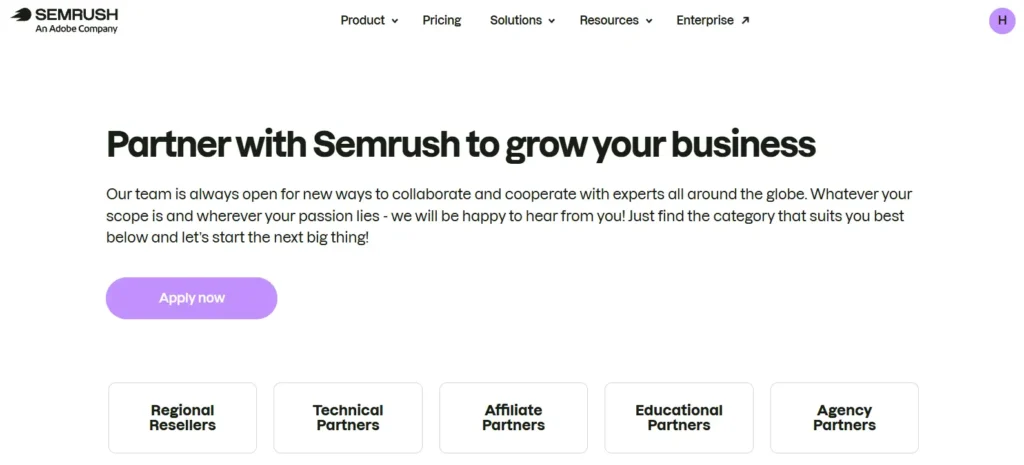
Semrush confuses more agencies than any other name on this list because it runs multiple partnership routes under one brand. The affiliate program and the Agency Partners directory are different relationships with different payouts.
The affiliate route moved to Impact and now pays flat amounts per sale, trial, and signup on last-click attribution. There is no recurring share since that migration, which changes the maths for SEO shops that expected a lifetime tail.
The Agency Partners route works differently. Certified agencies appear in the public directory, receive inbound leads, and use the partner badge in pitches. For consultancies with client books rather than audiences, the directory traffic often outperforms the affiliate payout.
| Detail | Value |
|---|---|
| Cookie duration | 120 days |
| Attribution | Last click |
| Affiliate network | Impact |
| Agency route pays | Leads, badge, certification |
Best for: SEO agencies and content consultancies with both an audience and a client book, since the two Semrush routes reward promotion and service delivery separately.
5. Kinsta Agency Partner Program
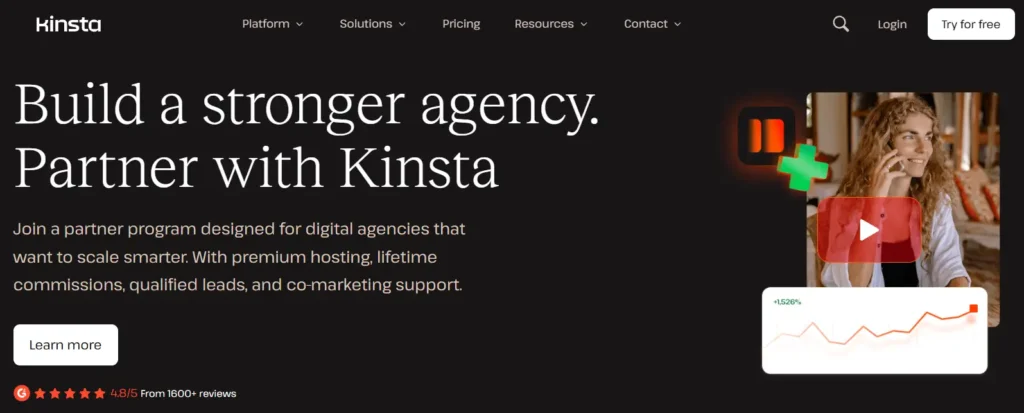
Managed WordPress hosting creates a quiet recurring line for web studios, and Kinsta leans into that with a program built around lead flow as much as payouts.
One structural detail trips agencies up. Recurring commission applies only to clients who sign up with Kinsta directly. Sites you host under your own agency plan earn nothing, so the host-versus-refer decision has revenue consequences worth deciding before onboarding a client.
The non-cash side is unusually strong. Partners get discounted hosting for their own site, referrals sent back from Kinsta, co-marketing through webinars and content, a featured directory listing, priority support, and free migrations. More than 300 agencies currently sit in the program.
| Detail | Value |
|---|---|
| Bounty | Up to $500 |
| Recurring share | 10% lifetime |
| Qualifying signups | Direct client only |
| Platform scope | WordPress hosting |
Best for: WordPress studios that want inbound referrals and co-marketing alongside hosting revenue, particularly teams strong at client delivery but weak at self promotion.
6. GetResponse MAX Agency Partner Program
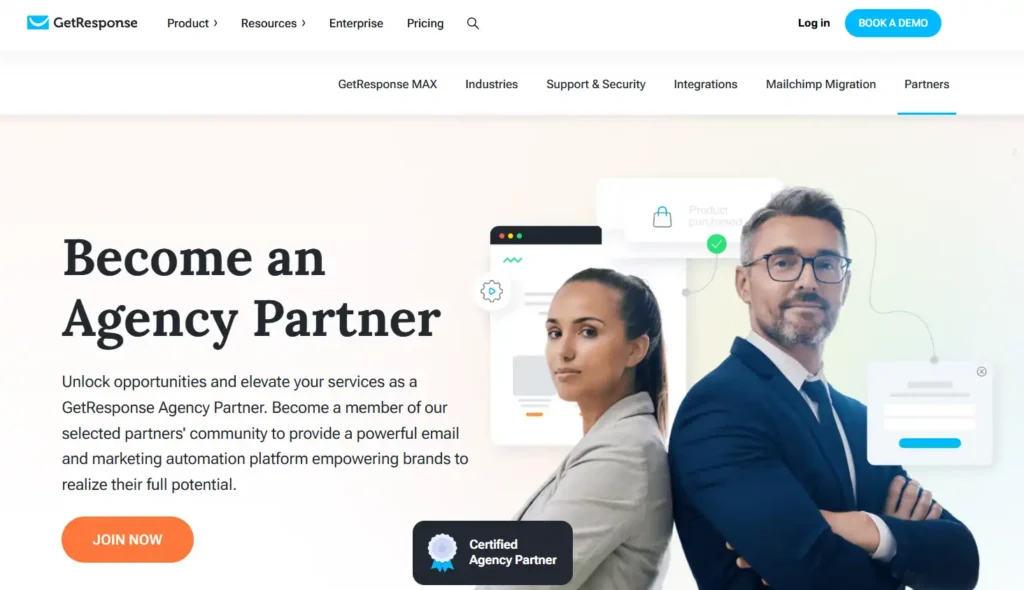
GetResponse separates referral and reseller opportunities, which gives smaller agencies two ways in without enterprise-level process overhead. Its MAX tier targets teams managing email, webinar, and automation work for multiple clients.
Rates sit near the top of this category, and both routes pay on a recurring basis rather than a single bounty. The exact percentage depends on which path you take and the tier you reach.
Brand pull is the trade-off. GetResponse carries less weight upmarket than the all-in-one platforms, and the product surface is narrower. For email-led shops serving SMB clients, the margin usually compensates. Co-branded sales materials are provided, which shortens the pitch work on smaller deals.
| Detail | Value |
|---|---|
| Affiliate route | Up to 60% |
| Reseller route | Up to 50% |
| Payout type | Recurring, lifetime |
| Sales support | Co-branded materials |
Best for: Email and webinar-led agencies serving SMB clients, where high recurring margin matters more than the brand recognition an enterprise platform brings to pitches.
7. WP Engine Agency Partner Program
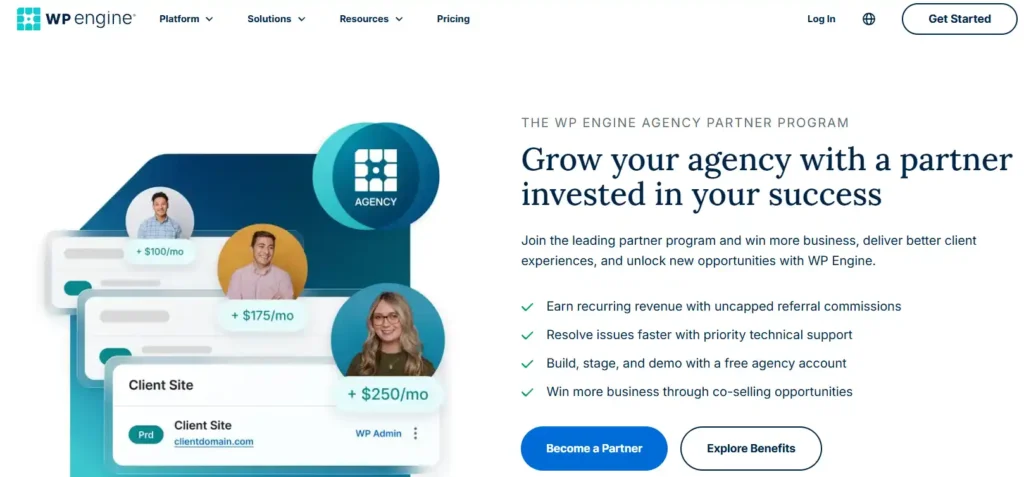
WordPress agencies of any size can join WP Engine without a fee, which keeps this one of the lower-friction agency partner programs to test alongside others.
Partners get a development environment, referral tracking, sales resources, and directory visibility from day one. Higher tiers unlock priority support, co-marketing budget, and dedicated account management, so the value climbs as referred volume does.
Commission is modest compared with lifetime programs, and the payout stops after a fixed window rather than continuing for the client's lifetime. The program works for both referral and resale models, which makes it easy to slot into an existing hosting workflow instead of rebuilding how you handle client sites.
| Detail | Value |
|---|---|
| Commission tiers | 8%, 10%, 12% |
| Payout window | Up to 12 months |
| Joining cost | Free |
| Models supported | Referral and resale |
Best for: WordPress agencies at any stage wanting a no-cost entry point, useful as a second or third program rather than a primary revenue line.
Stacking Agency Partner Programs Without Splitting Client Attribution
Most agencies join several agency partner programs at once. The risk is not workload. It is attribution collision, where two vendors claim the same client touchpoint and you get paid by neither.
Splits happen for predictable reasons:
The fix is process, not more programs. Register the deal before the demo call, keep partner links in one shared doc, and log a partner-sourced field in your CRM at proposal stage.
Two or three programs run properly return more than ten run loosely. Certifications expire, tiers reset, and unregistered deals never come back.
Attribution also explains why agency partner programs and affiliate programs pay so differently.
Agency Partner Programs vs Affiliate Programs: Where the Margin Sits
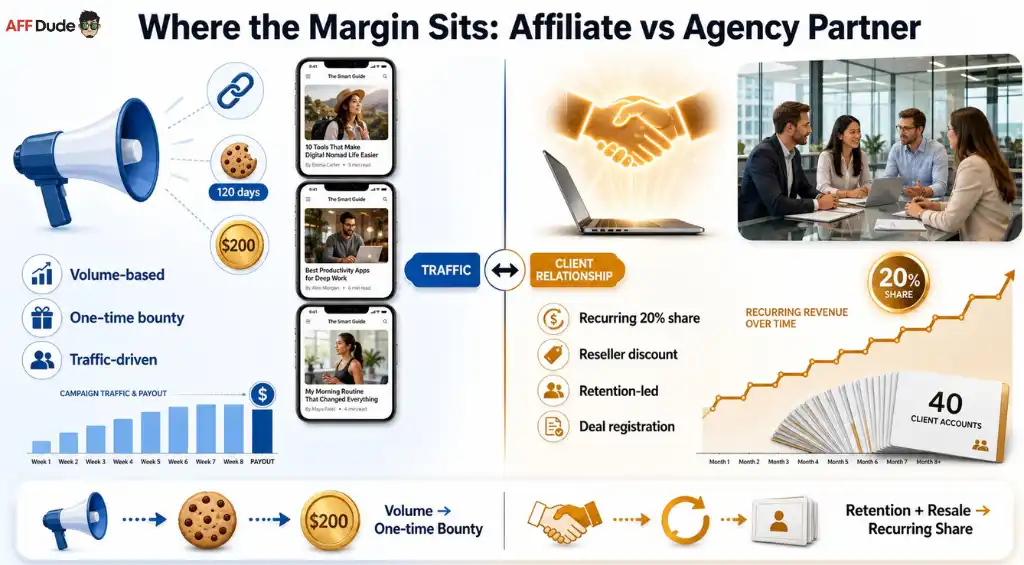
These two models look similar on the surface. Both pay you for sending customers to software. The economics underneath are not the same.
Affiliate programs pay for traffic. Attribution runs on a referral link and a cookie window, often 30 to 120 days, and the payout is usually a one-time bounty. Semrush pays $200 per sale through its affiliate route with a 120-day cookie.
Agency partner programs pay for the client relationship. Attribution runs on deal registration or account ownership, so the payout survives long sales cycles with multiple stakeholders.
That difference sets the margin:
An agency with 40 client accounts usually earns more from a 20% recurring share than from a bounty it collects once. A publisher with 40,000 monthly readers earns the opposite way.
Some vendors run both routes separately, which is where earnings get lost.
Final Word on Agency Partner Programs
Most agencies leave money behind quietly. They recommend the same tools every quarter and never register a single deal. The fix is small and boring: track what you already put clients on, then read the terms attached to it.
Two or three agency partner programs, run properly, will outperform a dozen signed up and forgotten. Retention decides what a rate is worth. Attribution decides whether it reaches you at all.
Start with the tools already sitting inside your client work. That part costs nothing to check.
Recommended Articles

Affiliate Disclosure: This post may contain some affiliate links, which means we may receive a commission if you purchase something that we recommend at no additional cost for you (none whatsoever!)