

iGaming GEO verification means checking whether a country or region is actually usable before you publish content, buy traffic, or push a casino/sportsbook offer.
The best GEO is not the one with the biggest hype. It is the GEO where local search demand, operator licensing, offer availability, payment methods, language, landing pages, and compliance rules all line up.
In 2026, this matters more because iGaming is growing, but regulation is tighter. Delasport's 2026 iGaming trends report says online gambling reached EUR 90.5B in 2025 and expects continued growth, while Google Ads still requires country-specific certification for many gambling ads. Translation: there is money in the vertical, but random GEO testing can get expensive fast.
Dude Take: A GEO is not verified until you see what the local user sees.
Why GEO Verification Matters In iGaming
iGaming affiliates love to say “this GEO is hot.” Cool. Hot for who? A licensed operator? A crypto casino? A sportsbook? SEO traffic? Native traffic? Telegram? RevShare? CPA? Mobile users? Desktop high rollers? One word, zero clarity.
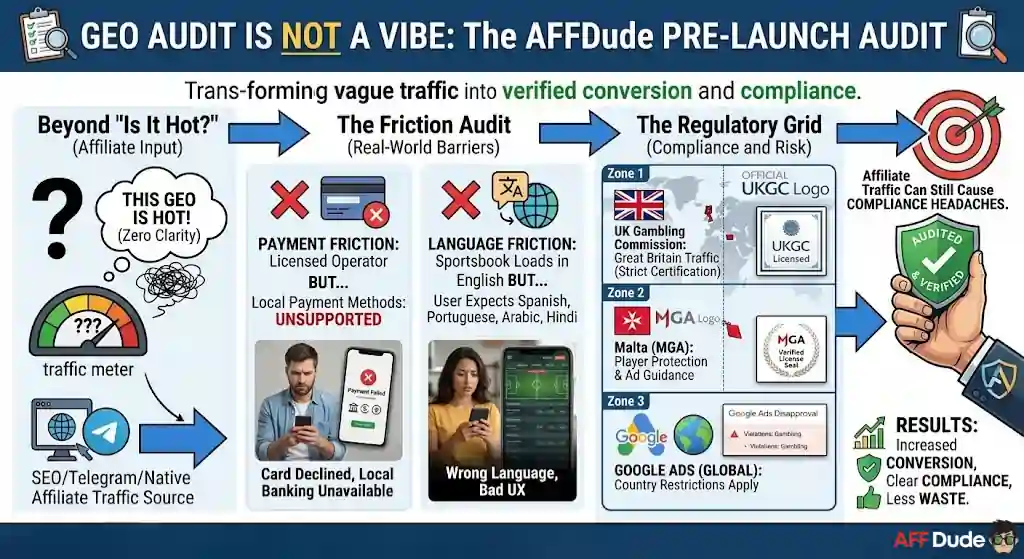
The same offer can perform very differently across countries because the friction changes. A casino might accept one country but not support local payment methods. A sportsbook might load in English but convert poorly because the local user expects Spanish, Portuguese, Arabic, Hindi, or another language.
The iGaming market is also fragmented. The UK Gambling Commission regulates remote gambling for Great Britain, Malta's MGA publishes player-protection and advertising guidance for licensees, and Google Ads applies country restrictions and certification requirements to gambling-related ads.
Even if you are “only an affiliate,” your traffic can still create compliance headaches for the operator.
That is why AFFDude treats GEO research like a pre-launch audit, not a vibes exercise.
The iGaming GEO Verification Checklist Every Affiliate Needs
Use this table before choosing an iGaming GEO. If one row fails, do not ignore it. Fix it, switch offer, or pick another market.
| Check | What To Verify | Why It Matters | Dude Rule |
|---|---|---|---|
| Local SERP | Search results from the target country and language | Shows real competitors, intent, and SERP features | Do not trust your home-country Google results |
| Licensing | Whether the operator can legally target the market | Protects payouts, domains, and partner relationships | Ask for written GEO permission |
| Offer terms | CPA, RevShare, hybrid, minimum deposit, bonus rules | Determines funnel economics | Big CPA means nothing if FTD friction is brutal |
| Payment methods | Cards, bank transfer, wallets, PIX, crypto, local rails | Payment failure kills deposits | Check deposit and withdrawal, not only signup |
| Landing page | Language, bonus, speed, mobile UX, restricted-country behavior | User trust happens after the click | Test from local mobile IP |
| Compliance | Responsible gambling, age checks, ad rules, banned claims | Prevents account and payout pain | No fake urgency, no guaranteed-win nonsense |
| Tracking | Sub-ID, postback, FTD, deposit, player value | Lets you optimize quality, not just registrations | Ask for downstream feedback |
This table is your first filter. The goal is not to find a perfect GEO. The goal is to avoid launching into a GEO where the funnel is broken before the first click.
Step 1: Check Local SERPs Like A Real User
Start with local search, not affiliate network hype. Use a VPN, local proxy, or SERP tool to view Google from the target country. Search in the local language and in English if both matter.

For example, a Brazil sportsbook query may behave differently in Portuguese than in English, and the SERP may include local brands, news, payment references, bonus pages, and regulatory language.
Look for three things. First, who is ranking? If the top results are giant authority sites, government pages, and established local brands, SEO will need more time. Second, what format ranks? Bonus pages, comparison tables, app pages, bookmaker reviews, or educational betting guides all signal different intent.
Third, what SERP features appear? If you see video, forums, news, and AI answers, your content needs more than a basic list.
AFFDude already has GEO traffic guides that can support this research, including Brazilian traffic sources, MENA Arabic traffic, and GCC traffic. Use those as traffic-source context, then verify the iGaming reality separately.
Step 2: Confirm The Operator Can Accept The GEO
Never assume a casino or sportsbook accepts a GEO because the landing page loads. Ask the affiliate manager directly. You want written confirmation of allowed countries, banned countries, product availability, licensing restrictions, and traffic-source restrictions.
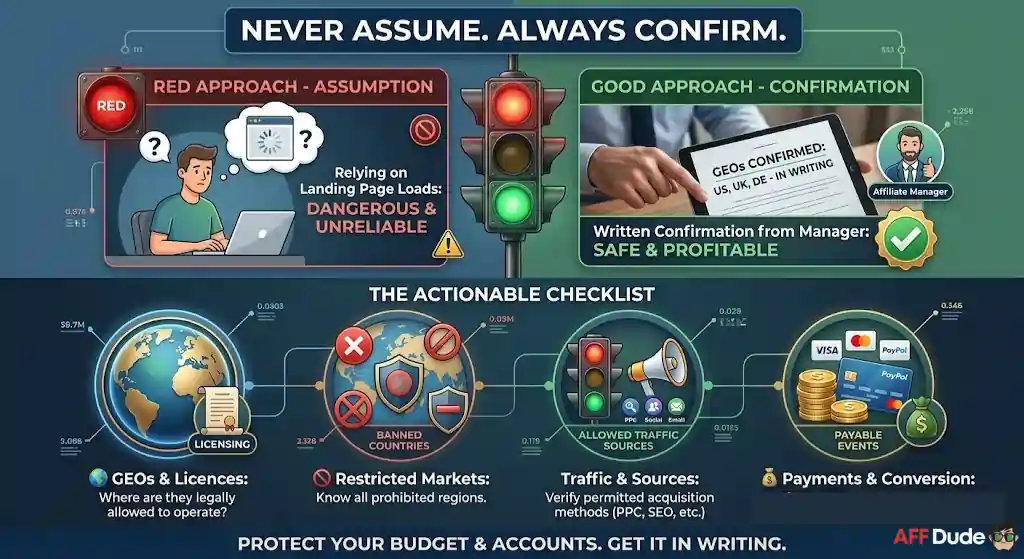
This is especially important for paid traffic. Google Ads says gambling-related ads may need certification and are affected by country restrictions.
Some ad formats cannot promote gambling, and campaigns targeting disallowed countries can be disapproved or limited. That is not a small warning. It means your creative, domain, advertiser relationship, and account can all take damage from sloppy GEO targeting.
For SEO affiliates, the risk is different but still real. Ranking a page for a restricted market may bring traffic the operator cannot monetize. Worse, it may create compliance pressure if the page promotes bonuses or operators in a way that conflicts with local rules.
Budget Burn Alert: Do not accept “yes bro, GEO is good” as confirmation. Ask: licensed where, allowed traffic sources, accepted payment methods, and payable conversion event.
Step 3: Test Payments Before You Trust The Funnel
Payment methods are where many iGaming campaigns quietly die. A user can like the bonus, trust the brand, and start registration, then abandon because the deposit method is weak.
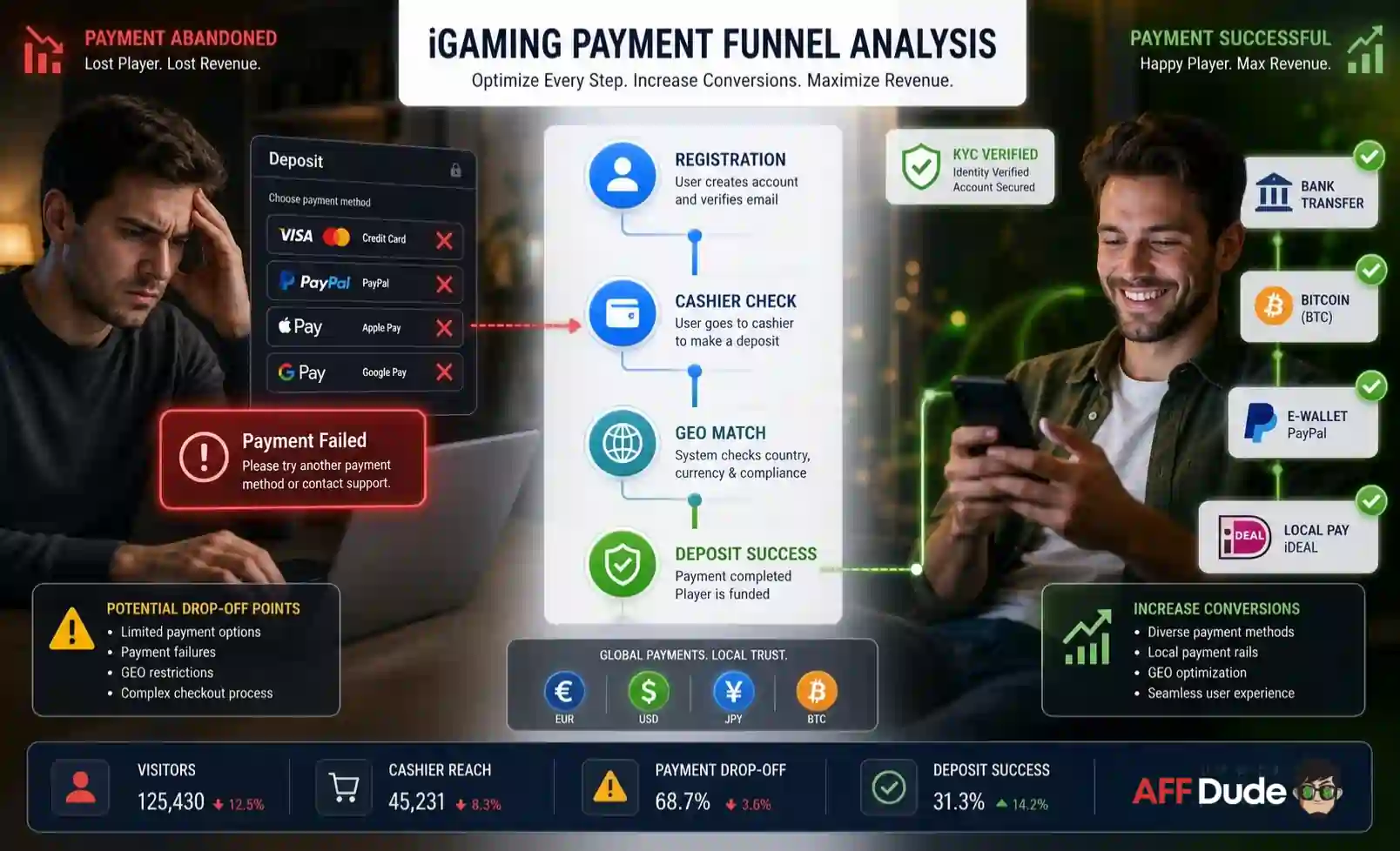
Check the cashier from the target GEO. Look at deposit options, withdrawal options, minimum deposit, currency, KYC timing, wallet availability, card acceptance, crypto availability, and whether local payment methods appear. In some markets, instant local rails matter more than the bonus.
In others, cards or e-wallets are enough. For crypto-first traffic, check whether crypto is actually supported for that GEO and whether the offer permits that angle.
This is also where CPA and RevShare math changes. CPA can look cleaner, but if the operator rejects low-quality deposits or invalid users, your EPC collapses. RevShare can be strong if payment flow, retention, and product quality are good.
If you need network options, AFFDude's iGaming affiliate networks guide and CPA gambling networks guide are natural next reads.
Step 4: Audit The Landing Page From The GEO
Open the landing page from a local mobile IP. Do not only test desktop. Many iGaming markets are mobile-first, and Delasport's 2026 trends report notes mobile as a major betting driver.
Even if the exact mobile share differs by market, the direction is obvious: if the mobile lander feels slow, unlocalized, or confusing, you are leaking deposits.
Check the headline, bonus, language, currency, responsible gambling footer, app links, payment logos, registration flow, KYC step, and whether the terms match what the affiliate manager promised.
Dude Tip: Screenshot the GEO landing page before launch. If payouts get disputed later, screenshots help you show what was actually promoted when traffic started.
Step 5: Build A Local Content Angle
After the technical checks, build the content. A generic “best online casinos” page is usually weak. A local page should answer local questions: which operators accept the country, which payment methods work, what bonus terms matter, whether sports betting or casino has stronger intent, and what responsible gambling tools are visible.
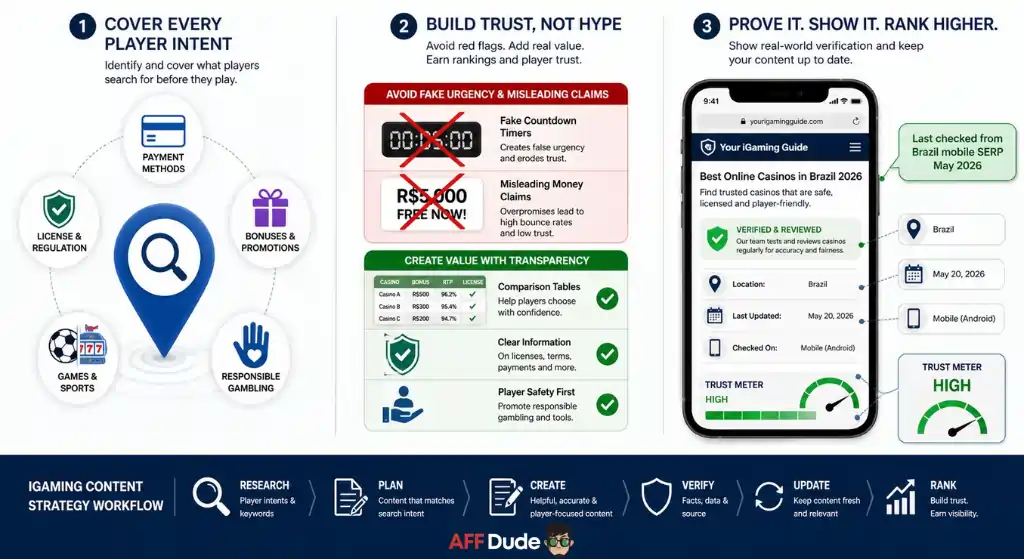
Do not overpromise. Avoid “guaranteed wins,” fake urgency, misleading bonus claims, or anything that implies gambling is a money-making method. Good iGaming content helps users compare licensed options, understand risk, and choose safely. It also helps the affiliate keep advertiser trust.
Make Money Move: Add a GEO verification note to every iGaming money page. A line such as “Last checked from Brazil mobile SERP and operator landing page in May 2026″ builds more trust than another generic bonus paragraph.
FAQ
What is the best iGaming GEO in 2026?
There is no universal best GEO. A good iGaming GEO depends on regulation, operator availability, payments, search competition, traffic cost, language, and payout model.
Should affiliates choose CPA or RevShare for new GEOs?
CPA is usually easier for testing because the feedback loop is faster. RevShare can be better when the operator has strong retention, smooth payments, and real player value.
Can affiliates run gambling ads on Google?
Sometimes, but only where Google permits gambling-related ads and the advertiser meets certification and country-specific requirements. Always check Google's policy and the operator's traffic rules first.
Affiliate Disclosure: This post may contain some affiliate links, which means we may receive a commission if you purchase something that we recommend at no additional cost for you (none whatsoever!)