
Here's the short version. The dating market is worth roughly $8 to $9 billion in 2026, over 380 million people swipe every month, and only about 25 million of them pay a penny. That gap is where affiliates print money.
Tier-1 dating leads still pay $5 to $10 a pop, RevShare deals run 25% to 50% lifetime, and AI has crashed the party on both sides of the table.
These Dating Marketing Statistics 2026 come from our own tracking, network chats, and years of running dating traffic. Read on. We've done the maths so you don't have to.
Dude take: Dating is the oldest vertical in the game, and it still slaps. Cheap entry, huge audience, offers for every skill level. If you're picking a first vertical, start here.
How Big Is the Dating Market in 2026?
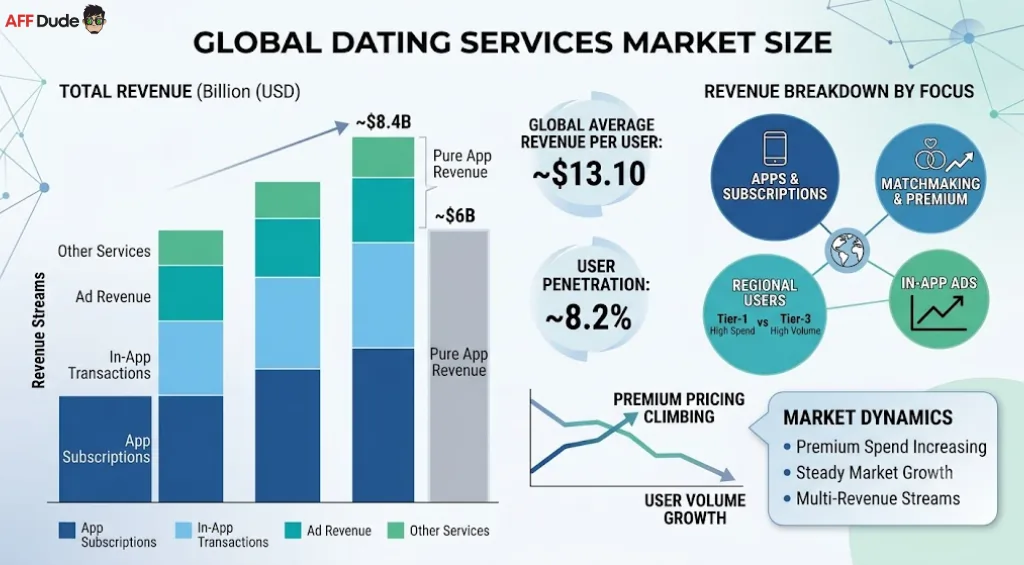
Big. And messy to measure. Every research house counts it differently.
The broad dating services market sits near $8.4 billion in 2026. Pure app revenue is closer to $6 billion after a small dip in 2025. Some analysts push the global figure past $12 billion once you fold in web platforms, matchmaking, and casual sub-niches.
Why the spread? Because “dating” means five different things. App subscriptions. In-app coins. Ad revenue. Matchmaking services. Adult verticals nobody wants on the record.
Our read: the honest number sits around $8 to $9 billion for services people actually pay for. We think it clears $10 billion by 2028 as premium pricing keeps climbing.
| Dating Market Segment | 2026 Revenue | Growth Signal |
|---|---|---|
| Dating services (broad) | ~$8.4 billion | Steady, single-digit growth |
| Dating apps only | ~$6 billion | Slight dip from 2025 |
| Matchmaking sub-market | ~$4.2 billion | Rising, premium-led |
| US market (largest single geo) | ~$2.65 billion | Mature, high spend per user |
| Global outlook by 2031 | ~$13.5 billion | ~11% CAGR on services |
Average revenue per user in dating services lands around $13.10 in 2026. User penetration hits 8.2% globally. Both numbers keep creeping up.
The takeaway for a marketer? The pie grows slowly, but the money per head grows faster. People pay more for less swiping.
One more angle worth flagging. Advertising revenue inside dating apps keeps climbing. Brands now buy space in front of dating users because the audience is young, engaged, and glued to the screen. In-app ad spend on dating platforms runs into the hundreds of millions each year.
That's a second revenue stream beyond subscriptions, and it hints at how valuable a dating user's attention really is.
Growth also splits by region. Mature markets like the US and UK grow slowly but spend heavily per head. Emerging markets grow fast on user count but spend little. Smart affiliates play both: high payouts in Tier-1, high volume in Tier-3.
How Many People Use Dating Apps Right Now?
Roughly 380 million people use dating apps worldwide in 2026. About 80 million of those sit in the US.
Here's the punchline. Only around 25 million pay. The rest ride the free tier like a gym membership they never cancel.
Age tells the real story. Younger daters dominate, but the fastest growth is at the grey end of the pool.
The over-50 crowd grows at 15% or more a year. Marketers keep ignoring them. That's a mistake.
Dude take: everyone chases the 22-year-old on Tinder. Meanwhile OurTime and senior offers convert like crazy with far less competition. Older users are lonelier, more patient, and more willing to pay. Do the maths.
One stat that never moves: 30% of US adults have tried online dating. That figure has held flat since 2019. The pool isn't growing much. Users just recycle the same faces.
The Gender Ratio Problem Every Dating Marketer Should Know
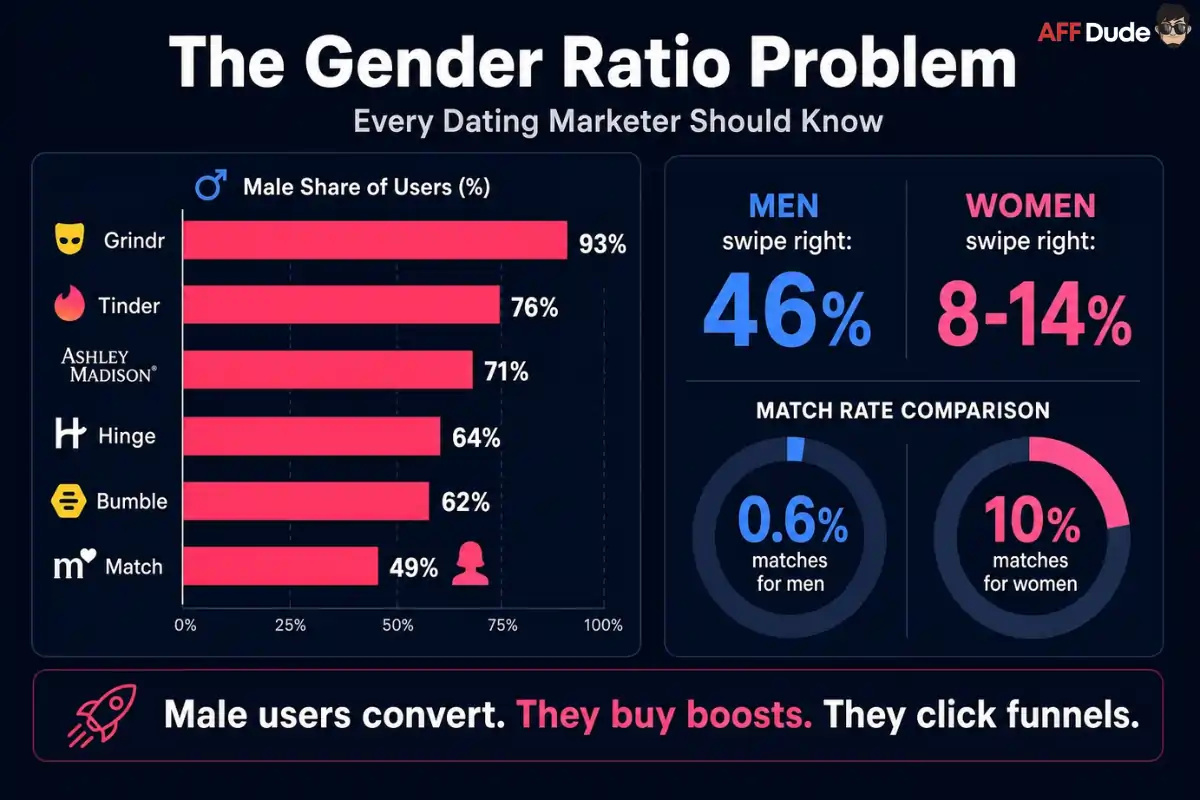
Dating apps run male-heavy. Always have. This shapes every campaign you'll ever build.
| Platform | Male Share | What It Means for Traffic |
|---|---|---|
| Grindr | ~93% | Niche, loyal, high intent |
| Tinder | ~76% | Volume king, brutal ratio |
| Ashley Madison | ~71% | Adult, high payout |
| Hinge | ~64% | Relationship-focused |
| Bumble | ~62% | Women-first model |
| Match.com | ~49% (51% female) | Balanced, older skew |
Now the match rates. This is where it gets grim for the lads.
Men swipe right on roughly 46% of profiles. Women swipe right on 8% to 14%. Yet women match on about 10% of swipes while men match on 0.6%.
Read that again. Women get around 2.7 matches a day. Men get about 1.1.
Why does a marketer care? Because male users are desperate for an edge. They buy boosts. They buy premium. They click your funnel. Male traffic converts on paid features because the ratio forces their hand.
AffDude take: run male-targeted dating offers and your CTR will thank you. Men are the buyers in this vertical. Build creatives that promise more matches, not more romance.
Who Actually Pays for Dating Apps?
Spending splits along clean lines. Knowing them sharpens your targeting.
So your golden buyer? A man over 30 with cash. He has accepted the algorithm won't reward his personality, so he pays for visibility.
Session length is shrinking, though. Average time per visit fell from 13.21 minutes in 2024 to 11.49 minutes in 2025. People swipe less and buy more.
Around 78% of Gen Z report dating app fatigue. They're burnt out on infinite swiping. Many now chase real-life meetups, speed dating, and social clubs instead.
That fatigue is a marketing signal, not a death knell. Fatigued users flock to apps that promise fewer, better matches. Sell the escape from the grind.
Dating Affiliate Marketing Payouts in 2026
Now the part you came for. What does dating traffic actually pay?
The dating vertical stays one of the friendliest for beginners. Low entry cost, loads of geos, offers for every budget. Here's the money map for 2026.
| Payout Model | Typical Rate (2026) | Best For |
|---|---|---|
| SOI / DOI registration | $2 to $8 per sign-up | Beginners, easy conversions |
| CPL (Cost Per Lead) | $1 to $6 per lead | Volume plays, mid geos |
| Tier-1 CPL (US, UK, DE) | $5 to $10 per lead | Quality traffic, higher spend |
| Subscription CPA (Tier-1) | $40 to $100+ per purchase | Warm traffic, proven funnels |
| RevShare | 25% to 50% lifetime | Patient affiliates, recurring cash |
Top RevShare partners squeeze up to 75% on some networks. Tier-3 CPL sits at $1 to $3 but comes with huge volume potential.
The models matter. A Single Opt-In offer pays fast because the user barely does anything. An email, a profile, done. RevShare pays slower but keeps paying, since dating subscriptions run $20 to $60 a month and users often stick around.
Sign-up conversion rates on quality dating traffic sit around 2% to 5%. That's healthy for a vertical this cheap to test.
AffDude take: start on SOI or CPL to learn the ropes and get cash flowing. Only move to RevShare once you trust your traffic quality. RevShare with junk traffic is just unpaid work.
SmartLinks Still Rule Mixed Traffic
Most big dating networks now push SmartLink technology. You send mixed traffic, the link routes each click to the highest-converting offer by geo and device. Set and forget, more or less.
For worldwide or dirty traffic, SmartLinks beat manual offer picking every time. You capture value from geos you'd otherwise waste.
The tech has sharpened too. Modern dating SmartLinks weigh 20-plus targeting signals before serving an offer, from device and browser to time of day. That real-time routing lifts conversion without you lifting a finger. For beginners, it removes the hardest part of the job: guessing which offer fits which click.
The Traffic Squeeze Nobody Warns You About
One trend hurts content-heavy affiliates in 2026. Organic content traffic fell 15% to 25% year on year as AI answer boxes eat clicks.
Meanwhile, influencer and creator-driven revenue rose 30% to 50% in high-intent verticals. The lesson? Don't lean on one traffic source. Blend paid, social, email, and creator channels.
Realistic dating ROI benchmarks now sit around $3 to $5 returned per $1 spent on social and subscription offers. Anyone quoting $12 to $15 is showing you gross numbers before scrub and network fees. Ignore the pitch decks.
Top Dating Apps by Users in 2026
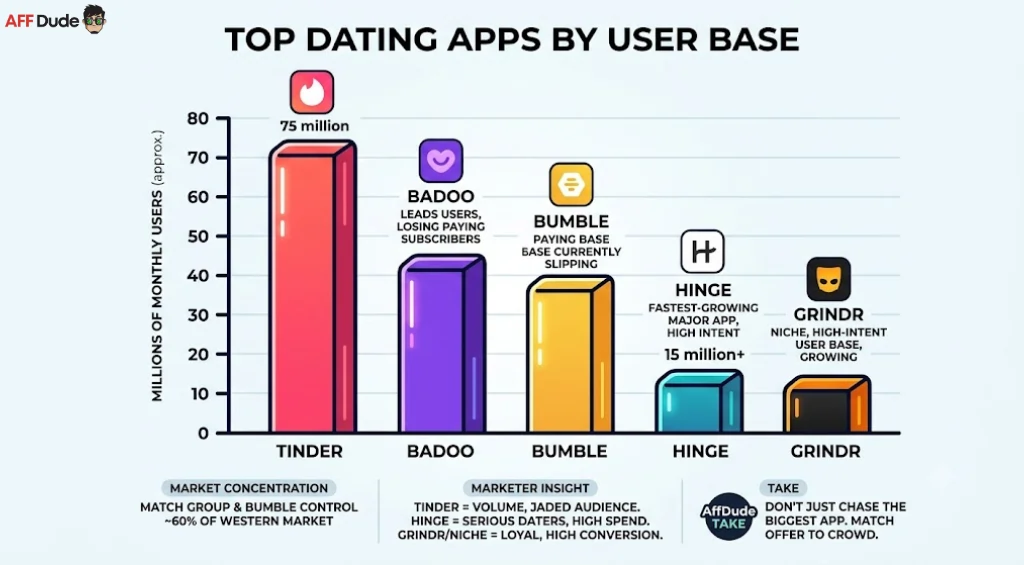
Knowing the big players helps you pick offers and read traffic quality. Here's how the leaders stack up in 2026.
Tinder still rules by raw user count. It carries around 75 million monthly users and pulls in more revenue than any rival. Yet its paying base keeps shrinking, down from 11.1 million in 2022 to 8.77 million in 2025.
Hinge is the only major app growing its subscribers. It added 17% more paying users and grew revenue 26% year on year. Bumble, by contrast, saw paying users drop 16% in a single year.
| App | Monthly Users (approx.) | Momentum in 2026 |
|---|---|---|
| Tinder | ~75 million | Leads on users, losing payers |
| Badoo | ~45 million | Strong in Europe and LatAm |
| Bumble | ~40 million | Paying base slipping |
| Hinge | ~15 million+ | Fastest-growing major app |
| Grindr | ~14.5 million | Niche, high-intent, growing |
What does this mean for a marketer? Tinder gives you volume but a jaded, price-shy crowd. Hinge attracts serious daters who spend. Grindr and niche apps bring loyal, high-intent users who convert well on the right offer.
Match Group and Bumble together control roughly 60% of the Western market. That concentration means a handful of brands set the pricing and the ad rules you'll work around.
AffDude take: don't just chase the biggest app. Match the offer to the crowd. A relationship-led funnel suits Hinge traffic. A casual or adult angle fits Tinder and Badoo audiences. Read the room.
Which Traffic Sources Work for Dating Offers?
Dating is one of the few verticals that runs on almost any traffic source. Your budget and skill set decide the pick.
Free traffic suits beginners. Short-form video on social platforms can push huge volume to SmartLinks with zero ad spend. The trade-off is slower scale and platform bans if you push adult angles.
Paid traffic scales fast but bites back. Mainstream ad platforms allow clean dating ads yet come with steep competition and tight compliance. Push, pop, and native networks handle grey and adult offers better, but they need testing budget.
| Traffic Source | Best Fit | Watch Out For |
|---|---|---|
| Social video (organic) | Beginners, mainstream offers | Slow scale, account bans |
| Push and pop networks | Volume, grey and adult offers | Lower traffic quality |
| Native ads | Mainstream, story-led funnels | Higher CPCs |
| Paid social | Scale, clean dating offers | Strict compliance, high cost |
| Email and creator | Warm audiences, RevShare plays | List quality, build time |
One shift matters most in 2026. Creator and influencer traffic keeps rising while pure content traffic fades. Blending channels protects you from any single algorithm change wiping out a campaign overnight.
Localised creatives win too. A pre-lander written for the user's country and language lifts conversion far more than a generic English page dropped into every geo.
AffDude take: white-hat funnels, local creatives, and compliance-friendly pre-landers are no longer optional in 2026. Higher ad costs punish lazy campaigns. Tighten your funnel or bleed budget.
AI Has Entered the Dating Chat
Artificial intelligence reshaped dating faster than any trend since the swipe. Both sides now run on it.
Platforms poured money into AI matching. Match Group put $60 million into an AI overhaul built around behavioural signals rather than profile photos. Hinge's AI recommendation engine lifted matches and contact exchanges by 15%.
Users are surprisingly open to it. Consider these AI dating adoption stats:
There's a catch, though. 64% of daters admit they'd feel cheated if a match used AI to write their prompts or touch up their photos. So people want AI help for themselves but hate it in others. Classic.
AffDude take: AI dating tools, coaches, and profile optimisers are a fresh sub-niche with almost no affiliate saturation yet. Early movers here will clean up. Watch this space and grab offers before everyone piles in.
Romance Scams: The Trust Tax on Dating Traffic
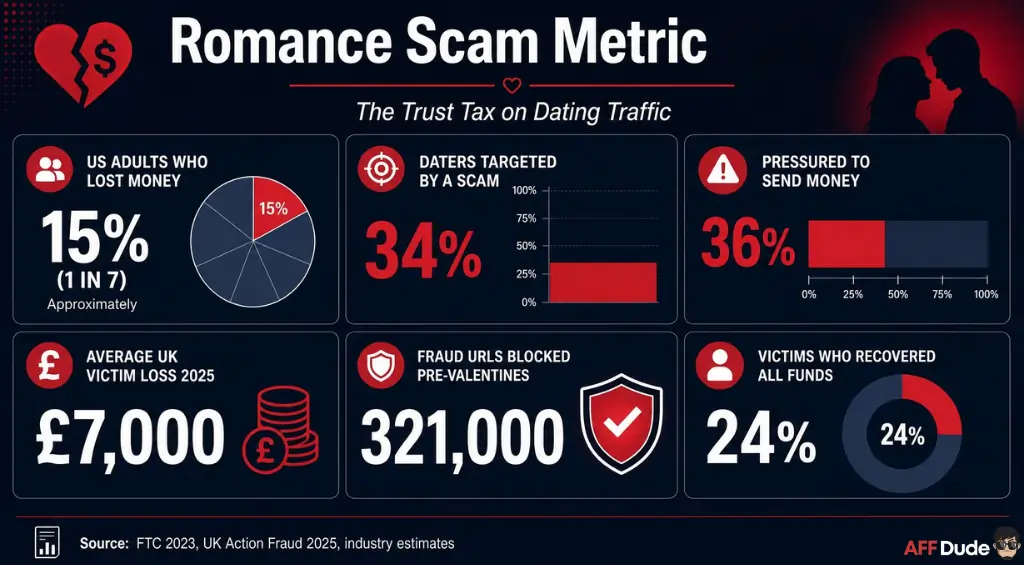
Here's the ugly side. Romance fraud is now baked into online dating, and it drags trust down for every honest offer you run.
The numbers are rough. In 2026, 1 in 7 American adults say they've lost money to a dating or romance scam. In the UK, 11% report the same. Reported US romance scam losses topped $1.14 billion back in 2023 and have kept climbing.
| Romance Scam Metric (2026) | Figure |
|---|---|
| US adults who lost money | ~15% (1 in 7) |
| Daters targeted by a scam | ~34% |
| Pressured to send money | ~36% |
| Average UK victim loss (2025) | ~£7,000 |
| Fraud URLs blocked pre-Valentine's | ~321,000 |
| Victims who recovered all funds | ~24% |
AI made it worse. Scammers now run bots that send 60-plus messages in 12 hours. Deepfake video calls are creeping in. Fake profiles are near impossible to spot with a reverse image search.
Younger adults get hit most often but lose less, usually under $500. Men aged 35 to 44 lose the biggest amounts.
Why does this matter to you as a marketer? Trust is now the product. Platforms selling identity verification and safety features are winning market share. Around 70% of users feel safer on apps with real verification. Promote safety-first offers and you tap into genuine demand.
AffDude take: don't touch shady offers that ride the scam wave. Short-term cash, long-term ban. Reputable verified-dating and safety offers are where the smart money sits in 2026.
Where the Dating Money Lives: Regional Breakdown
Geo choice makes or breaks a dating campaign. Here's how the map splits in 2026.
Tier-1 geos pay best per lead but come loaded with competition and high ad costs. Tier-2 markets offer cheaper traffic and decent $2 to $5 SOI payouts. Tier-3 gives you scale on thin margins.
India stands out. Cheap traffic, exploding smartphone use, and a young population make it a volume goldmine, even if payouts stay low.
Japan is worth a look too. The government there even backs AI matching to fight falling birth rates, which tells you how mainstream online dating has become. Southeast Asia rounds out the fast-growth pack, with mobile-first users signing up in huge numbers.
Europe splits by country. The UK, Germany, and France carry the biggest spend, but privacy rules like GDPR shape what offers you can run and how you collect data. Keep your funnels compliant or risk a fast ban.
AffDude take: new affiliates should test Tier-2 and Tier-3 first. Cheaper mistakes, faster lessons. Graduate to Tier-1 once your funnel converts and your pockets can absorb the ad spend.
Match Rates, Ghosting, and Why Funnels Break
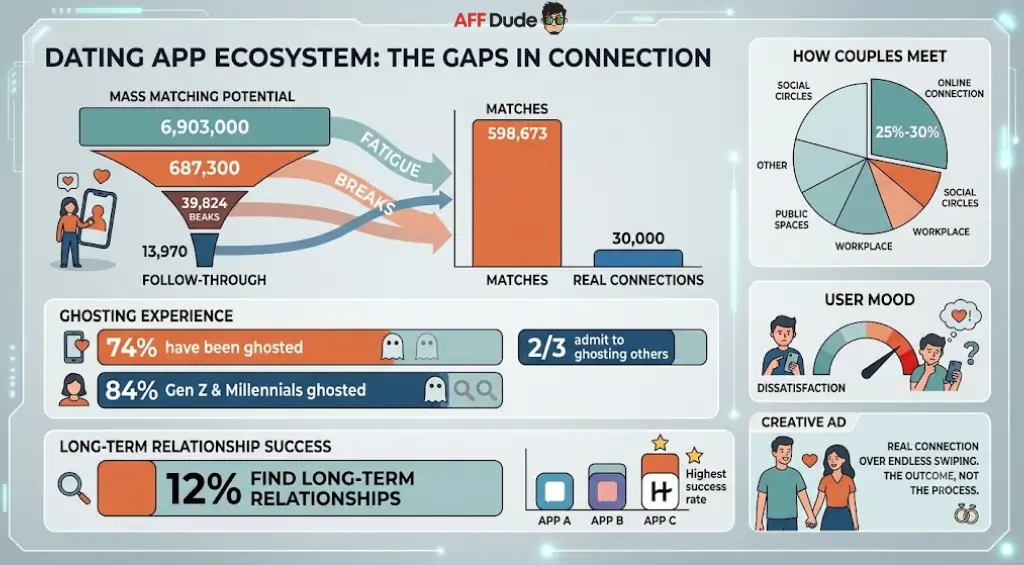
Dating apps are brilliant at matching and terrible at follow-through. That gap shapes user mood and, by extension, your creatives.
Around 74% of daters have been ghosted at least once. Among Gen Z and Millennials, it jumps to 84%. Two-thirds admit to ghosting someone themselves.
Only about 12% of dating app users report finding a long-term relationship through an app. Hinge posts the highest success rate among the big players.
Still, apps remain a top way couples meet. Around 25% to 30% of couples now connect online, a figure steady since 2017.
The mood is clear: users want results, not more swiping. Creatives that promise real connection over endless matches cut through the fatigue. Sell the outcome, not the process.
How Dating Users Spend Their Time and Money
Time on app tells you how hooked a user is. And hooked users convert.
Daters spend around 51 minutes a day across platforms. Millennials clock the most at nearly 56 minutes. Gen X and Gen Z sit close behind. Even Baby Boomers put in almost 37 minutes a day.
Add it up and the average dater spends roughly 310 hours a year on these apps. That's about 13 full days of swiping, messaging, and browsing.
Log-in frequency runs high too. Many users open a dating app 10 or more times a day. Short bursts, high frequency, strong habit. That habit loop is what makes dating traffic so reliable.
Spending patterns follow engagement. The more time a user sinks in, the more likely they pay for a boost, a super-like, or a premium tier. Micro-transactions now grow faster than fixed monthly plans, rising at double-digit rates as users buy small perks instead of full subscriptions.
Paying tiers still pull the weight, though. They account for close to 70% of total dating revenue. So a small slice of users funds almost the whole market.
AffDude take: high engagement plus low payment equals opportunity. The free-but-active user is your prime target. They're invested emotionally and time-wise, they just need the right nudge to open their wallet.
What We Think Happens Next in Dating Marketing
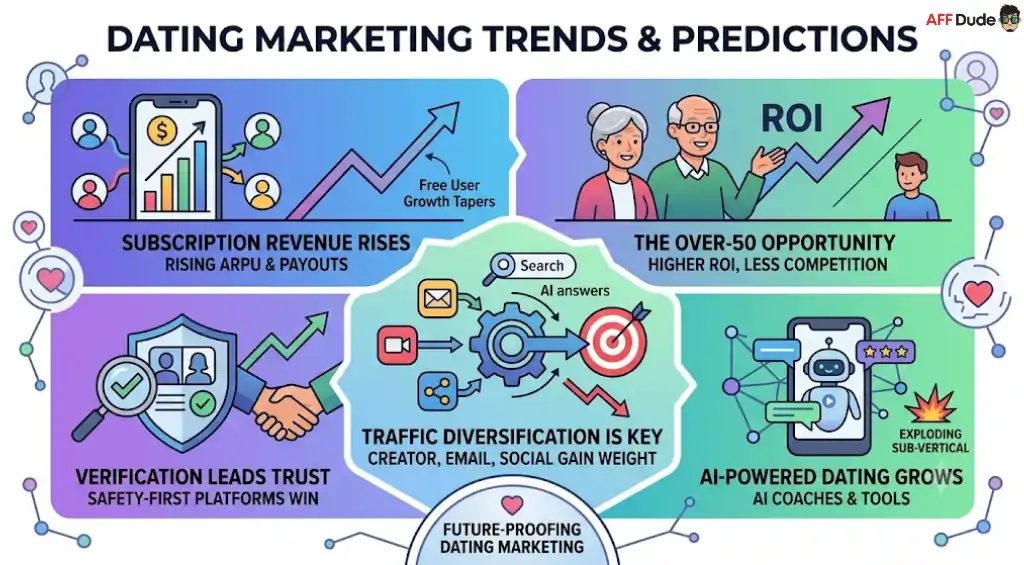
Time for our calls. These are our own reads based on the traffic we run and the networks we talk to daily.
First, premium pricing keeps rising while free users grow slower. Average revenue per user should push past $14 by 2027. That means richer CPA payouts on subscription offers, so lean into paid-conversion funnels.
Second, the over-50 segment becomes the sleeper hit. We expect senior dating offers to outperform mainstream youth offers on ROI within two years, simply because competition stays thin.
Third, AI-native dating products explode. We reckon AI dating coaches, profile tools, and companion apps become a proper affiliate sub-vertical by 2027, worth chasing now before payouts get squeezed.
Fourth, verification wins. Safety-first and identity-checked platforms should grab a bigger slice as trust becomes the main selling point. Offers built around real profiles will convert better than ever.
Fifth, content-only affiliates struggle unless they diversify. We expect creator, email, and social traffic to carry more weight as search clicks keep leaking to AI answers. Build a mixed traffic engine or watch margins thin out.
Sixth, micro-transactions keep eating fixed subscriptions. Users increasingly buy small perks over full monthly plans. Offers that sell instant visibility, boosts, or single features should convert better than long commitment sign-ups.
AffDude take: these Dating Marketing Statistics 2026 point one way. The vertical is stable, the money is real, and the winners will be affiliates who target buyers, not browsers. Chase men with money, seniors with patience, and safety-conscious daters with trust. That's the 2026 playbook.
FAQs About Darting Marketing Market in 2026
How big is the dating market in 2026?
The broad dating services market sits near $8.4 billion in 2026, with pure app revenue around $6 billion. Wider estimates that fold in web, matchmaking, and casual sub-niches push the figure past $12 billion. We peg the honest paid-services number at $8 to $9 billion.
How many people use dating apps in 2026?
About 380 million people use dating apps worldwide, with roughly 80 million in the US. Only around 25 million pay for premium features, which leaves a massive free-tier audience for affiliates to convert.
What do dating affiliate offers pay in 2026?
SOI and DOI sign-ups pay $2 to $8. CPL offers run $1 to $6, or $5 to $10 on Tier-1 traffic. Subscription CPA hits $40 to $100 plus in Tier-1 markets, and RevShare runs 25% to 50% lifetime, sometimes up to 75% for top partners.
Which gender converts best in dating marketing?
Men. They pay at 41% versus 29% for women, they buy boosts and premium to fight a tough match ratio, and they click match-focused creatives. Male-targeted dating offers usually deliver stronger conversion on paid features.
Is dating still a good affiliate vertical in 2026?
Yes. Low entry cost, huge audience, and offers for every budget keep it beginner-friendly. Rising premium spend and fresh AI sub-niches add new upside. Just favour reputable, safety-first offers and diversify your traffic sources.
What are the biggest dating marketing trends in 2026?
AI matching and AI dating tools, the fast-growing over-50 segment, verification-led trust as a selling point, and a shift away from infinite swiping toward intentional dating. Romance scams also push demand for safety features.
Sources
- Statista – Dating Services Market Forecast
- Business of Apps – Dating App Revenue and Usage
- Mordor Intelligence – Online Dating Services Market
- Precedence Research – Online Dating Services Market
- SwipeStats – Dating App User Statistics
- Pew Research Center – Online Dating in the US
- McAfee – 2026 Romance Scam Research
- Norton – Artificial Intimacy Report 2026
- Barclays – Romance Scams Insight 2026
- Federal Trade Commission – Romance Scam Data
Recommended Articles

Affiliate Disclosure: This post may contain some affiliate links, which means we may receive a commission if you purchase something that we recommend at no additional cost for you (none whatsoever!)