




Running ads shouldn’t mean handing over your identity—or your users’ data. Yet many ad platforms demand KYC, drop tracking cookies, and share profiles across the web, leaving privacy-minded publishers and advertisers stuck between earning revenue and staying anonymous.
This guide breaks that trade-off with a simple framework: pick networks built for minimal data collection, contextual targeting, and privacy-first payments. Below, you’ll find 6 Privacy Focused Ad Networks for Anonymity Lovers, analyzing their specific features, payment anonymity, and tracking standards—whether you’re publishing, buying traffic, or both.
What Defines a True Privacy Focused Ad Network?
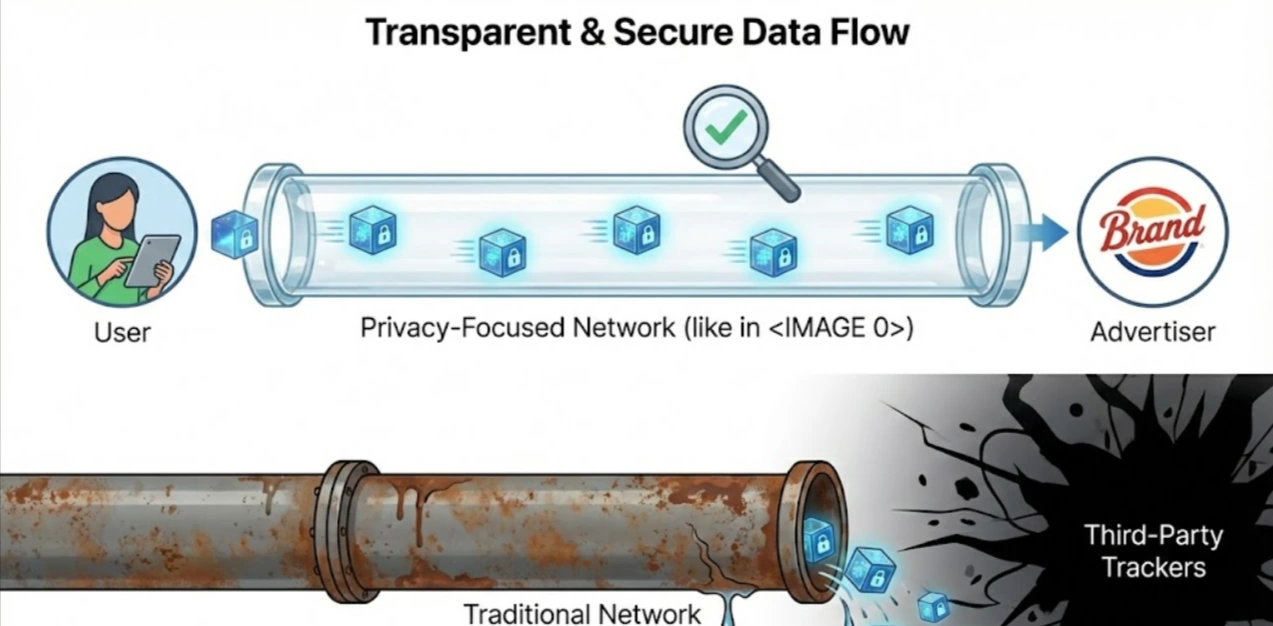
A true privacy focused ad network operates on a “zero-knowledge” principle, fundamentally rejecting the surveillance capitalism model used by Big Tech. Unlike traditional platforms that build invasive user profiles to retarget audiences, these networks prioritize data minimization from the very first click.
Instead of tracking user behavior across the web via third-party cookies, legitimate anonymity-friendly platforms rely on contextual targeting. This ensures ads match the website's content—like displaying hardware wallet offers on a crypto blog—without ever needing to know the visitor's identity or location.
Key characteristics include:
Understanding these technical distinctions is crucial before selecting a partner from the top-rated networks below.
Ad Networks That Respect User Privacy
| Top Privacy Focused Ad Networks | Core Privacy Technology | Primary Use Case |
|---|---|---|
| Adform | ID Fusion Technology | Enterprise Data Control |
| AADS | Zero KYC Requirements | Anonymous Crypto Ads |
| ADEX | Real-Time Fraud Blocks | Verified Clean Traffic |
| Bitmedia | Smart Bid Technology | Web3 Project Reach |
| Adshares | Blockchain Ad Protocol | Decentralized Ad Markets |
| GumGum | Contextual Intelligence Engine | Cookieless Brand Safety |
1. Adform

Adform redefines control in programmatic advertising by ensuring brands never surrender ownership of their first-party data. Built with GDPR and CCPA compliance at its core, the platform delivers privacy focused ad networks capabilities through its proprietary ID Fusion technology, seamlessly bridging the cookieless future without dependency on third-party tracking.
Unlike traditional DSPs that monetize your audience data, Adform's architecture guarantees advertisers and publishers retain 100% control over customer insights while maintaining full transparency across the supply chain.
Adform Key Features
Best For: Enterprise advertisers and publishers require institutional-grade privacy compliance with full data sovereignty control.
2. AADS

AADS stands as the longest-running privacy focused ad network in the crypto space, eliminating traditional KYC barriers while delivering 385 million daily impressions across 4,844 active publisher ad units. Built specifically for anonymity-conscious users, the platform accepts Bitcoin, Lightning Network, and 16+ cryptocurrencies, ensuring zero banking paper trails for both advertisers and publishers.
With instant campaign launches and self-serve management, AADS removes intermediary approval delays while maintaining rigorous content pre-screening to protect publisher reputation without compromising user identity.
AADS Key Features
Best For: Crypto publishers and advertisers prioritizing absolute anonymity with Bitcoin-based payment settlements and instant campaign control.
3. ADEX

ADEX delivers enterprise-level fraud detection while maintaining strict privacy standards for advertisers and publishers alike. The platform actively blocks bots, invalid traffic, and suspicious activity in real-time, ensuring your budget reaches genuine human audiences without invasive user tracking.
With zero impact on page load speeds and seamless implementation options, ADEX protects both campaign performance and user experience. The platform provides solid leverage for refund negotiations when fraudulent traffic is detected.
ADEX Key Features
Best For: Publishers and advertisers require bulletproof fraud protection while maintaining clean traffic quality and privacy compliance.
4. Bitmedia

Bitmedia powers over 1.5 billion monthly impressions across 550+ active publishers, establishing itself as the leading privacy focused ad network for Web3, blockchain, and cryptocurrency projects.
The self-serve platform eliminates intermediary delays while offering diverse ad formats including banner, sticky, Telegram, and in-app placements.
With smart bid optimization and precise conversion tracking, advertisers maintain full campaign control without relying on invasive third-party cookies or behavioral profiling.
Bitmedia Key Features
Best For: Crypto brands and Web3 projects seeking massive reach with flexible bidding models and multi-platform ad delivery.
5. Adshares

Adshares positions itself as a full Web3 standard for digital advertising, built entirely on a decentralized blockchain payment protocol that powers peer‑to‑peer ad settlements. Advertisers and publishers transact directly, gaining instant, transparent insight into every impression while protecting consumer privacy and removing unnecessary intermediaries.
With the capacity to handle 1.4 million transfers per second, Adshares enables scalable, low‑cost microtransactions for ad networks, metaverses, games, and AR/VR environments, making it ideal for anonymity‑minded Web3 ecosystems.
Adshares Key Features
Best For: Projects building Web3 ad networks, metaverse experiences, or games that demand transparent, privacy-respecting, on-chain ad settlement.
6. GumGum

GumGum is a contextual intelligence company that delivers high-impact ad experiences without relying on third‑party cookies, focusing instead on page content and environment to match ads with users. This privacy-friendly approach allows brands to reach relevant audiences while honoring growing regulatory and consumer demands for data protection.
By partnering with MFA‑free publishers and major global brands, GumGum shows that cookieless contextual targeting can drive performance, with case studies highlighting engagement rates that significantly outperform standard display units.
GumGum Key Features
Best For: Brands and agencies seeking scalable, cookieless reach through contextual ads that respect user privacy and avoid invasive tracking.
Comparing Revenue Models: CPM vs. CPC in Anonymous Networks

Choosing between CPM and CPC models in a privacy focused ad network requires understanding how anonymity impacts ad performance. Without invasive behavioral tracking data to guarantee conversion probability, revenue relies heavily on traffic quality and niche context rather than specific user demographics.
Select the model that aligns with your specific traffic engagement to maximize your crypto-based earnings.
FAQs Related to Privacy Focused Ad Networks
How do Privacy-Focused Ad Networks target users without cookies?
They utilize contextual targeting, matching ads to page content and keywords rather than tracking individual user browsing history or behavioral profiles.
Can I use Anonymous Ad Networks alongside Google AdSense?
Yes, most privacy networks are compatible, but ensure ad density doesn't violate Google’s policies regarding excessive advertising or interfering content.
Is KYC mandatory for withdrawing earnings from AADS?
No, AADS is a “no KYC” network, allowing publishers to withdraw revenue purely in cryptocurrency without submitting personal identity documents.
What is the difference between Behavioral and Contextual targeting?
Behavioral targeting tracks user history (cookies), while contextual targeting analyzes the current page’s content, respecting user anonymity and avoiding surveillance.
Are Privacy-Focused Ad Networks GDPR and CCPA compliant?
Yes, by minimizing personal data collection and relying on non-PII targeting methods, these networks are inherently designed to meet strict privacy regulations.
Do Crypto Ad Networks support CPM or CPC models?
Most support both. Networks like Bitmedia offer Smart Bid features to optimize between CPM (impressions) and CPC (clicks) based on campaign goals.
How does ID Fusion technology protect user identity?
It unifies first-party data without third-party cookies, allowing advertisers to reach audiences effectively while keeping user data siloed and private.
Take Control without Compromise
Monetizing traffic or running campaigns no longer requires sacrificing anonymity for revenue. The six privacy focused ad networks profiled above prove that contextual targeting, blockchain settlements, and zero-knowledge architectures deliver results without surveillance-based tracking.
If you prioritize instant Bitcoin payouts, enterprise compliance, or Web3 integration, matching your specific anonymity requirements to the right platform determines long-term sustainability.
Review each network's KYC policies, payment methods, and targeting mechanics, then test with small budgets to validate performance before scaling your strategy.
Recommended Articles