
Nikolay Zaharov Interview: MyBid Sales Head Gets Fully Honest

By :
Ali
August 5, 2026
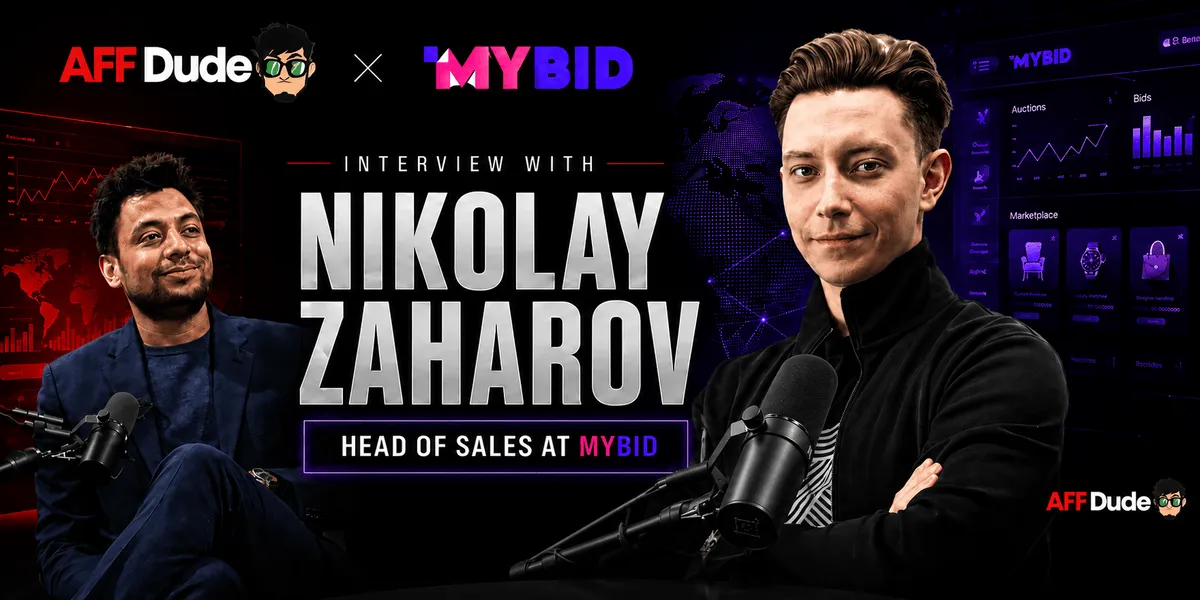
MyBid is an advertising network that helps media buyers and affiliate marketers run campaigns across push, pop, in-page, native, and other performance traffic formats.
Leading its sales operations is Nikolay Zaharov, Head of Sales at MyBid. Nikolay began his career as a power engineer before moving into affiliate marketing, where he worked with advertisers, webmasters, and traffic arbitrage teams.
He joined MyBid in 2021 and has managed the company’s RTB and Self Serve sales since 2024.

In this exclusive interview, Nikolay shares an honest view of the advertising industry, including campaign failures, traffic quality, advertiser mistakes, managed campaigns, anti-fraud systems, and the real opportunities across LATAM and Southeast Asia.
He also explains why push and pop traffic still work, how MyBid competes with larger ad networks, and what media buyers should check before increasing their campaign budgets.
1. Two-minute version for our readers. Who’s Nikolay, and how does an engineer from Moscow Power Engineering end up as Head of Sales at an ad network?
I trained as a power engineer. MPEI, bachelor’s and master’s, electrical power engineering. I got into affiliate while I was still a student: account manager at Lucky.
Online, running about fifty webmasters at once, then Affspace, a nutra network, where I helped build the affiliate department and basically lived on AffiliateFix and STM. In 2021 I moved to MyBid, to RTB, first as a manager. In 2023 I took over the unit at not the best possible moment, since the head of it and part of the team had just left. Since 2024 I’ve been responsible for all MyBid sales, both RTB and Self-Serve.
People ask about the engineering degree a lot. Honestly, it’s knowledge I never found a use for. What it did give me was an early understanding that there’s a hard ceiling on what you can earn in that field, and that’s how I ended up in affiliate.
2. Before joining your current company, you spent time working with several traffic arbitrage teams. What are the biggest lessons from those experiences that you still apply in your work today?
Three of them.
First: an affiliate isn’t buying traffic, he’s buying predictability. He’d rather take less volume at stable quality than a spike that leaves him digging through stats for a week. We still build our communication around that.
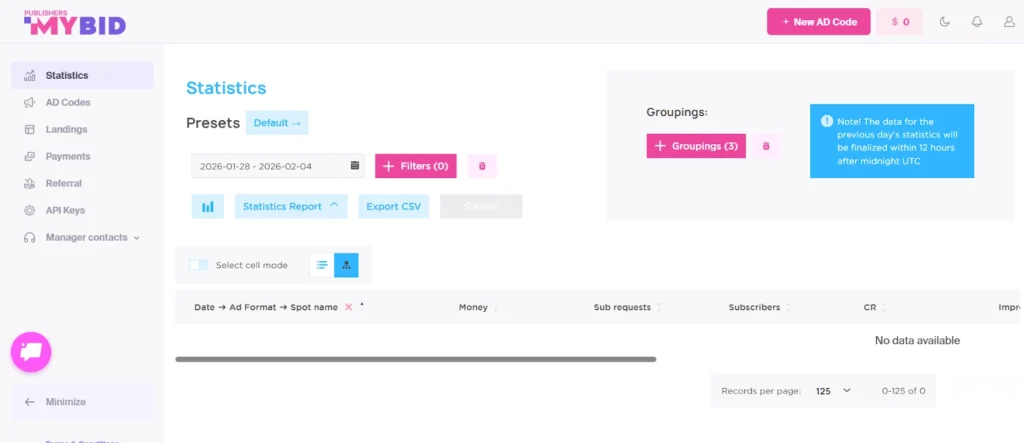
Second: almost every problem shows up first as “your traffic is bad.” In half the cases it’s the landing page, the postback, caps on the offer, or no localization. I showed the team how it should go. You walk the client’s funnel yourself, all the way to the end, and only then you go to anti-fraud.
Third, and it’s the uncomfortable one: a partner doesn’t leave because he’s in the red. He leaves because nobody explained the red to him. Silence costs more than a refund.
3. You’re Head of Sales at a network in a space absolutely stuffed with networks. When an affiliate asks “why not just run PropellerAds or Adcash,” what’s your honest answer, not the pitch-deck one?
The honest answer is: don’t switch. If Propeller works for you, leave it alone. I really don’t think there’s a source out there worth killing a working setup for.
We’re always happy to sit in a fair split next to our colleagues. And to answer the question head on: a different pool of publishers, a different auction, on some GEOs a lower bid for comparable quality. At the big networks, at your volume, you’re on self-service. With us the entry threshold is lower and there’s a manager who actually opens your stats. We’re also more flexible on the non-standard stuff, like exclusive flat buyouts of specific spots or custom filters for a client.
The flip side of being honest: we have less volume than the top three, and on a number of tier-1 GEOs we just don’t have as much traffic as you’d want yet. Anyone who tells you “we’re better than Propeller across the board” is lying to your face.
4. From the first chat, what attitudes or assumptions make you think an advertiser may risk mismanaging spend?
A few markers, and they’re all about how the person thinks, not about his budget.
“Give me your cheapest traffic.” A price with no metric attached means the guy isn’t doing the math on his funnel. No tracker and no postback, “I’ll just look in the dashboard,” means there’ll be nothing to optimize on and the traffic will end up as the guilty party.
Not being able to name a target CPA, or even what counts as a conversion. “My offer converts everywhere,” which almost always means it’s never been tested properly anywhere. Wanting to push a five-figure sum through in the first twenty-four hours with no test.
And the biggest red flag of all: demanding guarantees on ROI. We sell traffic, not conversions. The result depends on the offer, the landing page, the creatives, the competition. Someone who won’t accept that going in will come back with a complaint coming out. You have to say this out loud before the deposit, otherwise you’ve built false expectations yourself.
5. Let’s skip the sales pitch. What’s really going on behind the scenes when you’re dealing with advertisers? What’s the most thankless, or just plain unpleasant, part of the job?
The worst part is being the translator between the client and your own colleagues when both sides are partly right. The client is in the red and wants his money back, anti-fraud shows the traffic is clean, and you can see the problem is the landing page or the creatives. It’s a conversation where a good outcome is very hard to reach, but that’s the job.
Second is working with the type of client from my answer to question four. Getting someone to launch properly instead of “somehow” is painfully slow. And oddly enough, a lot of them see no value in it whatsoever. Usually those are the easy-money guys who think this industry is one big MAKE MONEY button.
Third, and nobody writes about this one: a serious part of my job is saying no to my own people. Not every client is worth having. Some days the most valuable thing I do is stop a deal that would have turned into a refund and a forum post a month later.
6. Handing your campaign to someone else’s account manager takes real trust. How do you win over a control-freak media buyer who wants their hands on every single bid?
You don’t. And experience says you shouldn’t even try. Control freaks among media buyers are an occupational deformation, and it’s usually the ones who’ve already lost money on somebody else’s “optimization.” Asking them for trust up front is naive.
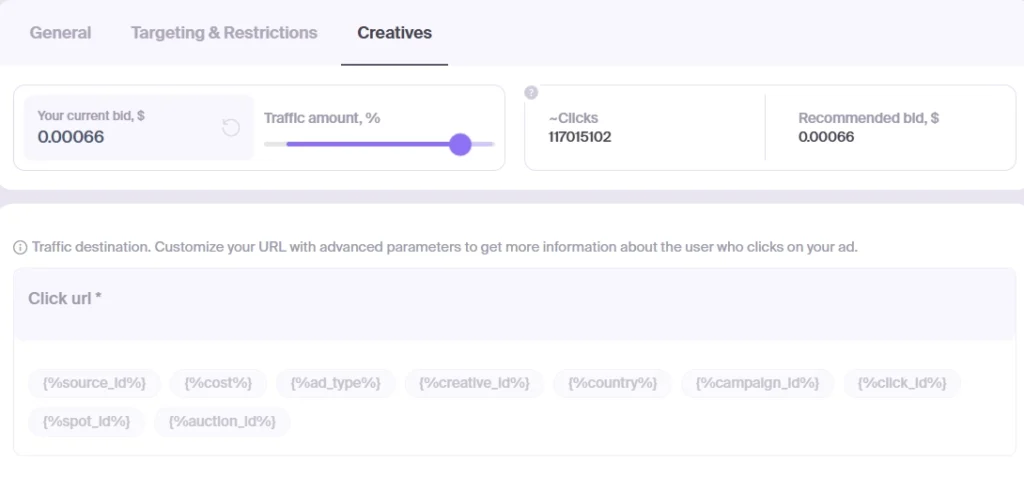
So I don’t offer trust, I offer a division of zones. Bids and budgets stay with him, I’m not taking the levers away.
We take on what he physically doesn’t have: traffic detail down to sources and spots, the competitive bid inside his targeting, an answer to “have you hit a volume ceiling or are you losing the auction.” He makes the call.
There is one trick we pull with guys like that from time to time. We run a duplicate campaign: his settings against ours, same budget, one week. May the best man win, so to speak 🙂
Trust in this market is only ever bought with a number in his own tracker.
7. Straight question. When a managed campaign flops, is that on your team or on the offer? How do you split the blame in those conversations?
We don’t split anything until we’ve taken the case apart properly. The order is technical first (postback, landing page, load speed, localization), then offer and creatives, then traffic by segment.
In my experience it comes out roughly even three ways. A third is setup and traffic on our side. A third is the offer, the landing page or the creatives on the client’s side. And a third is the market: the bid doesn’t reach good traffic, seasonality, a burned-out GEO. If it’s on us, we say so straight and we compensate. That’s always cheaper than an argument.
The one phrase I’ve banned in my team is “it works for everyone else, so the problem is on your end.” It has never once helped, even when it happens to be true.
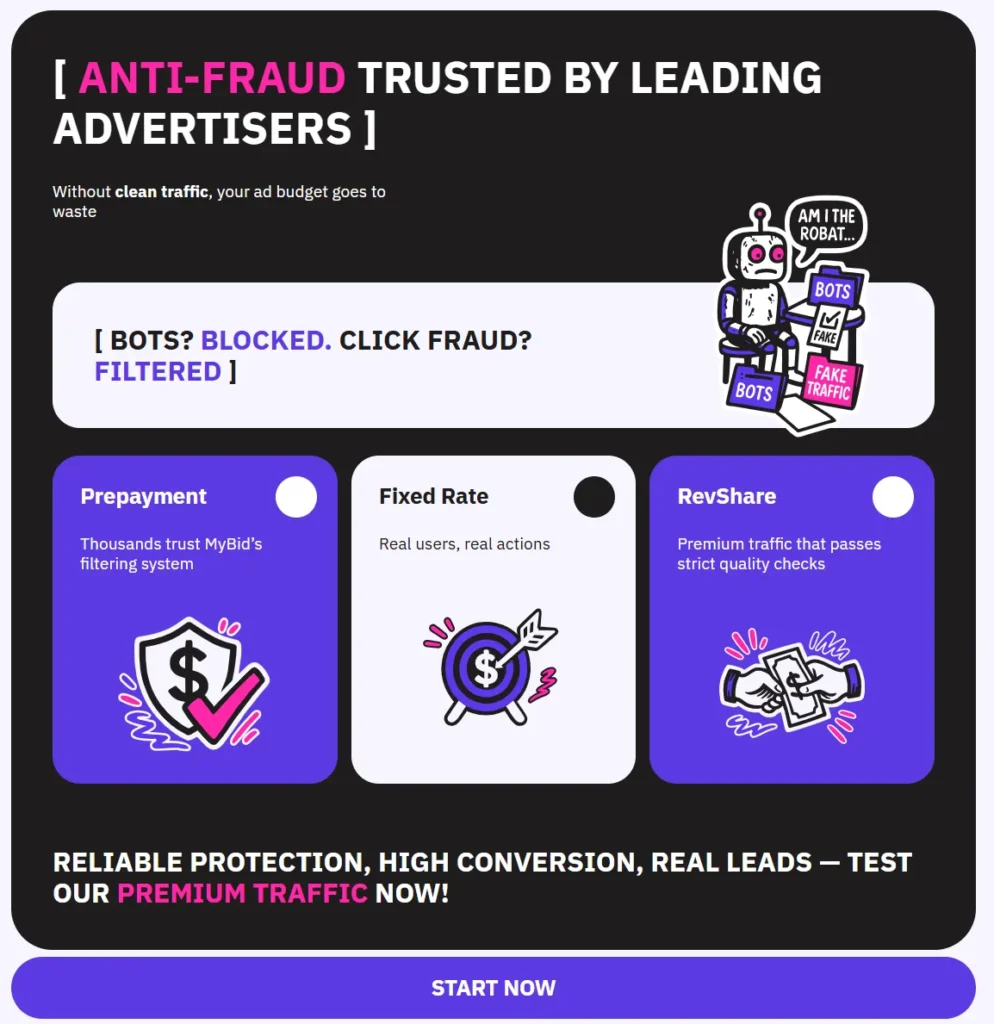
8. Every network on earth claims “premium traffic” and “in-house anti-fraud.” Every single one. What does yours actually do differently, in plain English, that a buyer can go and verify?
Agreed, both of those phrases stopped meaning anything a long time ago. So let’s stick to what you can check.
Premium and Optimum aren’t a line in our deck, they’re a separate targeting option in the dashboard. Launch two identical campaigns and compare for yourself. Stats go all the way down to the end traffic source, and a network that won’t show you the source breakdown isn’t going to let you optimize anything, so its anti-fraud is beside the point.
There’s Bid by source, white and black lists, domain WL, so you can take the sources you want and switch off the rest without asking a manager. For top clients we build custom filters. That’s a practice we were forced into in 2025, when the whole market got hit on quality.
9. You run the spicy verticals too: adult, iGaming, crypto, sweeps. Which one is the trickiest to source clean traffic for right now, and why that one?
Crypto, and it’s not close.
Adult is technically the easiest. The inventory is clear, the publishers have been known for years, the approaches are worked out. iGaming takes some digging at first to find what works, but you will find it. The main headache there is GEO restrictions. Sweeps throw off a lot of junk, but it’s predictable junk: the pattern is simple and it filters out.
Crypto collects everything at once. A high payout pulls in incentivized traffic and bot traffic together. On top of that the vertical is full of scam offers, so you end up vetting the advertiser as hard as the publisher, and for a network that’s a whole separate job. Then there’s the delayed conversion on top: a deposit can land a week later, so you can’t optimize on a short window and you’re almost always deciding on incomplete data.
10. You’re in WW GEOs. Everyone keeps saying the money’s moving to tier 3, Asia, the Middle East, Africa. Where’s the real opportunity, and where’s the hype outrunning reality?
The real opportunity is LATAM (Brazil, Mexico, Peru, Chile) and Southeast Asia (Indonesia, the Philippines, Vietnam). Three things came together there: mobile traffic volume, a cheap click, and local payment methods that finally work. That’s not a forecast anymore, that’s money.
The hype is India and parts of Africa, in the “there’s a billion people there” version. There really is a lot of traffic and it really is cheap, but without a local offer and a local payment method the economics don’t add up. And “the Middle East” as a single region is a fiction. The UAE and Saudi are closer to tier-1 on bids and very demanding on content, Egypt and Iraq are a completely different story and a completely different market.
And here’s the unpopular part: nobody cancelled tier-1. While everyone’s busy discussing tier-3, the most expensive conversions are still sitting there. You just have to know how to work them, which is hard.
11. Push and pop have been called “dead” for about five years and they keep printing money. Are they actually fading, or is that just people who never learned to run them properly?
They get buried by the people who walked in back in 2019 with a single creative and were surprised it stopped working six months later.
What actually changed: subscription bases burn out, and Google bans have genuinely made the format harder to work with. That’s exactly why in-page grew, doing the same job without the subscription. Pop isn’t going anywhere as long as there are pages with heavy traffic and a cheap click. It’s still the cheapest way to test an offer, and that’s its function, not being your main source at scale.
The format didn’t die. The “launch it and watch” approach died. Without source segmentation, frequency caps, regular creative rotation and postback-based optimization, these formats give you exactly the result described in all those “push is dead” articles.
12. AI is creeping into targeting, bidding, and creative, all of it. What part of your job does a machine already do better than you, and what part does it still get badly wrong?
Anything that comes down to volume it already does better than me. Finding patterns across hundreds of thousands of rows, cutting junk spots, picking a bid for the targeting, catching revenue degradation as it happens.
We launched an internal AI agent, I wrote the scenarios and the MVP spec, and it’s in production now. A question like “why did fill drop on this campaign” or “give me optimization options for these parameters” gets closed in seconds instead of half an hour of a manager’s time.
Creative drafts and localization, same story, though that’s just the LLMs everyone already has, we’re only applying them to our work.
I’m convinced AI is a kind of catalyst. It speeds the reaction up without taking part in it. And it’s worth stressing that this is a tool that makes your work faster, not one that does your work for you. The decision still has to be made by a person, on top of valid data the AI collected.
And my personal favourite: AI doesn’t take responsibility. It’s always funny to read an agent openly admitting it broke every rule it was given and promising to keep an eye on that going forward.
13. Confession booth. Tell us about a campaign or a client that went sideways, and what it actually taught you, the kind of lesson you can’t get from a case study.
Summer 2024, a client came in with a very large budget. He got going fast, and by the end of the year he’d tripled his original budget. No complaints about quality, everything looked great. That relaxed us, and we stopped watching him closely. Then in April 2025 he comes to us and says his CPA has gone to the moon and he’s pausing. We couldn’t hold him.
But that one stayed with me for life. Top clients are always under the personal control of at least a team lead. And whenever I can, I keep an eye on our key accounts’ campaigns myself, so that I understand what’s going on from the actual picture rather than from a report.
14. Last one, and it’s a test. I’m a jaded affiliate at your conference booth. I’ve heard every network pitch this week and I’m two seconds from walking off. You’ve got one line to make me stop. Go.
“Show me what your campaigns are doing on the other networks right now, and I’ll tell you how we improve those numbers on our traffic.”
Our conversation with Nikolay Zaharov offered a practical look at what happens behind the dashboard of an advertising network.
He explained that successful media buying is not about finding the cheapest traffic.
It is about tracking campaigns properly, testing each part of the funnel, studying individual traffic sources, and communicating clearly when results change.
Nikolay also shared why MyBid focuses on source level statistics, flexible campaign settings, custom filters, and hands on account support instead of making broad claims about premium traffic.
His message to advertisers is simple. Do not replace a campaign that already works. Test new traffic alongside it, compare the numbers inside your own tracker, and scale only when the data supports the decision.
For affiliates running push, pop, iGaming, adult, crypto, or sweepstakes campaigns, this interview provides a straightforward guide to testing traffic, controlling spend, and building more predictable campaigns.
Similar Posts

Ali
Aliakbar Fakhri is a top affiliate marketer and the founder of AFFiNCO, an agency driving business growth through affiliate strategies for over a decade. Based on his 10+ years of experience, Ali shares battle-tested insights to help marketers succeed. Follow him on the AffDude blog for more tips!

Nikolay Zaharov
Nikolay Zaharov, Head of Sales at MyBid, has led the company’s RTB and Self-Serve sales since 2024, bringing years of affiliate marketing and traffic acquisition expertise.