
Artificial intelligence has gone from a buzzword to a budget line. In 2026, 78.4% of marketers actively use AI tools, and global AI in marketing spend has climbed to $32.73 billion.
We are no longer debating if AI works. We are debating how fast you can scale it.
For brands still testing the waters, here is a reality check: companies using AI for marketing report 3.5x higher ROI compared to those running purely manual strategies.
Budgets are shifting. Job roles are changing. And AI-powered campaigns are outperforming human-only workflows across nearly every channel.
If you are building a marketing strategy for 2026, these AI marketing statistics will give you a clear picture of what is working, what is growing, and where smart money is heading.
💰AI Marketing Market Size in 2026
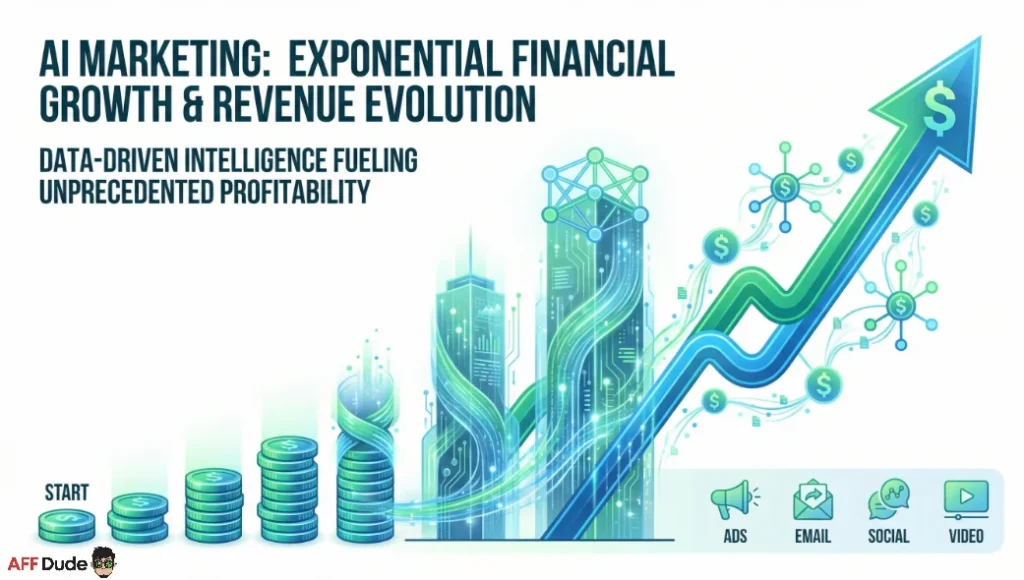
AI in marketing is one of the fastest-growing sectors in advertising technology. Market valuations have nearly doubled in just two years.
| Year | Market Size (USD) | Growth |
|---|---|---|
| 2021 | $12 billion | — |
| 2023 | $16.59 billion | +38% |
| 2024 | $20.39 billion | +23% |
| 2025 | $25.83 billion | +26.7% |
| 2026 | $32.73 billion | +26.7% |
| 2030 (Projected) | $82.23 billion | CAGR 25% |
| 2034 (Projected) | $217.33 billion | CAGR 26.7% |
| 2035 (Projected) | $296.32 billion | CAGR 25.2% |
Growth at 26.7% CAGR means AI marketing spend is roughly doubling every three years. For marketers, that signals massive competitive pressure to adopt or risk falling behind.
📈 AI Marketing Adoption Rates 2026
Adoption has crossed into mainstream territory. In 2026, not using AI puts you in the minority.
🏭 AI Adoption by Industry
Not every sector moves at the same pace. Tech and retail lead, while non-profits trail behind:
| Industry | AI Marketing Adoption Rate |
| Technology and Software | 94.2% |
| E-commerce and Retail | 88.6% |
| Financial Services | 84.8% |
| Healthcare | 76.4% |
| Manufacturing | 71.2% |
| Real Estate | 68.8% |
| Education | 64.2% |
| Non-profit | 48.6% |
For marketers in tech or e-commerce, AI is essentially universal. For those in education or non-profit, a significant first-mover advantage still exists.
🌐 Over 1 Billion People Now Use AI Monthly
AI is not just a marketer's tool. It is a consumer behaviour shift that affects how audiences search, buy, and interact with brands.
For marketers, a billion AI users means optimising content not just for Google, but for AI search engines like ChatGPT Search and Perplexity. Organic strategies must adapt fast.
🛠️ Most Popular AI Marketing Applications
AI is being used across every function of marketing. Content creation leads, but email, social, and paid media are close behind.
| AI Application | Marketer Adoption Rate |
|---|---|
| Content creation and copywriting | 68% |
| Email marketing optimisation | 62% |
| Social media management | 58% |
| Customer segmentation | 54% |
| Chatbots and customer service | 52% |
| Ad targeting and optimisation | 48% |
| Predictive analytics | 44% |
| SEO optimisation | 42% |
🚀 Emerging AI Marketing Technologies (2026)
Several newer applications are gaining rapid traction:
Video generation AI shows explosive growth. Tools like Sora and Runway are enabling marketers to produce video content at scale without full production teams.
✍️ AI Content Creation Statistics 2026
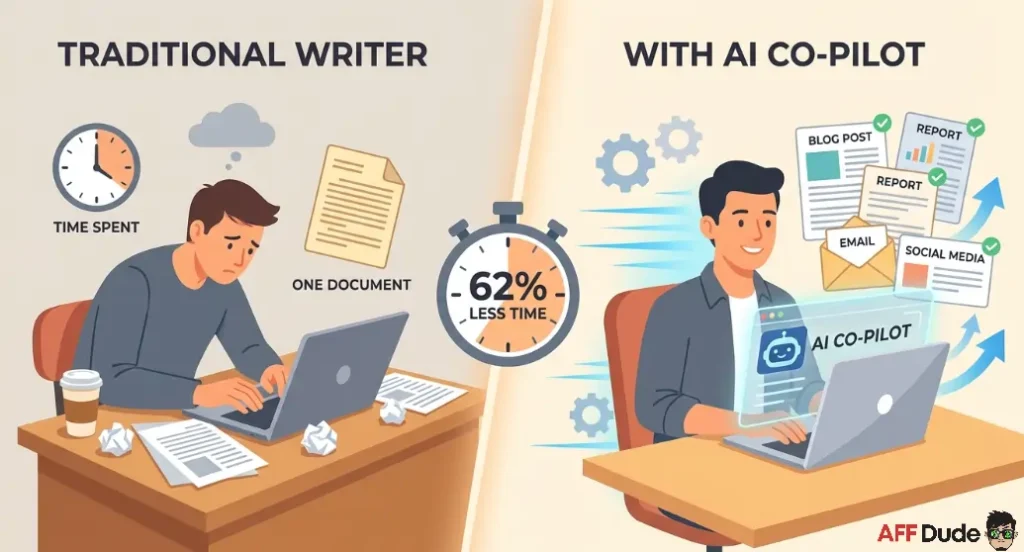
AI has fundamentally changed how marketing content gets produced. Speed is up. Cost is down. But human editing still matters.
Quality still wins.
While AI speeds up production, marketers who combine AI-assisted drafting with human editorial oversight report better engagement, trust, and conversion rates.
📣 AI in Advertising and Paid Media
Paid advertising runs on AI in 2026. From bidding algorithms to creative generation, automation dominates.
📢 Platform-Level AI Ad Performance
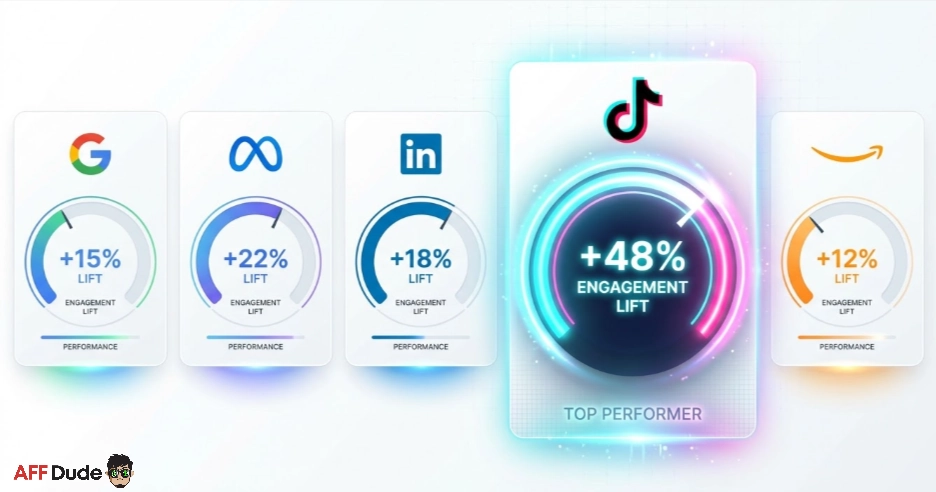
| Platform | AI Feature | Adoption Rate | Performance Lift |
|---|---|---|---|
| Google Ads | Performance Max | 64.8% | +35% conversions |
| Meta | Advantage+ | 58.2% | +29% ROAS |
| Automated Campaigns | 42.6% | +24% lead quality | |
| TikTok | Smart Creative | 38.4% | +48% engagement |
| Amazon | Sponsored Display | 52.8% | +32% sales |
Google's Performance Max leads in adoption, while TikTok's Smart Creative delivers highest engagement lift.
Marketers investing in AI-powered ad optimisation should test across multiple platforms to find best-performing combinations.
💸 AI Marketing ROI Statistics 2026
ROI data from AI marketing has become hard to argue against. Returns are measurable, consistent, and growing.
💲AI Marketing Budget Allocation
| AI Category | Budget Share | Average Investment | ROI |
|---|---|---|---|
| Marketing Automation | 28% | $32,000 | 285% |
| Content Creation Tools | 22% | $18,500 | 420% |
| Analytics and Insights | 18% | $28,000 | 340% |
| Advertising Optimisation | 16% | $42,000 | 380% |
| Chatbots and Support | 10% | $24,000 | 485% |
| Other AI Tools | 6% | $8,500 | 180% |
Content creation tools deliver the highest ROI per dollar invested at 420%, while chatbots lead in three-year cumulative returns at 485%.
Average percentage of marketing budget allocated to AI is now 18.4%, with a projected increase to 24% by end of 2026.
🤖 AI Chatbot and Customer Service Stats
AI chatbots save money and speed up support. But human agents still win on complex queries.
For brands handling high-volume support queries, chatbots deliver exceptional value. For complex or sensitive interactions, a hybrid model combining AI chatbot automation with human escalation works best.
🎯 AI Personalisation at Scale
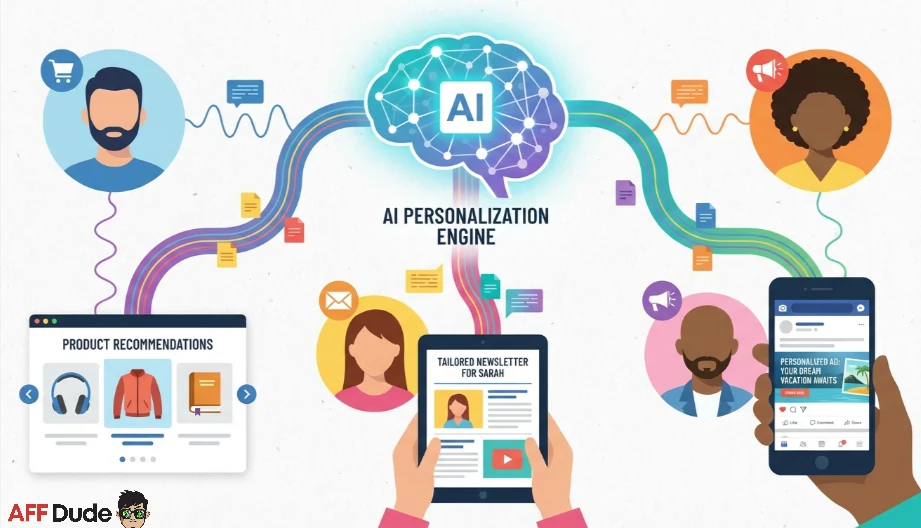
Personalisation powered by AI is no longer a luxury. Consumers expect it, and businesses that deliver it see massive revenue lifts.
📈 Predictive Analytics Adoption
AI predicts customer behaviour with increasing accuracy. Early adopters gain significant advantages:
Predictive analytics remains less common than content and email AI applications. But marketers using it gain a serious competitive edge with better targeting and faster decision-making.
⚠️ AI Marketing Challenges and Concerns
Adoption is high, but challenges remain. Privacy, quality control, and skill gaps are real barriers.
Success with AI marketing requires more than buying tools. Teams need clean data, clear use cases, and ongoing training to extract real value from AI investments.
🔮 AI Marketing Predictions: 2027 and Beyond
Based on current growth curves and investment patterns, several trends are clear:
AI marketing in 2026 is not about replacing marketers. It is about making good marketers faster, smarter, and more precise.
Teams that pair human creativity with AI-powered execution are already pulling ahead. And given where budgets and adoption rates are heading, that gap will only widen 🚀.