


Affiliate networks are where brands and publishers come together to make money. In 2026, these platforms process billions in commissions and connect over 2 million active affiliates worldwide. Amazon Associates alone holds nearly half of all affiliate network market share.
But it is not alone. Networks like Awin, CJ Affiliate, Rakuten, and ShareASale are growing fast and carving out serious ground.
If you run performance-based marketing campaigns, knowing which networks lead and where money flows is essential for smarter decisions and bigger payouts.
Affiliate Network Statistics: How Big Is the Industry in 2026?
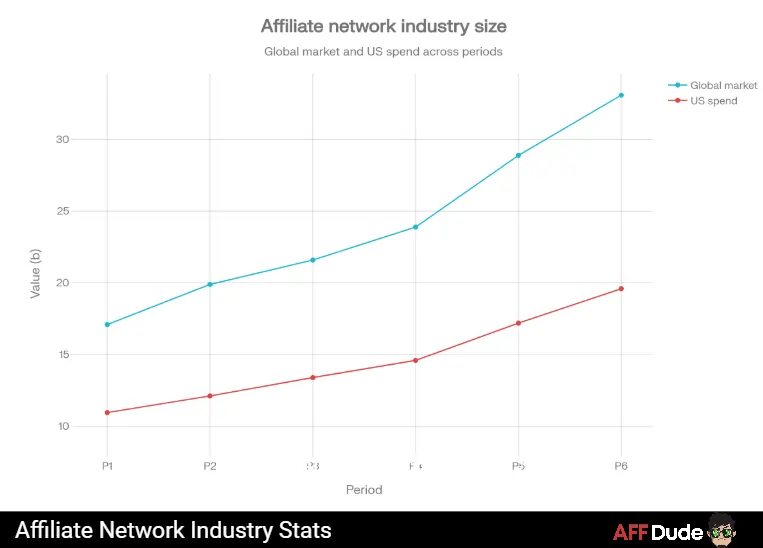
Affiliate networks sit at the centre of a $22.5 billion global industry in 2026. That figure is up from $20.2 billion in 2025, showing a steady 10.1% annual growth rate.
In the United States alone, brands are spending $13.2 billion on affiliate marketing programmes. US spending accounts for over 58% of all global affiliate revenue.
Here is how the industry has scaled year by year:
| Year | Global Market Size (USD) | US Spending (USD) | Annual Growth |
|---|---|---|---|
| 2023 | $15.7 billion | $9.56 billion | 9.2% |
| 2024 | $18.5 billion | $10.72 billion | 10.1% |
| 2025 | $20.2 billion | $12.0 billion | 11.9% |
| 2026 | $22.5 billion | $13.2 billion | 10.1% |
| 2028 | $27.5 billion | $15.8 billion | 9.2% |
| 2031 | $31.7 billion | $18.2 billion | 8.5% avg |
The affiliate creator network market alone is valued at $7.35 billion in 2026. It is projected to reach $14.49 billion by 2030, growing at a CAGR of 18.5%. Creator-driven affiliate revenue is on track to hit $1.3 billion in 2026.
Over 90% of ecommerce businesses are expected to use affiliate marketing networks by 2026. That tells you just how central these platforms have become for online commerce.
Affiliate Network Market Share Breakdown
Amazon Associates dominates with a 46.64% share of all affiliate programme market share worldwide. Nearly 86,000 companies use this single network in 2026. No other platform comes close in raw numbers.
Here is how major networks stack up:
| Network | Market Share | Active Affiliates | Key Strength |
|---|---|---|---|
| Amazon Associates | 46.64% | 900,000+ | Product range, consumer trust |
| Rakuten Affiliate | 7.70% | 150,000+ | Global reach, enterprise clients |
| Awin | 6.88% | 1,000,000+ | International presence, 30,000+ brands |
| ShareASale | 6.27% | 700,000+ | Beginner-friendly, 25,000+ merchants |
| CJ Affiliate | 6.03% | 70,000+ publishers | Premium brands, advanced tracking |
| Others | 26%+ | Varies | Niche-specific focus |
Amazon Associates has over 900,000 merchants worldwide. Awin hosts more than 30,000 brands across fashion, travel, finance, insurance, and telecoms. ShareASale operates across nearly 40 different product categories.
CJ Affiliate maintains 70,000 publisher collaborations with roughly 4,000 merchants. Rakuten Affiliate Network stands as the second largest programme worldwide with a 7.70% share.
47% of affiliate marketers prefer niche-specific affiliate networks over general ones. That means smaller networks serving specialised industries are gaining traction fast.
Top Affiliate Networks Compared: Features and Commissions
Not all networks are built the same. Each one targets different types of affiliates and offers different tools. Here is a closer look at what separates them.
1. Amazon Associates

Amazon Associates is the world's largest affiliate marketing network. It works well for content creators, bloggers, and review sites. Commission rates range from 1% to 10% depending on product category.
Amazon pays on a 60-day cycle. Cookie duration is just 24 hours, which is shorter than most competitors. Despite that, conversion rates remain high because of strong brand trust and a massive product catalogue.
2. Awin and ShareASale

Awin acquired ShareASale in 2017 to expand internationally. Together, they form one of the largest global affiliate network groups.
Awin has 15,000+ advertisers and over 100,000 publishers. ShareASale alone has 1.2 million registered publishers. ShareASale offers programmes in CPA, CPL, CPS, and CPC models.
Commission rates on ShareASale vary by merchant but typically range from 5% to 20%. Payments go out on the 20th of each month via direct deposit.
3. CJ Affiliate

CJ Affiliate works best for data-driven professionals. It partners with world-class brands and offers commission rates starting at 5% to 10% for most products.
CJ has 70,000 publisher collaborations and 4,000 merchants. Advanced tracking and reporting tools make it a favourite among experienced affiliates who want detailed performance analytics.
4. Rakuten Advertising

Rakuten focuses on enterprise-level partnerships. It holds 7.70% of the global market. Rakuten is especially strong in Asia and works well for affiliates targeting international audiences.
5. Impact and PartnerStack

Impact and PartnerStack are rising stars in 2026. Impact powers creator-driven affiliate revenue that is set to hit $1.3 billion in 2026. PartnerStack focuses on B2B affiliates and SaaS programmes.
Revenue Models Used by Affiliate Networks
How affiliates get paid matters. In 2026, four main commission payment models dominate across all major networks.
| Revenue Model | Usage Rate | Avg. Commission | Best For |
|---|---|---|---|
| Cost Per Sale (CPS) | 68% | 3% to 15% | Ecommerce, retail |
| Cost Per Lead (CPL) | 19% | $10 to $200 per lead | B2B, finance, services |
| Cost Per Click (CPC) | 8% | $0.10 to $5.00 | Traffic-heavy sites |
| Revenue Share | 5% | 20% to 50% ongoing | SaaS, subscriptions |
Cost Per Action remains the most common payment method, with 99% of affiliate programmes offering it. SaaS affiliate programmes now offer 20% to 70% commission rates, making them some of the highest-paying options available.
High-ticket affiliate programmes in education, business software, and financial services offer commissions from $500 to $5,000 per sale. Finance and insurance affiliates earn an average of $80 per lead.
How Much Do Affiliates Earn Through Networks?
Earnings vary widely based on experience, niche, and network choice. A software affiliate marketer earns an average of $5,967 per month. Successful full-time affiliates make $8,000 to $10,000 per month.
Here is a breakdown by experience level:
Brands earn an average of $15 for every $1 spent on affiliate network campaigns. Email marketing through affiliate channels returns $42 for every $1 spent. Content marketing affiliates achieve $16 to $20 ROI through organic traffic.
83% of affiliate recruiters find new affiliates through affiliate network dashboards. That means networks are not just payment processors. They are discovery platforms too.
Network Performance Metrics That Matter
Understanding key performance numbers helps you pick the right network and optimise campaigns. Here are the benchmarks for 2026.
65% of retailers report a 20%+ revenue increase from affiliate marketing channels. Affiliate marketing drives 16% of all ecommerce sales in the United States. That makes it one of four largest sources of online orders.
Traffic Sources Affiliates Use on Networks
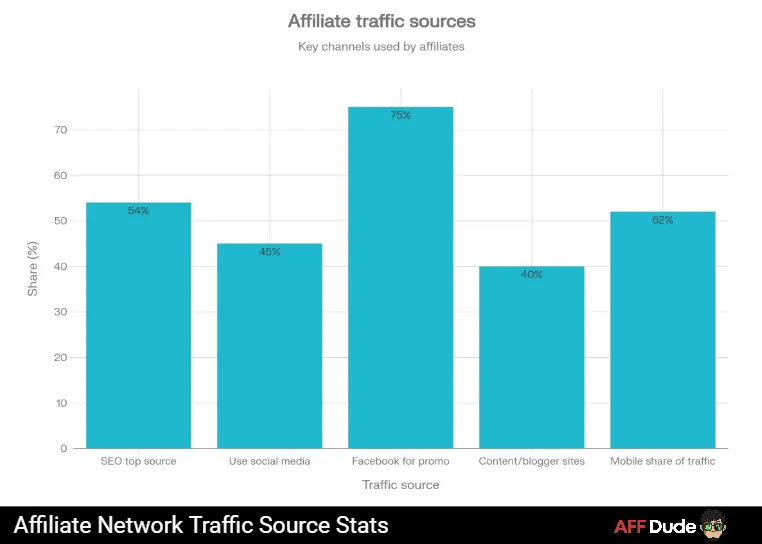
Where affiliates drive traffic from affects how well networks perform. SEO and social media remain the two biggest channels in 2026.
Mobile devices now account for over 52% of all affiliate network traffic. Mobile purchases through affiliate links have grown by 45% over the past two years. Any affiliate ignoring mobile optimization is losing half of potential revenue.
94% of publishers use multiple affiliate marketing networks at once. Diversifying across networks protects income from sudden policy changes and commission cuts.
How AI Is Changing Affiliate Networks in 2026
Artificial intelligence is reshaping how affiliates and networks operate. AI tools now automate content, tracking, fraud detection, and campaign optimisation.
Here is how affiliates are using AI in 2026:
Predictive analytics powered by AI help affiliates spot trending products before they go mainstream. Smart bidding algorithms ensure campaigns maintain peak performance across multiple channels at once.
AI and automation will continue to simplify affiliate marketing workflows and content creation. Networks that invest in AI-powered tools give affiliates a clear competitive edge.
Affiliate Network Fraud: A Billion-Dollar Problem
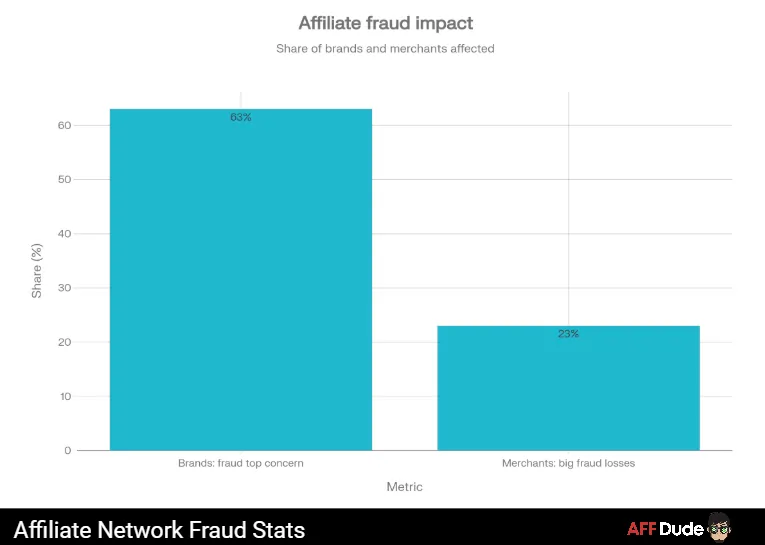
Fraud remains a major concern for affiliate networks. As payouts increase, bad actors find new ways to game the system.
Networks are investing heavily in AI-powered fraud detection systems. These tools analyse traffic patterns in real time and block suspicious activity before commissions get paid out.
Choosing networks with strong fraud prevention technology is no longer optional. It is essential for protecting both revenue and brand reputation.
Regional Growth of Affiliate Networks
Affiliate network adoption varies by region. North America leads, but Asia Pacific is catching up fast.
| Region | Market Share | Avg. Commission | Growth Rate | Top Niches |
|---|---|---|---|---|
| North America | 40% | 8% to 12% | 10% | Tech, Fashion, Health |
| Europe | 28% | 6% to 10% | 6.5% CAGR | Travel, Finance, Education |
| Asia Pacific | 22% | 10% to 15% | 10% CAGR | Electronics, Gaming, Beauty |
| Latin America | 6% | 12% to 18% | 25%+ | Fashion, Home, Fitness |
| Africa and Middle East | 4% | 15% to 25% | 30%+ | Mobile, Education, Finance |
Affiliate programme adoption is increasing by 25% to 30% annually in emerging markets. Lower competition and higher commission rates make Asia Pacific, Latin America, and Africa attractive for new affiliates.
Europe faces unique challenges due to GDPR compliance requirements but benefits from high consumer trust. Average conversion rates across major European markets sit at 4.2%, which is higher than the global average.
Asia Pacific is expected to nearly double its market value between 2024 and 2031. South America is projected to surpass $1.5 billion by 2031 with a CAGR of 7.4%.
Top-Performing Niches Across Affiliate Networks
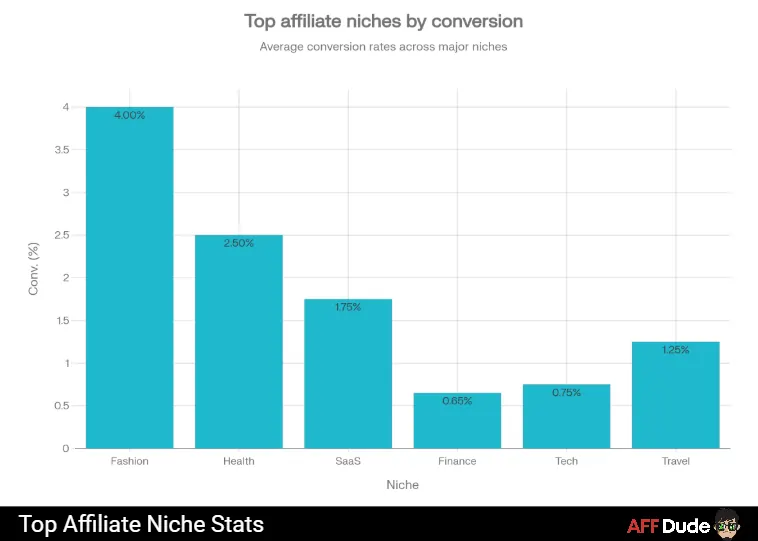
Niche selection determines earnings potential on any network. Some sectors consistently outperform others.
| Niche | Avg. Conversion Rate | Avg. Commission | Annual Revenue |
|---|---|---|---|
| Fashion and Apparel | 3.5% to 4.5% | 5% to 15% | $20 billion |
| Health and Wellness | 2.0% to 3.0% | 15% | Growing fast |
| SaaS and Software | 1.5% to 2.0% | 20% to 70% recurring | High LTV |
| Finance and Insurance | 0.5% to 0.8% | $50 to $200 CPA | $80 avg per lead |
| Tech and Electronics | 0.5% to 1.0% | 1% to 5% | High volume |
| Travel | 1.0% to 1.5% | 3% to 8% | $35 avg per booking |
Fashion and apparel hold a 23.27% share of all affiliate marketing niches, followed by sports and outdoors at 18.16%. SaaS programmes offer the best long-term value with recurring commissions of 20% to 70%.
High-ticket affiliate programmes in business software and financial services offer $500 to $5,000 per sale. These convert at lower rates but generate far more revenue per transaction.
Consumer Behaviour on Affiliate Networks
How buyers interact with affiliate content matters for every marketer running network campaigns.
Cross-device tracking has become essential. Shoppers often start research on mobile but complete purchases on desktop. Networks with advanced multi-touch attribution models give affiliates proper credit for their role in the buying journey.
What These Affiliate Network Stats Mean for Marketers
Every number in this breakdown points to one clear message. Affiliate networks are growing, paying more, and becoming smarter with AI and data.
Amazon Associates still leads with nearly half of all market share. But networks like Awin, Impact, and PartnerStack are gaining ground fast, especially in B2B and SaaS verticals.
For brands, running programmes on multiple networks maximises reach. For publishers, joining two or more networks protects income and opens up higher-paying opportunities.
The affiliate creator network market alone is growing at 18.5% CAGR. With 90%+ of ecommerce businesses adopting affiliate programmes by 2026, now is the time to pick your networks, choose a profitable niche, and start building.
Recommended Articles