
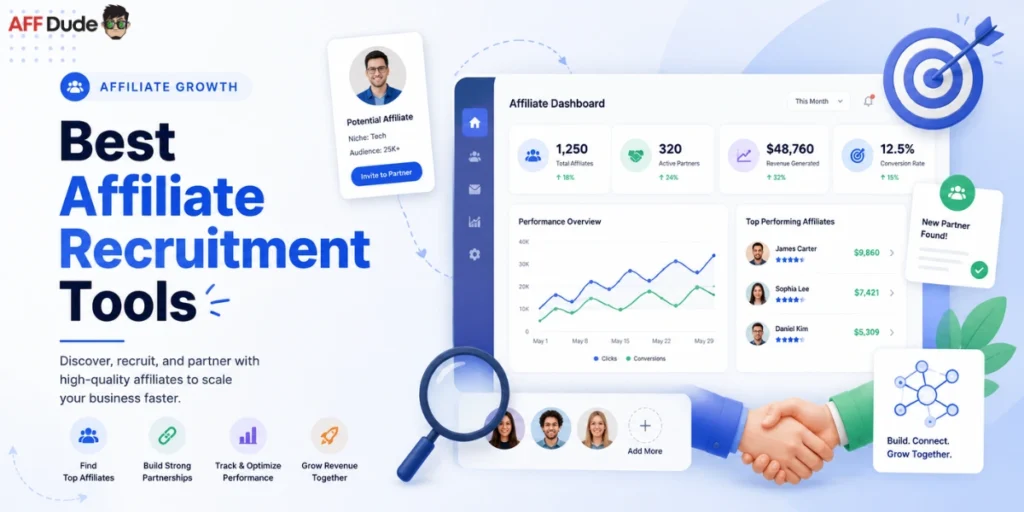
Your dashboard says 340 affiliates. Sort by revenue and the list drops to nine, and six of those are people you emailed yourself last spring. The signup form works. The signups just sit there. So where do the partners who actually sell come from?
That gap is why affiliate recruitment tools moved from nice extra to standard line item. Manual sourcing caps out fast, and the programs filling up now pull from creator databases and competitor backlink data rather than waiting on applications to arrive.
AFFDude's Take: These tools are loud about finding people and quiet about what happens after. A list of 500 qualified affiliates means little if 480 never post anything. Activation is the part nobody puts on the pricing page.
How We Stress-Tested Every Affiliate Recruitment Tool on This List
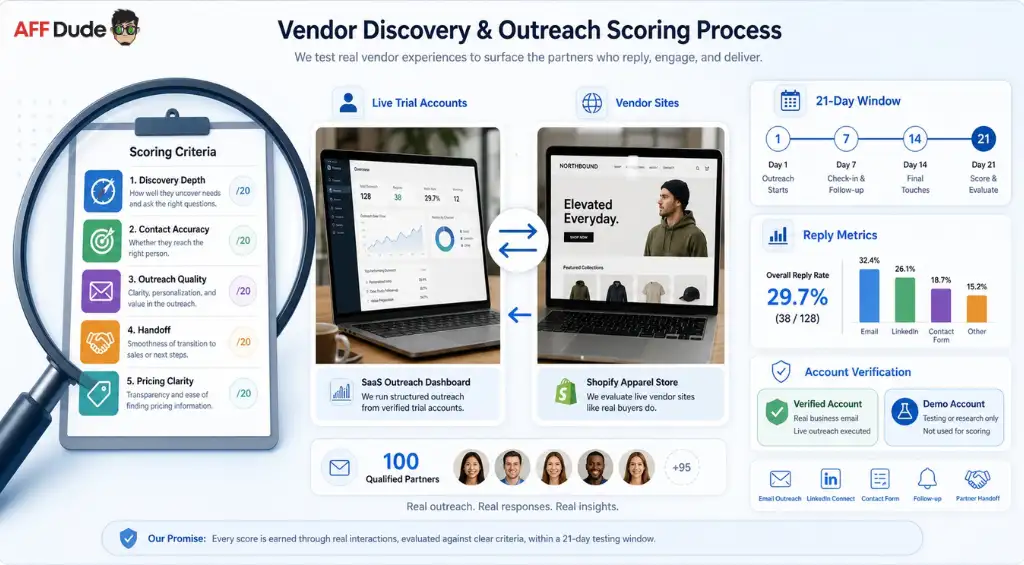
This section explains the testing method behind our rankings, so you can judge whether our criteria match your own program.
We ran each affiliate recruitment tool against the same task: build a list of 100 qualified partners for a mid-size SaaS brand and a Shopify apparel store, then move them to a first reply. That gave us comparable data across creator discovery, publisher discovery, and marketplace platforms.
Each tool was scored on five things:
We used live trial accounts and paid plans rather than vendor demos, and we logged reply rates over a 21-day window. Public pricing was verified against vendor sites in August 2026.
The rankings below follow that scoring order.
The 9 Best Affiliate Recruitment Tools, Ranked
| Best Affiliate Recruitment Tools | Recruitment Model | Core Data Signal |
|---|---|---|
| AffiliateFinder.ai | Outbound discovery only | Competitor mention scanning |
| PartnerStack | Inbound marketplace apply | B2B partner directory |
| Endorsely | Hybrid discovery plus management | Stripe revenue events |
| impact.com | Vetted marketplace matching | Historic conversion records |
| Affistash | Open web prospecting | Publisher traffic analytics |
| Publisher Discovery | Competitor gap targeting | Network publisher index |
| Cruva | Automated creator outreach | Estimated GMV signals |
| Modash | Outbound creator sourcing | Public social profiles |
| Respona | Managed placement outreach | Domain rating tiers |
1. AffiliateFinder.ai
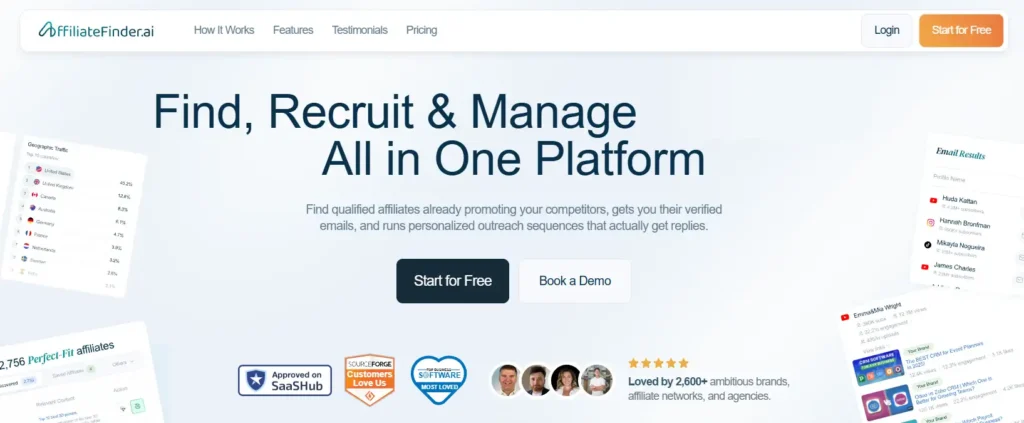
AffiliateFinder.ai works backwards from your competitors. You enter a rival brand, and the platform scans Google, YouTube, Instagram, TikTok, and 100+ affiliate networks to surface the bloggers, channels, and creators already promoting products like yours.
Every match returns an AI relevance score between 0 and 100 alongside a verified email address, and the index re-scans weekly so your recruitment pipeline stays populated with people who published recently rather than names sitting in a database since 2019.
It is a recruitment-only affiliate tool. Commission tracking, attribution, and payouts happen elsewhere, which suits teams who already run tracking software and only need the sourcing layer solved.
AffiliateFinder.ai Pros and Cons
- Finds partners already converting for competitors.
- Weekly rescans keep prospect lists current.
- Contact data arrives verified, not guessed.
- Relevance scoring removes manual shortlisting work.
- No tracking, attribution, or payout handling.
- Requires a second platform for management.
Use Cases
Best for: SaaS founders, affiliate managers, and agencies who want systematic competitor intelligence driving recruitment. Strongest when you already run tracking software and need the discovery and outreach layer solved properly.
2. PartnerStack
For B2B SaaS companies, PartnerStack solves the cold start problem differently. Rather than sending you outbound, it puts your program in front of a marketplace of 143,000+ active partners who browse, discover, and apply on their own.
The platform is a partner relationship management system first, so affiliate, referral, co-sell, and B2B influencer programs run side by side under one dashboard with shared tracking and reporting.
Partner payments consolidate into a single monthly invoice no matter how many people you owe, which is the operational detail that matters once a program passes a hundred active partners. PartnerStack has facilitated over $3.2B in partner-sourced sales to date.
PartnerStack Pros and Cons
- Marketplace removes cold outreach entirely.
- Four partner program types on one platform.
- Payout consolidation cuts finance team workload.
- Established partner pool skews toward SaaS buyers.
- Built for B2B, weak for ecommerce.
- No outbound discovery or prospecting tools.
Use Cases
Best for: B2B SaaS teams that want partners applying inbound instead of chasing them. The marketplace justifies the platform on its own for companies with limited recruitment headcount.
3. Endorsely
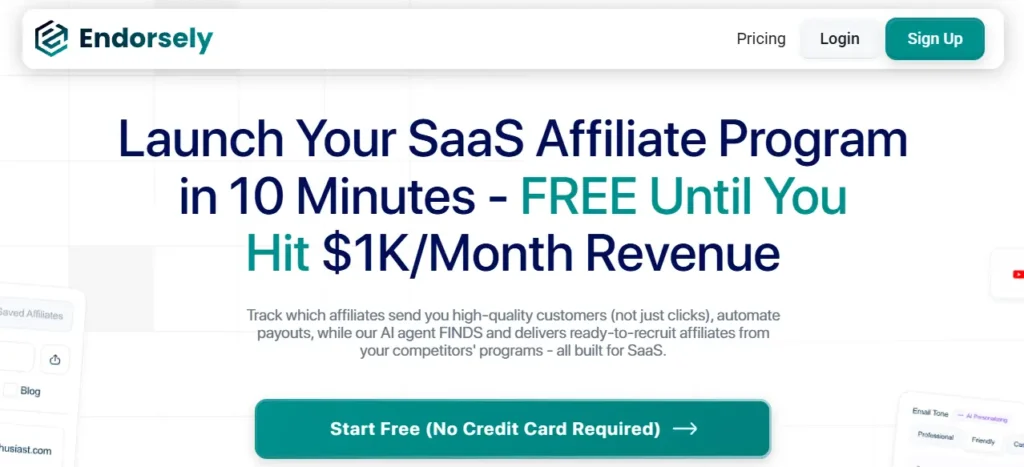
Endorsely bundles affiliate discovery into a full management platform aimed squarely at SaaS. Its AI Affiliate Finder takes your competitor names and returns affiliates promoting them across websites, YouTube channels, and newsletters, then drafts outreach emails using their contact details.
Setup runs on a one-click Stripe integration and takes roughly ten minutes, and the platform stays free until affiliates generate $1,000 per month in revenue.
Tracking goes past clicks and conversions into customer quality. Because it reads Stripe data directly, you see LTV, EPC, and free-trial-to-paid conversion per affiliate, which tells you which partners bring customers who stay and which bring churn.
Endorsely Pros and Cons
- Discovery and management sit in one workflow.
- Stripe data exposes real affiliate customer quality.
- Ten minute setup with no engineering time.
- Free until the program earns meaningfully.
- Stripe only, blocking other payment processors.
- Revenue caps force upgrades as you grow.
Use Cases
Best for: Early stage SaaS companies on Stripe who want recruitment, tracking, and payouts in one place without committing budget before the program proves itself.
4. impact.com
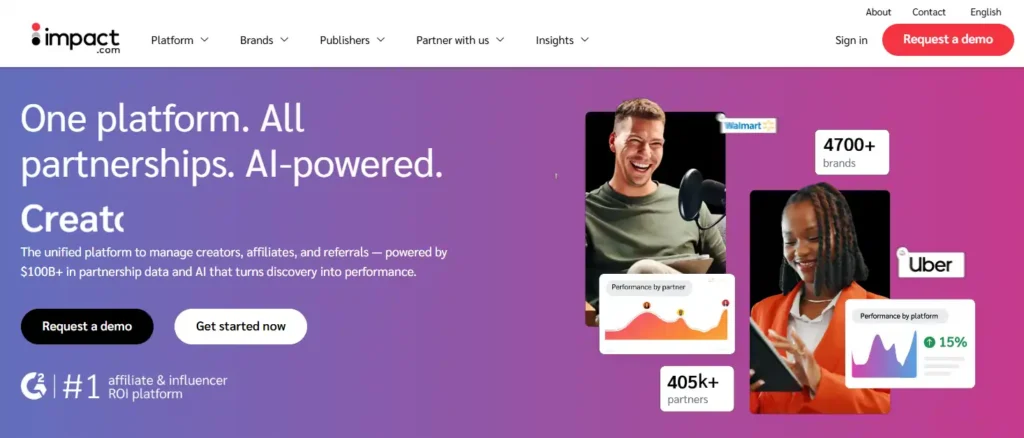
impact.com approaches recruitment through scale. Its partner marketplace holds hundreds of thousands of vetted affiliates, influencers, and publishers, each carrying documented conversion history by vertical, and partners apply to your program rather than the other way round.
The wider platform is a partnership management system covering discovery, contracting, tracking, fraud protection, attribution, and payments, built for brands running several partnership types at once.
Cross-device tracking, promo code attribution, and built-in fraud scoring make it a fit for programs where compliance and measurement carry real weight. The platform has tracked over $100B in partnership commerce, and custom contract templates handle verticals where terms differ by partner.
impact.com Pros and Cons
- Marketplace partners arrive with proven conversion records.
- Fraud detection flags anomalies before payouts clear.
- Handles affiliates, creators, and referrals together.
- Contracting flexibility suits regulated verticals.
- Transaction fees stack on top of subscription.
- Enterprise complexity overwhelms small in-house teams.
Use Cases
Best for: Mid-market and enterprise brands running several partnership types who need contracting, fraud protection, and attribution depth rather than outbound prospecting features.
5. Affistash
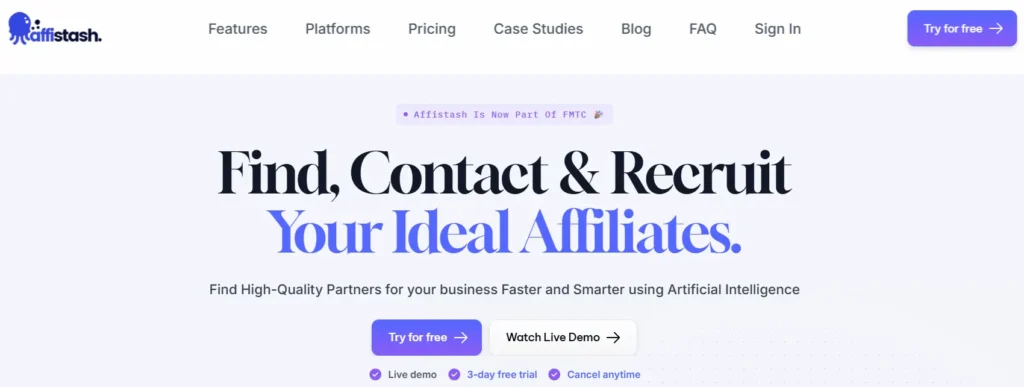
Affistash was built by affiliate managers for the sourcing half of the job. Instead of querying a closed network database, it searches the open web and returns traditional affiliates, influencers, newsletter operators, communities, and complementary businesses.
Each prospect comes with audience analysis covering traffic volume, geography, site category, engagement, and audience interests, and for publishers carrying referral links, the platform identifies which affiliate networks they already belong to.
An AI assistant composes partnership invitations for each prospect, and a built-in partner relationship manager holds notes, relationship status, and campaign history so outreach does not scatter across spreadsheets and inboxes.
Affistash Pros and Cons
- Searches beyond closed affiliate network databases.
- Audience data supports vetting before outreach.
- CRM keeps partnership status visible per prospect.
- Identifies which networks a publisher already uses.
- No commission tracking or payout processing.
- Credit-based discovery limits monthly prospecting volume.
Use Cases
Best for: Partnership managers and agencies who want open web discovery with audience context attached. Suits teams recruiting across mixed partner types rather than creators alone.
6. Publisher Discovery
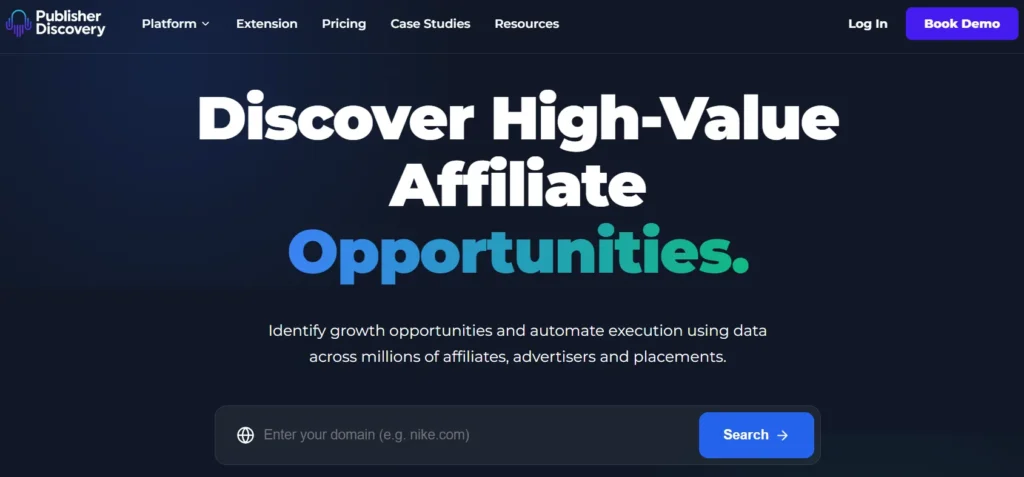
Publisher Discovery serves the traditional affiliate ecosystem: content sites, review blogs, comparison portals, and coupon publishers. It analyses 3.2M+ publishers across affiliate networks on a network-agnostic basis and processes over 8.5B data points.
Its core function is competitor gap analysis. You see exactly which publishers are active in rival programs, what projected incremental revenue capturing them would produce, and what percentage growth closing that gap represents.
Machine learning scores each publisher by predicted monthly revenue value, so recruitment effort concentrates on high-potential partners instead of working through a flat alphabetical list. Outreach automation then handles communication at scale once targets are set.
Publisher Discovery Pros and Cons
- Revenue scoring prioritises publishers worth pursuing.
- Network agnostic view across competitor affiliate programs.
- Quantifies revenue upside before recruitment begins.
- Deep coverage of coupon and comparison publishers.
- Per-seat pricing gets expensive for teams.
- No social or creator affiliate coverage.
Use Cases
Best for: Affiliate program managers and agencies recruiting publisher affiliates at scale who want revenue modelling behind target selection rather than a raw prospect list.
7. Cruva
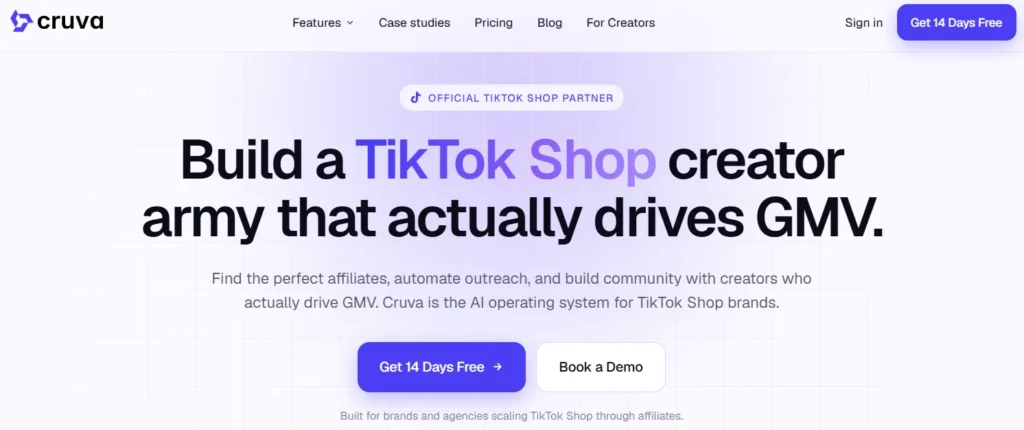
Cruva narrows its scope to one channel and goes deep. It is an official TikTok Shop partner, meaning its automation is approved by TikTok, and brands use it to discover, contact, and manage affiliates entirely inside that ecosystem.
Discovery runs on AI creator search filtered by niche fit and estimated GMV, plus competitor signals that show which creators are posting rival products and which content angles are moving units.
Retention gets equal weight. Private creator communities, contests, tiered rewards, and reactivation triggers exist because a recruited affiliate who posts once is not a partner, and Halo Effect reporting measures the lift creator content drives across paid ads and direct traffic.
Cruva Pros and Cons
- Official partner status protects account standing.
- Competitor signals reveal creators already selling similar products.
- Community tools tackle post-recruitment creator drop-off.
- Community tools tackle post-recruitment creator drop-off.
- TikTok Shop only, no other channels.
- Community features restricted on lower plan tiers.
Use Cases
Best for: TikTok Shop brands and agencies scaling creator programs where retention matters as much as recruitment. Not a fit if your affiliates sit outside TikTok.
8. Modash

Where most platforms surface creators who opted into a database, Modash indexes 380M+ public profiles across Instagram, TikTok, and YouTube with a 1K follower floor, so recruitment happens against the full landscape rather than a subset.
Two warm recruitment workflows separate it from standard discovery tools. Find Your Fans surfaces creators already following or engaging with your brand, and email list import matches existing customer contacts against creator profiles, turning buyers into your first prospect list.
Vetting data includes fake follower percentage, audience demographics, past brand collaborations, and engagement benchmarks. A native Shopify integration then ties promo codes, affiliate links, and payouts back to actual store revenue.
Modash Pros and Cons
- Full creator landscape indexed without opt-in gatekeeping.
- Existing customers convert into warm affiliate prospects.
- Content tracking runs without creator authentication.
- Shopify attribution connects partners to real revenue.
- Invite only, with no public application page.
- Creator focused, weak on publisher affiliates.
Use Cases
Best for: Ecommerce and DTC brands, especially on Shopify, recruiting creator affiliates who want discovery, outreach, tracking, and payments handled inside one connected workflow.
9. Respona
Respona operates on a results model rather than a subscription workflow. You define target landing pages, preferred anchor text, and publisher quality tiers, and the team handles publisher discovery, content creation, outreach, and live publishing end to end.
Quality tiers run from DR 20+ sites through to DR 60+, each with its own traffic thresholds, and you pre-approve domains and country TLD rules before anything publishes.
Content briefs analyse top-ranking pages and target low-competition, high-CPC keywords, with output optimised for traditional search and for AI answer engines including Google AI Overviews, ChatGPT, and Perplexity. Formats span listicles, reviews, comparisons, and news pieces.
Respona Pros and Cons
- Payment triggers only on live placements.
- Quality tiers make publisher standards explicit upfront.
- Content targets AI answer engines, not just search.
- Domain approval keeps brand placement under control.
- Publisher websites only, no social creators.
- No affiliate tracking, commissions, or relationship management.
Use Cases
Best for: Brands and agencies who want editorial presence on authoritative publisher sites without managing outreach themselves. Treat it as a visibility layer alongside a recruitment platform, not a replacement.
Outbound, Marketplace, or Hybrid: The 3 Affiliate Recruitment Tool Categories
Affiliate recruitment tools split into three categories, and the split matters because each one solves a different bottleneck.
Most mature programs run outbound and marketplace side by side. Category choice usually comes down to whether your gap is partner volume or partner quality.
What Separates a Real Affiliate Recruitment Tool From a Tracker
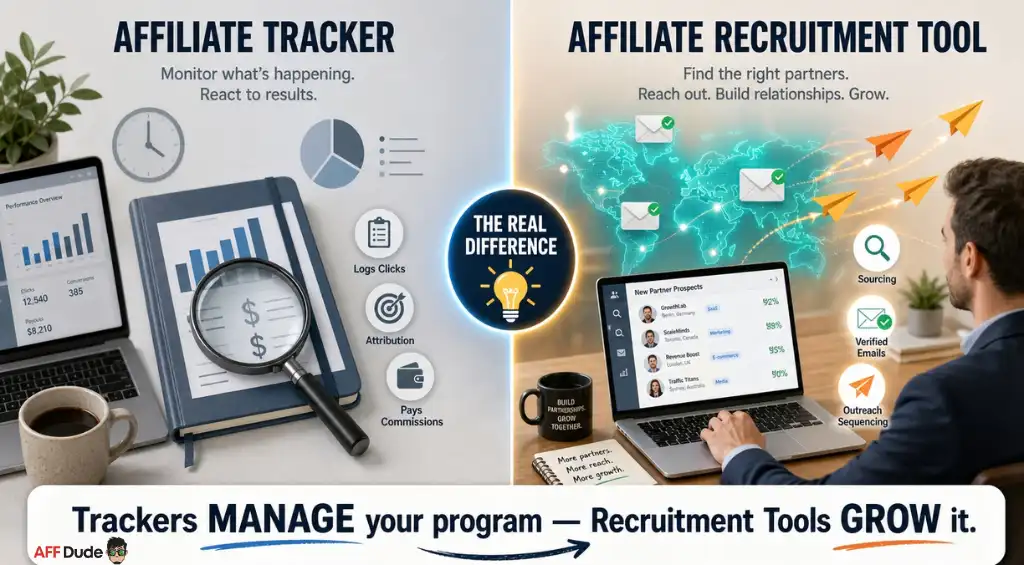
Recruitment software and tracking software get marketed with similar language, which is why plenty of brands buy the wrong one.
A tracker measures partners you already have. It logs clicks, attributes conversions, calculates commissions, and processes payouts. Recruitment sits outside its job description, usually handled by a sign-up page that waits for applications.
A recruitment tool starts earlier. It builds a prospect list from data you do not own yet: competitor partner rosters, ranking content, creator indexes, or affiliate network activity.
Three capabilities mark the difference:
If a platform only reports on existing partners, it manages your program. It does not grow it.
Recruitment Stack Verdict
Nine platforms, three fairly different jobs. Some source partners you have never met. Some open a door and wait for applications. Some do both, then track what happens next.
The gap worth watching sits after the signup. A tool can hand you 500 qualified names and still leave you with a quiet program six weeks later.
So look at your own numbers first. If applications are steady but revenue is flat, affiliate recruitment tools are not your bottleneck. If the pipeline is empty, they very much are.
Recommended Articles

Affiliate Disclosure: This post may contain some affiliate links, which means we may receive a commission if you purchase something that we recommend at no additional cost for you (none whatsoever!)