Inside Tyver: The Facebook Ads Spy Tool Meta Can’t Erase

By :
Ali
August 26, 2026
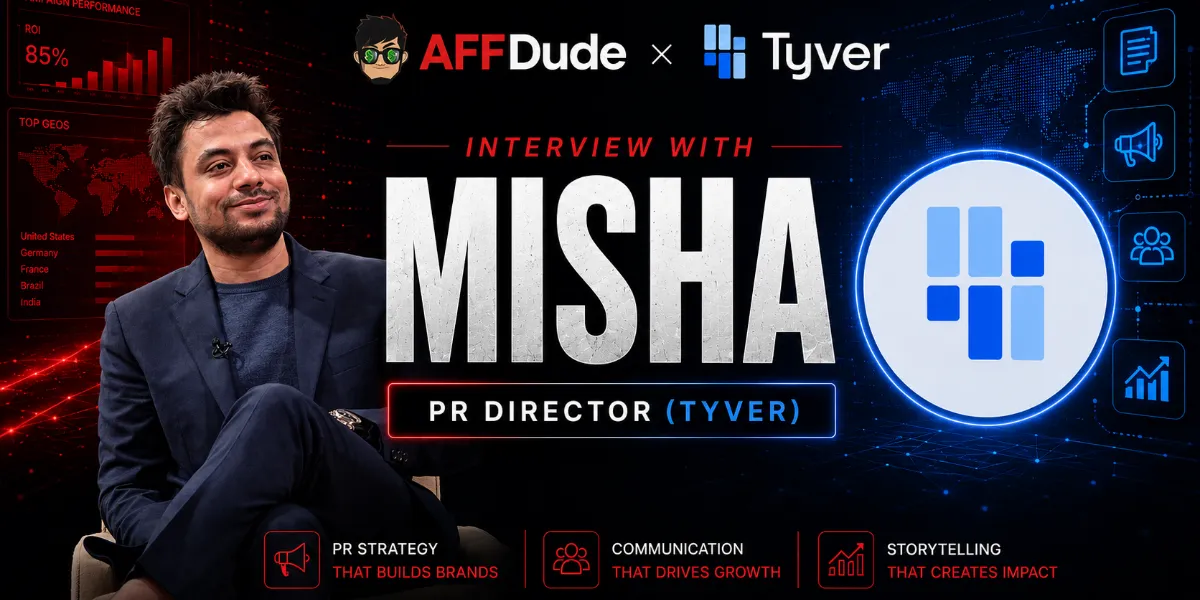
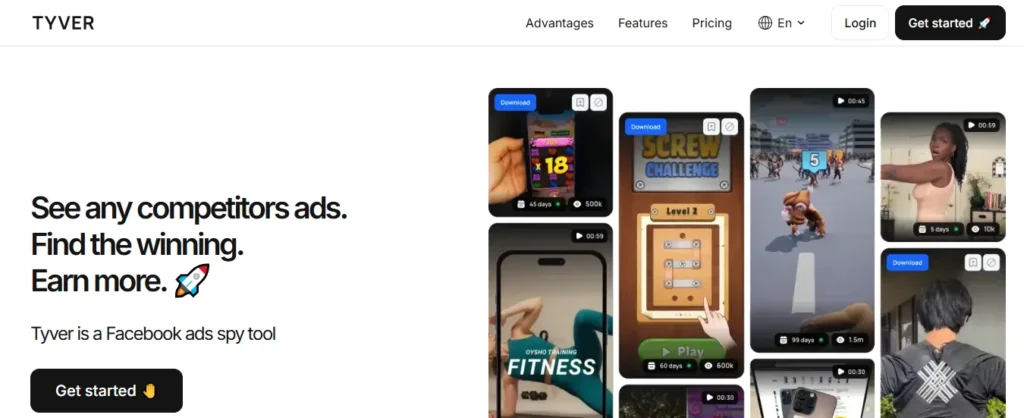
Tyver is a Facebook ads spy tool built for media buyers who spend their day digging through creatives. It pulls up to 91% of all Facebook ads into one searchable database, adds around three million new ads every 24 hours, and lets you filter that pile by keyword, domain, fan page, Pixel ID, country, reach, format and more.
The service covers gambling, dropshipping and CoD, nutra, sweepstakes, apps and e-commerce across 100+ countries, and it holds on to creatives even after they vanish from the Meta Ads Library, which is where most competitor research quietly falls apart.
Misha PR Director at Tyver
Misha got into affiliate marketing in 2016 through a classmate at university, started out buying Facebook traffic, and by 2021 had moved to the other side of the table into marketing and then PR. Tyver is the third company in the space he has worked for, and he has been there over a year.
In this exclusive interview, Misha talked about why hard-sell messaging bounces straight off media buyers, what Russian-speaking and English-speaking audiences respond to differently, and how he turns a three million ads per day claim into something a user can verify in one search.
1. Who is Misha? How did you get into affiliate marketing, and why did you choose PR?
Misha is just an ordinary guy who got excited about the idea of making money online without being tied to a specific place.
I got into affiliate marketing through a classmate during my first year at university. It was back in 2016. The market was much simpler back then: there was less competition, launching ad campaigns was easier, and, like many people, I started with classic media buying, running Facebook ads and trying different offers.
Over time, running ads became more difficult, competition increased, and making money that way became harder. At the same time, the market kept evolving, with new tools and services appearing that made affiliates’ work faster and easier.
By 2021, I was already using one of those tools myself, and at some point I thought, why not look at the industry from the other side? Instead of buying traffic for myself, I could help promote quality products that actually make affiliate marketers’ lives easier.
That’s how I gradually moved into marketing and eventually into PR.
What I really liked about PR was that you can influence much more than just the amount of advertising a product gets. You can shape how the market sees the product, build trust around it, and develop real relationships with the people in the industry.
2. What does your role at Tyver actually look like day to day, and what are you judged on?
Tyver is actually the third company in the affiliate marketing space that I’ve worked for, and I’m genuinely grateful that I ended up here.
I’ve been lucky with the team and with the company’s approach. Here, people are judged by their actual productivity and direct results, rather than simply being present at their desk, haha.
Like most people in this industry, my day-to-day work covers a lot of different things. I communicate with bloggers and influencers, work with Telegram channels, create useful content, write articles, work on SEO, build new integrations, run cross-promotions with similar services, look for new media opportunities and partners, and much more.
For me, though, PR has never been just about the number of publications or views. Ultimately, it has to contribute to the business.
The most straightforward KPI to track is probably direct company revenue, and I like the fact that I can directly influence it.
It’s especially rewarding to see that our work brings in not only returning users, but a steady flow of new ones as well.
I guess I’m doing something right, considering I’ve been with the company for more than a year now, haha.
3. What was the first win at Tyver that made you think, “Right, this is going to work”?
Honestly, there have been a lot of wins, both big and small. Those moments gradually made me realize that I was promoting a genuinely strong product with a lot of potential.
But the thing I remember most clearly is seeing the company’s revenue grow.
It was really satisfying to look at the charts and see revenue increasing month after month, not just because existing users were coming back, but because we were consistently bringing in new users as well.
Then there was one particularly memorable moment: one month, my KPI bonus was actually higher than my fixed salary.
Obviously, getting a bonus like that feels great, but the more important part for me was realizing what it actually meant. I had managed to bring a significant number of new users to the company and, as a result, generate additional revenue.
It also made me realize that I was living up to the trust of the people who had believed in me.
I think that feeling was the real “right, this is going to work” moment for me.
4. How does the nature of affiliate marketing change the way you approach PR?
In affiliate marketing, or traffic arbitrage as we usually call it in Russian-speaking markets, traditional advertising approaches don’t always work.
Think about it this way: you’re trying to sell something to people whose own job is selling products and services every day by buying traffic and testing different offers.
These people are very good at spotting the difference between genuine value and advertising for the sake of advertising.
So going to them with a message like “We’re the best service, buy it” is basically useless.
You have to sell real value, not just advertising. If a product genuinely solves a problem, saves time, money or effort, you need to show that honestly and clearly.
That’s why things like case studies, guides, real examples, numbers, and product demonstrations are so important for Tyver.
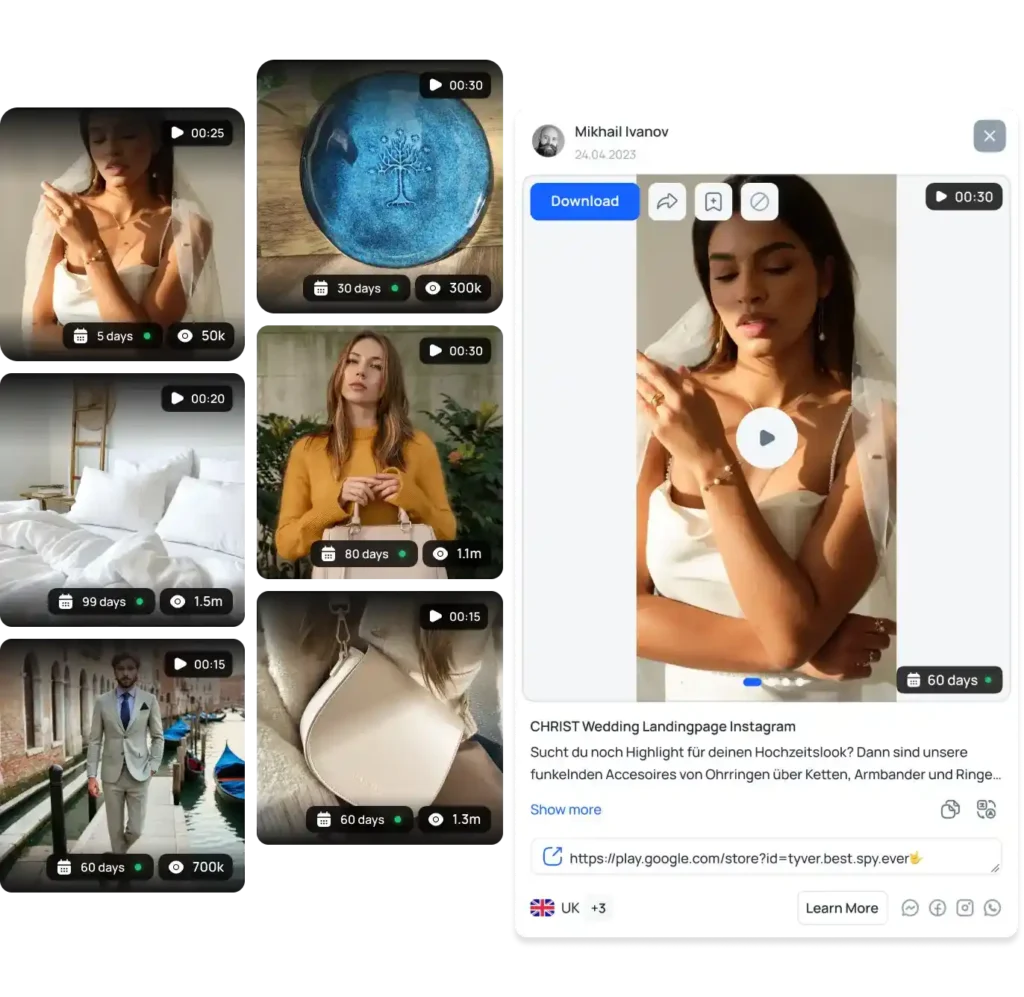
We don’t just tell people that our database contains millions of creatives. We can show them how quickly they can find the exact ads they need, check their reach and audience, discover similar creatives, and so on.
In the end, that can help them save budget, spot trends earlier, and find new ideas faster.
That’s also why reputation matters so much in this industry. If you keep going to bloggers and media outlets with straight-up advertising, people won’t take you seriously. And if you publish questionable case studies or make up results, people will remember that too.
After years in the industry, I’ve learned that reputation really does work in your favor when you build it through honesty, consistency and responsibility.
5. What actually earns a media buyer’s attention, and what gets ignored instantly?
Any reasonably experienced media buyer is mainly interested in things that make their life easier.
What helps them get the job done faster? What saves time and energy? What gives them more information with fewer actions?
That’s what really gets their attention.
That’s also why strong products in our niche need to be developed around actual user feedback, requests and problems rather than what the team simply thinks would be useful.
And what gets ignored instantly? Pretty much the same thing we talked about earlier: hard-sell advertising.
The moment someone realizes you’re just trying to sell them something, they naturally start trusting the message less.
That’s especially true with media buyers because they work with advertising every day and can recognize marketing patterns almost immediately.
6. How different are the Russian-speaking and English-speaking audiences?
Yes, there is definitely a difference.
The Russian-speaking audience is easier for me to work with because I understand the context much better. I know the local bloggers, influencers, niche media, groups and chats. I understand the language, the slang, the audience’s pain points, local events and even the inside jokes.
So sometimes you can communicate an idea with a single phrase or joke because you understand the cultural context behind it.
The English-speaking audience is a little more complicated.
On the surface, it’s simply an English-speaking audience, but in reality, the people behind the screen could be from the US, Vietnam, India, or dozens of other countries.
Their cultural backgrounds, local events, slang and attitudes toward content can all be very different. So you can’t rely too much on one local cultural reference and expect everyone to get it.
That’s why we try to make our English-language communication as universal, useful and concise as possible.
And honestly, I think that’s a good principle for any audience. Nobody wants to read a huge wall of text full of fluff. People want the information that actually matters, and then they want to get back to work.
7. What does Tyver get from being at conferences that you can never get online?
Tyver doesn’t have as much conference experience as some of the bigger companies because attending these events requires a serious investment of time, money and resources.
We have participated in conferences and interacted with the audience offline, and overall the experience was very positive. We got useful feedback, met new people and were able to see people’s reactions to the product in real life.
At the same time, we gradually realized that a lot of that feedback can also be collected online if you communicate properly with users and actually listen to them.
That said, offline events do have one obvious advantage: finding new partners and new promotion opportunities can be much easier.
You’re physically in the same room with people who already work in the same industry, so starting a conversation becomes much more natural.
Online, finding those people can take much more time.
So I see conferences as a strong additional channel for networking and discovering new opportunities, but definitely not as the only or primary part of a PR strategy.
8. What makes a partnership genuinely valuable?
This is actually one of my favorite questions, and I hope some of my partners read this and appreciate it, haha.
I think the most important thing is to remember that there is another human being on the other side of the screen.
Beyond the actual work, partnerships are about respect, honesty, integrity and responsibility.
If you promise something, you should deliver it on time and to the highest standard you can.
That’s how trust is built over time.
For me, a good partnership isn’t just a logo swap or a one-off placement. It’s a relationship that can keep working for a year, two years, or even longer.
The person responsible for one product today might move to another company in a couple of years, launch their own project, or start managing several products.
And if you’ve already built trust, they might come back to you for another partnership, advice or simply to exchange ideas.
I think those relationships are one of the most valuable assets you can build.
I’ve also seen the other side of it over the years: partners who thought too highly of themselves, failed to keep their promises, but still expected perfect discipline from everyone else.
It’s unpleasant, but it’s also useful experience.
Over time, you become much better at recognizing who is worth building a long-term relationship with and who simply isn’t worth your time.
So my advice to anyone starting out in PR or partnerships is simple: responsibility, honesty and respect for people always pay off, even when you’re dealing with something that seems insignificant.
9. What does Tyver give a media buyer that they can’t get from the free Meta Ads Library?
The biggest problem for a media buyer in 2026 is the sheer number of processes they have to manage at the same time.
You need to research creatives, analyze competitors, launch campaigns, work with anti-detect browsers, proxies, trackers and a long list of other tools.
And you can spend a huge amount of time just researching and preparing creatives.
Meta Ads Library is obviously a very useful tool, but it basically gives you a large pool of ads that you then have to sort through yourself.
Its search and filtering capabilities are much more limited, so finding something very specific can take a lot of time.
That’s exactly the problem Tyver solves.
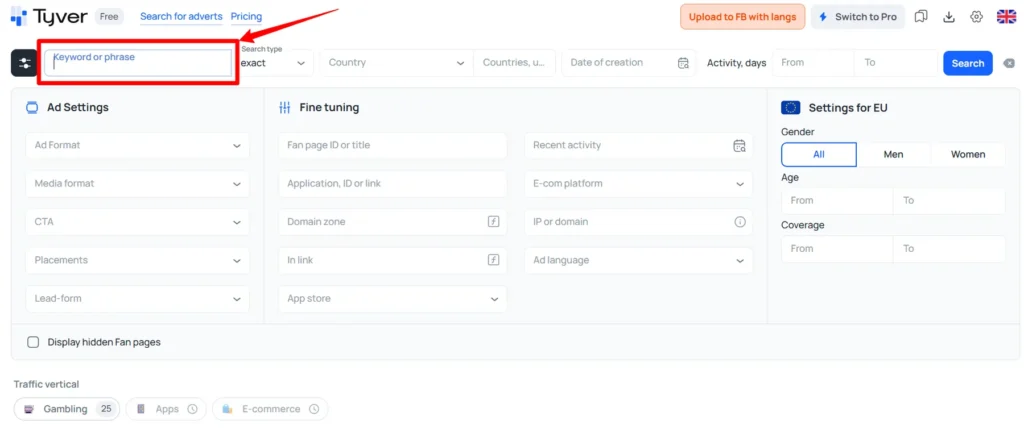
We take a huge database of creatives and turn it into a practical research tool where you can search using keywords, domains, fan pages, Pixel IDs, countries, dates, creative types and many other filters.
And Tyver adds another layer of functionality on top of that.
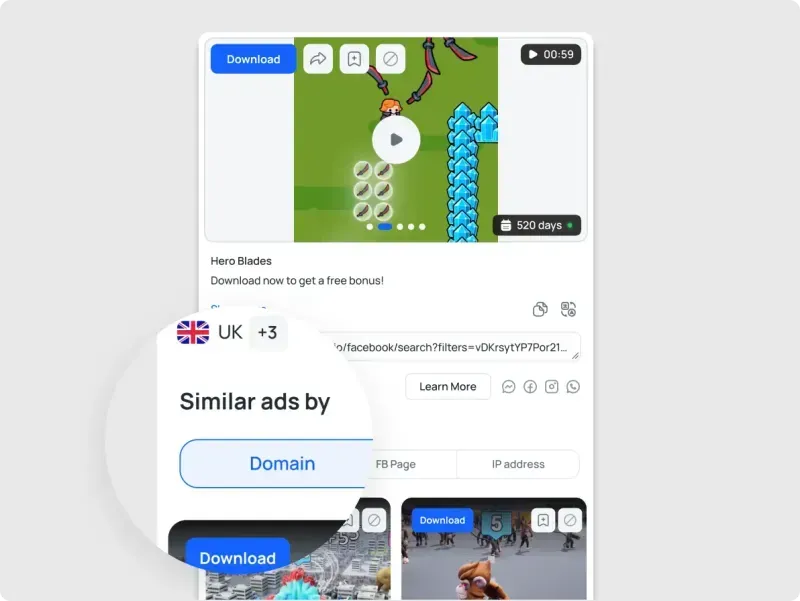
You can discover similar ads, check reach and audience data, work with creatives as a team, use the built-in media uniquifier, and specifically research gambling creatives by individual slots and offers.
And then there’s the historical data.
If an ad disappears from the Meta Ads Library, that doesn’t mean it suddenly stops being valuable for research. Tyver keeps those creatives in the database.
So ultimately, Tyver turns a massive amount of advertising data into a practical tool that saves media buyers time and helps them find relevant information much faster.
Save 20% on Tyver with Code AFFMAVEN
Get 20% off Tyver with code AFFMAVEN and speed up ad research with powerful creative search, advanced filters, competitor insights, and historical ad data—all in one place.
10. Three million new ads a day is a huge number. How do you make that mean something rather than just sound impressive?
Three million is definitely a huge number, and it’s hard to visualize what that actually means.
But I don’t really like saying, “Just trust us, we have three million.”
I’d rather give people a way to verify it for themselves.
You can open Tyver, set the date range to the last 24 hours, and simply see how many new ads are available.
Then you can use different keywords, countries, parameters and filters and see that every search gives you a different set of results.
That immediately shows you how large the database really is.
Even if you account for duplicates, similar ads or creatives that aren’t relevant to a particular person, three million is still an enormous amount of data.
And the important thing is that you don’t need to look through all three million.
You just need the ability to filter that massive pool quickly and find the hundreds or thousands of creatives that are actually relevant to your specific task.
11. Why does it matter so much that Tyver keeps deleted creatives?
A media buyer needs to see the full picture.
If ads constantly disappear from your market research, you’re looking at an incomplete picture and you may not understand what other players are actually testing.
In Tyver, that data stays available.
So even a month later, you can go back and see what creatives were being used, which trends kept coming back, which ideas continued to appear, and which ones were only starting to gain momentum.
There’s another interesting scenario as well.
Sometimes a media buyer finds a strong creative, but Facebook repeatedly blocks the campaign or account, so the ad quickly disappears from the public library.
That means other people may never get the chance to see or test the creative.
If that creative is preserved in Tyver, someone can discover it later, study the idea, adapt it to their own needs and run their own tests.
I’ve seen situations like this happen more than once in practice.
12. Why is being Meta-only actually a strength?
Meta advertising has historically been one of the most attractive traffic sources for media buyers.
There is a massive audience, an almost endless range of interests, and a huge variety of advertising formats and verticals.
But there’s another important point.
We deliberately chose to build a really strong product around one specific ecosystem instead of trying to cover Meta, TikTok, Google, Snapchat and every other ad platform at the same time.
Each platform has its own rules, technical nuances and constant changes.
Even by focusing only on Meta, we deal with new changes almost every day and have to adapt to keep the service working properly.
Trying to go equally deep into several platforms would require much more time and resources.
So for us, the better approach right now is to stay focused on Meta and make Tyver as deep and useful as possible within that ecosystem.
Maybe in a few years we’ll expand into other platforms. But today, specialization is a strength for us.
13. What’s the feature that gets the biggest “Oh, that’s clever” reaction?
Tyver has a lot of strong features, and I’m not just saying that because I’m representing the product, haha.
But one of the things I particularly like showing in demos is the reach and audience data.
You don’t just see the creative itself. You can also see the reach it received and get insights into the gender and age of the audience.
That already gives you a lot more context and helps you understand what kind of audience that particular ad may have worked well with.
Another strong feature is being able to search creatives by specific gambling offers and slots.
For example, you can select a specific slot like Gate of Olympus and, within a few clicks, see relevant creatives across different countries.
Instead of manually going through hundreds or thousands of ads, you immediately get a much more focused and relevant selection.
I also like the ability to find similar ads by the advertiser’s domain or fan page.
Sometimes you can identify a media buyer or advertiser whose work looks interesting and then follow what they’re doing over time.
And then there are the more practical tools, like the media uniquifier and team collaboration with individual access levels.
So there are a lot of features, but what I like most is that each of them solves a specific real-world problem.
14. What’s caught your eye recently in Meta advertising?
There have been huge changes in Meta advertising over the last few years.
The platform keeps introducing new technologies and relying more heavily on AI, while the market itself is evolving with new tools, creative approaches and new ways of dealing with moderation.
But I think one of the most interesting changes is happening in the creatives themselves.
The kind of advertising that worked five years ago, where you simply told someone, “Buy this product, it’s great,” is much less effective today.
People respond much better to realism, storytelling, strong visuals and the feeling that they’re looking at a real situation rather than a generic ad.
For example, a story about someone who actually tried a product and is talking about their experience.
Or a case where you show a specific problem and a specific solution.
So experienced media buyers are increasingly thinking not only about how to make a good-looking creative, but how to tell a story in a way that feels natural and believable.
15. How will AI change creative research over the next couple of years?
I see AI primarily as a tool.
The result depends heavily on whose hands that tool is in.
If you simply tell AI, “Make me a creative,” without bringing your own ideas, experience or understanding of the audience into the process, you’ll probably get something average.
But if a media buyer knows how to use these tools properly, AI can make their job dramatically easier.
It can help create images, videos and copy faster and allow people to test many more ideas.
At the same time, I don’t think AI will completely replace human experience.
You still need real-world data, cultural context, national preferences, traditions, lifestyles and dozens of other factors that influence how people perceive advertising.
And people are also getting much better at recognizing artificial content.
So simply generating a beautiful image is no longer enough.
In my opinion, the more AI-generated content there is, the more valuable it becomes to know the difference between a genuinely strong idea and something that is simply well-generated.
That’s also why creative research tools will have to evolve.
It won’t be enough to just give people a massive database. These tools will need to help users identify patterns faster, understand what’s gaining traction, and separate genuinely useful ideas from all the noise.
16. Someone wants to try Tyver this weekend. What should they do first?
When someone opens Tyver for the first time, they can get a little overwhelmed.
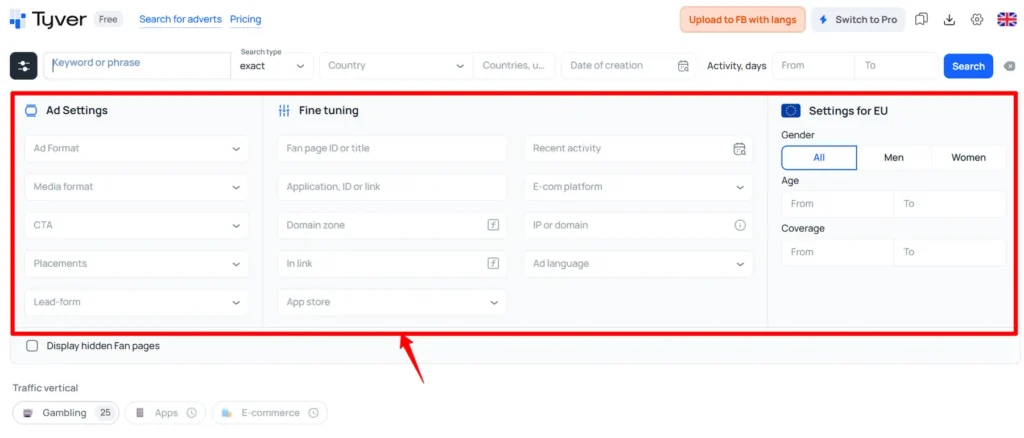
There’s a massive database, millions of new ads, a lot of filters and a lot of different features.
Trying to explore everything at once is simply impossible.
So I definitely wouldn’t recommend starting by trying to understand the entire platform.
I’d pick one or two countries and one specific vertical.
Then I’d try several different ways of searching: keywords, URL parameters, reach, views and other filters.
After that, I’d go even more specific.
For example, open the gambling section, pick one particular slot, say Gate of Olympus, and see what kind of creatives are being used across different countries.
The main thing is not to try to cover everything at once.
Pick one specific area and try to find something useful there.
Once you see how quickly Tyver can help you find the information you need and how many interesting ideas you can uncover, it becomes much easier to understand the value of the platform.
That’s the approach I’d recommend to any newcomer: don’t treat Tyver like an encyclopedia. Use it to solve one specific problem first.
Ready to stop digging through the Meta Ads Library by hand?
Our chat with Misha gave us a clear look at how creative research actually works in 2026. He’s sat on both sides of it, running Facebook campaigns since 2016 and now handling PR, so his read on what media buyers respond to comes from having been one of them.
The thread running through everything he said was verification. He’d rather you open Tyver, set the date filter to the last 24 hours and count the new ads yourself than take his word on the 3 million number. Same thinking behind keeping deleted creatives. A blocked campaign disappearing from Facebook doesn’t make the idea worthless, it just means nobody else gets to test it unless someone kept a copy.
His advice for a first weekend with the tool is refreshingly narrow. Pick one country and one vertical, try a few different search angles, then go deeper. Open the gambling section, choose a single slot like Gate of Olympus, and see what’s running across GEOs.
Meta keeps shifting, creatives keep getting more story-driven, and the buyers who spot the pattern early still take the money. The free plan costs nothing to poke around in. So what’s holding you back?
Similar Posts




Ali
Aliakbar Fakhri is a top affiliate marketer and the founder of AFFiNCO, an agency driving business growth through affiliate strategies for over a decade. Based on his 10+ years of experience, Ali shares battle-tested insights to help marketers succeed. Follow him on the AffDude blog for more tips!
Misha
Misha entered affiliate marketing in 2016, starting with Facebook traffic buying before moving into marketing and PR. He now works at Tyver, where he has spent over a year.