
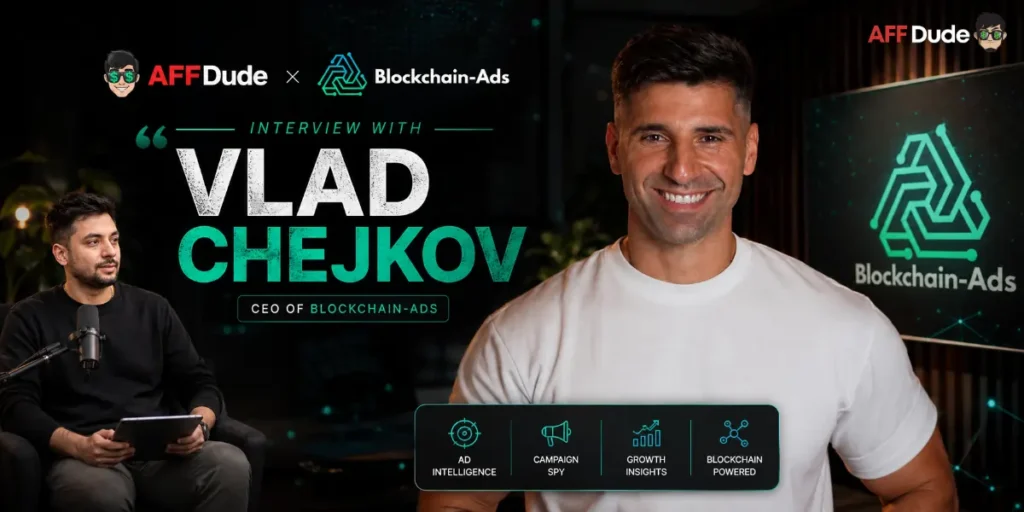
Blockchain-Ads is a leading ad network built for Web3, helping crypto and iGaming brands reach real users through on-chain targeting. It gives advertisers in regulated industries a place to run campaigns when Google and Meta shut the door.
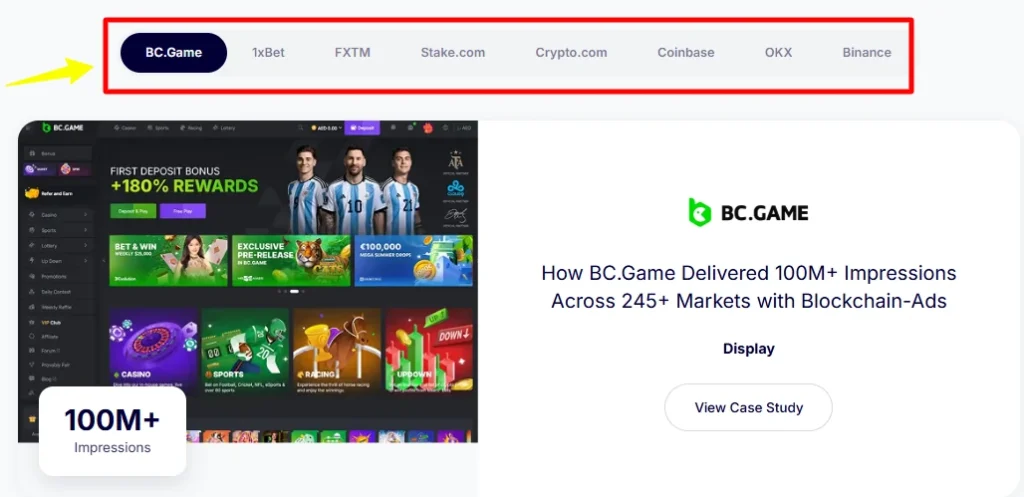
The platform has reshaped how crypto brands approach user acquisition by tapping wallet-level data that traditional ad tech simply can't see. Today some of the biggest names in the space run on it, including Crypto.com, Binance, Coinbase, OKX, Ripple, and iGaming heavyweights like Stake.com and BC.Game.
Vlad Chejkov CEO of Blockchain-Ads
Vlad came up through crypto marketing and ad tech, running his own agency before spotting the gap that became Blockchain-Ads. Five years and roughly $50 million in ad spend later, he's turned that early bet into one of the go-to platforms for advertisers in highly regulated verticals.

In this exclusive interview, Vlad shared his thoughts on…
Building an ad network from scratch, how the Web3 Cookie and wallet targeting actually work, and why content marketing beats crypto influencers every time. He also covered the Flux creative engine, fighting off faulty traffic, and the one call he'd put real money on.
1. Who’s Vlad, and how did you end up building an ad network for Web3?
I was running a marketing agency in the crypto space, and I had already spent time in ad tech before that. There was so much demand at the time that we simply went where the money was.
The moment everything changed came with one client: a large advertiser on an L1 blockchain with a massive budget to deploy and literally nowhere to spend it. They were restricted on Google, restricted on Meta, and restricted across nearly every ad network available.
So we asked the obvious question: why don’t we build the solution ourselves?
We connected a few publishers, set up a basic ad server, and that was it. That’s how Blockchain-Ads started.
Five years later, some of the biggest advertisers in the space are running campaigns on the platform, including Crypto.com, Binance, Coinbase, OKX, Ripple, Algorand, major iGaming companies such as BC.Game and Stake.com, as well as large financial companies operating in regulated industries.
It has been a huge transformation from where we started.
2. Blockchain-Ads grew out of your agency. What was the moment you knew?
It was that same moment: the L1 client with a significant budget and nowhere to deploy it. That was the decision point.
The entire space had demand, but no infrastructure to support it. So instead of telling the client, “Sorry, we can’t help,” we built the solution ourselves.
3. 300% growth, Binance and Coinbase on the roster. What did the grind actually look like?
The 300% growth was basically just the first year. After that, it became exponential. We’re now running around $50 million in ad spend through the platform, so realistically, the growth has been in the thousands of percent.
But before any of that came the real grind: stressful days, sleepless nights, and constant pressure. The level of uncertainty was tremendous. We didn’t know what was coming next, whether we would survive the month, how we would pay salaries.
We operated extremely lean, and honestly, that discipline is what kept us alive through the down markets. A bear market when you’re still a startup is no man’s land. You simply have to make it to the other side.
4. The version you don’t put on LinkedIn.
Nobody warns you about the fires. There are always multiple fires burning at the same time, and they never really stop. There is always a problem, always a situation that needs to be handled, and always an uncomfortable conversation you have to be in the middle of.
Sometimes it is with people you have worked with for a long time. Sometimes it is with customers who have relied on you. Sometimes it is with bad actors in the space, and there are plenty of them in the markets where we operate. You end up battling those situations every day.
I remember an interview, I think it was with Jensen Huang, where someone asked whether he would do it again if he had known how difficult it would be. He said no, he probably would not have started. I feel the same way. If I had known how hard it would be, I probably would not have started either. But I am in now, and there is no going back.
We have grown too much. We are scaling, the team is growing, the business is growing, and we are capturing more of the market. At this point, the only question left is how much further we can take it.
5. How do you keep the bar high when nobody shares an office?
We actually have several offices. The teams are distributed, but they work from offices across different locations.
The real answer, though, is not the office. It is the people.
Our team is largely self-reliant, self-sufficient, and accountable. The people are the company. When everyone in the organization holds themselves to a high standard, you do not need an office to enforce it. That is what keeps Blockchain-Ads growing.
6. When the laptop shuts, what does Vlad do?
Lift weights, smoke a cigar, sauna and steam. That’s the reset. And I spend time with my family, that part goes without saying.
7. In plain English, what’s “on-chain targeting” and this “Web3 cookie” of yours?
– The Web3 Cookie is a technology developed by the BCA Labs team. Compared to a traditional cookie, it picks up one more data point: the user’s wallet address.
Adding that wallet address to the user profile is what makes everything work. Once it’s there, you can collect on-chain signals tied to that specific wallet and drop that user into an audience bucket. If there are on-chain signals showing someone’s been trading or making transactions at scale, they get identified as a trader and placed in the traders audience. If that same wallet is playing on-chain iGaming apps, they get added to the gamers or iGamers audience. From there, advertisers on the Blockchain-Ads platform can target them.
So that’s all. A traditional cookie plus one extra data point, the wallet address, which then lets you target based on the actual on-chain behavior of those wallets. Traded? You’re marked a trader. Playing games? You’re a gamer. If a media buyer wants the deeper mechanics, it’s all in the Blockchain-Ads help center.
8. Where does wallet targeting crush it, and where does it fall flat?
Wallet targeting is at its best with campaigns at scale and user acquisition at scale. The advertisers who get the best results are the ones with large budgets running proper media plans over six or twelve months, spending somewhere between half a million and a million on user acquisition. At that level the targeting is on point, because there’s enough data for it to optimize.
Where it falls flat is small-budget campaigns. More often than not the targeting isn’t accurate there. Not enough data is collected, so the optimization can’t do its job. It’s a data engine, and a data engine needs volume.
9. Flux builds a fresh creative for every impression in under 10 milliseconds. What’s the catch?
We built the Flux engine to solve personalization at scale. It’s a just-in-time engine that picks up the user’s data points directly and adjusts the creative based on them: the wording, the visuals, and so on. Serving that tailored creative increases the potential for higher click-through rates, so campaign performance is better. We’ve seen a 27% lift in click-through rate on Flux campaigns compared to other campaign types.
10. Crypto and iGaming are a nightmare on Google and Meta. What can you do that the big platforms flat out can’t or won’t?
Google and Meta can do everything. There’s nothing they technically can’t do. The only thing they won’t do is properly service these highly regulated industries. For an advertiser in these verticals, the restrictions to get on Google or Meta are massive.
Blockchain-Ads is built specifically to serve these regulated industries. That’s our target market, and that’s what we do better. We serve these verticals better than Google and Meta are willing to.
11. Has the space actually cleaned up, or is a lot of it still smoke?
No. If anything, it’s the opposite. The space has been attacked and clogged even more, and honestly the biggest challenge we have right now is fighting off faulty traffic. This has been a problem for two decades, but it’s worse now.
The technology and capacity have improved, sure, but the bad actors have that same technology, so it’s a constant game of hide and seek with the bots and the faulty traffic trying to bypass detection. That’s going to continue. It’s exactly why we work with DoubleVerify as a third party, to protect our advertisers from that faulty traffic.
12. AI is chewing through the whole job. What stays human, and what gets automated?
Media buying stays human. People in this space want to make the decisions, and the whole value of a platform like Blockchain-Ads is the visibility and the ability to act on it. When advertisers are running campaigns at scale, they want to see everything and make the calls themselves.
Where AI helps is the reporting, distilling the performance data. But I don’t see everything getting automated in the next five years. AI will improve how we see the data and how we optimize, not replace the person making the decisions.
13. Big platforms are off limits, you’ve got $10k to spend, and it’s a vertical you’ve never touched. Walk us through your first 48 hours.
Honest answer: if all you have is $10k and you want results in the first 48 hours, don’t run it in this space. This works when you have a budget dedicated to scaling, $100k or more, and the campaigns are properly structured.
Here’s the real timeline. Month one is essentially the brand getting started on the platform. We call it brand activation, especially for a new account and a new brand. A lot of data has to be collected first. Day 30 is when you take the benchmark across all the metrics. Months two and three are when the campaigns optimize and reach their optimal level. After month three is when scaling actually starts, and the platform is built for exactly that: advertisers spending up to a million or a million and a half to reach all the audiences that are valuable to their brand.
14. Quick fire. Most overhyped thing in crypto marketing, and most underrated?
Most overhyped: crypto influencers. X, YouTube, it was all a flop. Overhyped, and it didn’t work.
Most underrated: content marketing and proper SEO. That’s what actually works.
15. One call you’d put real money on?
iGaming and prediction markets. It’s massive, and it’s overtaking marketing. The streamers, the content creators, paid media, social media, it’s everywhere. There’s so much interest and so much demand, and it’s in human nature, so I believe there’s huge potential for all the industries servicing it or adjacent to it. That’s the market, that’s the industry that will keep growing, and it will keep driving demand for marketing and advertising services. That’s the call I’d put real money on.
Our chat with Vlad Chejkov pulled back the curtain on what it really takes to run advertising in Web3. From that first L1 client with nowhere to spend, Vlad walked us through five years of turning Blockchain-Ads into a platform trusted by some of the biggest names in crypto and iGaming.
He was blunt about the grind, the constant fires, and the lean discipline that carried the company through the down markets.
He also broke down the tech that sets the platform apart, from wallet-level targeting that thrives on big-budget user acquisition to the Flux engine that builds a fresh creative per impression and lifts click-through rates by 27%.
His honest takes stuck with us. Crypto influencers were overhyped and mostly flopped, while proper SEO and content marketing quietly do the heavy lifting. And with around $50 million in ad spend already moving through the platform, his call on iGaming and prediction markets is one worth watching.
As crypto and regulated verticals keep growing, having an ad network built for them matters more than ever. Ready to scale your campaigns where the big platforms won't go?
Affiliate Disclosure: This post may contain some affiliate links, which means we may receive a commission if you purchase something that we recommend at no additional cost for you (none whatsoever!)