

Bottom Line for this OctoClick Review: OctoClick is worth testing if you buy or monetize push, native, popunder, and video traffic, but it is not a magic money button. It fits affiliate marketers, media buyers, publishers, and arbitrage teams who know how to track site IDs, cut bad placements, and optimize after enough data.
OctoClick works as a traffic buying and traffic selling platform. Advertisers use it to buy visits, clicks, impressions, and video views through various formats, while publishers use it to monetize website traffic through ad placements and auction-based demand.
My short take: OctoClick looks practical for performance marketers who already understand campaign testing. Beginners can still use it, but only if they start small, use proper tracking, and avoid judging a campaign after 50 clicks.
OctoClick’s main strength is not that it has every possible ad format. Its strength is a clean set of high-usage performance formats, direct publisher cooperation, real-time statistics, and targeting options that cover country, region, OS, browser, device, operators, IP, and time settings .
That makes it useful for affiliate campaigns, CPA offers, dating funnels, gambling funnels where allowed, nutra prelanders, sweepstakes flows, lead generation, ecommerce testing, and publisher monetization.
What Is OctoClick?
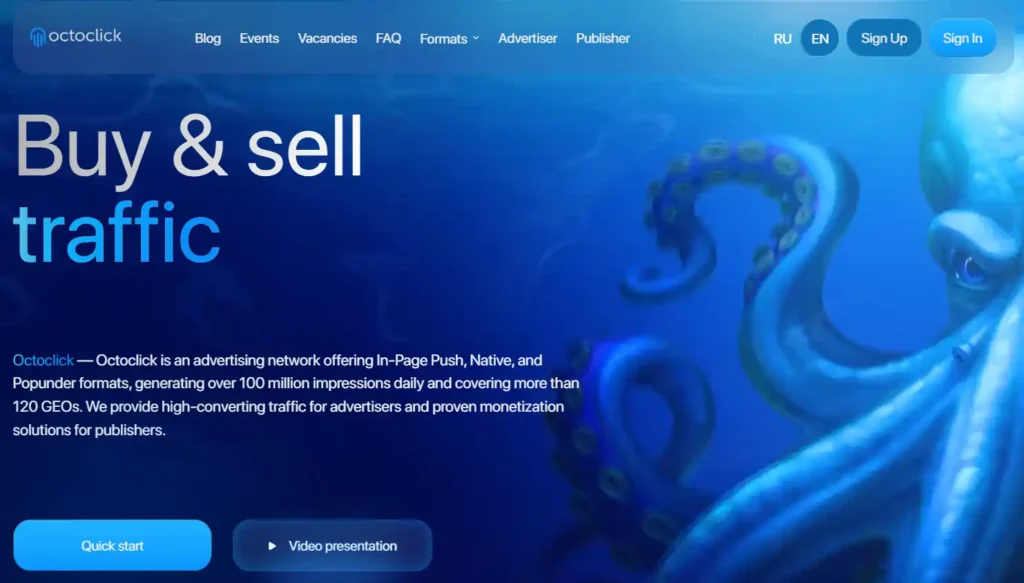
OctoClick is an ad network for advertisers and publishers. Advertisers buy traffic from websites, while publishers add ad placements to earn from visits, clicks, impressions, and user actions.
OctoClick promotes direct cooperation with webmasters, site moderation, real-time statistics, and multiple ad formats for buying and selling traffic . That matters because traffic quality usually depends on publisher quality, not just campaign settings.
For advertisers, OctoClick is a self-serve traffic source. For publishers, OctoClick is a monetization platform that sells website inventory through formats like In Page Push, Native Ads, and Popunder .
For affiliate marketers, OctoClick is mainly a testing source. It can send traffic to CPA offers, presell pages, smartlinks, direct offer pages, or ecommerce funnels.
For publishers, OctoClick is an extra revenue layer. It can sit beside display ads, affiliate widgets, direct deals, and other ad networks if ad density stays under control.
OctoClick also supports video ad formats on the advertiser side, including In Stream, Out Stream, and Video Pop Up . That gives video buyers more room than basic push-only networks.
How OctoClick Works
OctoClick has two sides.
Advertisers create campaigns, pick a format, add targeting, set bid type, upload creatives or URLs, set tracking, then send traffic to offers or landing pages.
Publishers add a website, pass moderation, place ad codes, test ad placements, then earn from traffic sold through OctoClick’s demand pool.
The buying side uses common paid traffic logic. Pick a vertical, select traffic format, define GEO and device filters, start with a test budget, collect data, cut bad zones, increase bids on profitable segments, and scale only after conversion data looks stable.
The selling side works more like website yield testing. Add placements, watch eCPM, CTR, fill, bounce signals, and user behavior, then adjust formats so revenue does not destroy site quality.
OctoClick also promotes real time statistics and exportable reports, which matter a lot when testing CPA campaigns. Without clean reporting, traffic buying turns into guessing, and guessing burns budget fast.
OctoClick for Advertisers: Self-Serve Traffic Buying, Campaign Controls, and Performance Tools
OctoClick’s advertiser side is built around traffic buying. It gives campaign controls for targeting, formats, payment models, tracking, creative setup, reporting, and optimization.
Campaign Setup
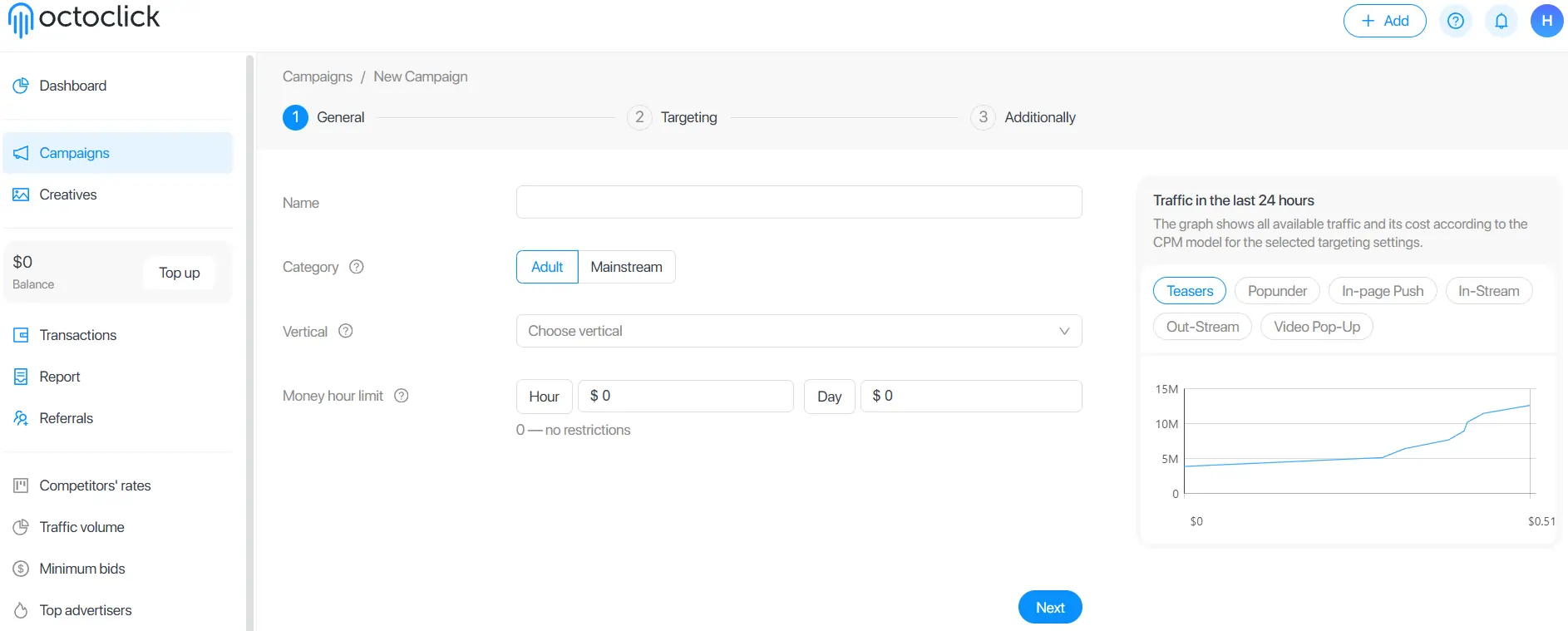
Campaign setup should be handled like a test lab, not like a one-click launch. Start with one offer, one main GEO, one device group, and one traffic format.
A clean OctoClick campaign setup usually looks like this:
- Pick one offer with clear payout rules.
- Choose one traffic format.
- Select GEO and device targeting.
- Add browser, OS, region, or operator filters if needed.
- Upload creatives and landing page URL.
- Add tracking macros.
- Connect postback tracking.
- Set daily and total budget controls.
- Submit campaign for moderation.
- Wait for data before changing too much.
Do not launch five formats, ten GEOs, and three offers in one messy test. That gives more noise than signal.
CPM and CPC Models
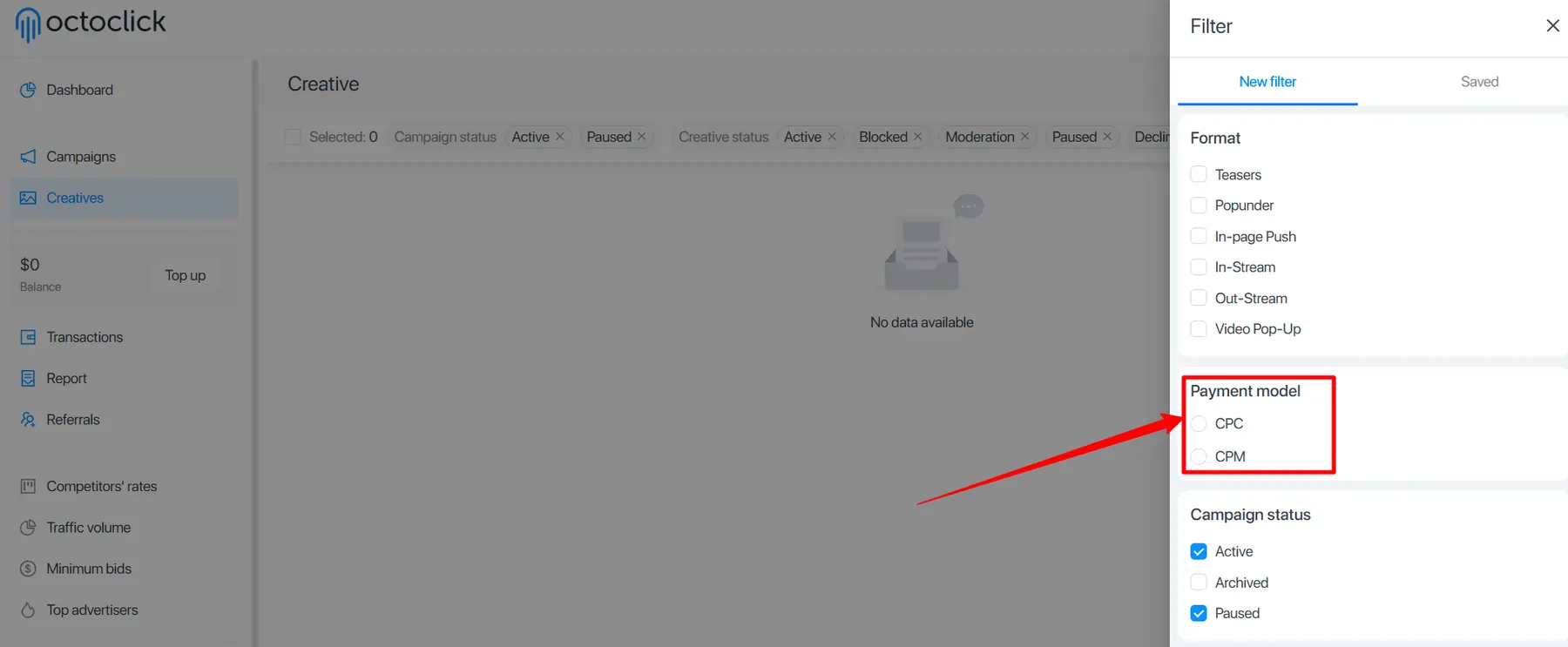
OctoClick supports CPM and CPC payment models for advertisers .
CPC means paying per click. CPM means paying per 1,000 impressions. CPC is usually easier for conversion-focused tests because spend is tied to clicks, while CPM needs stronger confidence in CTR, creative quality, and placement fit.
In CPC campaigns, weak creatives may simply receive fewer clicks. In CPM campaigns, weak creatives can still spend because impressions are being bought.
A simple testing rule: use CPC when validating a new offer or angle. Use CPM when CTR and placement quality are already proven.
Targeting Options
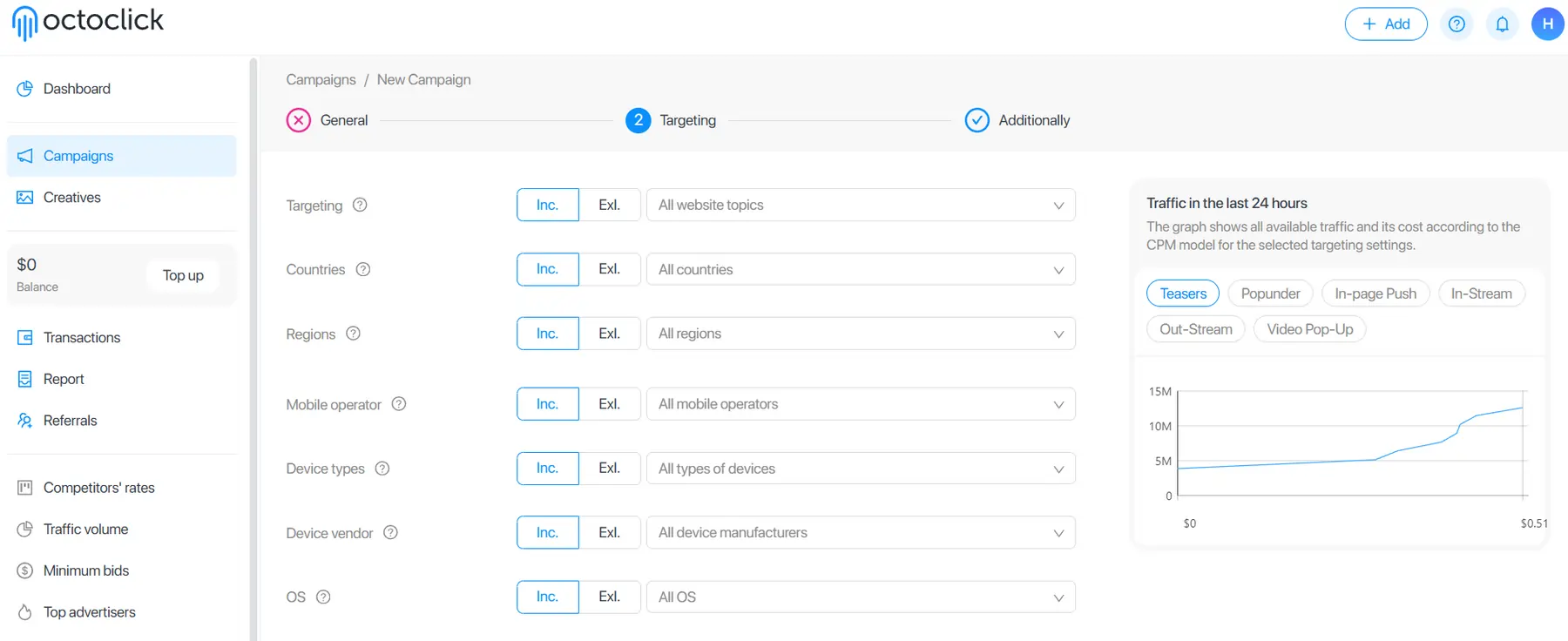
OctoClick lists targeting options across site categories, operating systems, regions, countries, device manufacturers, device types, IP, IP ranges, hourly ad scheduling, browsers, browser versions, browser language, and cellular operators .
That is enough for serious campaign filtering. It also means careless targeting can split data too thin.
Start broad enough to collect data, then tighten targeting after conversions show patterns. For example, do not block half the browsers before any clicks come in unless past data already supports that move.
Useful advertiser targeting filters include:
The best targeting setup depends on offer payout and funnel type. Dating and gambling campaigns may need stricter GEO, region, age-gated creative compliance, and device checks. Sweepstakes and lead-gen offers often need tight country and operator matching.
Budget Controls
Budget control matters because push, pop, native, and video traffic can spend fast once campaigns pass moderation.
Set daily limits, total limits, and test caps before launch. Do not wait until traffic starts moving to decide risk limits.
For first tests, the budget should be based on expected offer payout and conversion lag. If an offer needs many clicks before the first conversion, campaign data will look ugly early.
Use budget controls to protect learning. Bad buyers stop too early or spend too wide. Good buyers spend enough to read data, then cut fast.
Creative Setup
Creative setup depends on format. In-Page Push needs a tight title, short body copy, and clear image. Native needs a clickable teaser and content-style angle. Video formats need a hook that makes sense without heavy explanation.
Keep creatives honest. Aggressive claims may get rejected, hurt offer quality, or create poor post-click performance.
For dating campaigns, test emotional hooks, curiosity angles, and clean landing page flow. For gambling, test odds, bonus angles, event hooks, and compliance-safe wording. For nutra, avoid medical overclaims and use realistic benefit framing.
Creative testing should be structured. Change one thing at a time: image, title, call to action, landing page, or offer.
Macros and Tracking
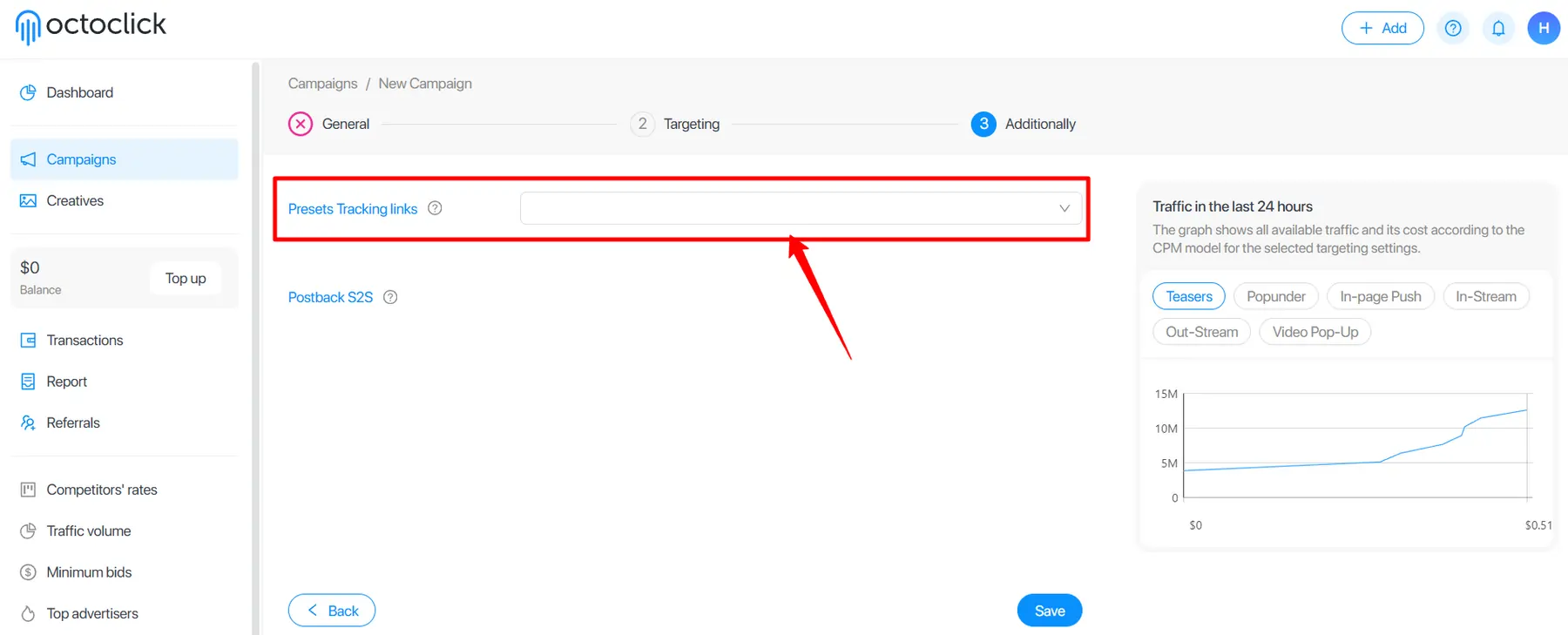
Tracking is where OctoClick becomes useful for serious buyers.
A proper setup should pass click ID, campaign ID, site ID, cost, device, browser, OS, country, region, operator, and creative data into a tracker. Then the tracker sends conversions back through postback.
BeMob has an OctoClick setup where the postback uses the OctoClick S2S endpoint and passes conversion ID through {externalId}; cost data can also be passed using macros such as {SPENT} in the tracker setup
A basic tracker URL should include fields like:
click_id={CLICK_ID}&site_id={SITE_ID}&campaign={CAMPAIGN_ID}&cost={SPENT}&country={COUNTRY}&device={DEVICE}&browser={BROWSER}Exact macro names should always be copied from the OctoClick dashboard or tracker template before launch. Wrong macro names create dirty data, and dirty data makes optimization useless.
Postback Setup
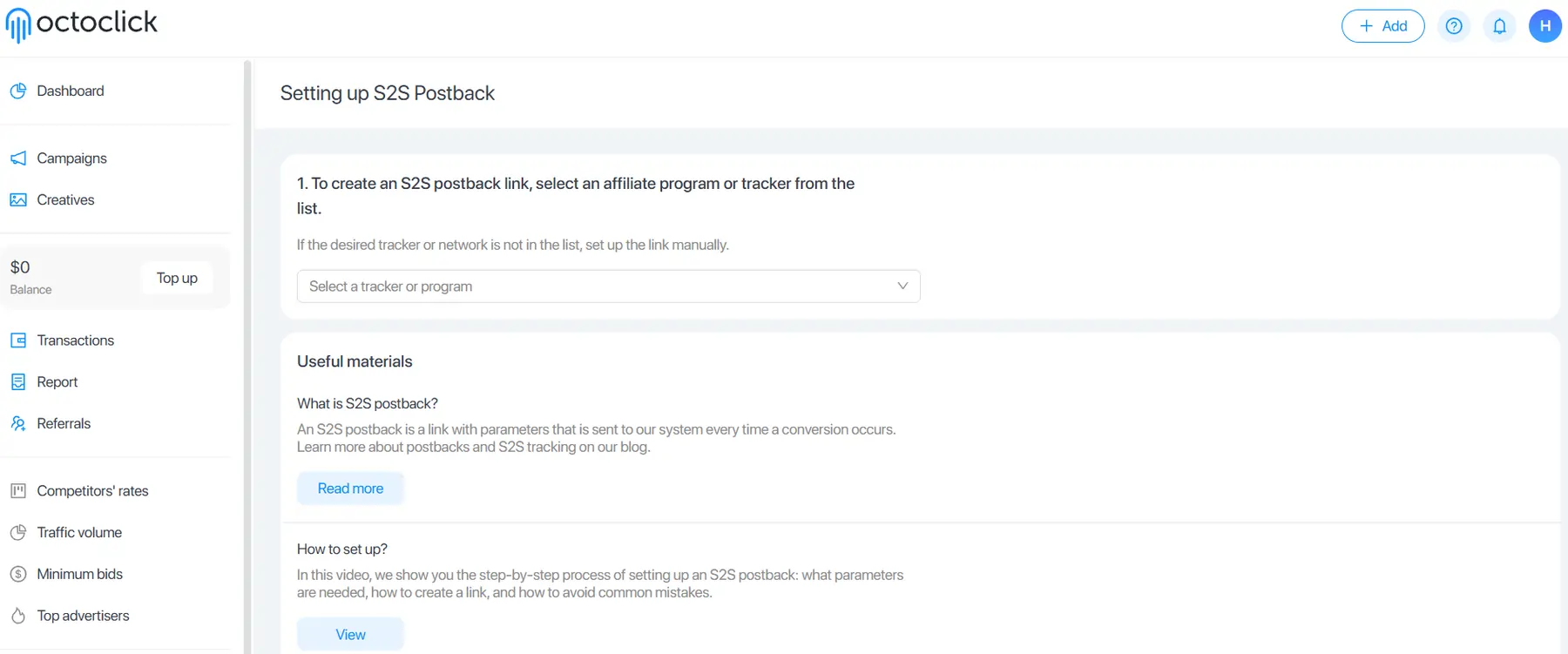
Postback setup sends conversion data back to OctoClick or your tracker. That lets campaign data show which traffic segments produced leads, deposits, sales, or other actions.
A clean flow looks like this:
- OctoClick sends a click with a click ID.
- Tracker stores that click ID.
- The user reaches the offer page.
- Conversion happens.
- Affiliate network fires postback to tracker.
- Tracker sends conversion data back to the traffic source if configured.
- Buyer checks ROI by placement, device, browser, and GEO.
Test postbacks before spending real money. One broken token can make a profitable campaign look dead.
For CPA marketers, postback accuracy is not optional. It controls whitelists, blacklists, payout matching, and scale decisions.
Moderation
OctoClick mentions direct cooperation with webmasters and website moderation on its advertiser page .
Campaign moderation usually checks creative, landing page, offer type, policy fit, and traffic category. Adult, gambling, dating, nutra, and finance-style offers may need more care than simple ecommerce pages.
Before submitting campaigns, check:
Moderation delays are not always bad. They can protect supply quality and reduce junk demand on publisher sites.
Optimization After Data Collection
Do not optimize too early. Wait until each placement, creative, device, and GEO has enough clicks or impressions to make a fair call.
First, cut obvious waste. Remove placements with spend and no conversion intent. Then isolate promising segments by device, OS, browser, region, operator, and hour.
Optimization order should be:
- Check tracking accuracy.
- Review cost by placement.
- Review conversions by placement.
- Compare creative CTR and conversion rate.
- Blacklist dead placements.
- Whitelist profitable placements.
- Adjust bids by segment.
- Split test landing pages.
- Scale only stable segments.
Blacklists help reduce waste. Whitelists help scale known winners. Both need enough data before decisions.
OctoClick for Publishers: Website Monetization and Auction-Based Demand
OctoClick’s publisher side is built for website owners who want to monetize traffic with multiple ad formats. The platform mentions auction-based monetization, multiple withdrawal methods, traffic monetization soon after registration, weekly payouts, payouts on request, and advanced moderation tools.
For publishers, OctoClick is not just about adding a tag and hoping for income. Placement quality, traffic GEOs, user device mix, ad density, and site category will affect revenue.
Website Monetization
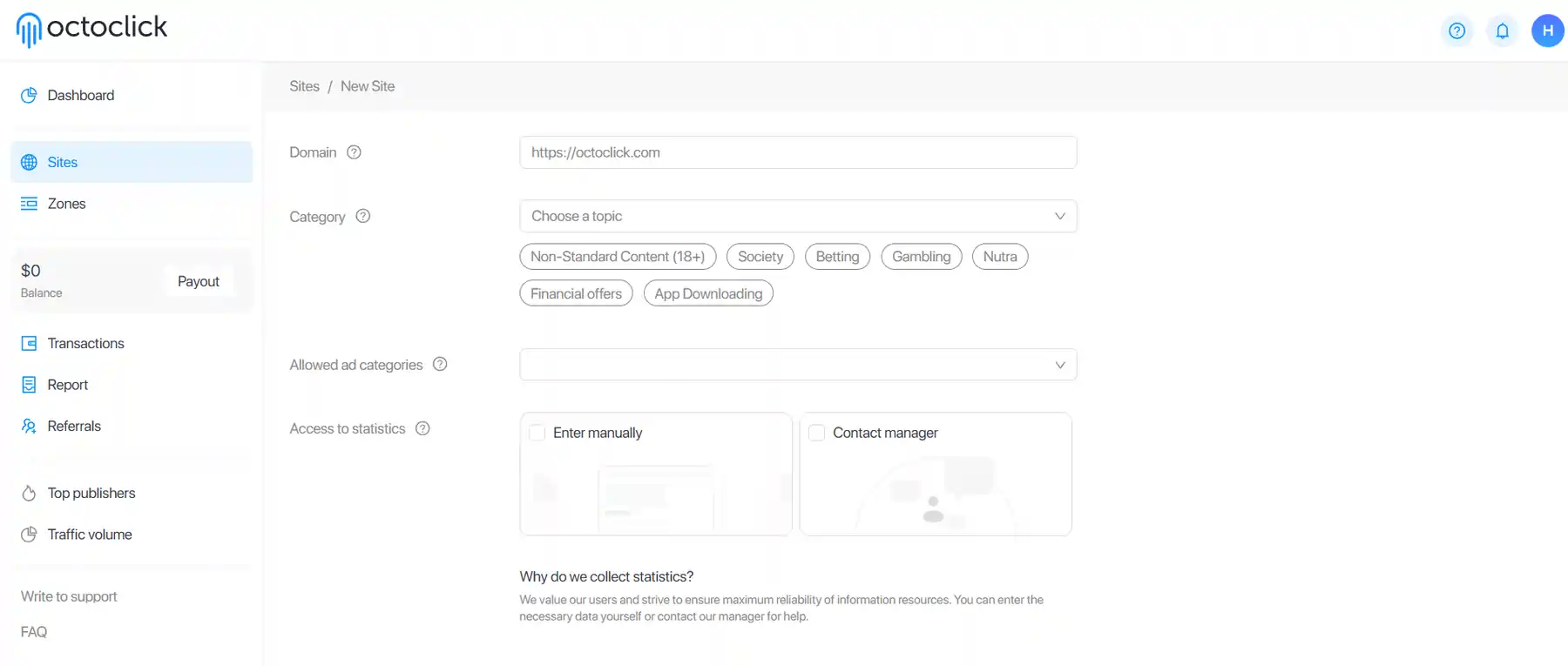
OctoClick lets publishers monetize websites through various ad formats such as In Page Push, Native Ads, and Popunder.
The publisher angle is simple. Add approved site traffic, place ad formats, earn revenue from advertiser demand, and monitor performance in real time.
This can work for entertainment sites, download sites, streaming style content, file sites, viral blogs, adult sites, tool sites, and high traffic content projects. The key is placement control.
A publisher should not place every format on day one. Start with one format, measure revenue, then add another placement only if bounce rate and user experience remain acceptable.
Auction Based Monetization
OctoClick has been described with auction based monetization, where advertiser demand competes for publisher traffic.
Auction-based monetization means advertisers compete for available traffic based on demand, targeting, and bid. In practice, stronger GEOs, better site categories, cleaner traffic, and visible placements usually attract better demand.
Publishers should test ad placement without ruining content experience. High visibility matters, but aggressive placement can reduce long-term traffic quality.
Payments and Withdrawals
OctoClick lists weekly payouts, payouts on request, and multiple withdrawal methods for publishers .
That is useful for publishers who need regular cash flow. Still, payment experience should be checked with a small first payout before moving major site inventory.
Before relying on any network, publishers should verify payment method availability in their account, minimum withdrawal requirements, payout approval rules, and traffic quality requirements.
Ad Format Placement
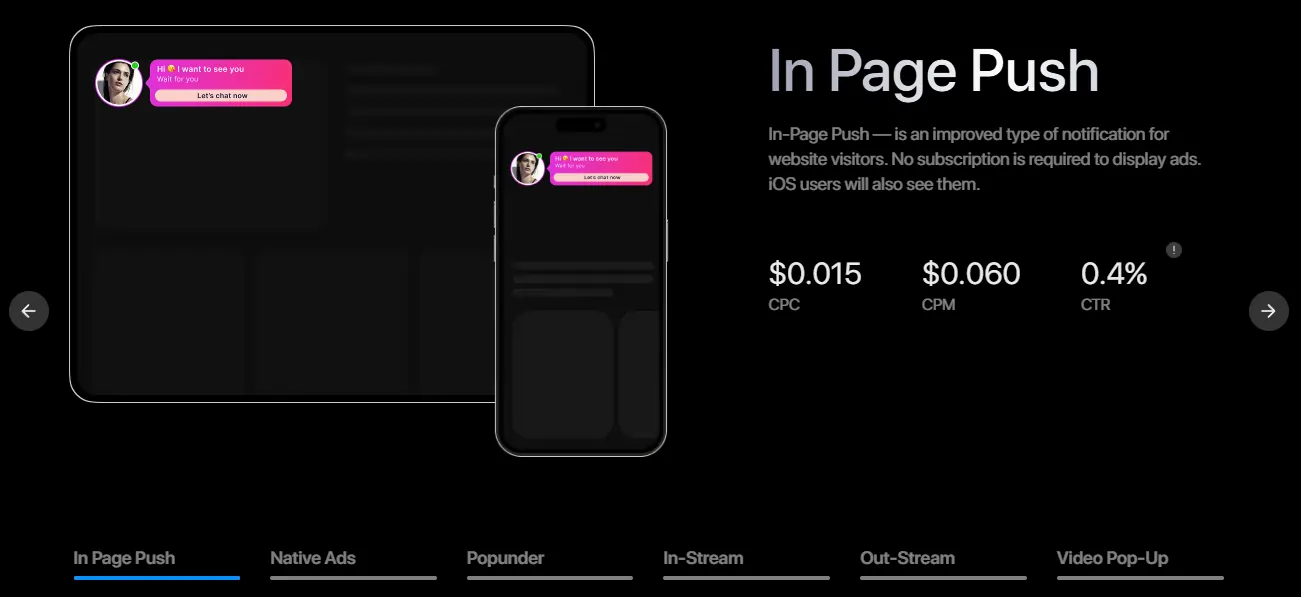
Ad placement affects revenue and user behavior. In-Page Push should be visible without feeling spammy. Native Ads should sit near content blocks. Popunder should be frequency-controlled. Video formats should not block core site usage.
For high-traffic publishers, test one format at a time. Compare revenue per session, bounce rate, page views, and repeat visits.
A publisher might earn more today by adding aggressive pop placements, but lose traffic quality tomorrow. That is bad math.
Traffic Approval
Publisher traffic approval matters because advertiser performance depends on supply quality. OctoClick mentions direct work with webmasters and site moderation .
Approval may look at site category, traffic source, traffic quality, content safety, bot signals, and format placement. Sites with fake traffic, forced clicks, malware, cloaking, or misleading placements are risky.
Good publisher traffic usually has:
Publishers should keep traffic sources clean. Short-term junk volume can harm long-term account value.
Revenue Potential
Revenue potential depends on traffic source, country mix, format, device split, vertical, advertiser demand, and placement style.
Publishers with high traffic sites have more room to test. Small sites can still use OctoClick, but low volume makes testing slower.
The best publisher setup usually has a clean main placement plus one secondary format. Too many ad units can lift short term earnings and hurt repeat users.
OctoClick Ad Formats
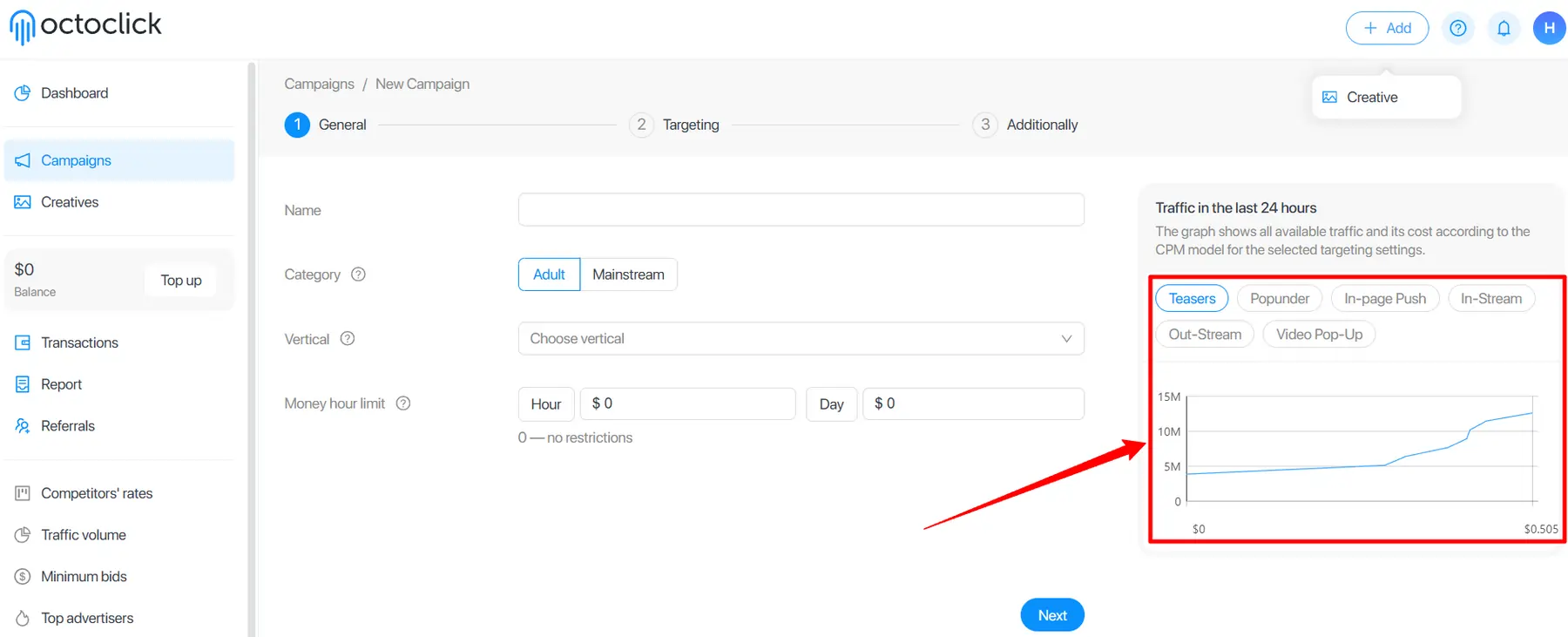
OctoClick’s format mix is one of the better reasons to test it. A buyer can run direct response campaigns and a publisher can test different ad units without using five networks.
| Format | Best use case | Buyer notes | Publisher notes |
|---|---|---|---|
| In Page Push | Sweepstakes, dating, app installs, lead gen | Good for short CTA offers and mobile traffic | Less aggressive than pop, easier to test on content sites |
| Native Ads | Nutra, ecommerce, advertorials, finance style pre sells | Best with pre sell pages and curiosity angles | Works inside content feeds and related post blocks |
| Popunder | Adult, dating, gambling, sweepstakes, direct landing tests | Strong for fast landing page tests | Higher revenue potential, but needs careful frequency control |
| In Stream | Video offers, apps, entertainment, brand response | Fits VAST based video delivery around video content | Best for sites with video player inventory |
| Out Stream | Content sites, feeds, scroll based video ads | Good for visual hooks and broad awareness | Can fit article pages without a main video player |
| Video Pop Up | Retargeting style hooks, visual offers, app promos | High visibility, but creative must be clean | Can earn attention, but overuse may hurt UX |
OctoClick Pricing and Test Budget
OctoClick gives advertisers CPC and CPM buying models.
CPC means paying for clicks. CPM means paying for every 1,000 impressions. CPC is safer when click intent matters, while CPM can work better when a buyer knows the placement quality and wants more volume.
| Format | CPC from | CPM from |
|---|---|---|
| In Page Push | $0.015 | $0.060 |
| Native Ads | $0.015 | $0.060 |
| Popunder | $0.003 | $3.035 |
| In Stream | $0.007 | $0.059 |
| Out Stream | $0.007 | $0.059 |
| Video Pop Up | $0.007 | $0.059 |
For test budgets, we would not start too small. A tiny test creates fake confidence.
A practical first test for CPA buyers:
For publishers, revenue planning is different. Track daily impressions, clicks, eCPM, bounce rate, and revenue by placement. Keep the format that earns without hurting repeat traffic.
Tracking and Optimization Setup
Tracking is the part where OctoClick becomes more than “buy traffic, hope for sales.”
Good tracking lets media buyers cut weak placements, scale winners, and send conversion data back to the traffic source. OctoClick can work with tracker setups and postback logic, including BeMob configurations that pass conversion ID and cost data.
Tracker Setup
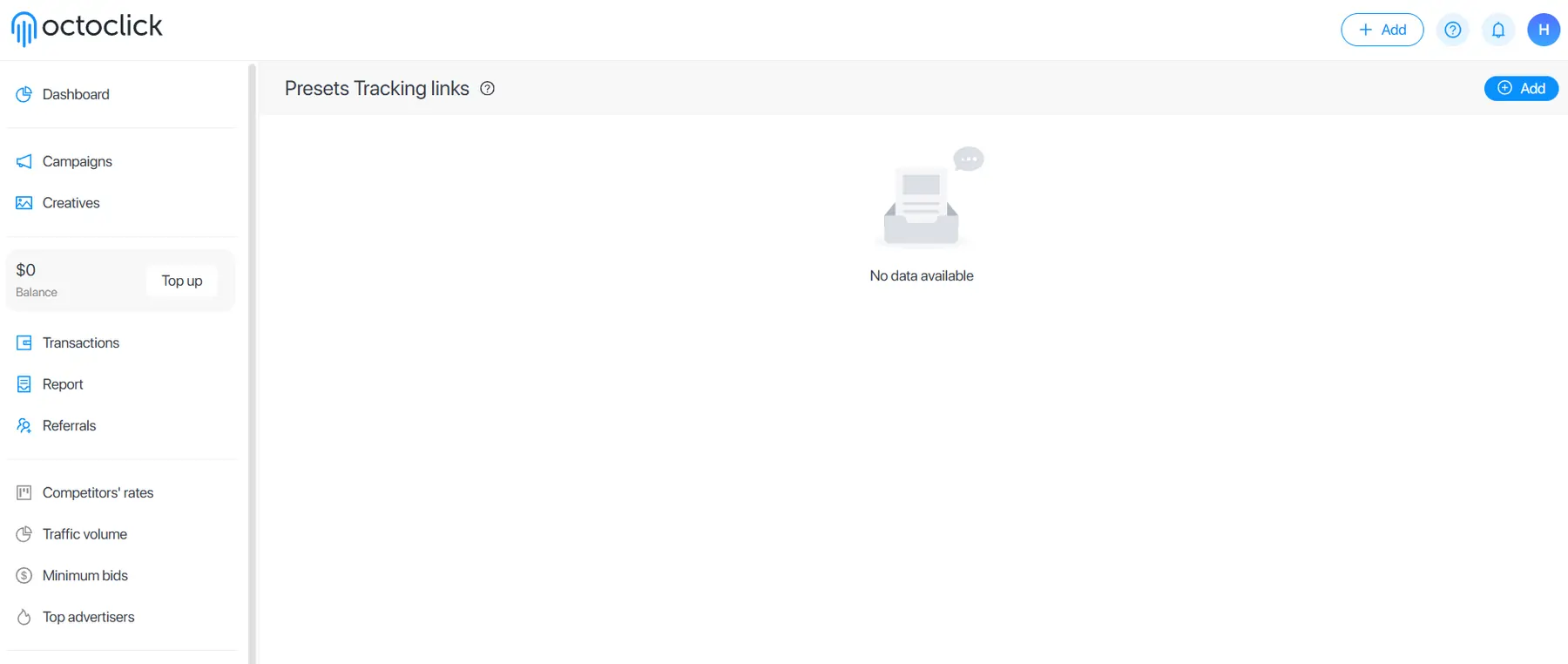
Use a tracker such as Binom, Keitaro, Voluum, RedTrack, BeMob, or an internal tracking stack. The tracker should sit between OctoClick traffic and the final offer.
Basic flow:
- OctoClick campaign URL sends traffic to the tracker.
- Tracker records click ID and macros.
- Tracker sends traffic to the landing page or offer.
- Affiliate network records conversion.
- Postback sends the conversion back to the tracker.
- Tracker shows profit by traffic slice.
- Buyer updates OctoClick campaign filters.
Do not skip the tracker. Network stats are useful, but tracker-level data gives cleaner control across traffic source, offer, lander, and affiliate network.
Important Macros
Macros help pass useful campaign details into tracking reports. Exact macro names must be checked inside OctoClick before launch.
Important macro groups:
If only one macro is done correctly, make it click ID. Without click ID, postback matching becomes messy.
Postback Setup
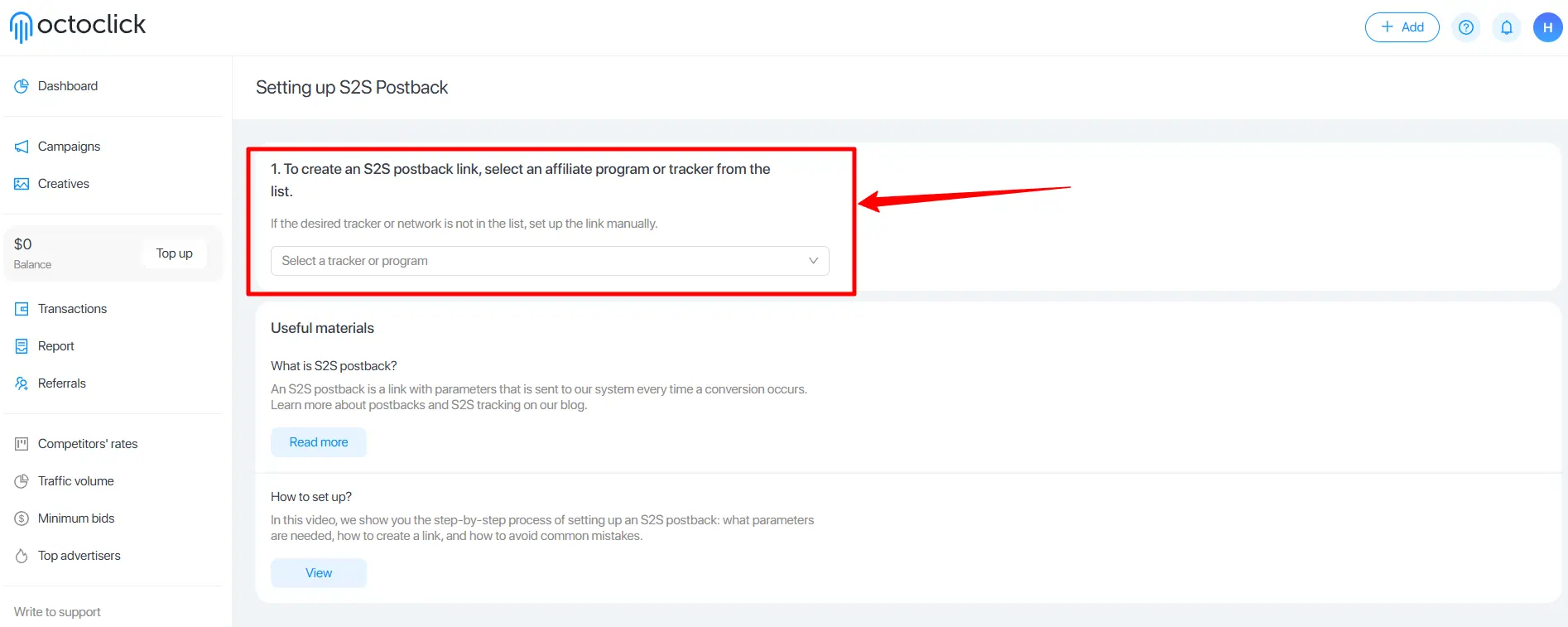
Postback should include click ID, payout, currency, conversion status, and event type. For multi-step CPA offers, send lead, registration, deposit, sale, or rebill as separate events if possible.
A basic postback URL usually looks like:
https://tracker.com/postback?clickid={click_id}&payout={payout}&status=approvedThe actual URL depends on tracker and affiliate network setup.
Always test postbacks before scaling. Use test clicks, test conversions, and check whether OctoClick, tracker, and affiliate dashboard numbers line up.
Blacklists and Whitelists
Blacklists remove placements that spend without value. Whitelists isolate placements that show conversion quality.
Do not blacklist too early. One bad click does not prove a bad site. But repeated spend without intent is a clear cut signal.
Useful blacklist triggers:
Whitelists are better for scale once winners appear. Build separate campaigns for winning placements, then adjust bid and budget carefully.
Device, Browser, OS, and Operator Targeting
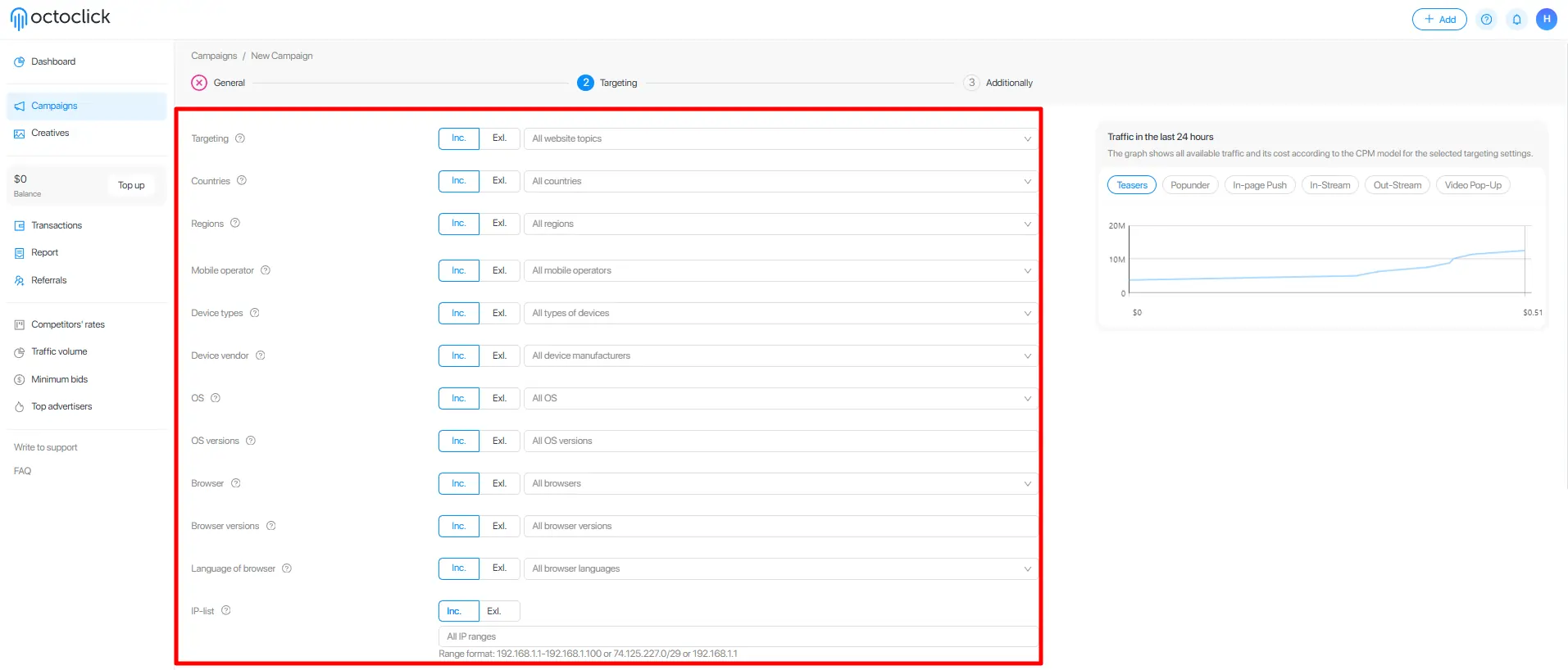
OctoClick lists targeting by operating system, browser, browser version, browser language, device manufacturer, device type, cellular operator, country, region, IP, and time scheduling.
Use these filters after data collection. For example, if Android traffic converts better than iOS for one offer, split Android into a dedicated campaign. If one browser burns spend, exclude it.
Operator targeting is useful for mobile offers, sweepstakes, carrier billing flows, and telecom-related funnels. Country and region targeting matter for dating, gambling, nutra, and lead-gen compliance.
Time targeting can reduce waste if conversions happen during specific hours. Check time-zone mapping before blocking hours.
Site ID Filtering
Site ID filtering is one of the most important parts of OctoClick optimization. It tells which publisher placements are sending traffic that converts.
Use site ID reports to answer:
If site ID filtering is ignored, a good campaign can stay unprofitable because weak placements eat budget.
OctoClick vs Competitors
OctoClick competes with bigger and more known ad networks like PropellerAds, Adsterra, TrafficStars, and ExoClick.
| Network | Strong Areas | Where It May Beat OctoClick | Where OctoClick Can Still Make Sense |
|---|---|---|---|
| OctoClick | Push-style, native, pop, video formats, direct publisher traffic, CPC/CPM testing | Less public scale proof than larger networks | Cleaner test source for buyers wanting fewer distractions |
| PropellerAds | Push, on-click, automation, large traffic pool | More pricing models and automation options | OctoClick may feel simpler for focused CPC/CPM tests |
| Adsterra | Broad publisher base, many monetization models | Wider mainstream recognition | OctoClick may suit buyers testing specific push/pop/video funnels |
| TrafficStars | Adult, mainstream, native, pop, pre-roll, push | Strong adult traffic positioning and broader format set | OctoClick may be useful as an extra traffic source |
| ExoClick | Huge adult/entertainment reach, many ad formats, deep targeting | More mature platform and wider format catalog | OctoClick may be worth testing for additional direct inventory |
Honest take:
OctoClick is not automatically better than PropellerAds, Adsterra, TrafficStars, or ExoClick.
It is another traffic source.
That is useful because affiliate marketing often needs more than one traffic source. A campaign that is expensive on one network may have cheaper pockets elsewhere. A placement that fails on one platform may work on another due to audience, format, or bid pressure.
Use OctoClick as a testable source, not as a guaranteed replacement.
Who Should Use OctoClick?
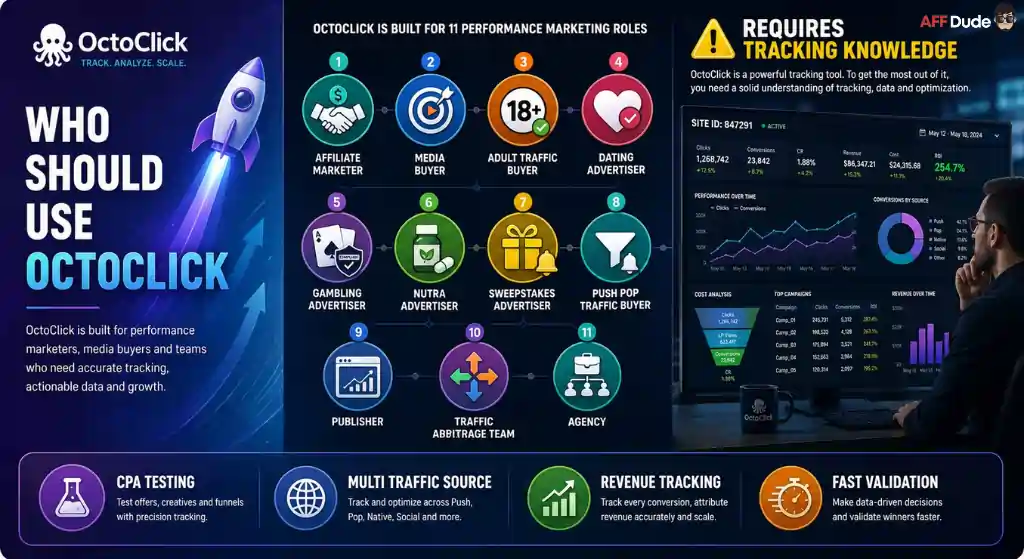
OctoClick makes sense for:
OctoClick is best for people who already understand tracking. If a buyer cannot read site ID data, conversion data, and cost data, results will be random.
Who Should Avoid OctoClick?
Avoid OctoClick if no tracker is being used.
Also avoid it if the goal is instant profit without testing. Traffic buying does not work like that.
OctoClick may not be ideal for:
A good offer can still fail with bad tracking. A bad offer can burn a budget even with good traffic.
Final Verdict
OctoClick is a solid traffic network for affiliate marketers, CPA buyers, media buyers, traffic arbitrage teams, and publishers who want push, native, pop, and video monetization options in one place.
It has the right core pieces: CPC and CPM buying, several ad formats, real time stats, publisher payouts, moderation, and targeting across GEO, device, browser, OS, operator, IP, and hour based filters.
Our verdict is positive but not blind.
OctoClick is worth testing if tracking is ready, budget caps are strict, and optimization is based on real placement data. It is not the best pick for lazy buying, fake publisher traffic, or teams expecting profit before data.
Dude verdict: Test OctoClick with a narrow campaign, track everything, cut weak sources fast, and scale only after conversions prove the traffic.'
Recommended Articles

Affiliate Disclosure: This post may contain some affiliate links, which means we may receive a commission if you purchase something that we recommend at no additional cost for you (none whatsoever!)