

Voice search is no longer a futuristic concept. It is a daily habit for more than 157 million Americans and billions of users worldwide.
With over 8.4 billion active voice assistants now in use globally, there are literally more voice-enabled devices on Earth than people. That number alone should make any marketer rethink how content gets found.

Typing is quick. But talking is quicker. And consumers are choosing speed. From asking Alexa for product recommendations to telling Siri to find a nearby restaurant, voice search optimisation has become a core pillar of modern SEO and digital marketing strategy.
If your brand is not ranking for conversational queries, you are invisible to a growing slice of your audience.
Here are all the voice search statistics for 2026 you need to plan, budget, and execute smarter campaigns.
🌍 Global Voice Search Usage Statistics 2026
Voice search has moved from an early-adopter novelty to an everyday utility across every major market.

| Metric | 2026 Figure |
|---|---|
| Weekly global voice search users | 27.6% of internet users |
| Daily voice search users | 127 million |
| Share of all search queries | 20% |
| YoY voice query growth | 45% |
| Smartphone users using voice | 58% |
Voice search is growing faster than most marketers realise.
A 45% jump in queries year-on-year means content teams that ignore conversational keyword optimisation are missing out on a rapidly expanding channel.
🔊 Voice Assistant Users in the United States 🇺🇸
America remains one of the largest markets for voice assistants, with adoption touching nearly half the population.
📈 US Voice Assistant User Growth
| Year | US Voice Assistant Users (Millions) | YoY Growth |
|---|---|---|
| 2022 | 142 | — |
| 2023 | 146.2 | +2.9% |
| 2024 | 149.8 | +2.5% |
| 2025 | 153.5 | +2.5% |
| 2026 (Projected) | 157.1 | +2.3% |
| 2027 (Projected) | 162.7 | +3.6% |
Growth is steady but not explosive. The slowdown signals saturation in early-adopter segments, while older demographics are gradually coming onboard.
👥 Voice Assistant Age Demographics
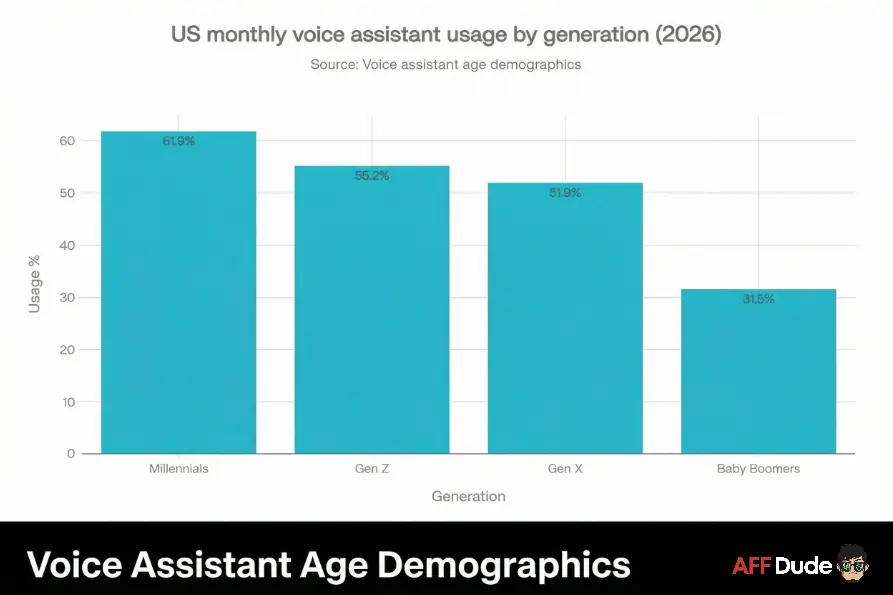
Understanding who uses voice search helps marketers build voice-optimised content strategies for the right audiences.
| Generation | US Monthly Voice Assistant Usage |
|---|---|
| Millennials | 61.9% |
| Gen Z | 55.2% |
| Gen X | 51.9% |
| Baby Boomers | 31.5% |
For B2C brands targeting Millennials and Gen Z, voice search is not a bonus channel. It is a primary discovery path.
💰 Voice Assistant Market Size and Revenue
The voice technology industry is experiencing rapid financial growth, driven by smart speakers, in-car assistants, and enterprise applications.
| Metric | Value |
|---|---|
| Voice assistant market (2024) | $7.35 billion |
| Voice assistant market (2033 projected) | $59.9 billion |
| Voice assistant CAGR | 26.80% |
| Smart speaker market (2025) | $12.3 billion |
| Smart speaker market (2026) | $23.32 billion |
| Smart speaker market (2030 projected) | $52.44 billion |
| Smart speaker CAGR | 20.41% |
| Voice recognition tech market (2029 projected) | ~$50 billion |
The voice assistant market is expected to grow 8x between 2024 and 2033, making it one of the fastest-expanding segments in marketing technology.
🔊 Smart Speaker Ownership and Usage
Smart speakers are the hardware backbone of voice search. Ownership continues to climb, especially in the US and Western Europe.
Leading Voice Assistants in the US
| Voice Assistant | US Active Users |
|---|---|
| Google Assistant | 88.8–92 million |
| Siri (Apple) | 86.5 million |
| Alexa (Amazon) | 75.6 million |
Google Assistant has overtaken Alexa in user numbers, though Amazon still leads in smart speaker hardware sales. For marketers, this means optimising for Google's voice search algorithm is a top priority.
🔍 Voice Search and SEO Statistics 2026
Voice search changes how people phrase queries. It demands a different approach to keyword research, content structure, and on-page SEO optimisation.
🤷♀️ What Ranks in Voice Search?
| Ranking Factor | Impact |
|---|---|
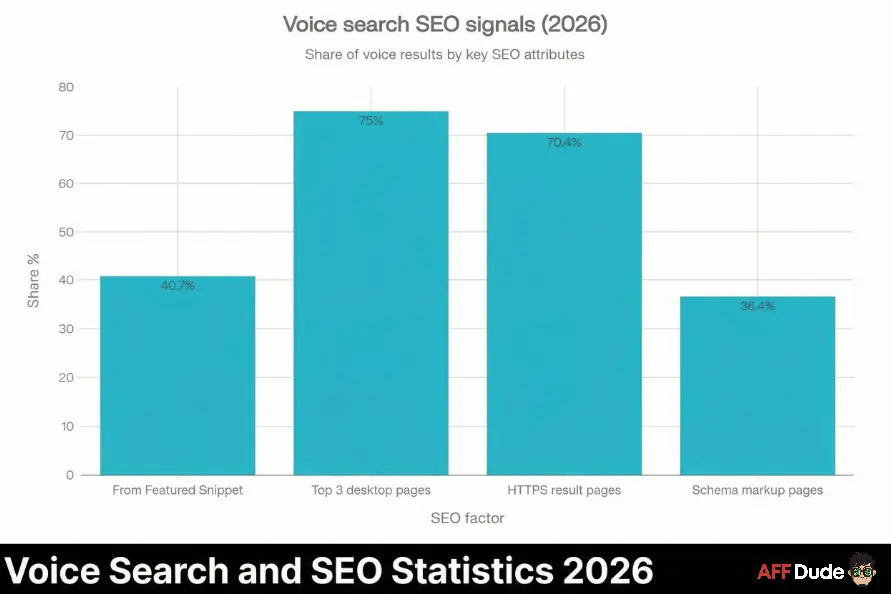
| Featured Snippet presence | 40.7% of answers sourced from here |
| Top 3 desktop ranking | 75% of voice results |
| HTTPS security | 70.4% of voice pages |
| Schema markup usage | 36.4% of voice results |
| Average result word count | 29 words |
| Page load speed | 4.6 seconds average |
For any brand investing in voice search SEO strategy, the playbook is clear: target Featured Snippets, write concise answers, use Schema markup, and ensure pages load fast on mobile.
📍 Voice Search for Local Business
Local search is where voice truly shines. People asking “near me” questions rely heavily on voice, and businesses optimised for local voice search win foot traffic.
For local businesses, especially restaurants, retail shops, and service providers, local SEO for voice search is no longer optional. Claiming and optimising Google Business profiles, adding FAQ pages, and using location-specific keywords are essential steps.
🛒Voice Commerce Statistics 2026
Purchasing through voice commands is one of the fastest-growing segments in e-commerce. Consumers are moving from search to buy with nothing more than spoken words.
Voice Commerce Growth:
| Year | Global Voice Commerce Value |
|---|---|
| 2024 | $19.4 billion |
| 2025 | $62 billion |
| 2026 | $80 billion |
That jump from $19.4 billion to $80 billion in two years is staggering. For e-commerce brands, voice commerce optimisation should be a priority line item, not an afterthought.
🏢 Brands Investing in Voice Search
Marketers and brands are putting real money behind voice. Adoption among businesses has hit critical mass in 2026.
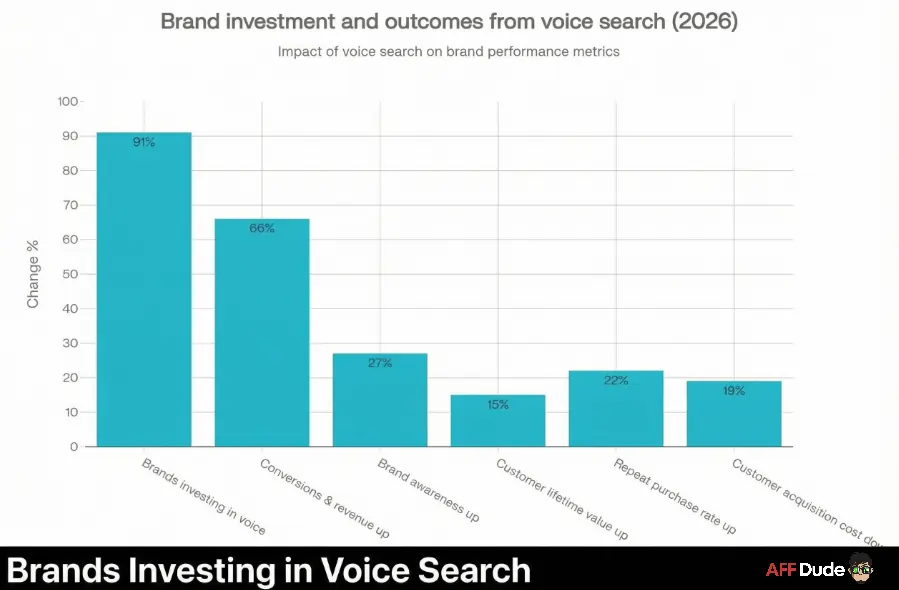
When 91% of brands are already investing, the question is not “should we?” but “how much more?” Marketers who lag on voice search marketing investment risk losing share to competitors who are already capturing conversational queries.
📱💻🚗 Voice Search by Device Type
Voice search is not limited to smart speakers. It happens across every screen and surface.
| Device | Usage Context |
|---|---|
| Smartphones | 58% of users engage with voice search on mobile |
| Smart speakers | 101 million US owners |
| In-car systems | 90% of new cars ship with voice assistants |
| Smart TVs | Growing segment for media search |
| Desktop/laptop | Rising use for hands-free work queries |
| Wearables | Smartwatch voice search growing with Apple Watch and Pixel Watch |
For marketers, this multi-device reality means voice-first content strategy must account for different intents across different devices.
A smartphone voice query (“find Italian food near me”) differs greatly from a smart speaker query (“add pasta to my shopping list”).
Recommended Articles

🔮 Voice Search Predictions: 2027 and Beyond
Current growth curves and investment data point to a clear direction for voice technology.
Voice search in 2026 sits at an inflection point. Adoption is mainstream. Commerce is booming. And AI is making assistants smarter every month.
Marketers who build voice search optimisation into content, SEO, and paid strategies today are not just keeping up. They are securing a head start in a channel that will only grow louder 🚀.
Affiliate Disclosure: This post may contain some affiliate links, which means we may receive a commission if you purchase something that we recommend at no additional cost for you (none whatsoever!)