


Every publisher eventually faces the same frustrating trade-off: you need ads to sustain your business, but the heavy scripts they require often destroy your site speed. Watching your Core Web Vitals plummet just to keep revenue stable is a compromise you shouldn't have to make.
It is entirely possible to monetize effectively without sacrificing technical performance. This analysis explores the 7 Best Lightweight Ad Networks designed for creators who need to protect their user experience, helping you maintain fast load times while securing consistent earnings.
Why Switching to Lightweight Ad Networks is Critical for SEO
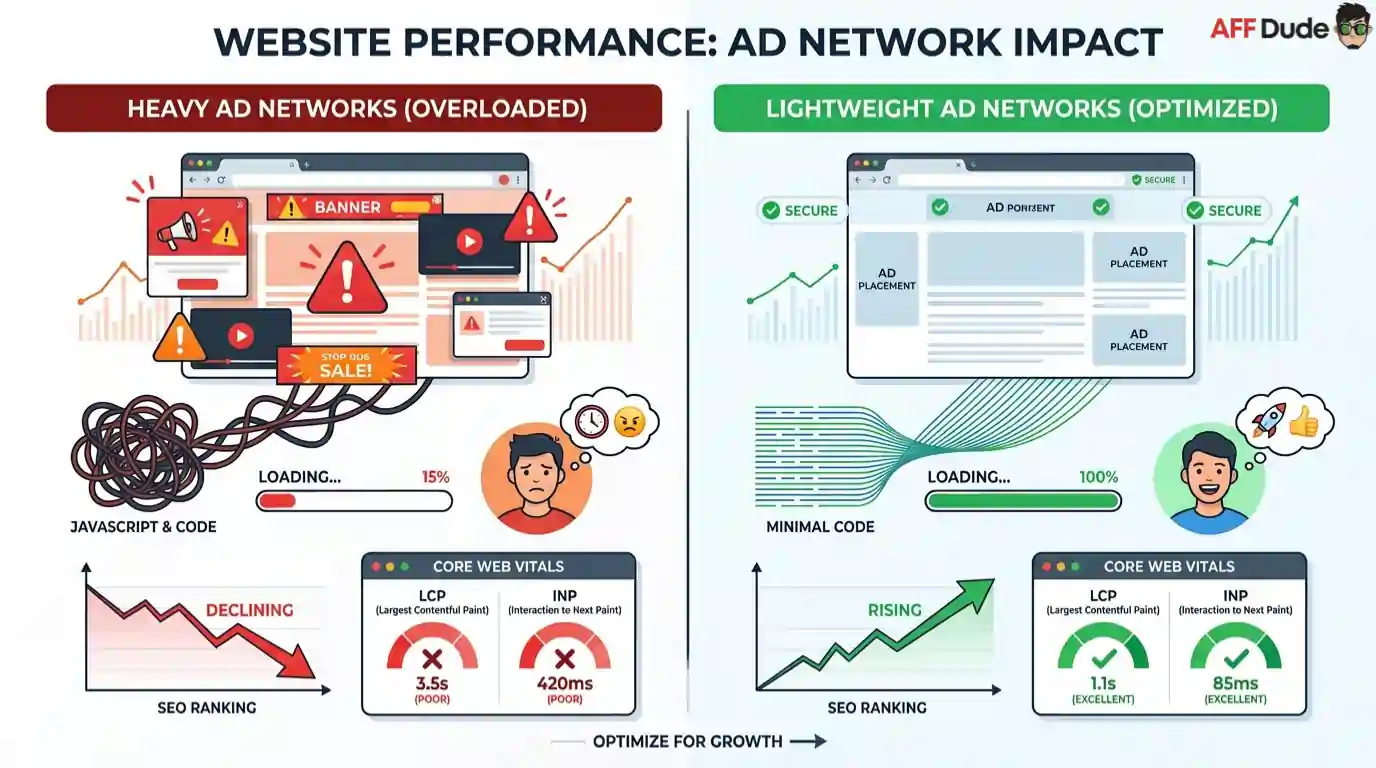
Heavy ad scripts are often the silent killers of a publisher's search rankings. When you overload your site with unoptimized code, you directly sabotage the user experience metrics Google prioritizes for ranking.
Switching to lightweight ad networks is essential for maintaining competitive SEO performance. Excessive JavaScript from traditional providers delays your Largest Contentful Paint (LCP) and spikes Interaction to Next Paint (INP) scores.
If your pages feel sluggish, users bounce before seeing your content, sending negative engagement signals to search engines.
Optimizing your ad stack offers immediate benefits:
Prioritizing speed through efficient ad delivery ensures you protect your hard-earned visibility while maintaining revenue.
Efficient Ad Networks Ideal for Lean Websites
| Best Lightweight Ad Networks | Best For | Key Speed Feature |
|---|---|---|
| PropellerAds | New Publishers | Multi-Tag Optimization |
| AdMaven | Aggressive Formats | Bypass Tech |
| Infolinks | Text-Heavy Blogs | Intent Targeting |
| Adsterra | Social Traffic | Fast Social Bar |
| Google AdSense | Reliable Baseline | Auto Ads |
| Adcash | Gaming Sites | Anti-Adblock |
| Opti Digital | Premium Publishers | Smart Lazy Loading |
1. PropellerAds

PropellerAds is a top-tier choice for publishers who need a lightweight ad network that prioritizes user experience alongside monetization. Known for its bypass-resistant ad formats, it delivers high CPMs without the code bloat that typically slows down websites.
Their “Multi-Tag” feature is particularly efficient, running multiple ad formats through a single, optimized script request.
This platform is ideal for sites with global traffic, offering excellent fill rates across Tier 2 and Tier 3 countries where other networks struggle.
Their AI-driven optimization tools automatically adjust ad delivery to match user behavior, ensuring you get the best possible revenue without manually tweaking complex settings or compromising your Core Web Vitals.
Why Choose PropellerAds?
It is the most accessible high-performance network for new publishers, offering weekly payouts and zero traffic requirements while maintaining fast load times.
2. AdMaven
AdMaven specializes in less intrusive, high-impact formats like pop-unders and push notifications that don't interfere with your site's main content rendering.
As a lightweight ad network, it separates its ad loading process from your critical rendering path, ensuring your LCP (Largest Contentful Paint) scores remain healthy even with aggressive monetization strategies in place.
Publishers often turn to AdMaven to monetize “ad-blind” audiences who ignore traditional banners. Their proprietary “Adblock Bypass” technology allows you to recover revenue from users with ad blockers, doing so via a streamlined script that doesn't add significant weight to your page headers or slow down initial interactivity.
Why Choose AdMaven?
Perfect for publishers needing to bypass ad blockers and monetize aggressive formats like pop-unders without destroying their page speed metrics.
3. Infolinks

Infolinks takes a completely different approach by targeting user intent within your text rather than relying on heavy display banners. Its core technology scans your content to place contextual hyperlinks and non-intrusive units, making it one of the most efficient lightweight ad networks available.
This network works exceptionally well as a complementary revenue stream alongside AdSense. Since their script is asynchronous and their ad units (like InFold and InText) only activate after the main content is visible, they offer a “set and forget” solution that boosts earnings without competing for bandwidth during the critical initial page load.
Why Choose Infolinks?
The best option for text-heavy blogs looking to add a secondary income stream that is virtually invisible to page speed tools.
4. Adsterra

Adsterra is a robust, tech-forward network that prides itself on its “Partner Care” approach and fast, secure ad delivery.
It serves as a powerful lightweight ad network by using smart delivery algorithms that optimize which ads are shown based on connection speed and device type. This ensures users on slower mobile connections aren't bombarded with heavy creatives that freeze their browsers.
They offer a specialized “Social Bar” format that completely replaces classic web push notifications.
Unlike standard push ads that require users to subscribe (and often slow down the browser), the Social Bar is a lightweight HTML/CSS element that loads instantly and boasts considerably higher CTRs, making it a favorite for performance-focused marketers.
Why Choose Adsterra?
Ideal for social and mobile traffic, offering high-converting innovative formats like the Social Bar that load instantly without browser lag.
5. Google AdSense

Google AdSense remains the industry standard, but recent updates have made it a surprisingly capable lightweight ad network when configured correctly. With features like “Auto Ads” and asynchronous code, Google has optimized its delivery to minimize main-thread blocking. It remains the safest, most reliable baseline for publishers worldwide.
While historically criticized for speed, modern AdSense allows for granular control over ad load. You can adjust the “Ad Load” slider to find the perfect sweet spot between revenue and performance.
Furthermore, its server infrastructure is unmatched, ensuring that ad requests are served from the edge location nearest to your visitor, reducing latency significantly compared to smaller networks.
Why Choose Google AdSense?
The most reliable, set-and-forget foundation for any ad stack, offering unmatched fill rates and global advertiser demand with improving speed controls.
6. Adcash

Adcash is designed for performance marketers and publishers who want granular control over their ad inventory.
As a lightweight ad network, it provides a “painless” integration process with clean, well-documented tags that don't conflict with other scripts. Their technology is built to serve high-quality ads globally without the redirect loops that often plague other networks.
Their “Anti-Adblock” solution is engineered to be lightweight, recovering lost revenue without executing heavy scripts that trigger Google's penalty algorithms.
Adcash is particularly strong for gaming and entertainment sites, where maintaining high frame rates and responsiveness is just as important as the ad revenue itself.
Why Choose Adcash?
A strong contender for gaming and entertainment sites needing flexible, high-fill global monetization that doesn't interrupt interactive user experiences.
7. Opti Digital

Opti Digital is a premium monetization solution that uses advanced AI to optimize floor prices in real-time. It stands out as a lightweight ad network solution because it uses a streamlined “all-in-one” wrapper that reduces the number of server calls your site makes.
Instead of multiple bidders clogging your header, Opti Digital consolidates demand into a single, efficient process.
This platform is specifically built for publishers struggling with Core Web Vitals. Their technology dynamically adjusts ad refreshing and loading sequences to protect your CLS (Cumulative Layout Shift) score. By lazy-loading ads smartly based on user scroll behavior, they ensure that ads only load when they are viewable, saving significant bandwidth and processing power.
Why Choose Opti Digital?
The premium choice for established publishers specifically looking to fix Core Web Vitals issues while maximizing revenue through AI-driven floor pricing.
How to Configure Lightweight Ad Networks for Maximum Speed

Even the most efficient lightweight ad networks require proper implementation to deliver their full potential. Without careful configuration, you risk negating the performance benefits you switched providers to gain.
Start by prioritizing asynchronous loading for all ad tags. This ensures your lightweight ad network scripts fetch in the background without blocking the rendering of your main content.
Pairing this with lazy loading is essential; it delays ad requests until the user scrolls near the placement, significantly reducing initial page weight.
Advanced optimization tactics include:
Correctly tuning these settings transforms your ad stack from a liability into a high-performance asset.
The Future of Fast & Efficient Ad Monetization
Balancing revenue with performance is never easy, but your site’s long-term health depends on it. Slow load times frustrate visitors and hurt your search rankings far more than a few extra ad impressions can justify.
By integrating lightweight ad networks, you protect the user experience that built your audience in the first place.
Test one or two options, monitor your Core Web Vitals, and see which setup maintains speed without sacrificing earnings. A fast, clean website always wins in the long run.
Recommended Articles

Affiliate Disclosure: This post may contain some affiliate links, which means we may receive a commission if you purchase something that we recommend at no additional cost for you (none whatsoever!)